Marketing Communications
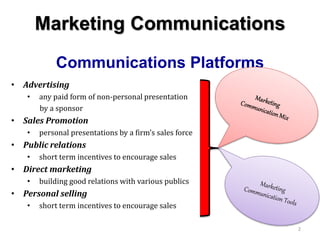
Communications Platforms
• Advertising
• any paid form of non-personal presentation
by a sponsor
• Sales Promotion
• personal presentations by a firm’s sales force
• Public relations
• short term incentives to encourage sales
• Direct marketing
• building good relations with various publics
• Personal selling
• short term incentives to encourage sales
2
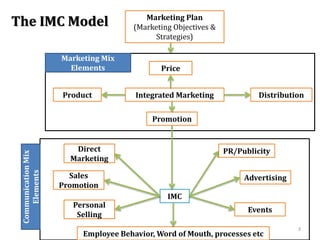
The IMC Model
3
Marketing Plan
(Marketing Objectives &
Strategies)
Integrated Marketing
Promotion
Distribution
Product
Price
Marketing Mix
Elements
Employee Behavior, Word of Mouth, processes etc
IMC
Sales
Promotion
PR/Publicity
Advertising
Events
Direct
Marketing
Personal
Selling
Communication
Mix
Elements
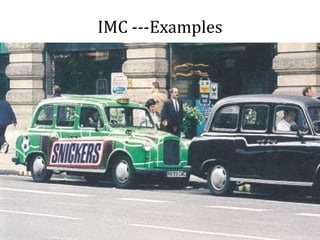
IMC ---Examples
4
The Marketing Communications Mix
?
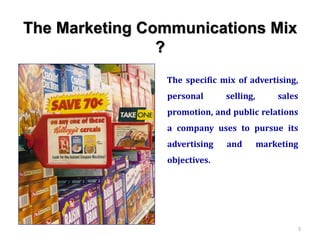
The specific mix of advertising,
personal selling, sales
promotion, and public relations
a company uses to pursue its
advertising and marketing
objectives.
5
6
7
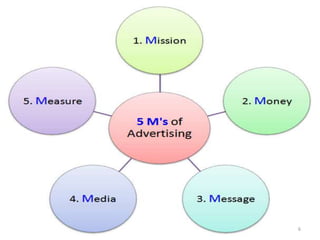
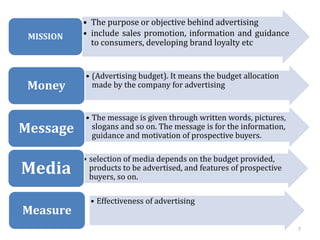
• The purpose or objective behind advertising
• include sales promotion, information and guidance
to consumers, developing brand loyalty etc
MISSION
• (Advertising budget). It means the budget allocation
made by the company for advertising
Money
• The message is given through written words, pictures,
slogans and so on. The message is for the information,
guidance and motivation of prospective buyers.
Message
• selection of media depends on the budget provided,
products to be advertised, and features of prospective
buyers, so on.
Media
• Effectiveness of advertising
Measure
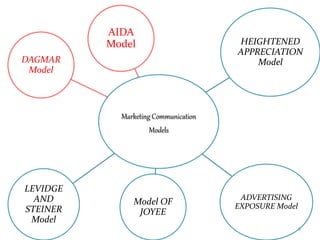
Models of
Marketing
Communication
Marketing Communication
Models
AIDA
Model HEIGHTENED
APPRECIATION
Model
ADVERTISING
EXPOSURE Model
DAGMAR
Model
Model OF
JOYEE
LEVIDGE
AND
STEINER
Model
9
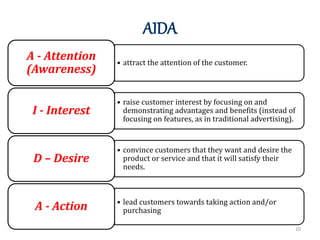
AIDA
10
• attract the attention of the customer.
A - Attention
(Awareness)
• raise customer interest by focusing on and
demonstrating advantages and benefits (instead of
focusing on features, as in traditional advertising).
I - Interest
• convince customers that they want and desire the
product or service and that it will satisfy their
needs.
D – Desire
• lead customers towards taking action and/or
purchasing
A - Action
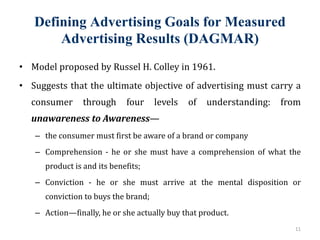
Defining Advertising Goals for Measured
Advertising Results (DAGMAR)
• Model proposed by Russel H. Colley in 1961.
• Suggests that the ultimate objective of advertising must carry a
consumer through four levels of understanding: from
unawareness to Awareness—
– the consumer must first be aware of a brand or company
– Comprehension - he or she must have a comprehension of what the
product is and its benefits;
– Conviction - he or she must arrive at the mental disposition or
conviction to buys the brand;
– Action—finally, he or she actually buy that product.
11
ETHICAL & SOCIAL ISSUES IN
MARKETING
COMMUNICATION 12
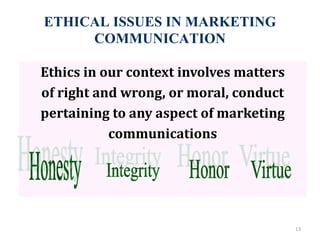
ETHICAL ISSUES IN MARKETING
COMMUNICATION
13
Ethics in our context involves matters
of right and wrong, or moral, conduct
pertaining to any aspect of marketing
communications
ETHICAL ISSUES IN MARKETING
COMMUNICATION
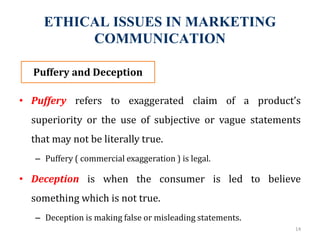
• Puffery refers to exaggerated claim of a product’s
superiority or the use of subjective or vague statements
that may not be literally true.
– Puffery ( commercial exaggeration ) is legal.
• Deception is when the consumer is led to believe
something which is not true.
– Deception is making false or misleading statements.
14
Puffery and Deception
SOCIAL & ETHICAL ISSUES IN
MARKETING COMMUNICATION
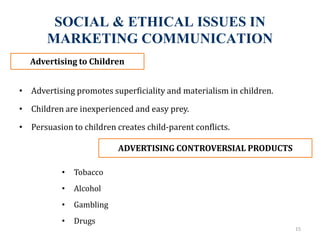
• Advertising promotes superficiality and materialism in children.
• Children are inexperienced and easy prey.
• Persuasion to children creates child-parent conflicts.
15
Advertising to Children
ADVERTISING CONTROVERSIAL PRODUCTS
• Tobacco
• Alcohol
• Gambling
• Drugs
SOCIAL & ETHICAL ISSUES IN
MARKETING COMMUNICATION
16
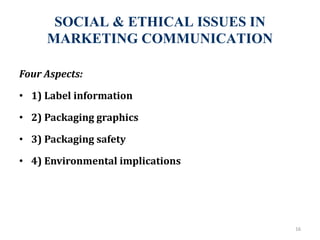
Four Aspects:
• 1) Label information
• 2) Packaging graphics
• 3) Packaging safety
• 4) Environmental implications
Introduction to
Advertising
Defining Modern Advertising
• Advertising is paid persuasive communication
• Uses non-personal mass media to reach broad audiences
to connect an identified sponsor with a target audience.
• According to American Marketing Association:
 “Advertising is any paid form of non-personal presentation and
promotion of ideas, goods and services by an identified
sponsor.”
18
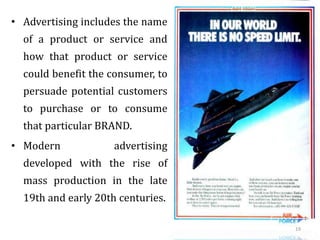
• Advertising includes the name
of a product or service and
how that product or service
could benefit the consumer, to
persuade potential customers
to purchase or to consume
that particular BRAND.
• Modern advertising
developed with the rise of
mass production in the late
19th and early 20th centuries.
19
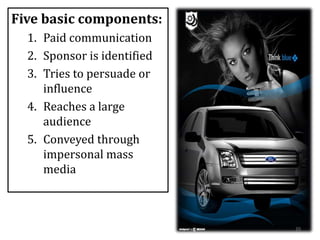
Five basic components:
1. Paid communication
2. Sponsor is identified
3. Tries to persuade or
influence
4. Reaches a large
audience
5. Conveyed through
impersonal mass
media
20
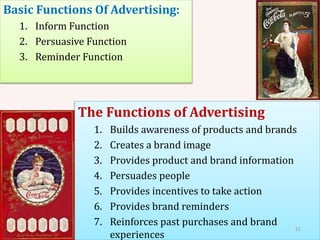
Basic Functions Of Advertising:
1. Inform Function
2. Persuasive Function
3. Reminder Function
The Functions of Advertising
1. Builds awareness of products and brands
2. Creates a brand image
3. Provides product and brand information
4. Persuades people
5. Provides incentives to take action
6. Provides brand reminders
7. Reinforces past purchases and brand
experiences
21
History & Evolution
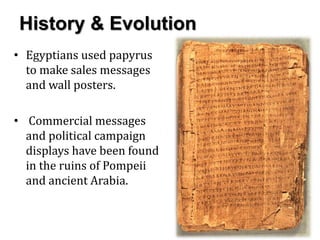
• Egyptians used papyrus
to make sales messages
and wall posters.
• Commercial messages
and political campaign
displays have been found
in the ruins of Pompeii
and ancient Arabia.
22
History & Evolution
• In 1704 The first newspaper advertisement, an announcement seeking a
buyer for an Oyster Bay, Long Island, estate, is published in the Boston
News-Letter.
• In June 1836, French newspaper La Presse was the first to include paid
advertising in its pages.
• Around 1840, Volney Palmer established a predecessor to advertising
agencies in Boston.
• The first radio commercial is credited to WEAF, New York on August 28,
1922 for the Queensboro real estate corporation.
• The world's first television advertisement was broadcast July 1, 1941. The
watchmaker Bulova paid $4 for a placement on New York station WNBT
before a baseball game. 23
Key Concepts of Advertising
• Strategy
• Creative idea
• Execution
• Media
• The logic and planning behind the ad
• Advertisers develop ads to meet
objectives
• Advertisers direct ads to identified
audiences
• Advertisers create messages that speak
to the audience’s concerns
• Advertisers run ads in the most
effective media
24
Key Concepts of Advertising
• Strategy
• Creative idea
• Execution
• Media
• The central idea that grabs the
consumer’s attention
• Creativity drives the entire field of
advertising
25
Key Concepts of Advertising
• Strategy
• Creative idea
• Execution
• Media
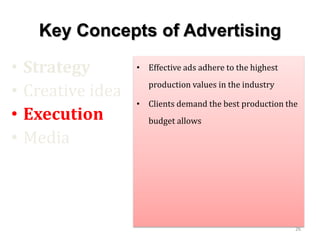
• Effective ads adhere to the highest
production values in the industry
• Clients demand the best production the
budget allows
26
Key Concepts of Advertising
• Strategy
• Creative idea
• Execution
• Media
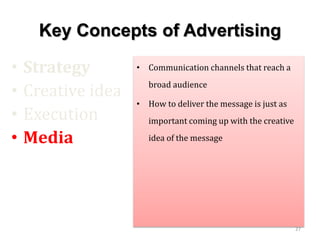
• Communication channels that reach a
broad audience
• How to deliver the message is just as
important coming up with the creative
idea of the message
27
Roles of Advertising
• Marketing
• Communication
• Economic
• Societal
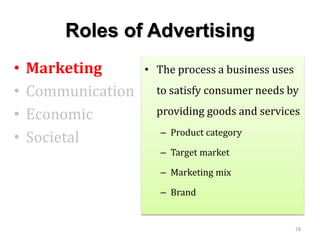
• The process a business uses
to satisfy consumer needs by
providing goods and services
– Product category
– Target market
– Marketing mix
– Brand
28
Roles of Advertising
• Marketing
• Communication
• Economic
• Societal
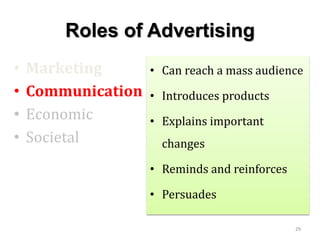
• Can reach a mass audience
• Introduces products
• Explains important
changes
• Reminds and reinforces
• Persuades
29
Roles of Advertising
• Marketing
• Communication
• Economic
• Societal
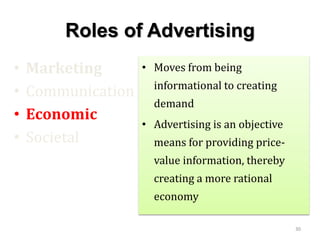
• Moves from being
informational to creating
demand
• Advertising is an objective
means for providing price-
value information, thereby
creating a more rational
economy
30
Roles of Advertising
• Marketing
• Communication
• Economic
• Societal
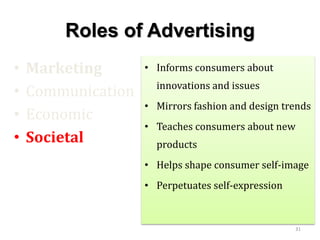
• Informs consumers about
innovations and issues
• Mirrors fashion and design trends
• Teaches consumers about new
products
• Helps shape consumer self-image
• Perpetuates self-expression
31

INTRO TO MARCOM.pptx

  • 2.
    Marketing Communications Communications Platforms •Advertising • any paid form of non-personal presentation by a sponsor • Sales Promotion • personal presentations by a firm’s sales force • Public relations • short term incentives to encourage sales • Direct marketing • building good relations with various publics • Personal selling • short term incentives to encourage sales 2
  • 3.
    The IMC Model 3 MarketingPlan (Marketing Objectives & Strategies) Integrated Marketing Promotion Distribution Product Price Marketing Mix Elements Employee Behavior, Word of Mouth, processes etc IMC Sales Promotion PR/Publicity Advertising Events Direct Marketing Personal Selling Communication Mix Elements
  • 4.
  • 5.
    The Marketing CommunicationsMix ? The specific mix of advertising, personal selling, sales promotion, and public relations a company uses to pursue its advertising and marketing objectives. 5
  • 6.
  • 7.
    7 • The purposeor objective behind advertising • include sales promotion, information and guidance to consumers, developing brand loyalty etc MISSION • (Advertising budget). It means the budget allocation made by the company for advertising Money • The message is given through written words, pictures, slogans and so on. The message is for the information, guidance and motivation of prospective buyers. Message • selection of media depends on the budget provided, products to be advertised, and features of prospective buyers, so on. Media • Effectiveness of advertising Measure
  • 8.
  • 9.
    Marketing Communication Models AIDA Model HEIGHTENED APPRECIATION Model ADVERTISING EXPOSUREModel DAGMAR Model Model OF JOYEE LEVIDGE AND STEINER Model 9
  • 10.
    AIDA 10 • attract theattention of the customer. A - Attention (Awareness) • raise customer interest by focusing on and demonstrating advantages and benefits (instead of focusing on features, as in traditional advertising). I - Interest • convince customers that they want and desire the product or service and that it will satisfy their needs. D – Desire • lead customers towards taking action and/or purchasing A - Action
  • 11.
    Defining Advertising Goalsfor Measured Advertising Results (DAGMAR) • Model proposed by Russel H. Colley in 1961. • Suggests that the ultimate objective of advertising must carry a consumer through four levels of understanding: from unawareness to Awareness— – the consumer must first be aware of a brand or company – Comprehension - he or she must have a comprehension of what the product is and its benefits; – Conviction - he or she must arrive at the mental disposition or conviction to buys the brand; – Action—finally, he or she actually buy that product. 11
  • 12.
    ETHICAL & SOCIALISSUES IN MARKETING COMMUNICATION 12
  • 13.
    ETHICAL ISSUES INMARKETING COMMUNICATION 13 Ethics in our context involves matters of right and wrong, or moral, conduct pertaining to any aspect of marketing communications
  • 14.
    ETHICAL ISSUES INMARKETING COMMUNICATION • Puffery refers to exaggerated claim of a product’s superiority or the use of subjective or vague statements that may not be literally true. – Puffery ( commercial exaggeration ) is legal. • Deception is when the consumer is led to believe something which is not true. – Deception is making false or misleading statements. 14 Puffery and Deception
  • 15.
    SOCIAL & ETHICALISSUES IN MARKETING COMMUNICATION • Advertising promotes superficiality and materialism in children. • Children are inexperienced and easy prey. • Persuasion to children creates child-parent conflicts. 15 Advertising to Children ADVERTISING CONTROVERSIAL PRODUCTS • Tobacco • Alcohol • Gambling • Drugs
  • 16.
    SOCIAL & ETHICALISSUES IN MARKETING COMMUNICATION 16 Four Aspects: • 1) Label information • 2) Packaging graphics • 3) Packaging safety • 4) Environmental implications
  • 17.
  • 18.
    Defining Modern Advertising •Advertising is paid persuasive communication • Uses non-personal mass media to reach broad audiences to connect an identified sponsor with a target audience. • According to American Marketing Association:  “Advertising is any paid form of non-personal presentation and promotion of ideas, goods and services by an identified sponsor.” 18
  • 19.
    • Advertising includesthe name of a product or service and how that product or service could benefit the consumer, to persuade potential customers to purchase or to consume that particular BRAND. • Modern advertising developed with the rise of mass production in the late 19th and early 20th centuries. 19
  • 20.
    Five basic components: 1.Paid communication 2. Sponsor is identified 3. Tries to persuade or influence 4. Reaches a large audience 5. Conveyed through impersonal mass media 20
  • 21.
    Basic Functions OfAdvertising: 1. Inform Function 2. Persuasive Function 3. Reminder Function The Functions of Advertising 1. Builds awareness of products and brands 2. Creates a brand image 3. Provides product and brand information 4. Persuades people 5. Provides incentives to take action 6. Provides brand reminders 7. Reinforces past purchases and brand experiences 21
  • 22.
    History & Evolution •Egyptians used papyrus to make sales messages and wall posters. • Commercial messages and political campaign displays have been found in the ruins of Pompeii and ancient Arabia. 22
  • 23.
    History & Evolution •In 1704 The first newspaper advertisement, an announcement seeking a buyer for an Oyster Bay, Long Island, estate, is published in the Boston News-Letter. • In June 1836, French newspaper La Presse was the first to include paid advertising in its pages. • Around 1840, Volney Palmer established a predecessor to advertising agencies in Boston. • The first radio commercial is credited to WEAF, New York on August 28, 1922 for the Queensboro real estate corporation. • The world's first television advertisement was broadcast July 1, 1941. The watchmaker Bulova paid $4 for a placement on New York station WNBT before a baseball game. 23
  • 24.
    Key Concepts ofAdvertising • Strategy • Creative idea • Execution • Media • The logic and planning behind the ad • Advertisers develop ads to meet objectives • Advertisers direct ads to identified audiences • Advertisers create messages that speak to the audience’s concerns • Advertisers run ads in the most effective media 24
  • 25.
    Key Concepts ofAdvertising • Strategy • Creative idea • Execution • Media • The central idea that grabs the consumer’s attention • Creativity drives the entire field of advertising 25
  • 26.
    Key Concepts ofAdvertising • Strategy • Creative idea • Execution • Media • Effective ads adhere to the highest production values in the industry • Clients demand the best production the budget allows 26
  • 27.
    Key Concepts ofAdvertising • Strategy • Creative idea • Execution • Media • Communication channels that reach a broad audience • How to deliver the message is just as important coming up with the creative idea of the message 27
  • 28.
    Roles of Advertising •Marketing • Communication • Economic • Societal • The process a business uses to satisfy consumer needs by providing goods and services – Product category – Target market – Marketing mix – Brand 28
  • 29.
    Roles of Advertising •Marketing • Communication • Economic • Societal • Can reach a mass audience • Introduces products • Explains important changes • Reminds and reinforces • Persuades 29
  • 30.
    Roles of Advertising •Marketing • Communication • Economic • Societal • Moves from being informational to creating demand • Advertising is an objective means for providing price- value information, thereby creating a more rational economy 30
  • 31.
    Roles of Advertising •Marketing • Communication • Economic • Societal • Informs consumers about innovations and issues • Mirrors fashion and design trends • Teaches consumers about new products • Helps shape consumer self-image • Perpetuates self-expression 31