Introduction to
Advertising
Advertising Principles
and Practices
Prentice Hall, © 2009
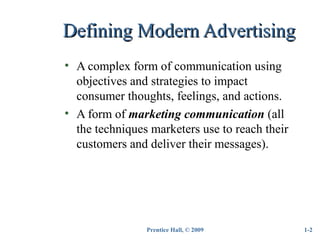
Defining Modern AdvertisingDefining Modern Advertising
• A complex form of communication using
objectives and strategies to impact
consumer thoughts, feelings, and actions.
• A form of marketing communication (all
the techniques marketers use to reach their
customers and deliver their messages).
1-2
WHAT IS ADVERTISING?
Prentice Hall, © 2009
Defining Modern AdvertisingDefining Modern Advertising
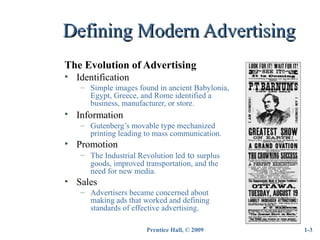
The Evolution of Advertising
• Identification
– Simple images found in ancient Babylonia,
Egypt, Greece, and Rome identified a
business, manufacturer, or store.
• Information
– Gutenberg’s movable type mechanized
printing leading to mass communication.
• Promotion
– The Industrial Revolution led to surplus
goods, improved transportation, and the
need for new media.
• Sales
– Advertisers became concerned about
making ads that worked and defining
standards of effective advertising.
1-3
Prentice Hall, © 2009
Defining Modern AdvertisingDefining Modern Advertising
1-4
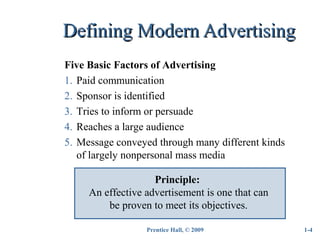
Principle:
An effective advertisement is one that can
be proven to meet its objectives.
Five Basic Factors of Advertising
1. Paid communication
2. Sponsor is identified
3. Tries to inform or persuade
4. Reaches a large audience
5. Message conveyed through many different kinds
of largely nonpersonal mass media
Prentice Hall, © 2009
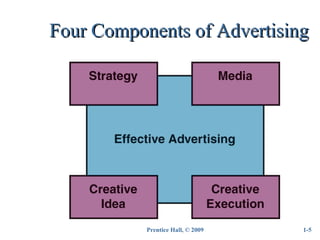
Four Components of AdvertisingFour Components of Advertising
1-5
Prentice Hall, © 2009
Four Components ofFour Components of
AdvertisingAdvertising
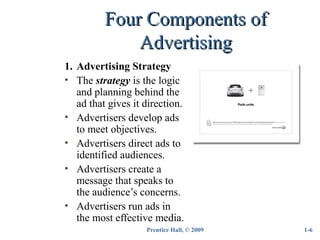
1. Advertising Strategy
• The strategy is the logic
and planning behind the
ad that gives it direction.
• Advertisers develop ads
to meet objectives.
• Advertisers direct ads to
identified audiences.
• Advertisers create a
message that speaks to
the audience’s concerns.
• Advertisers run ads in
the most effective media.
1-6
Prentice Hall, © 2009
Four Components ofFour Components of
AdvertisingAdvertising
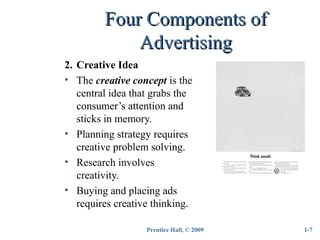
2. Creative Idea
• The creative concept is the
central idea that grabs the
consumer’s attention and
sticks in memory.
• Planning strategy requires
creative problem solving.
• Research involves
creativity.
• Buying and placing ads
requires creative thinking.
1-7
Prentice Hall, © 2009
Four Components ofFour Components of
AdvertisingAdvertising
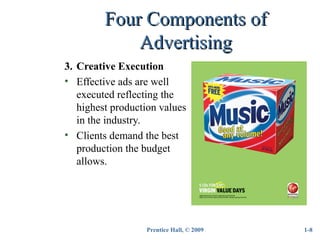
3. Creative Execution
• Effective ads are well
executed reflecting the
highest production values
in the industry.
• Clients demand the best
production the budget
allows.
1-8
Prentice Hall, © 2009
Four Components ofFour Components of
AdvertisingAdvertising
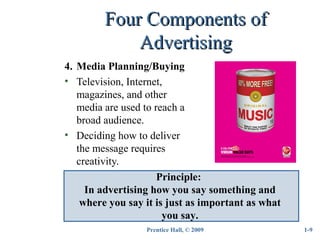
4. Media Planning/Buying
• Television, Internet,
magazines, and other
media are used to reach a
broad audience.
• Deciding how to deliver
the message requires
creativity.
1-9
Principle:
In advertising how you say something and
where you say it is just as important as what
you say.
Prentice Hall, © 2009
Four Roles of AdvertisingFour Roles of Advertising
1-10
1. The Marketing Role
• Marketing is satisfying customer wants and needs
by providing products (goods, services, and
ideas).
• The marketing department is responsible for
selling the product using the 4 Ps (product, price,
place/distribution, and promotion) and brand
development.
Principle:
A product can be services and
ideas as well as goods.
Prentice Hall, © 2009
Four Roles of AdvertisingFour Roles of Advertising
1-11
2. The Communication Role
• Advertising is a message to a consumer about a
product, designed to create a response.
• It is also a form of marketing communication.
• Advertising uses mass communication to transmit
product information to connect buyers and sellers
in them marketplace.
Principle:
One of advertising’s most important strengths is
its ability to reach a large audience.
Prentice Hall, © 2009
Four Roles of AdvertisingFour Roles of Advertising
1-12
3. The Economic Role
• Because it reaches large groups of people,
advertising makes marketing more cost-efficient
and lowers prices for consumers.
• Advertising creates a demand for a brand using
hard sell (persuading) and soft sell (image
building) techniques.
Prentice Hall, © 2009
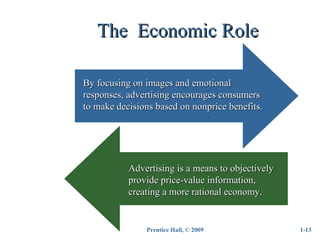
The Economic RoleThe Economic Role
1-13
Advertising is a means to objectivelyAdvertising is a means to objectively
provide price-value information,provide price-value information,
creating a more rational economy.creating a more rational economy.
By focusing on images and emotionalBy focusing on images and emotional
responses, advertising encourages consumersresponses, advertising encourages consumers
to make decisions based on nonprice benefits.to make decisions based on nonprice benefits.
Prentice Hall, © 2009
Four Roles of AdvertisingFour Roles of Advertising
1-14
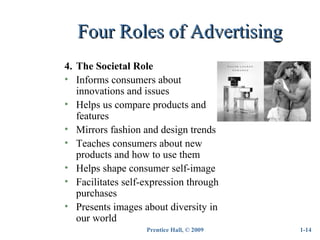
4. The Societal Role
• Informs consumers about
innovations and issues
• Helps us compare products and
features
• Mirrors fashion and design trends
• Teaches consumers about new
products and how to use them
• Helps shape consumer self-image
• Facilitates self-expression through
purchases
• Presents images about diversity in
our world
Prentice Hall, © 2009
Types of AdvertisingTypes of Advertising
1-15
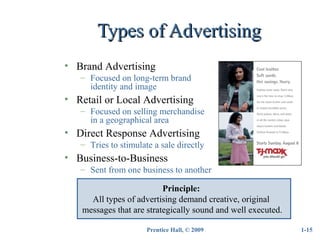
• Brand Advertising
– Focused on long-term brand
identity and image
• Retail or Local Advertising
– Focused on selling merchandise
in a geographical area
• Direct Response Advertising
– Tries to stimulate a sale directly
• Business-to-Business
– Sent from one business to another
Principle:
All types of advertising demand creative, original
messages that are strategically sound and well executed.
Prentice Hall, © 2009
Types of AdvertisingTypes of Advertising
1-16
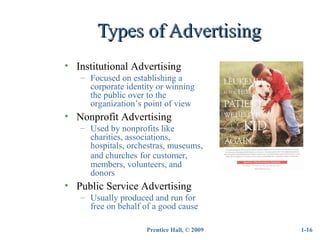
• Institutional Advertising
– Focused on establishing a
corporate identity or winning
the public over to the
organization’s point of view
• Nonprofit Advertising
– Used by nonprofits like
charities, associations,
hospitals, orchestras, museums,
and churches for customer,
members, volunteers, and
donors
• Public Service Advertising
– Usually produced and run for
free on behalf of a good cause
Prentice Hall, © 2009
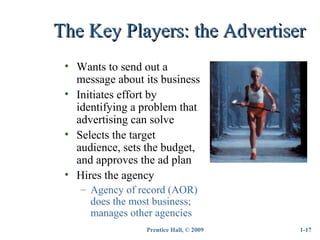
The Key Players: the AdvertiserThe Key Players: the Advertiser
• Wants to send out a
message about its business
• Initiates effort by
identifying a problem that
advertising can solve
• Selects the target
audience, sets the budget,
and approves the ad plan
• Hires the agency
– Agency of record (AOR)
does the most business;
manages other agencies
1-17
Prentice Hall, © 2009
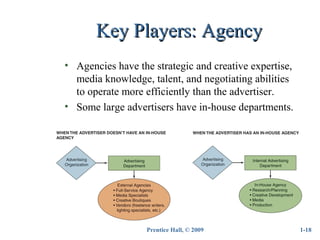
Key Players: AgencyKey Players: Agency
• Agencies have the strategic and creative expertise,
media knowledge, talent, and negotiating abilities
to operate more efficiently than the advertiser.
• Some large advertisers have in-house departments.
1-18
Prentice Hall, © 2009
Key Players: MediaKey Players: Media
• Media are channels of communication that
carry the message to the audience
• They’re vehicles, but also large media
conglomerates like Time Warner and
Viacom.
1-19
Principle:
Mass media advertising can be cost effective
because the costs are spread over the large
number of people the ad reaches.
Prentice Hall, © 2009
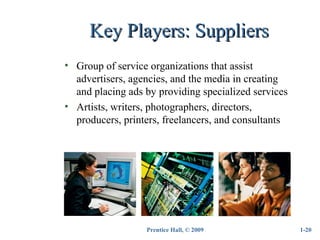
Key Players: SuppliersKey Players: Suppliers
• Group of service organizations that assist
advertisers, agencies, and the media in creating
and placing ads by providing specialized services
• Artists, writers, photographers, directors,
producers, printers, freelancers, and consultants
1-20
Insert
Prentice Hall, © 2009
Key Players: Target AudiencesKey Players: Target Audiences
• People to whom an ad is
directed—their responses
determine if advertising is
effective.
• Targeting is the process
of identifying the people
in the desired audience.
• Interactive technology
allows ads to be
customized to the target
audience’s individual
needs.
1-21
Insert
Prentice Hall, © 2009
• ENES ARSLANKAYA
1-22

Advertising

  • 1.
  • 2.
    Prentice Hall, ©2009 Defining Modern AdvertisingDefining Modern Advertising • A complex form of communication using objectives and strategies to impact consumer thoughts, feelings, and actions. • A form of marketing communication (all the techniques marketers use to reach their customers and deliver their messages). 1-2 WHAT IS ADVERTISING?
  • 3.
    Prentice Hall, ©2009 Defining Modern AdvertisingDefining Modern Advertising The Evolution of Advertising • Identification – Simple images found in ancient Babylonia, Egypt, Greece, and Rome identified a business, manufacturer, or store. • Information – Gutenberg’s movable type mechanized printing leading to mass communication. • Promotion – The Industrial Revolution led to surplus goods, improved transportation, and the need for new media. • Sales – Advertisers became concerned about making ads that worked and defining standards of effective advertising. 1-3
  • 4.
    Prentice Hall, ©2009 Defining Modern AdvertisingDefining Modern Advertising 1-4 Principle: An effective advertisement is one that can be proven to meet its objectives. Five Basic Factors of Advertising 1. Paid communication 2. Sponsor is identified 3. Tries to inform or persuade 4. Reaches a large audience 5. Message conveyed through many different kinds of largely nonpersonal mass media
  • 5.
    Prentice Hall, ©2009 Four Components of AdvertisingFour Components of Advertising 1-5
  • 6.
    Prentice Hall, ©2009 Four Components ofFour Components of AdvertisingAdvertising 1. Advertising Strategy • The strategy is the logic and planning behind the ad that gives it direction. • Advertisers develop ads to meet objectives. • Advertisers direct ads to identified audiences. • Advertisers create a message that speaks to the audience’s concerns. • Advertisers run ads in the most effective media. 1-6
  • 7.
    Prentice Hall, ©2009 Four Components ofFour Components of AdvertisingAdvertising 2. Creative Idea • The creative concept is the central idea that grabs the consumer’s attention and sticks in memory. • Planning strategy requires creative problem solving. • Research involves creativity. • Buying and placing ads requires creative thinking. 1-7
  • 8.
    Prentice Hall, ©2009 Four Components ofFour Components of AdvertisingAdvertising 3. Creative Execution • Effective ads are well executed reflecting the highest production values in the industry. • Clients demand the best production the budget allows. 1-8
  • 9.
    Prentice Hall, ©2009 Four Components ofFour Components of AdvertisingAdvertising 4. Media Planning/Buying • Television, Internet, magazines, and other media are used to reach a broad audience. • Deciding how to deliver the message requires creativity. 1-9 Principle: In advertising how you say something and where you say it is just as important as what you say.
  • 10.
    Prentice Hall, ©2009 Four Roles of AdvertisingFour Roles of Advertising 1-10 1. The Marketing Role • Marketing is satisfying customer wants and needs by providing products (goods, services, and ideas). • The marketing department is responsible for selling the product using the 4 Ps (product, price, place/distribution, and promotion) and brand development. Principle: A product can be services and ideas as well as goods.
  • 11.
    Prentice Hall, ©2009 Four Roles of AdvertisingFour Roles of Advertising 1-11 2. The Communication Role • Advertising is a message to a consumer about a product, designed to create a response. • It is also a form of marketing communication. • Advertising uses mass communication to transmit product information to connect buyers and sellers in them marketplace. Principle: One of advertising’s most important strengths is its ability to reach a large audience.
  • 12.
    Prentice Hall, ©2009 Four Roles of AdvertisingFour Roles of Advertising 1-12 3. The Economic Role • Because it reaches large groups of people, advertising makes marketing more cost-efficient and lowers prices for consumers. • Advertising creates a demand for a brand using hard sell (persuading) and soft sell (image building) techniques.
  • 13.
    Prentice Hall, ©2009 The Economic RoleThe Economic Role 1-13 Advertising is a means to objectivelyAdvertising is a means to objectively provide price-value information,provide price-value information, creating a more rational economy.creating a more rational economy. By focusing on images and emotionalBy focusing on images and emotional responses, advertising encourages consumersresponses, advertising encourages consumers to make decisions based on nonprice benefits.to make decisions based on nonprice benefits.
  • 14.
    Prentice Hall, ©2009 Four Roles of AdvertisingFour Roles of Advertising 1-14 4. The Societal Role • Informs consumers about innovations and issues • Helps us compare products and features • Mirrors fashion and design trends • Teaches consumers about new products and how to use them • Helps shape consumer self-image • Facilitates self-expression through purchases • Presents images about diversity in our world
  • 15.
    Prentice Hall, ©2009 Types of AdvertisingTypes of Advertising 1-15 • Brand Advertising – Focused on long-term brand identity and image • Retail or Local Advertising – Focused on selling merchandise in a geographical area • Direct Response Advertising – Tries to stimulate a sale directly • Business-to-Business – Sent from one business to another Principle: All types of advertising demand creative, original messages that are strategically sound and well executed.
  • 16.
    Prentice Hall, ©2009 Types of AdvertisingTypes of Advertising 1-16 • Institutional Advertising – Focused on establishing a corporate identity or winning the public over to the organization’s point of view • Nonprofit Advertising – Used by nonprofits like charities, associations, hospitals, orchestras, museums, and churches for customer, members, volunteers, and donors • Public Service Advertising – Usually produced and run for free on behalf of a good cause
  • 17.
    Prentice Hall, ©2009 The Key Players: the AdvertiserThe Key Players: the Advertiser • Wants to send out a message about its business • Initiates effort by identifying a problem that advertising can solve • Selects the target audience, sets the budget, and approves the ad plan • Hires the agency – Agency of record (AOR) does the most business; manages other agencies 1-17
  • 18.
    Prentice Hall, ©2009 Key Players: AgencyKey Players: Agency • Agencies have the strategic and creative expertise, media knowledge, talent, and negotiating abilities to operate more efficiently than the advertiser. • Some large advertisers have in-house departments. 1-18
  • 19.
    Prentice Hall, ©2009 Key Players: MediaKey Players: Media • Media are channels of communication that carry the message to the audience • They’re vehicles, but also large media conglomerates like Time Warner and Viacom. 1-19 Principle: Mass media advertising can be cost effective because the costs are spread over the large number of people the ad reaches.
  • 20.
    Prentice Hall, ©2009 Key Players: SuppliersKey Players: Suppliers • Group of service organizations that assist advertisers, agencies, and the media in creating and placing ads by providing specialized services • Artists, writers, photographers, directors, producers, printers, freelancers, and consultants 1-20 Insert
  • 21.
    Prentice Hall, ©2009 Key Players: Target AudiencesKey Players: Target Audiences • People to whom an ad is directed—their responses determine if advertising is effective. • Targeting is the process of identifying the people in the desired audience. • Interactive technology allows ads to be customized to the target audience’s individual needs. 1-21 Insert
  • 22.
    Prentice Hall, ©2009 • ENES ARSLANKAYA 1-22