An Introduction to OpenStack
What it is, why it potentially matters, and what you need to know
if you want to get started
Scott Lowe, VCDX 39
vExpert, Author, Blogger, Geek
http://blog.scottlowe.org / Twitter: @scott_lowe
Before we start
•Get involved! Audience participation is encouraged and
requested.
•If you use Twitter, feel free to tweet about this session (use
@MyVMUG or hashtag #NMVMUG)
•I encourage you to take photos or videos of today’s session
and share them online
•This presentation will be made available online after the event
•What OpenStack is—and what it is not
•OpenStack’s components
•Why does OpenStack matter?
•Does OpenStack matter to SMBs?
•How do I get started with OpenStack?
Agenda
•It’s not a single open source project (more on that in a moment)
•It’s not a hypervisor
•It’s not a storage platform
•It’s not (necessarily) competitive to VMware (more on that in a
moment)
What OpenStack is not
•A group of open source projects aimed at providing
comprehensive cloud services
•There are currently seven core projects within OpenStack
•More projects are in “incubation” phase
•All these projects communicate via public APIs
•It’s supported by the OpenStack Foundation, an independent
legal entity
So what is OpenStack?
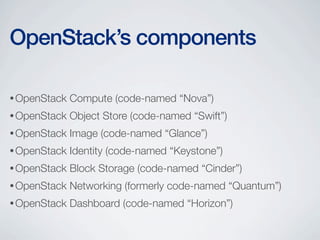
•OpenStack Compute (code-named “Nova”)
•OpenStack Object Store (code-named “Swift”)
•OpenStack Image (code-named “Glance”)
•OpenStack Identity (code-named “Keystone”)
•OpenStack Block Storage (code-named “Cinder”)
•OpenStack Networking (formerly code-named “Quantum”)
•OpenStack Dashboard (code-named “Horizon”)
OpenStack’s components
•Conceptually similar to Amazon EC2
•Can leverage multiple hypervisors (Xen, KVM, vSphere/ESXi,
Hyper-V)
•Made up of several sub-components (nova-api, nova-compute,
nova-schedule)
•Some sub-components are being broken out
•nova-network is being replaced by OpenStack Networking
•nova-volume is being replaced by OpenStack Block Storage
(“Cinder”)
OpenStack’s components:
Compute
•Think of it as similar to Amazon S3
•Provides distributed object storage
•Supports the OpenStack Object API as well as raw HTTP
•Authentication is handled via OpenStack Identity (typically)
OpenStack’s components:
Object Store
•This can be compared to Amazon’s AMI catalog
•Provides image storage, image retrieval, and image discovery
services
•These images are leveraged to launch instances (VMs)
•Can leverage the Object Store (“Swift”) or other storage
platforms, including Amazon S3, filesystems, and HTTP
OpenStack’s components:
Image
•Provides policy and authentication services for other OpenStack
services
•Leverages a pluggable architecture that can support LDAP, SQL,
and other backend services
OpenStack’s components:
Identity
•Can be compared in concept to Amazon EBS
•Provides block storage functionality to instances running on
Compute
•Recall that instances are stateless
•Block Storage provides persistent storage for instances
•Similar to Compute, it has several sub-components (cinder-api,
cinder-volume, cinder-scheduler)
•Leverages storage drivers to interact with underlying storage
platforms
OpenStack’s components:
Block Storage
•Provides “network as a service” functionality
•Allows for the programmatic creation of (potentially complex)
per-tenant networks
•Uses a plug-in architecture; plugins exist for a number of
different back-end implementations, including Nicira NVP, Open
vSwitch (OVS), Linux bridge, Cisco, and others
•Has essentially replaced nova-network
OpenStack’s components:
Network
•A web application that runs on Apache
•Provides a graphical user interface (GUI) for other OpenStack
services
•Leverages the APIs of the other OpenStack services
OpenStack’s components:
Dashboard
•One of only a few significant open source projects attempting to
provide a comprehensive cloud services framework
•Enjoys broad industry support
•Some significant providers are adopting OpenStack as their
cloud services platform
•Like Linux, OpenStack could have a profound impact on your
data center or cloud deployment
Why does OpenStack matter?
Does OpenStack matter to
SMBs?
•The answer is both “Yes” and “No” (maybe “It depends”?)
•Why no?
•Probably not ready for in-house deployments by SMBs (yet)
•A fair amount of expertise required to get it up and running
Why OpenStack doesn’t matter
to SMBs
•The answer is both “Yes” and “No” (maybe “It depends”?)
•Why yes?
•It heralds a potential sea change with how cloud environments
are built and deployed
•Enables “best of breed” clouds built using open (source) APIs
•Signals that we could see cross-cloud interoperability in the
not-too-distant future
Why OpenStack does matter to
SMBs
•DevStack is a great tool for getting started
•OpenStack is heavily Linux-based, so get familiar with Linux if
you aren't already (Ubuntu is very common in OpenStack)
•Instances are stateless, so configuration management is critical
(Puppet)
•OpenStack itself is mostly written in Python
•Other commonly-used technologies include KVM, network
namespaces, & OVS
How do I get started with
OpenStack?
Questions &
answers
Thank you!
Don’t forget to provide feedback to your VMUG leaders on this
session.

An Introduction to OpenStack

  • 1.
    An Introduction toOpenStack What it is, why it potentially matters, and what you need to know if you want to get started Scott Lowe, VCDX 39 vExpert, Author, Blogger, Geek http://blog.scottlowe.org / Twitter: @scott_lowe
  • 2.
    Before we start •Getinvolved! Audience participation is encouraged and requested. •If you use Twitter, feel free to tweet about this session (use @MyVMUG or hashtag #NMVMUG) •I encourage you to take photos or videos of today’s session and share them online •This presentation will be made available online after the event
  • 3.
    •What OpenStack is—andwhat it is not •OpenStack’s components •Why does OpenStack matter? •Does OpenStack matter to SMBs? •How do I get started with OpenStack? Agenda
  • 4.
    •It’s not asingle open source project (more on that in a moment) •It’s not a hypervisor •It’s not a storage platform •It’s not (necessarily) competitive to VMware (more on that in a moment) What OpenStack is not
  • 5.
    •A group ofopen source projects aimed at providing comprehensive cloud services •There are currently seven core projects within OpenStack •More projects are in “incubation” phase •All these projects communicate via public APIs •It’s supported by the OpenStack Foundation, an independent legal entity So what is OpenStack?
  • 6.
    •OpenStack Compute (code-named“Nova”) •OpenStack Object Store (code-named “Swift”) •OpenStack Image (code-named “Glance”) •OpenStack Identity (code-named “Keystone”) •OpenStack Block Storage (code-named “Cinder”) •OpenStack Networking (formerly code-named “Quantum”) •OpenStack Dashboard (code-named “Horizon”) OpenStack’s components
  • 7.
    •Conceptually similar toAmazon EC2 •Can leverage multiple hypervisors (Xen, KVM, vSphere/ESXi, Hyper-V) •Made up of several sub-components (nova-api, nova-compute, nova-schedule) •Some sub-components are being broken out •nova-network is being replaced by OpenStack Networking •nova-volume is being replaced by OpenStack Block Storage (“Cinder”) OpenStack’s components: Compute
  • 8.
    •Think of itas similar to Amazon S3 •Provides distributed object storage •Supports the OpenStack Object API as well as raw HTTP •Authentication is handled via OpenStack Identity (typically) OpenStack’s components: Object Store
  • 9.
    •This can becompared to Amazon’s AMI catalog •Provides image storage, image retrieval, and image discovery services •These images are leveraged to launch instances (VMs) •Can leverage the Object Store (“Swift”) or other storage platforms, including Amazon S3, filesystems, and HTTP OpenStack’s components: Image
  • 10.
    •Provides policy andauthentication services for other OpenStack services •Leverages a pluggable architecture that can support LDAP, SQL, and other backend services OpenStack’s components: Identity
  • 11.
    •Can be comparedin concept to Amazon EBS •Provides block storage functionality to instances running on Compute •Recall that instances are stateless •Block Storage provides persistent storage for instances •Similar to Compute, it has several sub-components (cinder-api, cinder-volume, cinder-scheduler) •Leverages storage drivers to interact with underlying storage platforms OpenStack’s components: Block Storage
  • 12.
    •Provides “network asa service” functionality •Allows for the programmatic creation of (potentially complex) per-tenant networks •Uses a plug-in architecture; plugins exist for a number of different back-end implementations, including Nicira NVP, Open vSwitch (OVS), Linux bridge, Cisco, and others •Has essentially replaced nova-network OpenStack’s components: Network
  • 13.
    •A web applicationthat runs on Apache •Provides a graphical user interface (GUI) for other OpenStack services •Leverages the APIs of the other OpenStack services OpenStack’s components: Dashboard
  • 14.
    •One of onlya few significant open source projects attempting to provide a comprehensive cloud services framework •Enjoys broad industry support •Some significant providers are adopting OpenStack as their cloud services platform •Like Linux, OpenStack could have a profound impact on your data center or cloud deployment Why does OpenStack matter?
  • 15.
  • 16.
    •The answer isboth “Yes” and “No” (maybe “It depends”?) •Why no? •Probably not ready for in-house deployments by SMBs (yet) •A fair amount of expertise required to get it up and running Why OpenStack doesn’t matter to SMBs
  • 17.
    •The answer isboth “Yes” and “No” (maybe “It depends”?) •Why yes? •It heralds a potential sea change with how cloud environments are built and deployed •Enables “best of breed” clouds built using open (source) APIs •Signals that we could see cross-cloud interoperability in the not-too-distant future Why OpenStack does matter to SMBs
  • 18.
    •DevStack is agreat tool for getting started •OpenStack is heavily Linux-based, so get familiar with Linux if you aren't already (Ubuntu is very common in OpenStack) •Instances are stateless, so configuration management is critical (Puppet) •OpenStack itself is mostly written in Python •Other commonly-used technologies include KVM, network namespaces, & OVS How do I get started with OpenStack?
  • 19.
  • 20.
    Thank you! Don’t forgetto provide feedback to your VMUG leaders on this session.