INTRODUCTION OF
VECTOR IN A PLANE
What are Vectors?
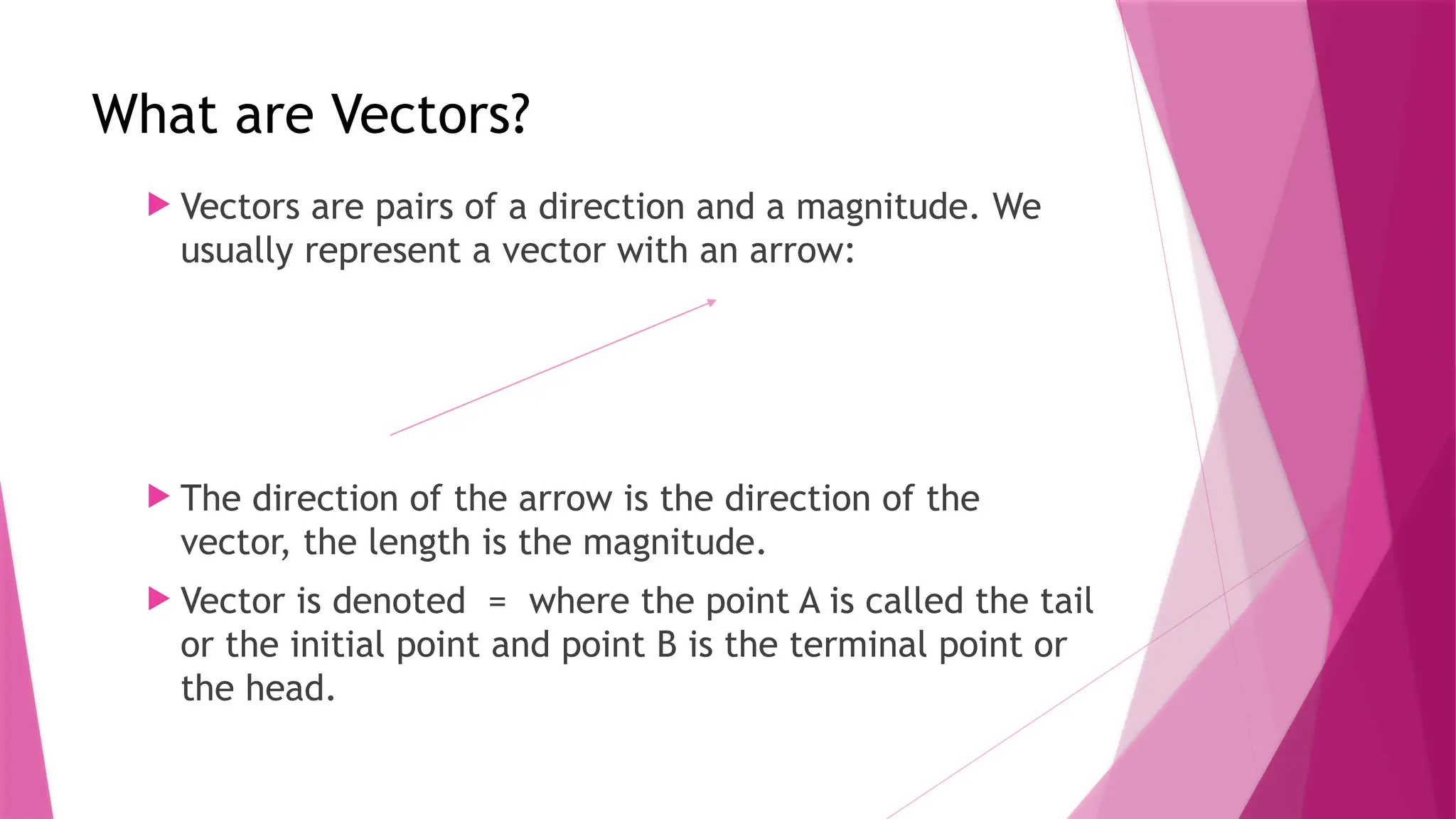
 Vectors are pairs of a direction and a magnitude. We
usually represent a vector with an arrow:
 The direction of the arrow is the direction of the
vector, the length is the magnitude.
 Vector is denoted = where the point A is called the tail
or the initial point and point B is the terminal point or
the head.
Magnitude of a Vector
The magnitude of a vector is the distance between the initial
point P and the end point Q. in symbols the magnitude of is written as .
if the coordinates of the initial point and the end point of a
vector is given, the Distance Formula can be used to find its magnitude.
Q(
P(
Direction of a vector
The direction of a vector is the measure of the
angle it makes with a horizontal line.
One of the following formulas can be used to
find the direction of a vector:
where x is the horizontal change and y is the
vertical change or where ( is the initial point and
( is the terminal point.
COMPONENTS
Vector components are the change in x and the change in y.
In situations in which vectors are directed at angles to the customary
coordinate axes, a useful mathematical trick will be employed to transform the
vector into two parts with each part being directed along the coordinate axes.
=
+
Northwest vectors have a northward and westward part.
=
+
An upward and rightward vector has an upward and rightward part.
TYPES OF VECTORS
Equal vector –Vector of the same
length and direction are called
equivalent.
Collinear vector –Two vectors are
collinear, if they lie on the same line
or parallel lines.
Opposite vector – if they have the
same magnitude but opposite
direction.
Null vector – is the dimensional vector
of length (i.e., the vector with
components, each of which is 0). A
second meaning of null vector when
applied to a matrix is a nonzero vector
with the property that Ax = 0
ASSESSMENT
TEST I: Write True or False ( 1 point each)
1. Vectors are used to represent velocity, force and tension
2. A component form of a vector is the ordered pair that
describe the changes in the x and y values.
3. The Associative Law, which state the order or addition
does not depend on which pair of vector is added first: (a
+ b) + c = a + (b + c)
4. If then is stated by the associative property of addition
of vectors.
5. A null vector is a vector with a zero magnitude.
Test II: Solving: Find the magnitude and direction of the
ordered pair (2 points each)
1. A(2,3) and B(4,6)
2. C(1,1) and D(5,3)
3. P(6,7) and Q(5,2)
Draw or Illustrate:
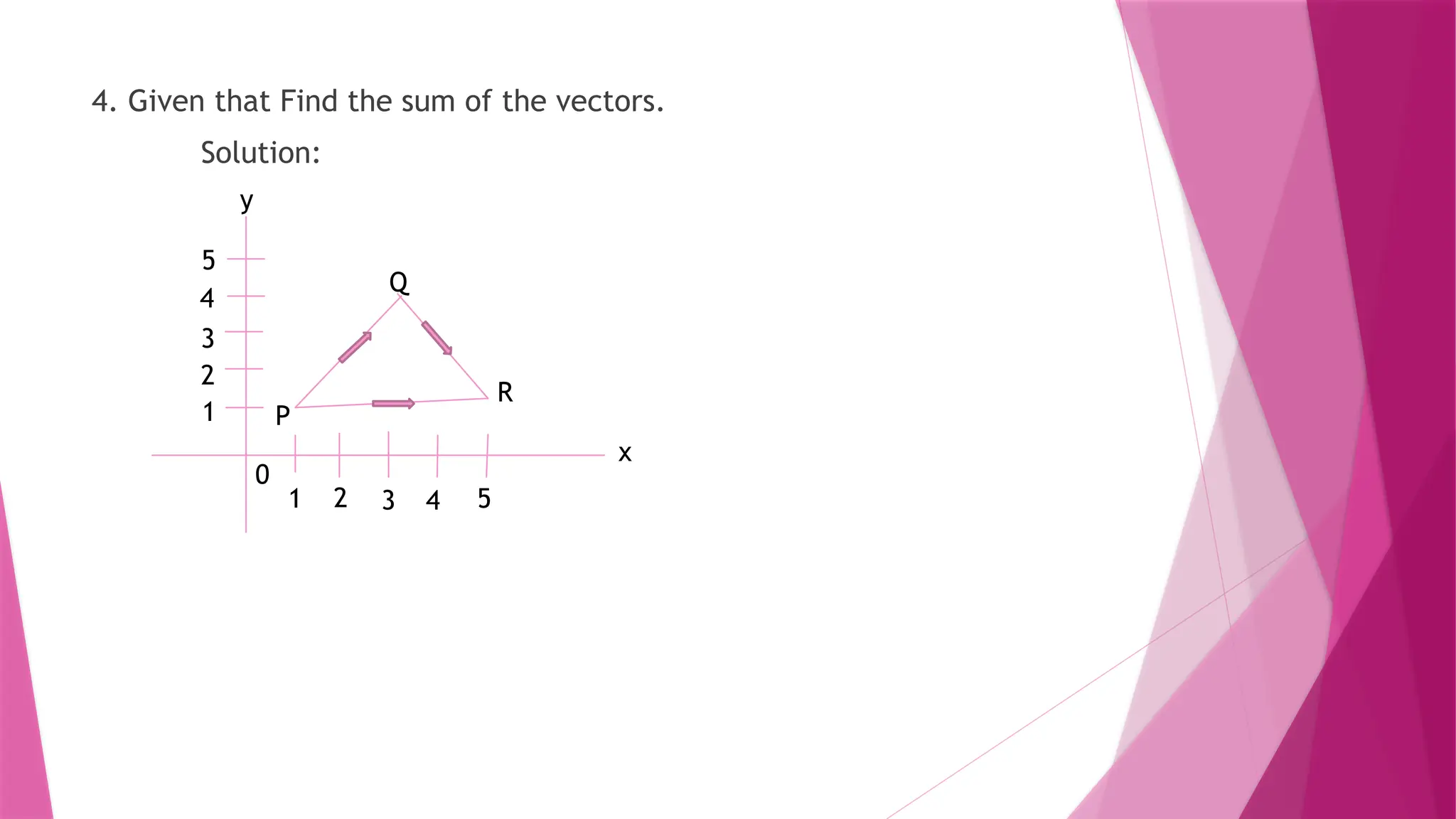
4. Given that . Find the sum of the vectors.
5. If A = and c = 2 Find Ca.
Answer Key
I. True or False
1.T
2.T
3.F
4.F
5.T
II. Solving
1. A(2,3) and B(4,6) 2. C(1,1) and
B(5,3)
or
or 2
3. P(6,7) and Q(5,2)
4. Given that Find the sum of the vectors.
Solution:
Q
R
P
5
4
2
3
1
1
0
2 3 4 5
y
x
5. If A = and c = 2, Find cA.
cA = 2
cA =
cA =

INTRODUCTION OF VECTOR IN PLANE LESSON.pptx

  • 1.
  • 2.
    What are Vectors? Vectors are pairs of a direction and a magnitude. We usually represent a vector with an arrow:  The direction of the arrow is the direction of the vector, the length is the magnitude.  Vector is denoted = where the point A is called the tail or the initial point and point B is the terminal point or the head.
  • 3.
    Magnitude of aVector The magnitude of a vector is the distance between the initial point P and the end point Q. in symbols the magnitude of is written as . if the coordinates of the initial point and the end point of a vector is given, the Distance Formula can be used to find its magnitude. Q( P(
  • 4.
    Direction of avector The direction of a vector is the measure of the angle it makes with a horizontal line. One of the following formulas can be used to find the direction of a vector: where x is the horizontal change and y is the vertical change or where ( is the initial point and ( is the terminal point.
  • 5.
    COMPONENTS Vector components arethe change in x and the change in y. In situations in which vectors are directed at angles to the customary coordinate axes, a useful mathematical trick will be employed to transform the vector into two parts with each part being directed along the coordinate axes. = + Northwest vectors have a northward and westward part. = + An upward and rightward vector has an upward and rightward part.
  • 6.
    TYPES OF VECTORS Equalvector –Vector of the same length and direction are called equivalent. Collinear vector –Two vectors are collinear, if they lie on the same line or parallel lines.
  • 7.
    Opposite vector –if they have the same magnitude but opposite direction. Null vector – is the dimensional vector of length (i.e., the vector with components, each of which is 0). A second meaning of null vector when applied to a matrix is a nonzero vector with the property that Ax = 0
  • 8.
    ASSESSMENT TEST I: WriteTrue or False ( 1 point each) 1. Vectors are used to represent velocity, force and tension 2. A component form of a vector is the ordered pair that describe the changes in the x and y values. 3. The Associative Law, which state the order or addition does not depend on which pair of vector is added first: (a + b) + c = a + (b + c) 4. If then is stated by the associative property of addition of vectors. 5. A null vector is a vector with a zero magnitude.
  • 9.
    Test II: Solving:Find the magnitude and direction of the ordered pair (2 points each) 1. A(2,3) and B(4,6) 2. C(1,1) and D(5,3) 3. P(6,7) and Q(5,2) Draw or Illustrate: 4. Given that . Find the sum of the vectors. 5. If A = and c = 2 Find Ca.
  • 10.
    Answer Key I. Trueor False 1.T 2.T 3.F 4.F 5.T
  • 11.
    II. Solving 1. A(2,3)and B(4,6) 2. C(1,1) and B(5,3) or or 2
  • 12.
  • 13.
    4. Given thatFind the sum of the vectors. Solution: Q R P 5 4 2 3 1 1 0 2 3 4 5 y x
  • 14.
    5. If A= and c = 2, Find cA. cA = 2 cA = cA =