Introduction to Vectors
By: Dheeraj Pandey
Vectors
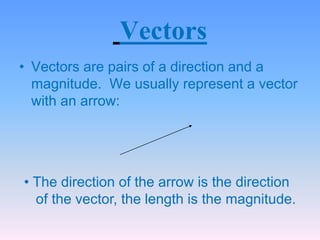
• Vectors are pairs of a direction and a
magnitude. We usually represent a vector
with an arrow:
• The direction of the arrow is the direction
of the vector, the length is the magnitude.
Basic Properties
1. Equality:
Two vectors are said to be equal if they
have the same magnitude and direction.
2. Opposite,Parallel or Antiparallel vector:
Two vectors are opposite if they have the same
magnitude but opposite direction.
Two vectors are parallel if they have the same
direction but not necessarily the same
magnitude.
Antiparallel if they have opposite direction but not
necessarily the same magnitude.
Components
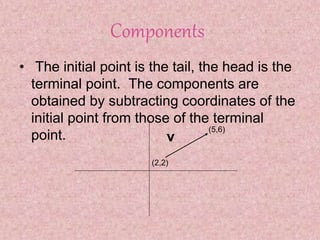
• The initial point is the tail, the head is the
terminal point. The components are
obtained by subtracting coordinates of the
initial point from those of the terminal
point. v
(2,2)
(5,6)
Addition and Subtraction of
Vectors
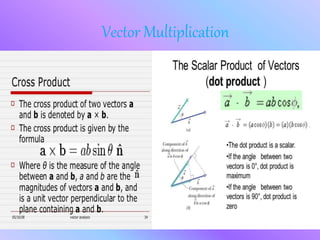
Vector Multiplication
Applications

IntroductiontoVectors.ppt

  • 1.
  • 2.
    Vectors • Vectors arepairs of a direction and a magnitude. We usually represent a vector with an arrow: • The direction of the arrow is the direction of the vector, the length is the magnitude.
  • 3.
    Basic Properties 1. Equality: Twovectors are said to be equal if they have the same magnitude and direction. 2. Opposite,Parallel or Antiparallel vector: Two vectors are opposite if they have the same magnitude but opposite direction. Two vectors are parallel if they have the same direction but not necessarily the same magnitude. Antiparallel if they have opposite direction but not necessarily the same magnitude.
  • 4.
    Components • The initialpoint is the tail, the head is the terminal point. The components are obtained by subtracting coordinates of the initial point from those of the terminal point. v (2,2) (5,6)
  • 6.
  • 7.
  • 8.