ROP Chaining
What is it?
• So that we can control the EIP via a series of
cleverly crafted RETs, that’s not in our control, on
the Stack and bypass ASLR, W^X etc. and finally
achieve attacker controlled code execution !
Why is it needed ?
Let us decode that ****
• EIP
• RETs
• Stack
• Code execution
• ASLR
• W^X
Basics
• Function call under the hood
Function call ()
• CALL = PUSH RET ADDRESS ON STACK
• { = SET UP THE STACK =
• MOVE ESP AHEAD
• PUSH EBP
• MOV ESP TO EBP
Function Return
• return/ } =
• 2) ret =
• return control back to the calling function = the return
address stored earlier on the stack = pop eip
• 1) leave =
• restore esp = mov ebp to esp
• restore ebp = pop ebp
TOS
CALL instruction
TOS
Return Address
{ = function set up
TOS
Old EBP xxxx
EBP
Old EBP
EBP
xxxx
Argument
Return Address
TOS
Old EBP xxxx
EBP
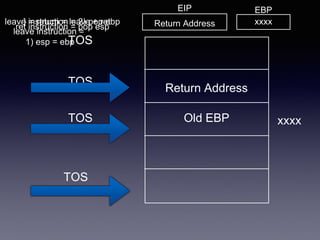
xxxx} = return = leave + ret
leave instruction =
1) esp = ebp
TOS
leave instruction = 2) pop ebp
TOS
ret instruction = pop esp
TOS
Return Address
EIP
Hence the idea
• Put things WE want on the stack so that it
eventually ends up in the EIP
• Vanilla Buffer Overflow works
Challenges
• Stack region should be executable (DEP/W^X)
• Address to put on stack (address of shell
code) should be known/predictable (ASLR)
ASLR
• What ?
• Why ?
• How ?
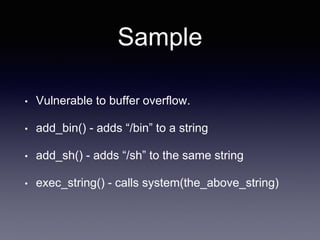
Sample
• Vulnerable to buffer overflow.
• add_bin() - adds “/bin” to a string
• add_sh() - adds “/sh” to the same string
• exec_string() - calls system(the_above_string)
Objective
• Get $
• Hint :
• How do we execute all 3 ()s in a sequence ?
Initial thoughts ?
• Address of each function is known ! Can’t we just
put them on the stack as we would for the first
function ?
YES, that’s the idea !
• But NO, not as directly ! WHY ?
What just happened ?
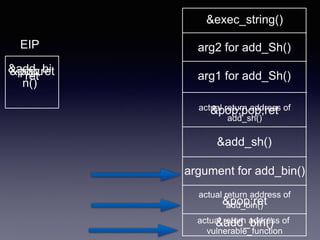
• We arranged the stack as we were planning to.
actual return address of
vulnerable_function
&add_bin()
actual return address of
add_bin()&pop;ret
argument for add_bin()
actual return address of
add_sh()
&add_sh()
&pop;pop;ret
arg1 for add_Sh()
arg2 for add_Sh()
&exec_string()
EIP
&add_bi
n()
&pop;retpopret
ROP-fu
• This is what is ROP chaining
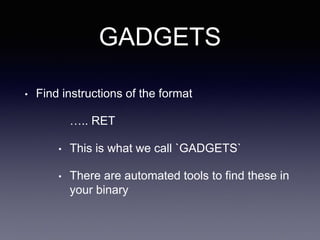
GADGETS
• Find instructions of the format
….. RET
• This is what we call `GADGETS`
• There are automated tools to find these in
your binary
ACHIEVEMENT
• Use them to achieve what you want. This is one
way to bypass ASLR - actually better said as :
achieve what we want despite ASLR being
present !
Applications
Some rather fancy ones
• Exploits
• JailBreaks
• Rooting
QUESTIONS ??
Resources
• https://reverseengineering.stackexchange.com/questions/1992/what-is-plt-got
• https://www.blackhat.com/presentations/bh-usa-08/Shacham/BH_US_08_Shacham_Return_Oriented_Programming.pdf
• https://www.trust.informatik.tu-darmstadt.de/fileadmin/user_upload/Group_TRUST/LectureSlides/Chapter02%20-
%20RuntimeAttacks.pdf
• https://stackoverflow.com/questions/4292447/does-ret-instruction-cause-esp-register-added-by-4
• https://security.stackexchange.com/questions/37373/aslr-randomization-bss
• https://www.trustwave.com/Resources/SpiderLabs-Blog/Baby-s-first-NX-ASLR-bypass/
• https://www.rcesecurity.com/2011/12/stack-manipulation-using-pop-ret/
• https://dkalemis.wordpress.com/2010/10/27/the-need-for-a-pop-pop-ret-instruction-sequence/
• https://github.com/JonathanSalwan/ROPgadget
• https://sploitfun.wordpress.com/2015/05/08/bypassing-aslr-part-iii/
• https://stackoverflow.com/questions/41231637/how-does-a-function-call-work
• http://www.avrbeginners.net/new/wp-content/uploads/2011/08/avrbeginners_04_Jumps_Calls_and_the_Stack_1.0.1.pdf
• https://cs.nyu.edu/courses/fall04/V22.0201-003/ia32_chap_03.pdf
• https://stackoverflow.com/questions/16368769/return-to-call-after-jumps-in-assembly
Return Oriented Programming (ROP chaining)

Return Oriented Programming (ROP chaining)

  • 1.
  • 2.
  • 3.
    • So thatwe can control the EIP via a series of cleverly crafted RETs, that’s not in our control, on the Stack and bypass ASLR, W^X etc. and finally achieve attacker controlled code execution ! Why is it needed ?
  • 5.
    Let us decodethat **** • EIP • RETs • Stack • Code execution • ASLR • W^X
  • 6.
  • 7.
    Function call () •CALL = PUSH RET ADDRESS ON STACK • { = SET UP THE STACK = • MOVE ESP AHEAD • PUSH EBP • MOV ESP TO EBP
  • 8.
    Function Return • return/} = • 2) ret = • return control back to the calling function = the return address stored earlier on the stack = pop eip • 1) leave = • restore esp = mov ebp to esp • restore ebp = pop ebp
  • 9.
    TOS CALL instruction TOS Return Address {= function set up TOS Old EBP xxxx EBP Old EBP EBP xxxx Argument
  • 10.
    Return Address TOS Old EBPxxxx EBP xxxx} = return = leave + ret leave instruction = 1) esp = ebp TOS leave instruction = 2) pop ebp TOS ret instruction = pop esp TOS Return Address EIP
  • 11.
    Hence the idea •Put things WE want on the stack so that it eventually ends up in the EIP • Vanilla Buffer Overflow works
  • 12.
    Challenges • Stack regionshould be executable (DEP/W^X) • Address to put on stack (address of shell code) should be known/predictable (ASLR)
  • 13.
    ASLR • What ? •Why ? • How ?
  • 14.
    Sample • Vulnerable tobuffer overflow. • add_bin() - adds “/bin” to a string • add_sh() - adds “/sh” to the same string • exec_string() - calls system(the_above_string)
  • 15.
    Objective • Get $ •Hint : • How do we execute all 3 ()s in a sequence ?
  • 16.
    Initial thoughts ? •Address of each function is known ! Can’t we just put them on the stack as we would for the first function ?
  • 17.
    YES, that’s theidea ! • But NO, not as directly ! WHY ?
  • 19.
    What just happened? • We arranged the stack as we were planning to.
  • 20.
    actual return addressof vulnerable_function &add_bin() actual return address of add_bin()&pop;ret argument for add_bin() actual return address of add_sh() &add_sh() &pop;pop;ret arg1 for add_Sh() arg2 for add_Sh() &exec_string() EIP &add_bi n() &pop;retpopret
  • 21.
    ROP-fu • This iswhat is ROP chaining
  • 22.
    GADGETS • Find instructionsof the format ….. RET • This is what we call `GADGETS` • There are automated tools to find these in your binary
  • 23.
    ACHIEVEMENT • Use themto achieve what you want. This is one way to bypass ASLR - actually better said as : achieve what we want despite ASLR being present !
  • 24.
    Applications Some rather fancyones • Exploits • JailBreaks • Rooting
  • 25.
  • 26.
    Resources • https://reverseengineering.stackexchange.com/questions/1992/what-is-plt-got • https://www.blackhat.com/presentations/bh-usa-08/Shacham/BH_US_08_Shacham_Return_Oriented_Programming.pdf •https://www.trust.informatik.tu-darmstadt.de/fileadmin/user_upload/Group_TRUST/LectureSlides/Chapter02%20- %20RuntimeAttacks.pdf • https://stackoverflow.com/questions/4292447/does-ret-instruction-cause-esp-register-added-by-4 • https://security.stackexchange.com/questions/37373/aslr-randomization-bss • https://www.trustwave.com/Resources/SpiderLabs-Blog/Baby-s-first-NX-ASLR-bypass/ • https://www.rcesecurity.com/2011/12/stack-manipulation-using-pop-ret/ • https://dkalemis.wordpress.com/2010/10/27/the-need-for-a-pop-pop-ret-instruction-sequence/ • https://github.com/JonathanSalwan/ROPgadget • https://sploitfun.wordpress.com/2015/05/08/bypassing-aslr-part-iii/ • https://stackoverflow.com/questions/41231637/how-does-a-function-call-work • http://www.avrbeginners.net/new/wp-content/uploads/2011/08/avrbeginners_04_Jumps_Calls_and_the_Stack_1.0.1.pdf • https://cs.nyu.edu/courses/fall04/V22.0201-003/ia32_chap_03.pdf • https://stackoverflow.com/questions/16368769/return-to-call-after-jumps-in-assembly

Editor's Notes

  • #3 Just a very clever trick with a very fancy (but meaningful) name !
  • #5 Some of us at this point are like
  • #7 gcc -ggdb -mpreferred-stack-boundary=2 -fno-stack-protector -z execstack -o funCall_output funCall.c