Introduction
:
LEARNING
OF
EXPERTIS
E
Pirkko Hyvönen, pirkko.hyvonen@oulu.fi
Post-doc researher
KTK/ LET, Oulun yliopisto
30.9.2013 pirkko.hyvonen@oulu.fi 2
EXPERT AND
EXPERTISE
Who is an expert? Why
do you think so? What
is her/his domain?
How experts think and
perform?
How to become an
expert?
What is your
expertise? Where are
you in your expertise?
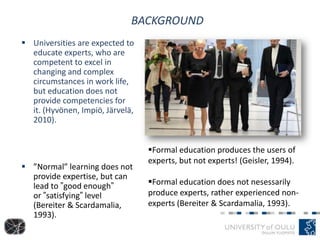
BACKGROUND
 Universities are expected to
educate experts, who are
competent to excel in
changing and complex
circumstances in work life,
but education does not
provide competencies for
it. (Hyvönen, Impiö, Järvelä,
2010).
 ”Normal” learning does not
provide expertise, but can
lead to ”good enough”
or ”satisfying” level
(Bereiter & Scardamalia,
1993).
Formal education produces the users of
experts, but not experts! (Geisler, 1994).
Formal education does not nesessarily
produce experts, rather experienced non-
experts (Bereiter & Scardamalia, 1993).
STEREOTYPES related to EXPERTISE
Gender
Age
Education
Objective truth
(Bereiter & Scardamalia, 1993)
Expertise is more than general intelligence: ”Capasity to
perform consistently at a superior level” (Weisberg, 2006)
LET AIMS TO EDUCATE EXPERTS IN LEARNING AND EDUCATIONAL TECHNOLOGY.
The students will be competent to work in schools and work places and use their
expertise in adapting to changing situations, solving problems, creating social
innovations and integrating technologies in practices. They know how people learn
and behave in various contexts.
DEFINITIONS IN DICTIONARIES 1968-
2011
1968: One who is very skillful and well-
informed in some special field (Webster)
2005: Characteristics , skills and knowledge
that distinguishes experts from novices and
less experienced people (Wikipedia)
2011: person, who in certain domain can
recognise problems and solve them
efficiently. Expertise includes knowledge,
experiences and skills for expressing.
(Wikipedia)
1) How experts think; how do they
perform? Why?
2) How to learn to be an expert?
3) What is expertise in my field/ in my
competence?
LEARNING EXPERTISE IS A PATH OR
JOURNEY OF COMPETENCE BUILDING
including also regressions (Alexander, 2003; Bereiter
& Scardamalia, 1986; Lajoie, 2003)
Learning expertise comprices of three overlapping
dimensions:
 knowledge construction (Bransford et al,
2000; Sawyer, 2006)
 expert-like performance (eg., Bereiter &
Scardamalia, 1993; Tynjälä, 2007)
 self-regulation (Boekaerts, Pintrich &
Zeidner, 2000; Lin, Schwarz & Hatano, 2005)
 It is a transitional learning process where goals are
set, monitored, reflected and scaffolded (Lajoie,
2003)
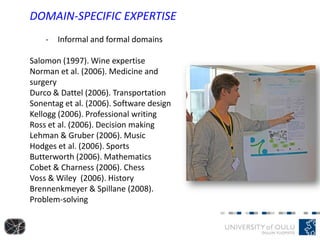
DOMAIN-SPECIFIC EXPERTISE
- Informal and formal domains
Salomon (1997). Wine expertise
Norman et al. (2006). Medicine and
surgery
Durco & Dattel (2006). Transportation
Sonentag et al. (2006). Software design
Kellogg (2006). Professional writing
Ross et al. (2006). Decision making
Lehman & Gruber (2006). Music
Hodges et al. (2006). Sports
Butterworth (2006). Mathematics
Cobet & Charness (2006). Chess
Voss & Wiley (2006). History
Brennenkmeyer & Spillane (2008).
Problem-solving
GENERATING THE BEST
- Find the best solution
DETECTION and
RECOGNITION
- Detect and perceive
features that novices
cannot
QUALITATIVE ANALYSIS
-Analyse problems,
develope problem
representations
EXPERTS can EXCELL (Chi, 2006)
MONITORING & REFLECTING
- Have good self-monitoring
and predicting skills
STRATEGIES
- Use the best and effective
strategies in a given situation
OPPORTUNISTIC
- Can use whatever sources
of information that are
available
COGNITIVE EFFORT
Can retrieve relevant domain
knowledge
DOMAIN-LIMITED
- Have not necessarily
knowledge about other
domains
OVERTLY CONFIDENT
- eg. in music and physics
GLOSSING OVER
- Sometimes they overlook
details
CONTEXT-DEPENDENT WITHIN
A DOMAIN
- Sometimes they rely too much
for contextual cues
EXPERTS may FALL SHORT (Chi, 2006)
INFLEXIBLE
INACCURATE PREDICTION,
JUDGMENT AND ADVICE
- Cannot always take the
perspectives of novices
BIAS AND FUNCTIONAL
FIXEDNESS
- Analyse problems in other
domain through the
priciples of their own
domain
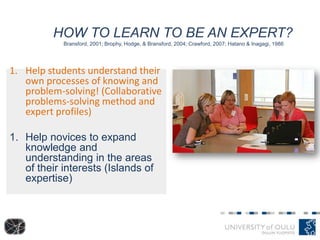
HOW TO LEARN TO BE AN EXPERT?
Bransford, 2001; Brophy, Hodge, & Bransford, 2004; Crawford, 2007; Hatano & Inagagi, 1986
1. Help students understand their
own processes of knowing and
problem-solving! (Collaborative
problems-solving method and
expert profiles)
1. Help novices to expand
knowledge and
understanding in the areas
of their interests (Islands of
expertise)
ISLANDS OF EXPERTISE
Help novices to expand
knowledge and understanding
in the areas of their interests
30.9.2013 12© pirkko.hyvonen@oulu.fi
ISLANDS OF EXPERTISE
(Crowley & Jacobs, 2002; Palmquist & Crowley, 2007)
• Children and adult novices can develope knowledge
constructions and deep understanding of phenomena, which
they are personally and deeply interested in, and they are
motivated to learn more (Chi & Koeske, 1983,).
Where people find problems that lead to interest; where the
interest comes from; what is the first touch towards area of
interest? How interests starts, developes and grows? How does
it maintain? Do it transform?
(Anke Grotlüschen, University of Hamburg)
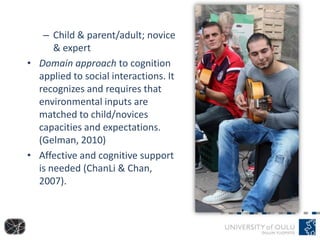
– Child & parent/adult; novice
& expert
• Domain approach to cognition
applied to social interactions. It
recognizes and requires that
environmental inputs are
matched to child/novices
capacities and expectations.
(Gelman, 2010)
• Affective and cognitive support
is needed (ChanLi & Chan,
2007).
”BUILDING” AN ISLAND (knowledge construction)
”working theories”
 Building is seen as social and cognitive process, where learning
habits are practiced and developed.
 Island is woven throughtout multiple activities, hence
it is essential to be occupied in many ways (negotiating, activities, reading,
teaching, problem-solving, memorising etc.) with the phenomen, learn in
activity, particularly in conversations.
 Abstract and general themes
 Building may continue for weeks, months or years
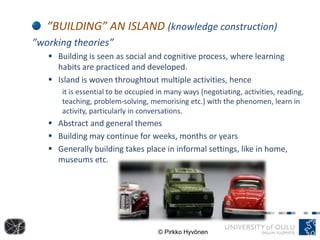
 Generally building takes place in informal settings, like in home,
museums etc.
© Pirkko Hyvönen
YOU ARE NOT ALONE IN THE ISLAND! (learning is
social)
 Construct knowledge and deepen your understanding with other
people by negotiations, explanations and problem-solving situations
in everyday practices.
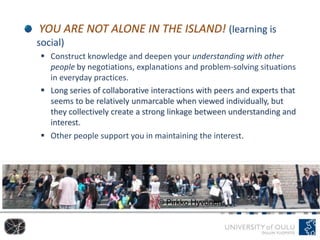
 Long series of collaborative interactions with peers and experts that
seems to be relatively unmarcable when viewed individually, but
they collectively create a strong linkage between understanding and
interest.
 Other people support you in maintaining the interest.
© Pirkko Hyvönen
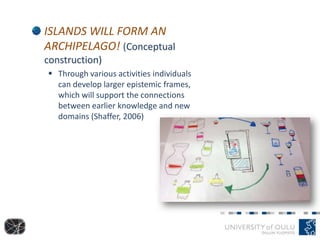
ISLANDS WILL FORM AN
ARCHIPELAGO! (Conceptual
construction)
 Through various activities individuals
can develop larger epistemic frames,
which will support the connections
between earlier knowledge and new
domains (Shaffer, 2006)
18
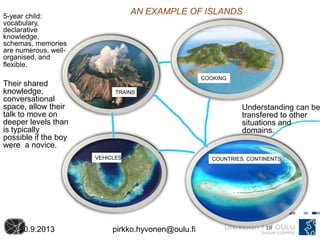
COOKING
COUNTRIES, CONTINENTSVEHICLES
TRAINS
AN EXAMPLE OF ISLANDS5-year child:
vocabulary,
declarative
knowledge,
schemas, memories
are numerous, well-
organised, and
flexible.
Their shared
knowledge,
conversational
space, allow their
talk to move on
deeper levels than
is typically
possible if the boy
were a novice.
30.9.2013 pirkko.hyvonen@oulu.fi
Understanding can be
transfered to other
situations and
domains.
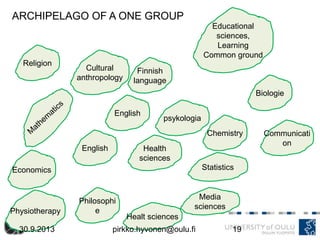
Religion
Healt sciences
Finnish
language
English
Biologie
Statistics
Health
sciences
Chemistry
Educational
sciences,
Learning
Common ground
English
Economics
Philosophi
e
Media
sciences
Cultural
anthropology
Communicati
on
Physiotherapy
ARCHIPELAGO OF A ONE GROUP
psykologia
30.9.2013 pirkko.hyvonen@oulu.fi 19
30.9.2013 pirkko.hyvonen@oulu.fi 20
TASK
Where people find problems that lead to interest; where the
interest comes from; what is the first touch towards area of
interest? How interests starts, developes and grows? How does
it maintain? Do it transform?
Discuss in small groups about your islands and how have they
evolved. During the discussion draw your islands (archipelago)
and write down your thoughts. Complete the texts / pictures in
your blog, dl is 4.10.
1) What is the origin of the interest/s?
2) How did the interest maintain? How did it transfom?
REFERENCES
Chi, M.T.H. & Koeske, R. (1983). Network representation of a child’s
dinosaur knowledge. Developmental Psychology, 19, 29–39.
Crowley, K., & Jacobs, M. (2002). Building islands of expertise in
everyday family activities. In G. Leinhardt, K. Crowley, & K Knutson
(Eds.), Learning conversations in museums (pp. 401–423). Mahwah,
NJ: Lawrence Erlbaum Associates.
Gelman, S.A. (2010). Modules, theories, or islands of expertise?
Domain specifity in socialization. Child Development, 81(3), 715–
719.
Palmquist, S. D. & Crowley, K. (2007). Studying dinosaur learning on
an island of expertise. In R. Goldman, R. Pea, B. Barron, & S. Derry
(Eds.), Video research in the learning sciences (pp. 271–286).
Mahwah, NJ: Erlbaum.
Shaffer, D.W. (2006). Epistemic frames for epistemic games.
Computers & Education, 46, 223–234.30.9.2013 pirkko.hyvonen@oulu.fi 21
References
Alexander, P. A. (2003). The development of expertise: The journey from acclimation to proficiency.
Educational Researcher, 32(8): 10–14.
Bereiter, C. & Scardamalia, M. (1993). Surpassing ourselves. An inquiry into the nature and
implications of expertise. Chicago: Open Court Publishing Company.
Bransford, J. (2001). Thought on adaptive expertise. Retrieved June 15, 2008, from
http://www.vanth.org/docs/AdaptiveExpertise.pdf.
Bransford, J. D., Brown, A. L. & Cocking, R. R. (Eds.) (2000). How people learn: Brain, mind, and
school. Washington: National Academy Press.
http://books.nap.edu/catalog.php?record_id=9853
Brenninkmeyer, L. D. & Spillane, J. P. (2008). Problem-solving processes of experts and typical school
principals: A quantitative look. School Leadership & Management, 28(5), 435–468.
Brophy, S., Hodge, L., & Bransford, J. (2004). Work in progress – Adaptive expertise: Beyond apply
academic knowledge. Frontiers in Education 3 (FIE): S1B/28-
S1B/30, http://ieeexplore.ieee.org/xpl/freeabs_all.jsp?arnumber=1408679.
Chi, M. T. H. (2006). Two approaches to the study of experts’ characteristics. In K. A. Ericsson, N.
Charness, P. J. Feltovich & R. R. Hoffman (Eds.), The Cambridge Handbook of Expertise and Expert
Performance (pp. 21–30). Cambridge: Cambridge University Press.
Chi, M.T.H., Glaser, R., & Rees, E. (1982). Expertise in problem-solving. In R.J. Sternberg (Ed.),
Advances in the psychology of human intelligence (pp. 7–75).
Chi, M. T. H. & Koeske, R. D. (1983). Network representation of a child’s dinosaur knowledge.
Developmental Psychology, 19(1): 29–39.
Crawford, V, M, (2007), Adaptive expertise as knowledge building in science teacher’s problem solving.
Paper accepted for the proceedings of the European Cognitive Science Conference. Delphi, Greece.
Ericsson, K. A. (2006). An introduction to Cambridge handbook of expertise and expert performance: Its
development, organization, and content. In K. A. Ericsson, N. Charness, P. J. Feltovich & R. R.
Hoffman (Eds.), The Cambridge handbook of expertise and expert performance (pp. 3–19). Cambridge:
Cambridge University Press.
Hatano, G. & Inagagi, K. (1986). Two courses of expertise. In H. Stevenson, H. Azuma & K. Hakuta
(Eds.), Child development and education in Japan (pp. 262–272). New York (N.Y.): Freeman.
Hatano, G. & Oura, Y. (2003). Commentary: Reconceptualizing school learning using
insight from expertise research. Educational Researcher, 32(8): 26–29.
Hmelo-Silver, C., Marathe, S. & Liu, L. (2007). Fish swim, rocks sit, and lungs breathe: Expert-novice
understanding of complex systems. The Journal of the Learning Sciences, 16(3), 307 – 331.
Holoyoak, 1991
Johnsson, E. J. (1988). Expertise and decision under uncertainty: Performance and process. In T. H.
Michele, H. Chi, R. Glaser & M. T. Farr (Eds.), The nature of expertise (pp. 209–228). Hillsdale (N.J.):
Lawrence Erlbaum.
Jonassen, D. H. (2007). What makes scientific problems difficult? In D. H. Jonassen (Ed.), Learning to
solve complex scientific problems (pp. 3–23).
Lajoie, S. P. (2003). Transitions and trajectories for studies of expertise. Educational Researcher, 32(8):
21–25.
Lin, X., Schwartz, D.L., & Bransford, J. (2007). Intercultural adaptive expertise: Explicit and implicit
lessons from Dr. Hatano. Human Development, 50, 65–72.
Posner, M. J. (1988). Introduction: What is it to be an expert? In M.T.H. Chi, R. Glaser, & M.J.F. Farr
(Eds.), The nature of expertise (pp. xxix–1). Hillsdale (N.J.): Lawrence Erlbaum .
Tsui, A.B.M. (2009). Distinctive qualities of expert teachers. Teachers and Teaching: Theory and
Practice, 15(4), 421–439.
Weisberg, R. W. (2006). Modes of expertise in creative thinking: Evidence from case studies. In K. A.
Ericsson, N. Charness, P. J. Feltovich & R. R. Hoffman (Eds.), The Cambridge handbook of expertise
and expert performance (Eds.), (pp. 761-787). Cambridge: Cambridge University Press.
Zimmerman, B. J. (2006). Development of adaptation of expertise: The role of self-regulatory processes
and beliefs. In K. A. Ericsson, N. Charness, P. J. Feltovich & R. R. Hoffman (Eds.), The Cambridge
handbook of expertise and expert performance (pp. 705–722). Cambridge: Cambridge University
Press.
Yates and Tschirhart (2007).

Intro expertise 2013

  • 1.
  • 2.
    30.9.2013 pirkko.hyvonen@oulu.fi 2 EXPERTAND EXPERTISE Who is an expert? Why do you think so? What is her/his domain? How experts think and perform? How to become an expert? What is your expertise? Where are you in your expertise?
  • 3.
    BACKGROUND  Universities areexpected to educate experts, who are competent to excel in changing and complex circumstances in work life, but education does not provide competencies for it. (Hyvönen, Impiö, Järvelä, 2010).  ”Normal” learning does not provide expertise, but can lead to ”good enough” or ”satisfying” level (Bereiter & Scardamalia, 1993). Formal education produces the users of experts, but not experts! (Geisler, 1994). Formal education does not nesessarily produce experts, rather experienced non- experts (Bereiter & Scardamalia, 1993).
  • 4.
    STEREOTYPES related toEXPERTISE Gender Age Education Objective truth (Bereiter & Scardamalia, 1993) Expertise is more than general intelligence: ”Capasity to perform consistently at a superior level” (Weisberg, 2006)
  • 5.
    LET AIMS TOEDUCATE EXPERTS IN LEARNING AND EDUCATIONAL TECHNOLOGY. The students will be competent to work in schools and work places and use their expertise in adapting to changing situations, solving problems, creating social innovations and integrating technologies in practices. They know how people learn and behave in various contexts.
  • 6.
    DEFINITIONS IN DICTIONARIES1968- 2011 1968: One who is very skillful and well- informed in some special field (Webster) 2005: Characteristics , skills and knowledge that distinguishes experts from novices and less experienced people (Wikipedia) 2011: person, who in certain domain can recognise problems and solve them efficiently. Expertise includes knowledge, experiences and skills for expressing. (Wikipedia) 1) How experts think; how do they perform? Why? 2) How to learn to be an expert? 3) What is expertise in my field/ in my competence?
  • 7.
    LEARNING EXPERTISE ISA PATH OR JOURNEY OF COMPETENCE BUILDING including also regressions (Alexander, 2003; Bereiter & Scardamalia, 1986; Lajoie, 2003) Learning expertise comprices of three overlapping dimensions:  knowledge construction (Bransford et al, 2000; Sawyer, 2006)  expert-like performance (eg., Bereiter & Scardamalia, 1993; Tynjälä, 2007)  self-regulation (Boekaerts, Pintrich & Zeidner, 2000; Lin, Schwarz & Hatano, 2005)  It is a transitional learning process where goals are set, monitored, reflected and scaffolded (Lajoie, 2003)
  • 8.
    DOMAIN-SPECIFIC EXPERTISE - Informaland formal domains Salomon (1997). Wine expertise Norman et al. (2006). Medicine and surgery Durco & Dattel (2006). Transportation Sonentag et al. (2006). Software design Kellogg (2006). Professional writing Ross et al. (2006). Decision making Lehman & Gruber (2006). Music Hodges et al. (2006). Sports Butterworth (2006). Mathematics Cobet & Charness (2006). Chess Voss & Wiley (2006). History Brennenkmeyer & Spillane (2008). Problem-solving
  • 9.
    GENERATING THE BEST -Find the best solution DETECTION and RECOGNITION - Detect and perceive features that novices cannot QUALITATIVE ANALYSIS -Analyse problems, develope problem representations EXPERTS can EXCELL (Chi, 2006) MONITORING & REFLECTING - Have good self-monitoring and predicting skills STRATEGIES - Use the best and effective strategies in a given situation OPPORTUNISTIC - Can use whatever sources of information that are available COGNITIVE EFFORT Can retrieve relevant domain knowledge
  • 10.
    DOMAIN-LIMITED - Have notnecessarily knowledge about other domains OVERTLY CONFIDENT - eg. in music and physics GLOSSING OVER - Sometimes they overlook details CONTEXT-DEPENDENT WITHIN A DOMAIN - Sometimes they rely too much for contextual cues EXPERTS may FALL SHORT (Chi, 2006) INFLEXIBLE INACCURATE PREDICTION, JUDGMENT AND ADVICE - Cannot always take the perspectives of novices BIAS AND FUNCTIONAL FIXEDNESS - Analyse problems in other domain through the priciples of their own domain
  • 11.
    HOW TO LEARNTO BE AN EXPERT? Bransford, 2001; Brophy, Hodge, & Bransford, 2004; Crawford, 2007; Hatano & Inagagi, 1986 1. Help students understand their own processes of knowing and problem-solving! (Collaborative problems-solving method and expert profiles) 1. Help novices to expand knowledge and understanding in the areas of their interests (Islands of expertise)
  • 12.
    ISLANDS OF EXPERTISE Helpnovices to expand knowledge and understanding in the areas of their interests 30.9.2013 12© pirkko.hyvonen@oulu.fi
  • 13.
    ISLANDS OF EXPERTISE (Crowley& Jacobs, 2002; Palmquist & Crowley, 2007) • Children and adult novices can develope knowledge constructions and deep understanding of phenomena, which they are personally and deeply interested in, and they are motivated to learn more (Chi & Koeske, 1983,). Where people find problems that lead to interest; where the interest comes from; what is the first touch towards area of interest? How interests starts, developes and grows? How does it maintain? Do it transform? (Anke Grotlüschen, University of Hamburg)
  • 14.
    – Child &parent/adult; novice & expert • Domain approach to cognition applied to social interactions. It recognizes and requires that environmental inputs are matched to child/novices capacities and expectations. (Gelman, 2010) • Affective and cognitive support is needed (ChanLi & Chan, 2007).
  • 15.
    ”BUILDING” AN ISLAND(knowledge construction) ”working theories”  Building is seen as social and cognitive process, where learning habits are practiced and developed.  Island is woven throughtout multiple activities, hence it is essential to be occupied in many ways (negotiating, activities, reading, teaching, problem-solving, memorising etc.) with the phenomen, learn in activity, particularly in conversations.  Abstract and general themes  Building may continue for weeks, months or years  Generally building takes place in informal settings, like in home, museums etc. © Pirkko Hyvönen
  • 16.
    YOU ARE NOTALONE IN THE ISLAND! (learning is social)  Construct knowledge and deepen your understanding with other people by negotiations, explanations and problem-solving situations in everyday practices.  Long series of collaborative interactions with peers and experts that seems to be relatively unmarcable when viewed individually, but they collectively create a strong linkage between understanding and interest.  Other people support you in maintaining the interest. © Pirkko Hyvönen
  • 17.
    ISLANDS WILL FORMAN ARCHIPELAGO! (Conceptual construction)  Through various activities individuals can develop larger epistemic frames, which will support the connections between earlier knowledge and new domains (Shaffer, 2006)
  • 18.
    18 COOKING COUNTRIES, CONTINENTSVEHICLES TRAINS AN EXAMPLEOF ISLANDS5-year child: vocabulary, declarative knowledge, schemas, memories are numerous, well- organised, and flexible. Their shared knowledge, conversational space, allow their talk to move on deeper levels than is typically possible if the boy were a novice. 30.9.2013 pirkko.hyvonen@oulu.fi Understanding can be transfered to other situations and domains.
  • 19.
  • 20.
    30.9.2013 pirkko.hyvonen@oulu.fi 20 TASK Wherepeople find problems that lead to interest; where the interest comes from; what is the first touch towards area of interest? How interests starts, developes and grows? How does it maintain? Do it transform? Discuss in small groups about your islands and how have they evolved. During the discussion draw your islands (archipelago) and write down your thoughts. Complete the texts / pictures in your blog, dl is 4.10. 1) What is the origin of the interest/s? 2) How did the interest maintain? How did it transfom?
  • 21.
    REFERENCES Chi, M.T.H. &Koeske, R. (1983). Network representation of a child’s dinosaur knowledge. Developmental Psychology, 19, 29–39. Crowley, K., & Jacobs, M. (2002). Building islands of expertise in everyday family activities. In G. Leinhardt, K. Crowley, & K Knutson (Eds.), Learning conversations in museums (pp. 401–423). Mahwah, NJ: Lawrence Erlbaum Associates. Gelman, S.A. (2010). Modules, theories, or islands of expertise? Domain specifity in socialization. Child Development, 81(3), 715– 719. Palmquist, S. D. & Crowley, K. (2007). Studying dinosaur learning on an island of expertise. In R. Goldman, R. Pea, B. Barron, & S. Derry (Eds.), Video research in the learning sciences (pp. 271–286). Mahwah, NJ: Erlbaum. Shaffer, D.W. (2006). Epistemic frames for epistemic games. Computers & Education, 46, 223–234.30.9.2013 pirkko.hyvonen@oulu.fi 21
  • 22.
    References Alexander, P. A.(2003). The development of expertise: The journey from acclimation to proficiency. Educational Researcher, 32(8): 10–14. Bereiter, C. & Scardamalia, M. (1993). Surpassing ourselves. An inquiry into the nature and implications of expertise. Chicago: Open Court Publishing Company. Bransford, J. (2001). Thought on adaptive expertise. Retrieved June 15, 2008, from http://www.vanth.org/docs/AdaptiveExpertise.pdf. Bransford, J. D., Brown, A. L. & Cocking, R. R. (Eds.) (2000). How people learn: Brain, mind, and school. Washington: National Academy Press. http://books.nap.edu/catalog.php?record_id=9853 Brenninkmeyer, L. D. & Spillane, J. P. (2008). Problem-solving processes of experts and typical school principals: A quantitative look. School Leadership & Management, 28(5), 435–468. Brophy, S., Hodge, L., & Bransford, J. (2004). Work in progress – Adaptive expertise: Beyond apply academic knowledge. Frontiers in Education 3 (FIE): S1B/28- S1B/30, http://ieeexplore.ieee.org/xpl/freeabs_all.jsp?arnumber=1408679. Chi, M. T. H. (2006). Two approaches to the study of experts’ characteristics. In K. A. Ericsson, N. Charness, P. J. Feltovich & R. R. Hoffman (Eds.), The Cambridge Handbook of Expertise and Expert Performance (pp. 21–30). Cambridge: Cambridge University Press. Chi, M.T.H., Glaser, R., & Rees, E. (1982). Expertise in problem-solving. In R.J. Sternberg (Ed.), Advances in the psychology of human intelligence (pp. 7–75). Chi, M. T. H. & Koeske, R. D. (1983). Network representation of a child’s dinosaur knowledge. Developmental Psychology, 19(1): 29–39. Crawford, V, M, (2007), Adaptive expertise as knowledge building in science teacher’s problem solving. Paper accepted for the proceedings of the European Cognitive Science Conference. Delphi, Greece. Ericsson, K. A. (2006). An introduction to Cambridge handbook of expertise and expert performance: Its development, organization, and content. In K. A. Ericsson, N. Charness, P. J. Feltovich & R. R. Hoffman (Eds.), The Cambridge handbook of expertise and expert performance (pp. 3–19). Cambridge: Cambridge University Press.
  • 23.
    Hatano, G. &Inagagi, K. (1986). Two courses of expertise. In H. Stevenson, H. Azuma & K. Hakuta (Eds.), Child development and education in Japan (pp. 262–272). New York (N.Y.): Freeman. Hatano, G. & Oura, Y. (2003). Commentary: Reconceptualizing school learning using insight from expertise research. Educational Researcher, 32(8): 26–29. Hmelo-Silver, C., Marathe, S. & Liu, L. (2007). Fish swim, rocks sit, and lungs breathe: Expert-novice understanding of complex systems. The Journal of the Learning Sciences, 16(3), 307 – 331. Holoyoak, 1991 Johnsson, E. J. (1988). Expertise and decision under uncertainty: Performance and process. In T. H. Michele, H. Chi, R. Glaser & M. T. Farr (Eds.), The nature of expertise (pp. 209–228). Hillsdale (N.J.): Lawrence Erlbaum. Jonassen, D. H. (2007). What makes scientific problems difficult? In D. H. Jonassen (Ed.), Learning to solve complex scientific problems (pp. 3–23). Lajoie, S. P. (2003). Transitions and trajectories for studies of expertise. Educational Researcher, 32(8): 21–25. Lin, X., Schwartz, D.L., & Bransford, J. (2007). Intercultural adaptive expertise: Explicit and implicit lessons from Dr. Hatano. Human Development, 50, 65–72. Posner, M. J. (1988). Introduction: What is it to be an expert? In M.T.H. Chi, R. Glaser, & M.J.F. Farr (Eds.), The nature of expertise (pp. xxix–1). Hillsdale (N.J.): Lawrence Erlbaum . Tsui, A.B.M. (2009). Distinctive qualities of expert teachers. Teachers and Teaching: Theory and Practice, 15(4), 421–439. Weisberg, R. W. (2006). Modes of expertise in creative thinking: Evidence from case studies. In K. A. Ericsson, N. Charness, P. J. Feltovich & R. R. Hoffman (Eds.), The Cambridge handbook of expertise and expert performance (Eds.), (pp. 761-787). Cambridge: Cambridge University Press. Zimmerman, B. J. (2006). Development of adaptation of expertise: The role of self-regulatory processes and beliefs. In K. A. Ericsson, N. Charness, P. J. Feltovich & R. R. Hoffman (Eds.), The Cambridge handbook of expertise and expert performance (pp. 705–722). Cambridge: Cambridge University Press. Yates and Tschirhart (2007).

Editor's Notes

  • #4 Normallearningcanreachsatisfyingbasiclevel. Thenit is possible to freementalresources in order to usethem for higherlevelactivities (in knowledgeconstruction, skills and self-regulation)
  • #12 Informal and formalenvironments
  • #14 Children / adultNovice / expert
  • #15 Nature of social interactionfromnovices and expert’sperspective
  • #18 Epistemicframescanbeseen as a transfer (moreSchaffer, 2006) Transfer