Module 2
Primitive and Evolved Brain
Human
Development
and Evolution
of the Brain
• There is a great deal of evidence that we humans
slowly ascended from lower life forms to what we
are today, by way of the evolutionary impulse – the
energy and intelligence that gave rise to the
universe and is animating our bodies, minds, and
personalities in this very moment. Each
evolutionary change had to prove it’s worth by
surviving the continual battle for existence and this
process has gone on since the cosmos was created
out of ‘nothing’ – since the very beginning of time.
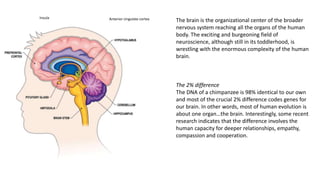
Anterior cingulate cortex
Insula
The brain is the organizational center of the broader
nervous system reaching all the organs of the human
body. The exciting and burgeoning field of
neuroscience, although still in its toddlerhood, is
wrestling with the enormous complexity of the human
brain.
The 2% difference
The DNA of a chimpanzee is 98% identical to our own
and most of the crucial 2% difference codes genes for
our brain. In other words, most of human evolution is
about one organ…the brain. Interestingly, some recent
research indicates that the difference involves the
human capacity for deeper relationships, empathy,
compassion and cooperation.
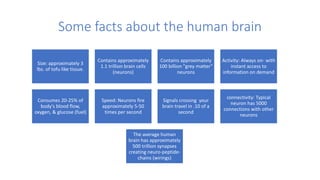
Some facts about the human brain
Size: approximately 3
lbs. of tofu like tissue.
Contains approximately
1.1 trillion brain cells
(neurons)
Contains approximately
100 billion "grey matter"
neurons
Activity: Always on- with
instant access to
information on demand
Consumes 20-25% of
body's blood flow,
oxygen, & glucose (fuel)
Speed: Neurons fire
approximately 5-50
times per second
Signals crossing your
brain travel in .10 of a
second
connectivity: Typical
neuron has 5000
connections with other
neurons
The average human
brain has approximately
500 trillion synapses
creating neuro-peptide-
chains (wirings)
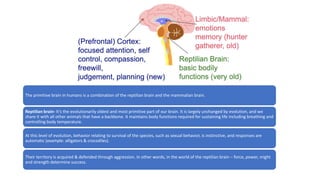
The primitive brain in humans is a combination of the reptilian brain and the mammalian brain.
Reptilian brain- It’s the evolutionarily oldest and most primitive part of our brain. It is largely unchanged by evolution, and we
share it with all other animals that have a backbone. It maintains body functions required for sustaining life including breathing and
controlling body temperature.
At this level of evolution, behavior relating to survival of the species, such as sexual behavior, is instinctive, and responses are
automatic (example: alligators & crocodiles).
Their territory is acquired & defended through aggression. In other words, in the world of the reptilian brain – force, power, might
and strength determine success.
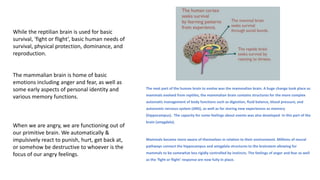
The next part of the human brain to evolve was the mammalian brain. A huge change took place as
mammals evolved from reptiles, the mammalian brain contains structures for the more complex
automatic management of body functions such as digestion, fluid balance, blood pressure, and
autonomic nervous system (ANS), as well as for storing new experiences as memory
(hippocampus). The capacity for some feelings about events was also developed in this part of the
brain (amygdala).
Mammals became more aware of themselves in relation to their environment. Millions of neural
pathways connect the hippocampus and amygdala structures to the brainstem allowing for
mammals to be somewhat less rigidly controlled by instincts. The feelings of anger and fear as well
as the ‘fight or flight’ response are now fully in place.
While the reptilian brain is used for basic
survival, ‘fight or flight’, basic human needs of
survival, physical protection, dominance, and
reproduction.
The mammalian brain is home of basic
emotions including anger and fear, as well as
some early aspects of personal identity and
various memory functions.
When we are angry, we are functioning out of
our primitive brain. We automatically &
impulsively react to punish, hurt, get back at,
or somehow be destructive to whoever is the
focus of our angry feelings.
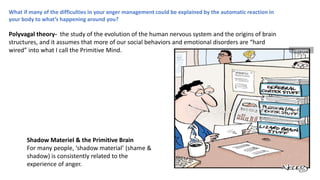
What if many of the difficulties in your anger management could be explained by the automatic reaction in
your body to what’s happening around you?
Polyvagal theory- the study of the evolution of the human nervous system and the origins of brain
structures, and it assumes that more of our social behaviors and emotional disorders are “hard
wired” into what I call the Primitive Mind.
Shadow Materiel & the Primitive Brain
For many people, ‘shadow material’ (shame &
shadow) is consistently related to the
experience of anger.
Can you think of time when you were functioning out of the
primitive brain?
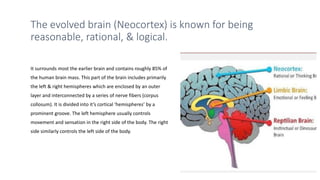
The evolved brain (Neocortex) is known for being
reasonable, rational, & logical.
It surrounds most the earlier brain and contains roughly 85% of
the human brain mass. This part of the brain includes primarily
the left & right hemispheres which are enclosed by an outer
layer and interconnected by a series of nerve fibers (corpus
collosum). It is divided into it’s cortical ‘hemispheres’ by a
prominent groove. The left hemisphere usually controls
movement and sensation in the right side of the body. The right
side similarly controls the left side of the body.
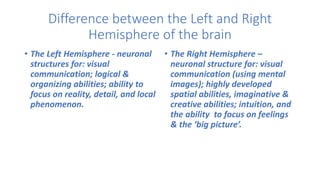
Difference between the Left and Right
Hemisphere of the brain
• The Left Hemisphere - neuronal
structures for: visual
communication; logical &
organizing abilities; ability to
focus on reality, detail, and local
phenomenon.
• The Right Hemisphere –
neuronal structure for: visual
communication (using mental
images); highly developed
spatial abilities, imaginative &
creative abilities; intuition, and
the ability to focus on feelings
& the ‘big picture’.
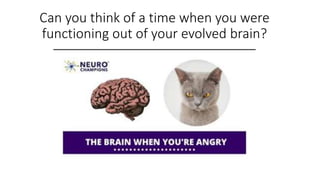
Can you think of a time when you were
functioning out of your evolved brain?
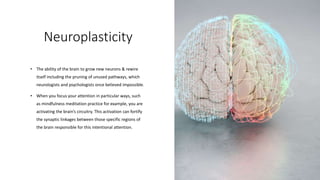
Neuroplasticity
• The ability of the brain to grow new neurons & rewire
itself including the pruning of unused pathways, which
neurologists and psychologists once believed impossible.
• When you focus your attention in particular ways, such
as mindfulness meditation practice for example, you are
activating the brain’s circuitry. This activation can fortify
the synaptic linkages between those specific regions of
the brain responsible for this intentional attention.
The 7 Conditions
Anxiety – complex combination of
fear, apprehension, and worry,
often accompanied by
uncomfortable physical
sensations.
Stress – A term for a wide range
of strong external stimuli, both
physical and psychological.
Drugs – Any substance that can
be used to modify a chemical
process in the body, for example
to treat an illness, relieve a
symptom, enhance a
performance or ability, or to alter
states of mind.
Alcohol – Almost always ethanol,
also known as grain alcohol, and
to any beverage that contains
ethanol.
Tired – Feeling of excessive
fatigue or lethargy, with a desire
to rest, perhaps t sleep.
Hungry – Applied literally to the
need or craving for food.
Sick or Ill – An actual physical,
pathophysiological process which
may cause an abnormal condition
of the body or mind.
The Big Question
• What do I need right now to be
OK, and to be healthy in the
long term?
*Homework: Anger Log

module 2.pptx

  • 1.
  • 2.
    Human Development and Evolution of theBrain • There is a great deal of evidence that we humans slowly ascended from lower life forms to what we are today, by way of the evolutionary impulse – the energy and intelligence that gave rise to the universe and is animating our bodies, minds, and personalities in this very moment. Each evolutionary change had to prove it’s worth by surviving the continual battle for existence and this process has gone on since the cosmos was created out of ‘nothing’ – since the very beginning of time.
  • 3.
    Anterior cingulate cortex Insula Thebrain is the organizational center of the broader nervous system reaching all the organs of the human body. The exciting and burgeoning field of neuroscience, although still in its toddlerhood, is wrestling with the enormous complexity of the human brain. The 2% difference The DNA of a chimpanzee is 98% identical to our own and most of the crucial 2% difference codes genes for our brain. In other words, most of human evolution is about one organ…the brain. Interestingly, some recent research indicates that the difference involves the human capacity for deeper relationships, empathy, compassion and cooperation.
  • 4.
    Some facts aboutthe human brain Size: approximately 3 lbs. of tofu like tissue. Contains approximately 1.1 trillion brain cells (neurons) Contains approximately 100 billion "grey matter" neurons Activity: Always on- with instant access to information on demand Consumes 20-25% of body's blood flow, oxygen, & glucose (fuel) Speed: Neurons fire approximately 5-50 times per second Signals crossing your brain travel in .10 of a second connectivity: Typical neuron has 5000 connections with other neurons The average human brain has approximately 500 trillion synapses creating neuro-peptide- chains (wirings)
  • 5.
    The primitive brainin humans is a combination of the reptilian brain and the mammalian brain. Reptilian brain- It’s the evolutionarily oldest and most primitive part of our brain. It is largely unchanged by evolution, and we share it with all other animals that have a backbone. It maintains body functions required for sustaining life including breathing and controlling body temperature. At this level of evolution, behavior relating to survival of the species, such as sexual behavior, is instinctive, and responses are automatic (example: alligators & crocodiles). Their territory is acquired & defended through aggression. In other words, in the world of the reptilian brain – force, power, might and strength determine success.
  • 6.
    The next partof the human brain to evolve was the mammalian brain. A huge change took place as mammals evolved from reptiles, the mammalian brain contains structures for the more complex automatic management of body functions such as digestion, fluid balance, blood pressure, and autonomic nervous system (ANS), as well as for storing new experiences as memory (hippocampus). The capacity for some feelings about events was also developed in this part of the brain (amygdala). Mammals became more aware of themselves in relation to their environment. Millions of neural pathways connect the hippocampus and amygdala structures to the brainstem allowing for mammals to be somewhat less rigidly controlled by instincts. The feelings of anger and fear as well as the ‘fight or flight’ response are now fully in place. While the reptilian brain is used for basic survival, ‘fight or flight’, basic human needs of survival, physical protection, dominance, and reproduction. The mammalian brain is home of basic emotions including anger and fear, as well as some early aspects of personal identity and various memory functions. When we are angry, we are functioning out of our primitive brain. We automatically & impulsively react to punish, hurt, get back at, or somehow be destructive to whoever is the focus of our angry feelings.
  • 7.
    What if manyof the difficulties in your anger management could be explained by the automatic reaction in your body to what’s happening around you? Polyvagal theory- the study of the evolution of the human nervous system and the origins of brain structures, and it assumes that more of our social behaviors and emotional disorders are “hard wired” into what I call the Primitive Mind. Shadow Materiel & the Primitive Brain For many people, ‘shadow material’ (shame & shadow) is consistently related to the experience of anger.
  • 9.
    Can you thinkof time when you were functioning out of the primitive brain?
  • 10.
    The evolved brain(Neocortex) is known for being reasonable, rational, & logical. It surrounds most the earlier brain and contains roughly 85% of the human brain mass. This part of the brain includes primarily the left & right hemispheres which are enclosed by an outer layer and interconnected by a series of nerve fibers (corpus collosum). It is divided into it’s cortical ‘hemispheres’ by a prominent groove. The left hemisphere usually controls movement and sensation in the right side of the body. The right side similarly controls the left side of the body.
  • 11.
    Difference between theLeft and Right Hemisphere of the brain • The Left Hemisphere - neuronal structures for: visual communication; logical & organizing abilities; ability to focus on reality, detail, and local phenomenon. • The Right Hemisphere – neuronal structure for: visual communication (using mental images); highly developed spatial abilities, imaginative & creative abilities; intuition, and the ability to focus on feelings & the ‘big picture’.
  • 12.
    Can you thinkof a time when you were functioning out of your evolved brain?
  • 13.
    Neuroplasticity • The abilityof the brain to grow new neurons & rewire itself including the pruning of unused pathways, which neurologists and psychologists once believed impossible. • When you focus your attention in particular ways, such as mindfulness meditation practice for example, you are activating the brain’s circuitry. This activation can fortify the synaptic linkages between those specific regions of the brain responsible for this intentional attention.
  • 14.
    The 7 Conditions Anxiety– complex combination of fear, apprehension, and worry, often accompanied by uncomfortable physical sensations. Stress – A term for a wide range of strong external stimuli, both physical and psychological. Drugs – Any substance that can be used to modify a chemical process in the body, for example to treat an illness, relieve a symptom, enhance a performance or ability, or to alter states of mind. Alcohol – Almost always ethanol, also known as grain alcohol, and to any beverage that contains ethanol. Tired – Feeling of excessive fatigue or lethargy, with a desire to rest, perhaps t sleep. Hungry – Applied literally to the need or craving for food. Sick or Ill – An actual physical, pathophysiological process which may cause an abnormal condition of the body or mind.
  • 15.
    The Big Question •What do I need right now to be OK, and to be healthy in the long term? *Homework: Anger Log