INTRAMEDULLARY TUMOR WITH ENHANCING NODULE  Approach towards IntramedullarytumorsCASE HAEMANGIOBLASTOMAMERCURY IMAGING INSTITUTE SCO 172-173 SEC 9C  CHANDIGARHMERCURY IMAGING CENTRE SCO 16-17 SEC 20D CHANDIGARH
INTRAMEDULLARY NEOPLASMSTYPES Glialtumors :EpendymomaAstrocytomaGangliogliomaNon glialtumors :HaemangioblastomaLymphoma Metastasis . Some points to remember ....Define Central / eccentric location.Comment on adjacent cord                                         ( Edema, expansion)Look  for Intratumoral cysts ( usuallymalignant –should be rescected)Look for Peritumoral cysts  ( Donot carry the malignancy – Can be left ) Cap sign –Lesions with tendency to haemorrhage have hypointense rim / peripheral border due to haemosiderin( ependymoma , astrocytoma)Salt and pepper – Appreciated in paraganglioma .
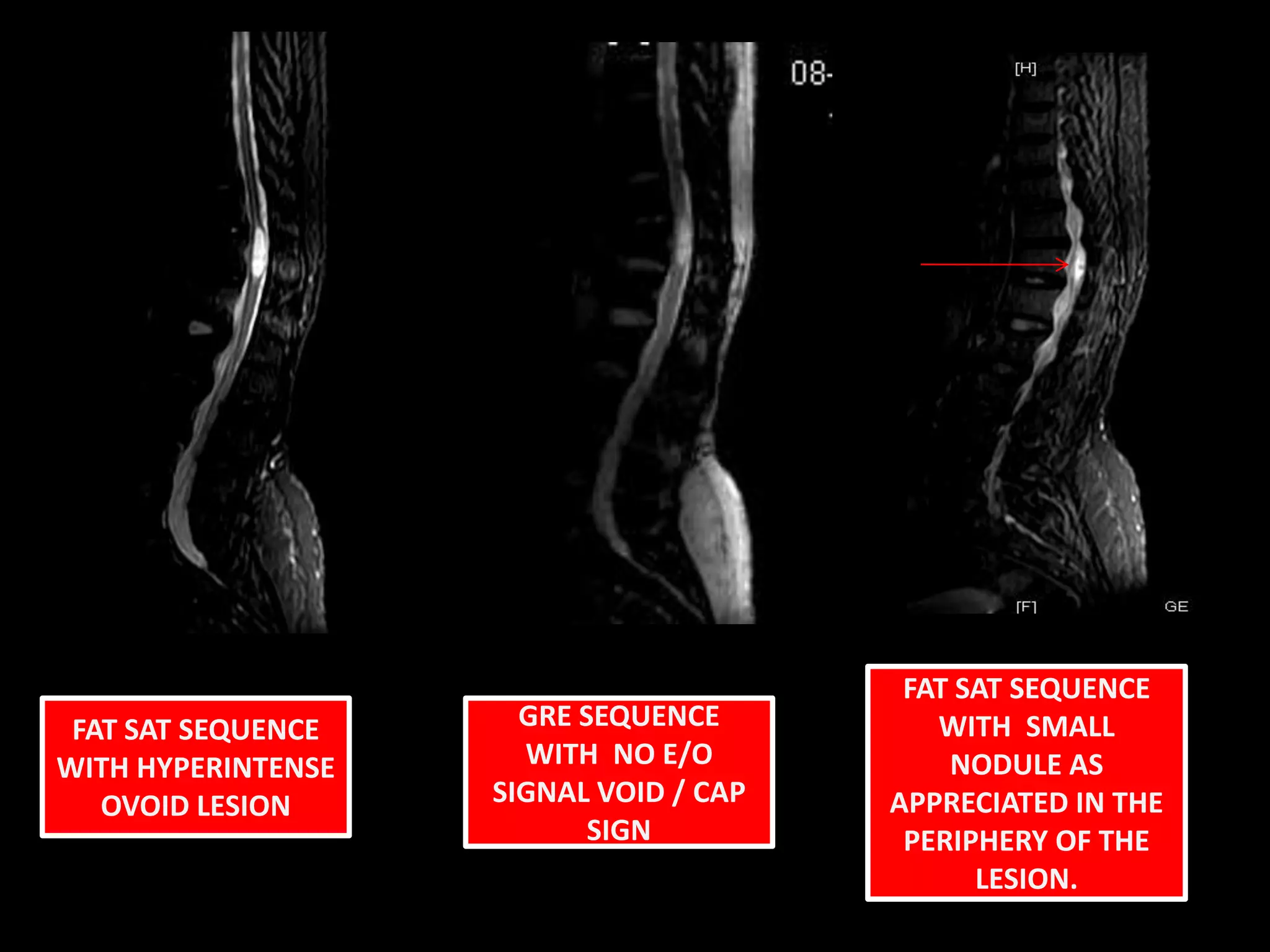
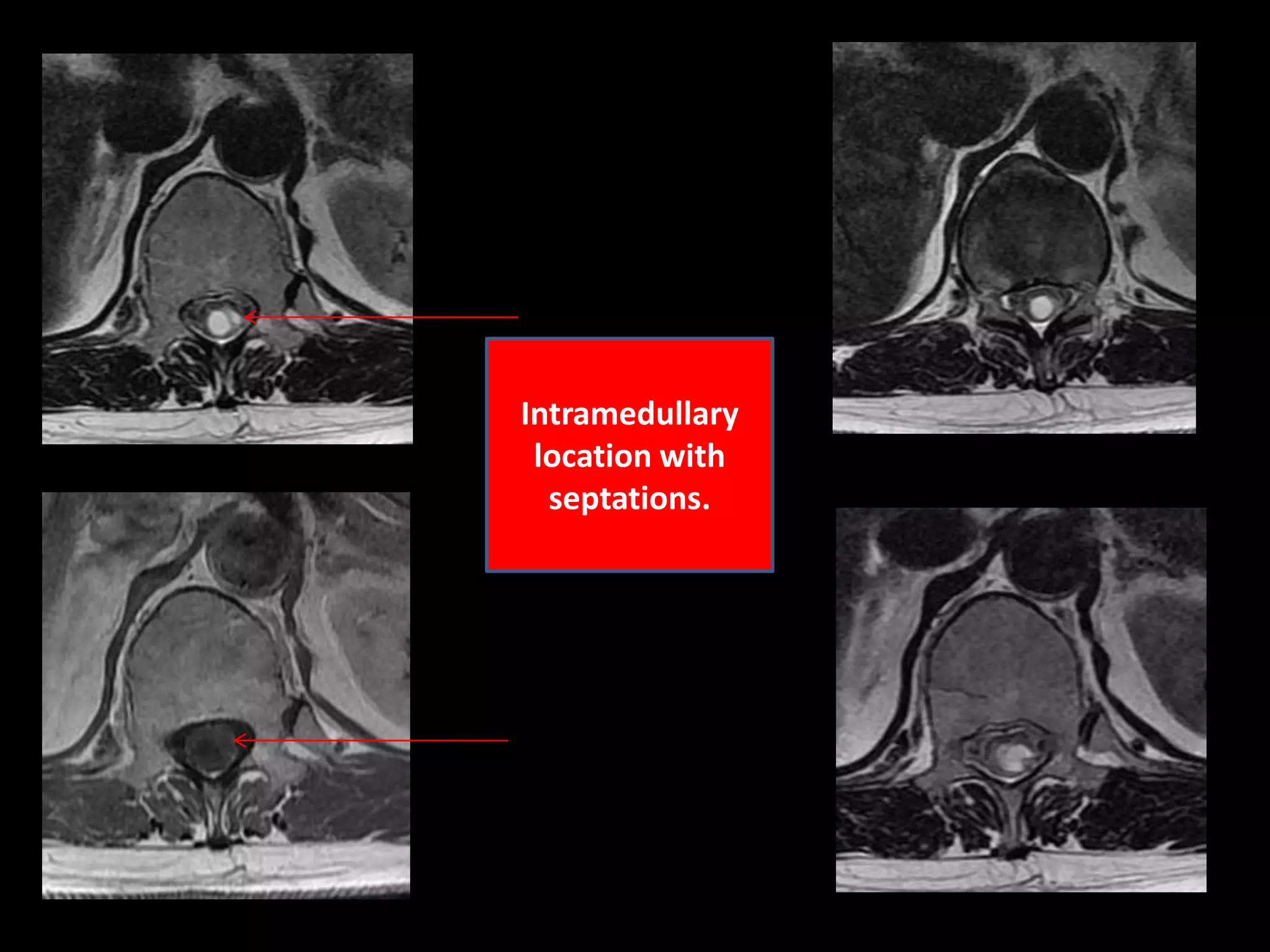
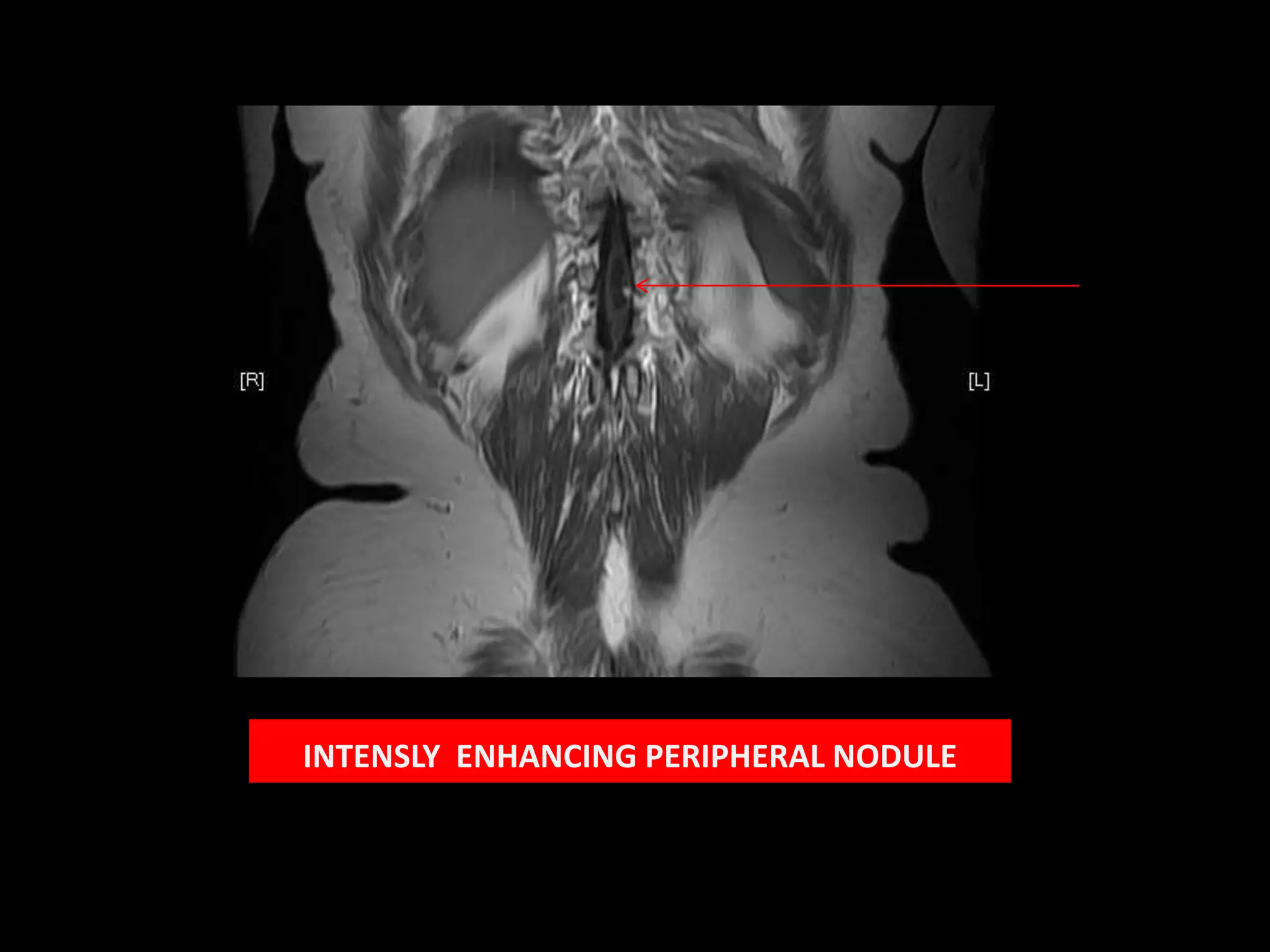
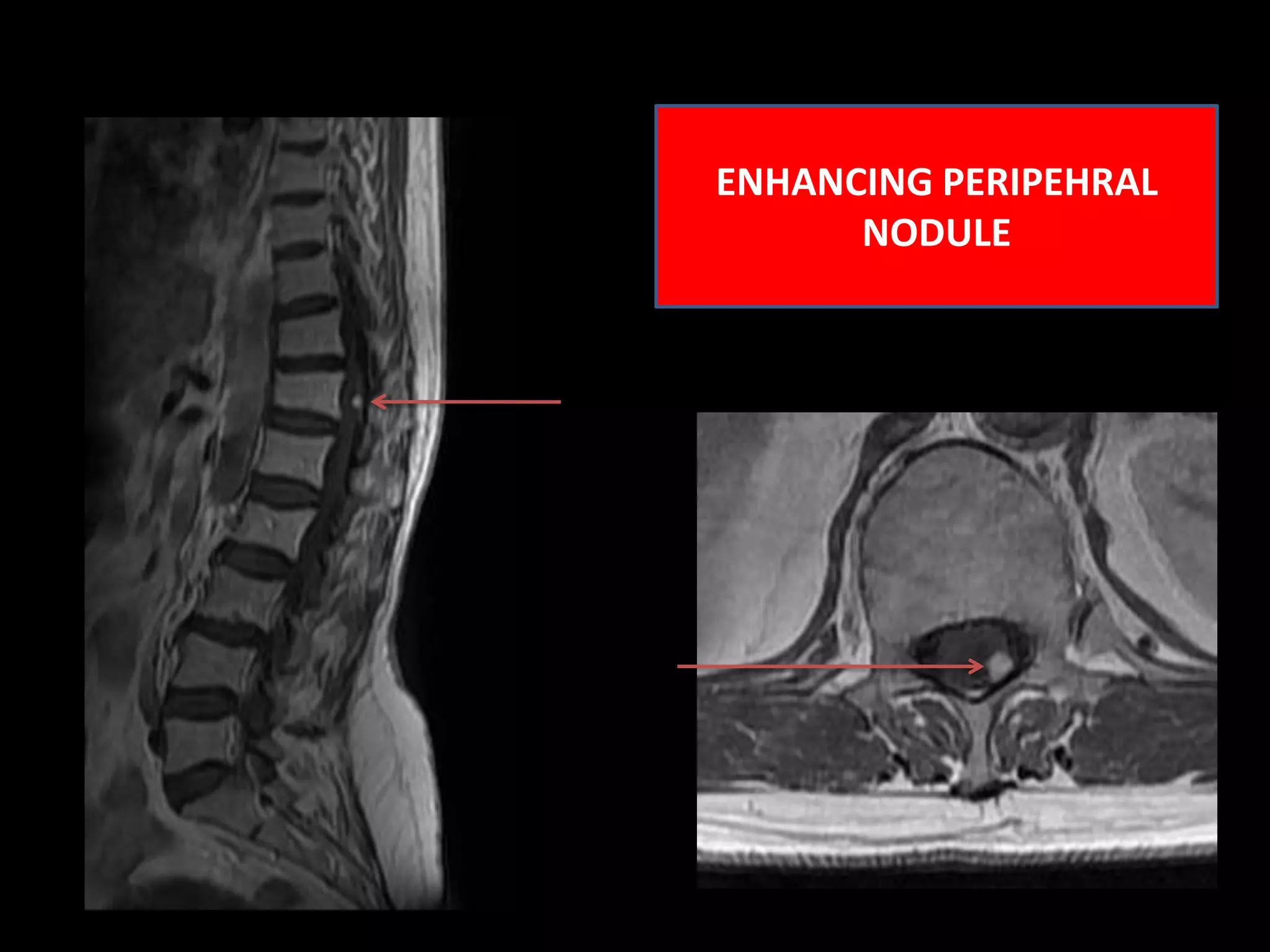
Case 158 Year old female with sensory and motor complaints pertaining to lower extremity with worsening for last one year. MR Images – Intramedullary cystic lesion ( size 28mmx 08mmx 08mm ) with septations and solitary intensely enhancing tumor nodule is appreciated in the lower dorsal region.                                  Important negative findings are :No cap sign appreciated. No signal voids appreciated .No associated syrinx .No Intratumoral cysts /Peritumoral cysts .No pathological enhancement elsewhere in the tumor.
FAT SAT SEQUENCE WITH  SMALL NODULE AS APPRECIATED IN THE PERIPHERY OF THE LESION.FAT SAT SEQUENCE WITH HYPERINTENSE OVOID LESIONGRE SEQUENCE WITH  NO E/O SIGNAL VOID / CAP SIGN
Intramedullary location with septations.
INTENSLY  ENHANCING PERIPHERAL NODULE
ENHANCING PERIPEHRAL NODULE
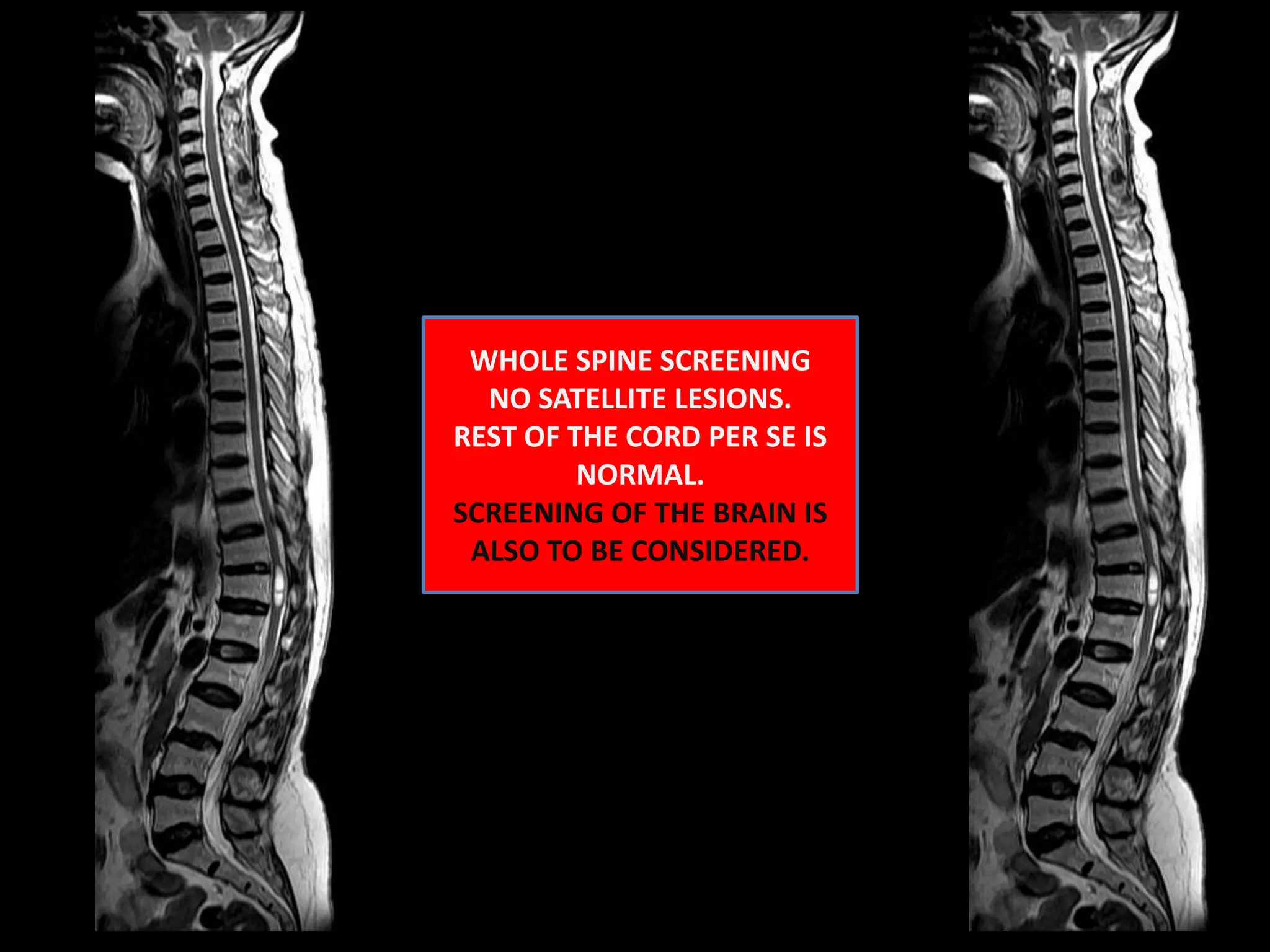
WHOLE SPINE SCREENING NO SATELLITE LESIONS.REST OF THE CORD PER SE IS NORMAL.SCREENING OF THE BRAIN IS ALSO TO BE CONSIDERED.
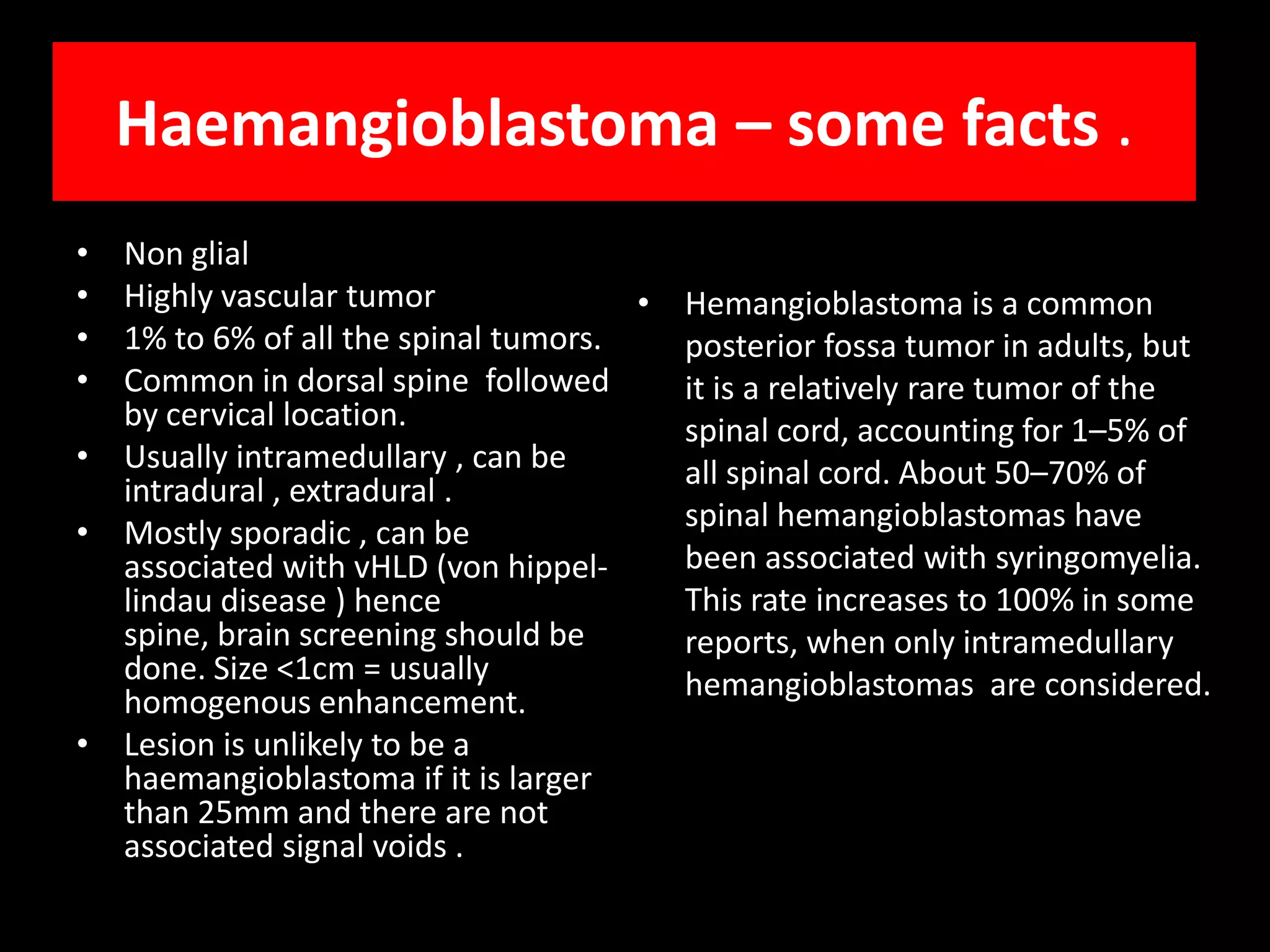
Haemangioblastoma – some facts .Non glialHighly vascular tumor1% to 6% of all the spinal tumors.Common in dorsal spine  followed  by cervical location.Usually intramedullary , can be intradural , extradural .Mostly sporadic , can be associated with vHLD (von hippel-lindau disease ) hence spine, brain screening should be done. Size <1cm = usually homogenous enhancement.Lesion is unlikely to be a haemangioblastoma if it is larger than 25mm and there are not associated signal voids .Hemangioblastomais a common posterior fossatumor in adults, but it is a relatively rare tumor of the spinal cord, accounting for 1–5% of all spinal cord. About 50–70% of spinal hemangioblastomas have been associated with syringomyelia. This rate increases to 100% in some reports, when only intramedullaryhemangioblastomas  are considered.
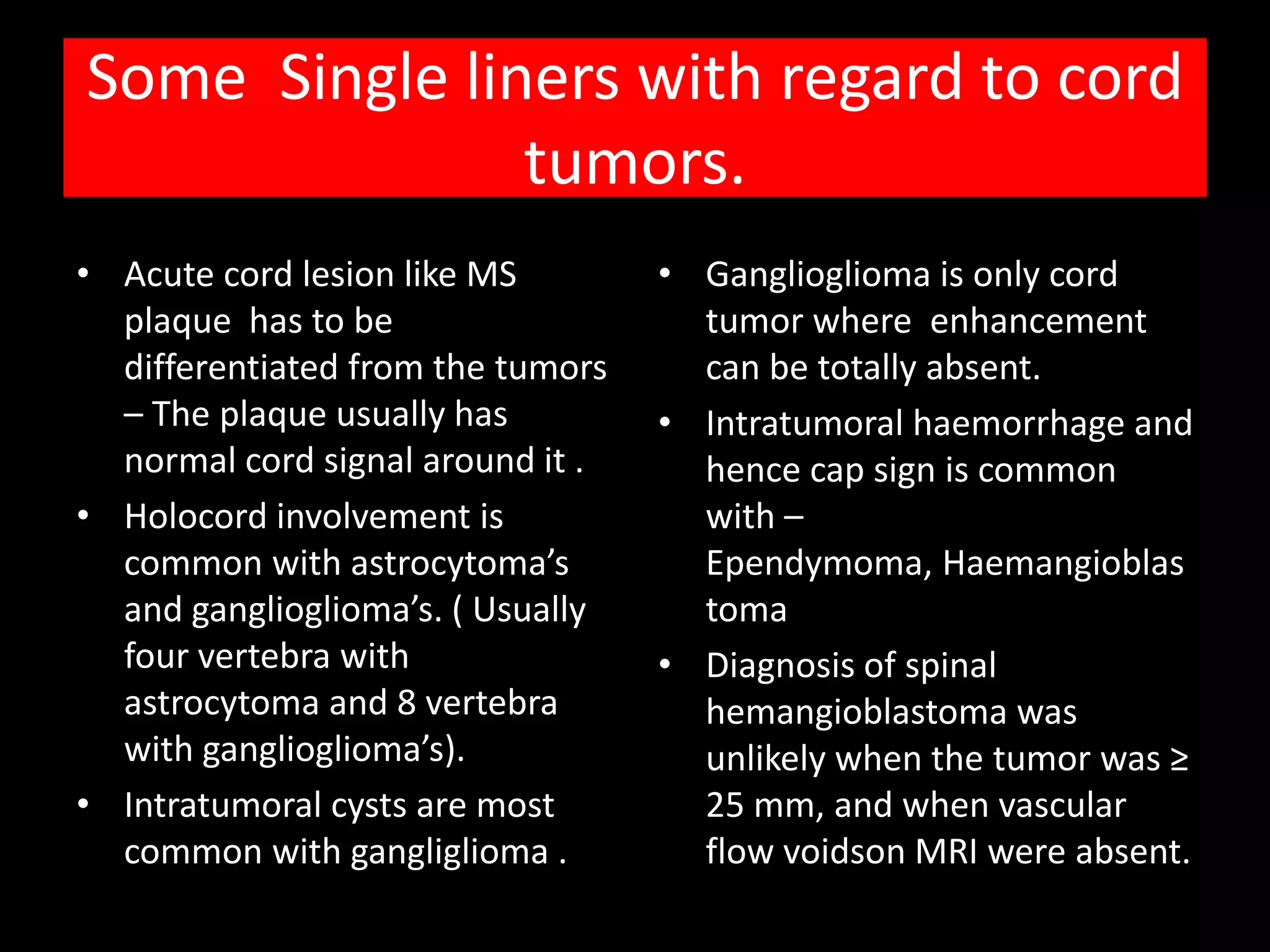
Some  Single liners with regard to cord tumors.Acute cord lesion like MS plaque  has to be differentiated from the tumors – The plaque usually has normal cord signal around it .Holocord involvement is common with astrocytoma’s and ganglioglioma’s. ( Usually four vertebra with astrocytoma and 8 vertebra with ganglioglioma’s). Intratumoral cysts are most common with gangliglioma . Ganglioglioma is only cord tumor where  enhancement can be totally absent. Intratumoralhaemorrhage and hence cap sign is common with –Ependymoma, HaemangioblastomaDiagnosis of spinal hemangioblastoma was unlikely when the tumor was ≥ 25 mm, and when vascular flow voidson MRI were absent.

Intramedullary tumors

  • 1.
    INTRAMEDULLARY TUMOR WITHENHANCING NODULE Approach towards IntramedullarytumorsCASE HAEMANGIOBLASTOMAMERCURY IMAGING INSTITUTE SCO 172-173 SEC 9C CHANDIGARHMERCURY IMAGING CENTRE SCO 16-17 SEC 20D CHANDIGARH
  • 2.
    INTRAMEDULLARY NEOPLASMSTYPES Glialtumors:EpendymomaAstrocytomaGangliogliomaNon glialtumors :HaemangioblastomaLymphoma Metastasis . Some points to remember ....Define Central / eccentric location.Comment on adjacent cord ( Edema, expansion)Look for Intratumoral cysts ( usuallymalignant –should be rescected)Look for Peritumoral cysts ( Donot carry the malignancy – Can be left ) Cap sign –Lesions with tendency to haemorrhage have hypointense rim / peripheral border due to haemosiderin( ependymoma , astrocytoma)Salt and pepper – Appreciated in paraganglioma .
  • 3.
    Case 158 Yearold female with sensory and motor complaints pertaining to lower extremity with worsening for last one year. MR Images – Intramedullary cystic lesion ( size 28mmx 08mmx 08mm ) with septations and solitary intensely enhancing tumor nodule is appreciated in the lower dorsal region. Important negative findings are :No cap sign appreciated. No signal voids appreciated .No associated syrinx .No Intratumoral cysts /Peritumoral cysts .No pathological enhancement elsewhere in the tumor.
  • 4.
    FAT SAT SEQUENCEWITH SMALL NODULE AS APPRECIATED IN THE PERIPHERY OF THE LESION.FAT SAT SEQUENCE WITH HYPERINTENSE OVOID LESIONGRE SEQUENCE WITH NO E/O SIGNAL VOID / CAP SIGN
  • 5.
  • 6.
    INTENSLY ENHANCINGPERIPHERAL NODULE
  • 7.
  • 8.
    WHOLE SPINE SCREENINGNO SATELLITE LESIONS.REST OF THE CORD PER SE IS NORMAL.SCREENING OF THE BRAIN IS ALSO TO BE CONSIDERED.
  • 9.
    Haemangioblastoma – somefacts .Non glialHighly vascular tumor1% to 6% of all the spinal tumors.Common in dorsal spine followed by cervical location.Usually intramedullary , can be intradural , extradural .Mostly sporadic , can be associated with vHLD (von hippel-lindau disease ) hence spine, brain screening should be done. Size <1cm = usually homogenous enhancement.Lesion is unlikely to be a haemangioblastoma if it is larger than 25mm and there are not associated signal voids .Hemangioblastomais a common posterior fossatumor in adults, but it is a relatively rare tumor of the spinal cord, accounting for 1–5% of all spinal cord. About 50–70% of spinal hemangioblastomas have been associated with syringomyelia. This rate increases to 100% in some reports, when only intramedullaryhemangioblastomas are considered.
  • 10.
    Some Singleliners with regard to cord tumors.Acute cord lesion like MS plaque has to be differentiated from the tumors – The plaque usually has normal cord signal around it .Holocord involvement is common with astrocytoma’s and ganglioglioma’s. ( Usually four vertebra with astrocytoma and 8 vertebra with ganglioglioma’s). Intratumoral cysts are most common with gangliglioma . Ganglioglioma is only cord tumor where enhancement can be totally absent. Intratumoralhaemorrhage and hence cap sign is common with –Ependymoma, HaemangioblastomaDiagnosis of spinal hemangioblastoma was unlikely when the tumor was ≥ 25 mm, and when vascular flow voidson MRI were absent.