 Localization
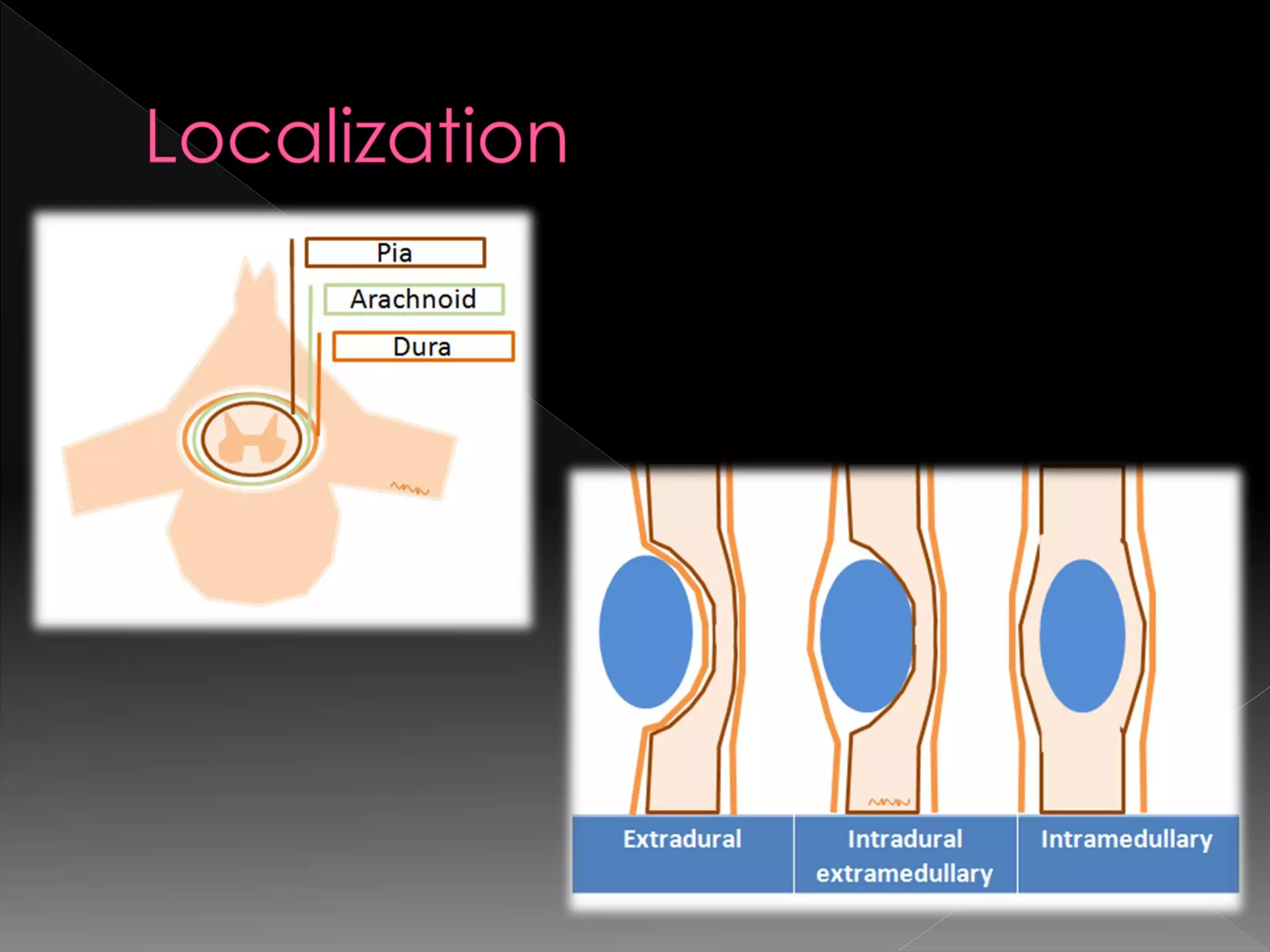
› Extradural
› Intradural
 Extramedullary
 Intramedullary
› Of which level of the spinal cord.
› Of which part in the cross section.
 Characterization
› Margin: Well/ ill define
› The present of: Calcification, hemorrhage, cyst,
restricted diffusion part, pattern enhancement.
› Effect to the surrounding structure: Cord edema,
vertebral scalloping.
Look for
1. Dura: Dark line on
T2w
2. CSF space
› Compare the lesion
side with another
side
3. Spinal cord
› Compressed
› Fusiform enlarged.
Epidural abscess Spinal
meningioma
Astrocytoma
Ref. Spinal tumor, Radiopaedia.org
 Extradural : Spinal column tumor (esp.
vertebral metastasis)
 Intradural
› Extramedullary: Schwannoma, Meningioma
› Intramedullary: Ependymoma (50%),
Astrocytoma (25%)
 Extradural
› Spinal column tumor
 Intradural
› Extramedullary: CSF spreading (esp.
medulloblastoma)
› Intramedullary: Astrocytoma (60%),
Ependymoma (15-30%), etc. (ganglioglioma,
germinoma, PNET, ATRT)
 **Congenital tumor**
 From clinical history and physical
examination
› Age of the patient
› Congenital anomalies: Myelocele,
myelomeningocele, dorsal dermal sinus,
tethered cord.
 From imaging
› Fat component
› Cystic lesion
› Dermal sinus track
 Lipoma
 Dermoid/ Epidermoid
 Teratoma
 Hamartoma
 Enterogeneous cyst
T1w T2w T1FS
• Most common type of occult spinal
dysraphism
• Classified as follows
• Lipomyelocele or
lipomyelomeningocele (84%)
•Fibrolipoma of the filum terminale
(12%)
• intradural lipoma (4%).
•MRI
• Sharply circumscribed masses
• Follow fat signal on all sequences:
•T1: hyperintense
•T2: hypointense
•T1 C+ (Gd): no enhancement
•fat-suppressed
sequences: hypointense
 Location
› Intramedullar or extramedullary
 Dermoid:
› Content : skin appendages(sebaceous glands,
sweat glands, hair, and hair follicles, fat
component)
› Location: midline
 Epidermoid:
› Content: desquamation and breakdown of
keratin not skin appendages
› Location: Paramedian
 Chemical meningitis.
 Dermoid
› Fat component  High T1w and T2w
› But for spinal dermoid, fat component may not
be identified  cannot differentiate from
epidermoid.
› No restricted diffusion
 Epidermoid
› Signal similar to CSF on T1w, T2w
› Restricted diffusion.
 Both: No enhancement unless infected or
inflamed.
 About 50% of dorsal
dermal sinuses end in
dermoid or
epidermoid tumors.
 20-30% of dermoid
and epidermoid
tumors are associated
with dorsal dermal
sinus.
 Dorsal dermal sinus with infected/
inflamed epidermoid (intra and
extramedullar part).
 Leptomengitis.
 Intraoperative findings
 Pathological findings
Primary : more common than secondary or
metastasis
 Astrocytoma
 Ependymoma
 Hemangioblastoma
 > 50%of intramed in children; epen 24-38%
 Peak incidence 30-40 yrs (mean 31 yrs)
 MC at thoracic level, rare at filum teminale
 75-92% low grade
 Findings
› Plain film : Widen spinal canal and bony erosion
› Mark fusiform expansion of cord; frequently eccentric and
posterior.
› Less hemorrhage, necrosis, hypervascularity and less
heterogeneous as compared to ependymoma.
› Almost always enhanced.
› No capsule -> infiltrative, poorly define margin
› Cyst : Rostal and caudal tend to be benign (not tumoral
cyst => within the tumor and enh)
 MC tumor in adult
 MC primary cord tumor of the lower spinal cord, conus
medullaris and filum terminale
Features Ddx from astrocytoma
1. Location : Lower cord <Astro : thoracic>
2. Location : Central (cell lining central canal) with
centrifugal growth. <Astro : eccentric posterior>
3. Prone to hemorrhage  can come with
unexplained subarachnoid hemorrhage.;
Hemorrhage with hemosiderin caps <Astro : Not
uncommon>
4. Area of hypointense on T2w which enh = reflecting
hypercellularity <Astro : less common>
5. Delicate capsule : Well define <Astro : infiltrative>
Ependymoma Astrocytoma
1. Location : Lower cord
2. Location : Central (cell lining central
canal) with centrifugal growth.
3. Prone to hemorrhage  can come
with unexplained subarachnoid
hemorrhage.; Hemorrhage with
hemosiderin caps
4. Area of hypointense on T2w which
enh = reflecting hypercellularity
5. Delicate capsule : Well define
1. Location : thoracic
2. Location : eccentric posterior
3. Hemorrhage : Not uncommon
4. Area of hypointense on T2w: less
common
5. Astro : infiltrative
 MC primary posterior fossa tumor in
adult but rarely involves cord.
 30% of cord hemangioblastoma
have vHL.
› AD
› Cerebellar hemangioblastoma, retinal
angiomatosis, RCC,
pheochromocytoma and spinal
hemangioma
 Findings :
› Plain film : Widen spinal canal.
› Location : Thoracic (51%)
› Cyst 40-60%; may larger than the tumor
› Asso with meningeal varicosities at the
posterior cord. <helps DDx metastasis>
 Metastasis
› From Breast, melanoma, lymphoma, colon,
kidney
› Findings
 Location : Thoracic then cervical and lumbar
 Fast progression  Plain film negative.
 Disproportional edema compare to the size of
metastatic tumor.
 Rarely cyst
 Rarely may be hemorrhage
 Homogenous and marked enhancement
Intramedullary spinal cord metastasis with central cystic change/necrosis.
Rykken J et al. AJNR Am J Neuroradiol 2013;34:2043-2049
©2013 by American Society of Neuroradiology
Spinal tumor

Spinal tumor

  • 2.
     Localization › Extradural ›Intradural  Extramedullary  Intramedullary › Of which level of the spinal cord. › Of which part in the cross section.  Characterization › Margin: Well/ ill define › The present of: Calcification, hemorrhage, cyst, restricted diffusion part, pattern enhancement. › Effect to the surrounding structure: Cord edema, vertebral scalloping.
  • 4.
    Look for 1. Dura:Dark line on T2w 2. CSF space › Compare the lesion side with another side 3. Spinal cord › Compressed › Fusiform enlarged. Epidural abscess Spinal meningioma Astrocytoma Ref. Spinal tumor, Radiopaedia.org
  • 5.
     Extradural :Spinal column tumor (esp. vertebral metastasis)  Intradural › Extramedullary: Schwannoma, Meningioma › Intramedullary: Ependymoma (50%), Astrocytoma (25%)
  • 6.
     Extradural › Spinalcolumn tumor  Intradural › Extramedullary: CSF spreading (esp. medulloblastoma) › Intramedullary: Astrocytoma (60%), Ependymoma (15-30%), etc. (ganglioglioma, germinoma, PNET, ATRT)  **Congenital tumor**
  • 7.
     From clinicalhistory and physical examination › Age of the patient › Congenital anomalies: Myelocele, myelomeningocele, dorsal dermal sinus, tethered cord.  From imaging › Fat component › Cystic lesion › Dermal sinus track
  • 8.
     Lipoma  Dermoid/Epidermoid  Teratoma  Hamartoma  Enterogeneous cyst
  • 9.
    T1w T2w T1FS •Most common type of occult spinal dysraphism • Classified as follows • Lipomyelocele or lipomyelomeningocele (84%) •Fibrolipoma of the filum terminale (12%) • intradural lipoma (4%). •MRI • Sharply circumscribed masses • Follow fat signal on all sequences: •T1: hyperintense •T2: hypointense •T1 C+ (Gd): no enhancement •fat-suppressed sequences: hypointense
  • 10.
     Location › Intramedullaror extramedullary  Dermoid: › Content : skin appendages(sebaceous glands, sweat glands, hair, and hair follicles, fat component) › Location: midline  Epidermoid: › Content: desquamation and breakdown of keratin not skin appendages › Location: Paramedian  Chemical meningitis.
  • 11.
     Dermoid › Fatcomponent  High T1w and T2w › But for spinal dermoid, fat component may not be identified  cannot differentiate from epidermoid. › No restricted diffusion  Epidermoid › Signal similar to CSF on T1w, T2w › Restricted diffusion.  Both: No enhancement unless infected or inflamed.
  • 12.
     About 50%of dorsal dermal sinuses end in dermoid or epidermoid tumors.  20-30% of dermoid and epidermoid tumors are associated with dorsal dermal sinus.
  • 15.
     Dorsal dermalsinus with infected/ inflamed epidermoid (intra and extramedullar part).  Leptomengitis.  Intraoperative findings  Pathological findings
  • 16.
    Primary : morecommon than secondary or metastasis  Astrocytoma  Ependymoma  Hemangioblastoma
  • 17.
     > 50%ofintramed in children; epen 24-38%  Peak incidence 30-40 yrs (mean 31 yrs)  MC at thoracic level, rare at filum teminale  75-92% low grade  Findings › Plain film : Widen spinal canal and bony erosion › Mark fusiform expansion of cord; frequently eccentric and posterior. › Less hemorrhage, necrosis, hypervascularity and less heterogeneous as compared to ependymoma. › Almost always enhanced. › No capsule -> infiltrative, poorly define margin › Cyst : Rostal and caudal tend to be benign (not tumoral cyst => within the tumor and enh)
  • 18.
     MC tumorin adult  MC primary cord tumor of the lower spinal cord, conus medullaris and filum terminale Features Ddx from astrocytoma 1. Location : Lower cord <Astro : thoracic> 2. Location : Central (cell lining central canal) with centrifugal growth. <Astro : eccentric posterior> 3. Prone to hemorrhage  can come with unexplained subarachnoid hemorrhage.; Hemorrhage with hemosiderin caps <Astro : Not uncommon> 4. Area of hypointense on T2w which enh = reflecting hypercellularity <Astro : less common> 5. Delicate capsule : Well define <Astro : infiltrative>
  • 19.
    Ependymoma Astrocytoma 1. Location: Lower cord 2. Location : Central (cell lining central canal) with centrifugal growth. 3. Prone to hemorrhage  can come with unexplained subarachnoid hemorrhage.; Hemorrhage with hemosiderin caps 4. Area of hypointense on T2w which enh = reflecting hypercellularity 5. Delicate capsule : Well define 1. Location : thoracic 2. Location : eccentric posterior 3. Hemorrhage : Not uncommon 4. Area of hypointense on T2w: less common 5. Astro : infiltrative
  • 20.
     MC primaryposterior fossa tumor in adult but rarely involves cord.  30% of cord hemangioblastoma have vHL. › AD › Cerebellar hemangioblastoma, retinal angiomatosis, RCC, pheochromocytoma and spinal hemangioma  Findings : › Plain film : Widen spinal canal. › Location : Thoracic (51%) › Cyst 40-60%; may larger than the tumor › Asso with meningeal varicosities at the posterior cord. <helps DDx metastasis>
  • 21.
     Metastasis › FromBreast, melanoma, lymphoma, colon, kidney › Findings  Location : Thoracic then cervical and lumbar  Fast progression  Plain film negative.  Disproportional edema compare to the size of metastatic tumor.  Rarely cyst  Rarely may be hemorrhage  Homogenous and marked enhancement
  • 22.
    Intramedullary spinal cordmetastasis with central cystic change/necrosis. Rykken J et al. AJNR Am J Neuroradiol 2013;34:2043-2049 ©2013 by American Society of Neuroradiology