Treating Chronic Back Pain: New Knowledge, More Choices


            MBBS, MD (Anesthesiology), FIPP
      Director. Interventional Pain and Spine Centre
                     New Delhi ,India


                                                www.ipscindia.com
   Normal Architecture of the Disc

   Pathophysiology of Disc related pain

   Intradiscal Procedures for

        Discogenic pain
        Herniated disc
INTERVERTEBRAL
      DISC

       Nucleous Pulposus


   Irregular network of collagen fibers type II
    (viscocity) > type I and elastin fibers

   Proteoglycans( Agrrecan)-Osmotic properties
    to resist compression


                                               www.ipscindia.com
ANNULUS FIBROSUS


   Callagen fibers type I (Thickness) > type II

   Runs oblique in alternating direction
    ---Tensile strength

   Also contains some proteoglycans and
    Elastin fibers
END PLATE


   Approx 1 mm thick
   Considered part of disc rather than body
   Made up of hyaline cartilage mostly (young) and
    fibrocartilage (old)
   The collagen fibers of the inner 2/3rds of the
    annulus form the fibro cartilaginous component
    of the VEP
LUMBAR INTERVERTEBRAL
          DISC
  - NERVE INNERVATION

       Outer 1/3rds of the annulus circumferentially
       Posterior plexus - Sinuvertebral nerves stems from Rami
        Communicans
       Anterior plexus formed by bridging of sympathetic trunks and
        the proximal ends of the GRCs
BLOOD SUPPLY AND
NUTRITION


         Capillaries arise in
           Vertebral body             Diffusion

                                   O 2 and glucose
       Penetrates Subchondral
                  Bone
                                     Lactic acid

     Terminates at Vertebral End
                 Plates
                                                  www.ipscindia.com
Pathophysiology


Disc Degeneration –Internal Disc Disruption-
      Discogenic pain- Disc Herniation
Pathophysiology-
Disc Degeneration

              Decrease in end plate Permiability

                    Failure of nutrient supply
                                &
                     Accumulation of waste

                            Low p H

                             Injury
-
DISC
DEGENERATION
           Loss of Proteoglycan &
           collagen and degradation

             Fall in osmotic pressure
                    of disc matrix

             No longer behaves
              

          hydrostatically under load

             Loose height and fluid
                 more rapidly

          Stress concentration along
            End plates and Annulus

                                         www.ipscindia.com
INTERNAL DISC DISRUPTION
PATHOPHYSIOLOGY-
  INTERNAL DISC
    DISRUPTION

         Normal Disc – Pressure evenly distributed along end
          plates and annulus


          • Degenerated disc – Uneven stress across End
             plates and annulus –Fissures and Tear
INTERNAL DISC
DISRUPTION

        Annular tear and fissures
PATHOPHYSIOLOGY-
DISCOGENIC PAIN


                   Only outer 1/3 is
                      innervated


                   Now the whole
                        disc
                      can feel


                                       www.ipscindia.com
RISK FACTORS –DISC
DEGENERATION


           Age:
                   Vascular changes e.g. Atherosclerosis
                   End Plate changes e.g. calcification
                   Sub cortical sclerosis


           Genetic factors :

                   Aggrecan gene polymorphism
RISK
FACTORS
                      Life style:
  Prolonged
  sitting                                      Lack of Exercise
                                                   Obesity


              Smoking


              Smoking and IVD Degeneration .Spine 1991: Sep; 16(9): 1015-21
              Sally Roberts, Jill P.G. Urban
Aging of Disc           Degeneration of Disc
• Affects Nucleous          • Annulus & End plates

• Increased proteoglycan    • Concentric or radial tear in the
  fragmentation and water     annulus, Inwards buckling of
  content is decreased        annulus & radial bulging of outer
                              annulus
• Nucleus is gradually      • Endplate defects & vertical
  replaced by collagen        bulging of endplates into the
  fibers.                     adjacent vertebral bodies.

• Disc height is
  maintained.               • Reduced disc height


• Look black on T2          • Look black on T2 weighted
  weighted image of MRI       image of MRI
Investigations
             Plain Radiographs
C T SCAN


               •The vacuum disc phenomenon

                     •Loss of disc height.

           •Secondary findings of disc degeneration,
                     Endplate sclerosis
                     Osteophyte formation
MRI

   Test of Choice

        Architecture of Disc
        Disruption of endplates

        Secondary changes

        Herniation
MRI
                                        HIZ


      Fibrovascular ingrowth into region of Annular tear


      The pathogenesis and clinical significance of a high-intensity zone (HIZ) of lumbar
      intervertebral disc on MR imaging in the patient with discogenic low back pain.
      Eur Spine J. 2005 Jul 27
MRI   MODIC CHANGES SECONDARY
        TO DISC DEGENERATION


              Type- I  Low signal in T1-weighed
              sequences and high signal in T2)---edema.


              Type II  High signal in T1-weighed sequences
              and either high or intermediate signal in T2)
              ---fatty replacement


              Type III  Low signal in T1 and low signal
              in T2--sclerotic changes.
FACET ARTHROPATHY
                           SECONDARY TO DISC
MRI                          DEGENERATION
                          Disc bears 80% of weight
                          Facet joints bears 20 % of weight


      A change in the intervertebral disc produces
         Change in the whole motion segment
MRI

         Ligamental Buckling   Degenerative Changes –
                                Intraspinal Ligaments
GRADES OF DISC
DEGENERATION


         Magnetic Resonance Classification of Lumbar Intervertebral Disc Degeneration
         SPINE Volume 26, Number 17, pp 1873–1878
MODIFIED PFIRRMANN GRADING
SYSTEM-
            8 GRADES


     Modified Pfirrmann Grading System for Lumbar Intervertebral Disc Degeneration
     Spine: 15 November 2007 - Volume 32 - Issue 24 - pp E708-E712
Intradiscal Procedures
DISCOGRAPHY
DISCOGRAPHY -3 COMPONENTS
PROVOCATIVE DISCOGRAPHY-
DERBY’S CLASSIFICATION-
PAIN PROVOCATION AND
DISCOMETRY


       Pain @ <15 psi   -       chemically
                                 sensitive

       Pain @ 15-50 psi -       mechanically
                                 sensitive

       Pain @ 51-90 psi -       intermediate

       Pain @ >90 psi   -       normal disc

       No Pain              -   normal disc
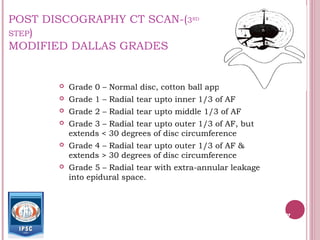
POST DISCOGRAPHY CT SCAN-(3RD
STEP)
MODIFIED DALLAS GRADES
                    Site and Extent of Tear

          Grade 0 – Normal disc, cotton ball appearance
          Grade 1 – Radial tear upto inner 1/3 of AF
          Grade 2 – Radial tear upto middle 1/3 of AF
          Grade 3 – Radial tear upto outer 1/3 of AF, but
           extends < 30 degrees of disc circumference
          Grade 4 – Radial tear upto outer 1/3 of AF &
           extends > 30 degrees of disc circumference
          Grade 5 – Radial tear with extra-annular leakage
           into epidural space.


     Disc stimulation + Discography = Provocative Discography
     Step 1 and 2       Step 3
Interventions for
       Discogenic pain       Contained Disc
                                Herniation
Level of                   Description                    Implications
Evidence
1A +       RCT’s( good quality) . Benefit >> Risk
1B +       RCT’s(methodological weakness). Benefit >>      Positive
           Risk

                                                        Recommendations
2B +       RCT’s(methodological weakness). Benefit >
           Risk          Level of Evidence

2B +       RCT’s(methodological weakness).              Considered
           Contradictory results
2C +       Observational Studies. No conclusive
           evidence
0          Case reports. Insufficient evidence          Only study related
2C -       Observational studies- no effectiveness      Negative
IDET
   Indication
        Mild to moderate Degeneration
        Absent radicular symptom

        Positive discogram  1week-IDET


   Contraindication
        Large disc herniation
        Canal stenosis

        Disc height loss > 50%


   Mechanism of Action
     strengthen  the collagen fibers,
     Seal fissures,
     denature inflammatory exudates, or coagulate
      nociceptors
Temperature- 65
  degree to 90
    degree

    16 min


 Nerve fiber
 damage


Stabilization of
   fissures
   Saal JS, Saal JA. Management of chronic discogenic low back pain
    with a thermal intradiscal catheter: a preliminary report. Spine.
    2000;25:382-8


   Freeman BJ, Fraser RD, Cain CM. et al. A randomized, double-blind,
    controlled trial: intradiscal electrothermal therapy versus placebo
    for the treatment of chronic discogenic low back pain. Spine.
    2005;30:2369-77

   Nunley PD, Jawahar A, Brandao SM. et al. Intradiscal electrothermal therapy
    (IDET) for low back pain in worker's compensation patients: can it provide
    a potential answer? Long-term results. J Spinal Disord Tech. 2008;21:11-8
POSTERIOR ANNULOPLASTY
   Electrodes (Disctrode) – Placed in Posterior
    Annulus
NUCLEOPLASTY
OR
RF COBLATION
                            Bipolar radiofrequency probe
                                 Coblation (molecular

                                  dissociation) technology
                                  to ablate tissue
                                 Thermal energy for

                                  coagulation
                                                                            Perc-D Spine Wand


                                                         •125 V of Energy
                                                         •60-70 degree
        (Courtesy of Arthrocare Spine, Sunnyvale, CA.)
NUCLEOPLASTY
OR
RF COBLATION

       Indication
              Discogenic pain
               with contained disc
               herniation
           (No prospective randomized controlled studies for purely
             Discogenic pain)


       Contraindication
              Extruded disc


              Disc herniation >33 %
               of sagittal diameter of spinal canal
BIACUPLAST
Y


        Kapural L, Mekhail N. Novel Intradiscal Biacuplasty (IDB) for the
        treatment of Lumbar Discogenic Pain. PainPractice J. 2007;7:130–135.
Insufficient number of studies about its efficacy and
safety the preliminary findings show that this method
was effective and safe.


Kapural L, Mekhail N. Novel Intradiscal Biacuplasty (IDB) for
the Treatment of Lumbar Discogenic Pain. Pain Practice.
2007;7:130-4

Kapural L, Ng A, Dalton J. et al. Intervertebral disc biacuplasty for the
treatment of lumbar discogenic pain: results of a six-month follow-
up. Pain Med. 2008;9:60-7
Intradiscal Injections

                     INTRADISCAL
                     STEROID


                  • Prevent Inflammatory cascade

                  • Modic Type – I


  •Eur Spine J (2007) 16:925–931
  Buttermann GR (2004) The effect of spinal steroid injections for Degenerative
  disc disease. Spine J 4:495–505
Intradiscal Injections
                           METHYLENE
                           BLUE


  • Weak Neurolytic effect

  • Inhibition of Guanylate Cyclase
   and NO synthesis


 PAIN: Volume 149, Issue 1 , Pages 124-129, April
 2010
Intradiscal Injections
                            INTRADISCAL
                            OZONE


               Anti-inflammatory properties

               Primary Indicaction is Radicular Pain.


  Eur J Radiol 2009 Dec; 72(3) :499-504.
INTRADISCAL PROCEDURES FOR DISC
PROLAPSE
INDICATIONS OF PERCUTANEOUS
MECHANICAL DISC DECOMPRESSION

   Unilateral leg pain greater than back pain.
   Radicular symptoms in a specific dermatomal
    distribution that correlates with MRI findings.
   Positive straight leg raising test or positive bowstring
    sign, or both.
   No improvement after 6 weeks of conservative therapy.
   Imaging studies (CT, MRI, discography) indicating a
    subligamentous contained disc herniation.
   Well maintained disc height of 60%.
PERCUTANEOUS DISC DECOMPRESSION

              Rotating probe is inserted through needle
               into the disc under X-Ray/ Fluoroscopic
               guidance


              Rotating tip removes small portion of disc
               material.


              Because only enough of the disc is removed to
               reduce pressure inside the disc, the spine
               remains stable.
NUCLEOTOMY


                The herniation suctioned
                 toward the probe where an
                 integrated knife then cuts it
                 away from the disk. The
                 material is then suctioned
                 away
HYDRODISCECTOMY
   Cutting with water fluidJet technology
     uses  the Venturi Effect created by high velocity saline
      jets to cut and aspirate targeted tissue
OZONE DISCECTOMY/ OZONUCLEOLYSIS
                           It’s action is due to
                            the active oxygen
                            atom (singlet
                            oxygen) liberated
                            from it.
                           It attaches with the
                            proteo-glycan
                            bridges in the
                            nucleus pulposus.
                           They are broken
                            down and they no
                            longer capable of
                            holding water.
                           As a result disc
                            shrinks and
                            mummified and
                            there is
                            decompression of
                            nerve roots.
Regenerative Therapies


            Glucosamine and chondrointin sulphate-

      Enhance the Repair response of chondrocytes and retard the
                   enzymatic degradation of cartilage.


                     Cell based Therapies

                     Stimulate the disc cell to produce matrix
       Direct injection of Growth factor/ Cytokine inhibitor- Unsuccessful
                   Gene of interest is introduced into target cell


                 Nucleous Pulposus augmentation

          Injectable Nucleous –Solution of Protein polymer and
                            crosslinking agent
www.ipscindia.com

Intradiscal procedures current evidence

  • 1.
    Treating Chronic BackPain: New Knowledge, More Choices MBBS, MD (Anesthesiology), FIPP Director. Interventional Pain and Spine Centre New Delhi ,India www.ipscindia.com
  • 2.
    Normal Architecture of the Disc  Pathophysiology of Disc related pain  Intradiscal Procedures for  Discogenic pain  Herniated disc
  • 3.
    INTERVERTEBRAL DISC Nucleous Pulposus  Irregular network of collagen fibers type II (viscocity) > type I and elastin fibers  Proteoglycans( Agrrecan)-Osmotic properties to resist compression www.ipscindia.com
  • 4.
    ANNULUS FIBROSUS  Callagen fibers type I (Thickness) > type II  Runs oblique in alternating direction ---Tensile strength  Also contains some proteoglycans and Elastin fibers
  • 5.
    END PLATE  Approx 1 mm thick  Considered part of disc rather than body  Made up of hyaline cartilage mostly (young) and fibrocartilage (old)  The collagen fibers of the inner 2/3rds of the annulus form the fibro cartilaginous component of the VEP
  • 6.
    LUMBAR INTERVERTEBRAL DISC - NERVE INNERVATION  Outer 1/3rds of the annulus circumferentially  Posterior plexus - Sinuvertebral nerves stems from Rami Communicans  Anterior plexus formed by bridging of sympathetic trunks and the proximal ends of the GRCs
  • 7.
    BLOOD SUPPLY AND NUTRITION Capillaries arise in Vertebral body Diffusion O 2 and glucose Penetrates Subchondral Bone Lactic acid Terminates at Vertebral End Plates www.ipscindia.com
  • 8.
    Pathophysiology Disc Degeneration –InternalDisc Disruption- Discogenic pain- Disc Herniation
  • 9.
    Pathophysiology- Disc Degeneration Decrease in end plate Permiability Failure of nutrient supply & Accumulation of waste Low p H Injury
  • 10.
    - DISC DEGENERATION  Loss of Proteoglycan & collagen and degradation  Fall in osmotic pressure of disc matrix No longer behaves  hydrostatically under load  Loose height and fluid more rapidly  Stress concentration along End plates and Annulus www.ipscindia.com
  • 11.
  • 12.
    PATHOPHYSIOLOGY- INTERNALDISC DISRUPTION  Normal Disc – Pressure evenly distributed along end plates and annulus • Degenerated disc – Uneven stress across End plates and annulus –Fissures and Tear
  • 13.
    INTERNAL DISC DISRUPTION  Annular tear and fissures
  • 14.
    PATHOPHYSIOLOGY- DISCOGENIC PAIN Only outer 1/3 is innervated Now the whole disc can feel www.ipscindia.com
  • 15.
    RISK FACTORS –DISC DEGENERATION Age: Vascular changes e.g. Atherosclerosis End Plate changes e.g. calcification Sub cortical sclerosis Genetic factors : Aggrecan gene polymorphism
  • 16.
    RISK FACTORS Life style: Prolonged sitting Lack of Exercise Obesity Smoking Smoking and IVD Degeneration .Spine 1991: Sep; 16(9): 1015-21 Sally Roberts, Jill P.G. Urban
  • 17.
    Aging of Disc Degeneration of Disc • Affects Nucleous • Annulus & End plates • Increased proteoglycan • Concentric or radial tear in the fragmentation and water annulus, Inwards buckling of content is decreased annulus & radial bulging of outer annulus • Nucleus is gradually • Endplate defects & vertical replaced by collagen bulging of endplates into the fibers. adjacent vertebral bodies. • Disc height is maintained. • Reduced disc height • Look black on T2 • Look black on T2 weighted weighted image of MRI image of MRI
  • 18.
    Investigations Plain Radiographs
  • 19.
    C T SCAN •The vacuum disc phenomenon •Loss of disc height. •Secondary findings of disc degeneration, Endplate sclerosis Osteophyte formation
  • 20.
    MRI  Test of Choice  Architecture of Disc  Disruption of endplates  Secondary changes  Herniation
  • 21.
    MRI HIZ Fibrovascular ingrowth into region of Annular tear The pathogenesis and clinical significance of a high-intensity zone (HIZ) of lumbar intervertebral disc on MR imaging in the patient with discogenic low back pain. Eur Spine J. 2005 Jul 27
  • 22.
    MRI MODIC CHANGES SECONDARY TO DISC DEGENERATION Type- I  Low signal in T1-weighed sequences and high signal in T2)---edema. Type II  High signal in T1-weighed sequences and either high or intermediate signal in T2) ---fatty replacement Type III  Low signal in T1 and low signal in T2--sclerotic changes.
  • 23.
    FACET ARTHROPATHY SECONDARY TO DISC MRI DEGENERATION  Disc bears 80% of weight  Facet joints bears 20 % of weight A change in the intervertebral disc produces Change in the whole motion segment
  • 24.
    MRI  Ligamental Buckling Degenerative Changes – Intraspinal Ligaments
  • 25.
    GRADES OF DISC DEGENERATION Magnetic Resonance Classification of Lumbar Intervertebral Disc Degeneration SPINE Volume 26, Number 17, pp 1873–1878
  • 26.
    MODIFIED PFIRRMANN GRADING SYSTEM- 8 GRADES Modified Pfirrmann Grading System for Lumbar Intervertebral Disc Degeneration Spine: 15 November 2007 - Volume 32 - Issue 24 - pp E708-E712
  • 27.
  • 28.
  • 29.
  • 30.
    PROVOCATIVE DISCOGRAPHY- DERBY’S CLASSIFICATION- PAINPROVOCATION AND DISCOMETRY  Pain @ <15 psi - chemically sensitive  Pain @ 15-50 psi - mechanically sensitive  Pain @ 51-90 psi - intermediate  Pain @ >90 psi - normal disc  No Pain - normal disc
  • 31.
    POST DISCOGRAPHY CTSCAN-(3RD STEP) MODIFIED DALLAS GRADES Site and Extent of Tear  Grade 0 – Normal disc, cotton ball appearance  Grade 1 – Radial tear upto inner 1/3 of AF  Grade 2 – Radial tear upto middle 1/3 of AF  Grade 3 – Radial tear upto outer 1/3 of AF, but extends < 30 degrees of disc circumference  Grade 4 – Radial tear upto outer 1/3 of AF & extends > 30 degrees of disc circumference  Grade 5 – Radial tear with extra-annular leakage into epidural space. Disc stimulation + Discography = Provocative Discography Step 1 and 2 Step 3
  • 32.
    Interventions for Discogenic pain Contained Disc Herniation Level of Description Implications Evidence 1A + RCT’s( good quality) . Benefit >> Risk 1B + RCT’s(methodological weakness). Benefit >> Positive Risk Recommendations 2B + RCT’s(methodological weakness). Benefit > Risk Level of Evidence 2B + RCT’s(methodological weakness). Considered Contradictory results 2C + Observational Studies. No conclusive evidence 0 Case reports. Insufficient evidence Only study related 2C - Observational studies- no effectiveness Negative
  • 33.
    IDET  Indication  Mild to moderate Degeneration  Absent radicular symptom  Positive discogram  1week-IDET  Contraindication  Large disc herniation  Canal stenosis  Disc height loss > 50%  Mechanism of Action  strengthen the collagen fibers,  Seal fissures,  denature inflammatory exudates, or coagulate nociceptors
  • 34.
    Temperature- 65 degree to 90 degree 16 min Nerve fiber damage Stabilization of fissures
  • 35.
    Saal JS, Saal JA. Management of chronic discogenic low back pain with a thermal intradiscal catheter: a preliminary report. Spine. 2000;25:382-8  Freeman BJ, Fraser RD, Cain CM. et al. A randomized, double-blind, controlled trial: intradiscal electrothermal therapy versus placebo for the treatment of chronic discogenic low back pain. Spine. 2005;30:2369-77  Nunley PD, Jawahar A, Brandao SM. et al. Intradiscal electrothermal therapy (IDET) for low back pain in worker's compensation patients: can it provide a potential answer? Long-term results. J Spinal Disord Tech. 2008;21:11-8
  • 36.
    POSTERIOR ANNULOPLASTY  Electrodes (Disctrode) – Placed in Posterior Annulus
  • 37.
    NUCLEOPLASTY OR RF COBLATION  Bipolar radiofrequency probe  Coblation (molecular dissociation) technology to ablate tissue  Thermal energy for coagulation Perc-D Spine Wand •125 V of Energy •60-70 degree (Courtesy of Arthrocare Spine, Sunnyvale, CA.)
  • 38.
    NUCLEOPLASTY OR RF COBLATION  Indication  Discogenic pain with contained disc herniation (No prospective randomized controlled studies for purely Discogenic pain)  Contraindication  Extruded disc  Disc herniation >33 % of sagittal diameter of spinal canal
  • 39.
    BIACUPLAST Y Kapural L, Mekhail N. Novel Intradiscal Biacuplasty (IDB) for the treatment of Lumbar Discogenic Pain. PainPractice J. 2007;7:130–135.
  • 40.
    Insufficient number ofstudies about its efficacy and safety the preliminary findings show that this method was effective and safe. Kapural L, Mekhail N. Novel Intradiscal Biacuplasty (IDB) for the Treatment of Lumbar Discogenic Pain. Pain Practice. 2007;7:130-4 Kapural L, Ng A, Dalton J. et al. Intervertebral disc biacuplasty for the treatment of lumbar discogenic pain: results of a six-month follow- up. Pain Med. 2008;9:60-7
  • 41.
    Intradiscal Injections INTRADISCAL STEROID • Prevent Inflammatory cascade • Modic Type – I •Eur Spine J (2007) 16:925–931 Buttermann GR (2004) The effect of spinal steroid injections for Degenerative disc disease. Spine J 4:495–505
  • 42.
    Intradiscal Injections METHYLENE BLUE • Weak Neurolytic effect • Inhibition of Guanylate Cyclase and NO synthesis PAIN: Volume 149, Issue 1 , Pages 124-129, April 2010
  • 43.
    Intradiscal Injections INTRADISCAL OZONE  Anti-inflammatory properties  Primary Indicaction is Radicular Pain. Eur J Radiol 2009 Dec; 72(3) :499-504.
  • 44.
  • 45.
    INDICATIONS OF PERCUTANEOUS MECHANICALDISC DECOMPRESSION  Unilateral leg pain greater than back pain.  Radicular symptoms in a specific dermatomal distribution that correlates with MRI findings.  Positive straight leg raising test or positive bowstring sign, or both.  No improvement after 6 weeks of conservative therapy.  Imaging studies (CT, MRI, discography) indicating a subligamentous contained disc herniation.  Well maintained disc height of 60%.
  • 46.
    PERCUTANEOUS DISC DECOMPRESSION  Rotating probe is inserted through needle into the disc under X-Ray/ Fluoroscopic guidance  Rotating tip removes small portion of disc material.  Because only enough of the disc is removed to reduce pressure inside the disc, the spine remains stable.
  • 47.
    NUCLEOTOMY  The herniation suctioned toward the probe where an integrated knife then cuts it away from the disk. The material is then suctioned away
  • 48.
    HYDRODISCECTOMY  Cutting with water fluidJet technology  uses the Venturi Effect created by high velocity saline jets to cut and aspirate targeted tissue
  • 49.
    OZONE DISCECTOMY/ OZONUCLEOLYSIS  It’s action is due to the active oxygen atom (singlet oxygen) liberated from it.  It attaches with the proteo-glycan bridges in the nucleus pulposus.  They are broken down and they no longer capable of holding water.  As a result disc shrinks and mummified and there is decompression of nerve roots.
  • 50.
    Regenerative Therapies  Glucosamine and chondrointin sulphate- Enhance the Repair response of chondrocytes and retard the enzymatic degradation of cartilage.  Cell based Therapies Stimulate the disc cell to produce matrix Direct injection of Growth factor/ Cytokine inhibitor- Unsuccessful Gene of interest is introduced into target cell  Nucleous Pulposus augmentation Injectable Nucleous –Solution of Protein polymer and crosslinking agent
  • 51.