2IPSC India Training Institute
7
61
2
3
4
Introduction
Anatomy
Fluoroscopic Anatomy
Radiological Evaluation
Pathophysiology
Lumbar Spine
Interventions
Thoracic, Sacral and
Pelvic Interventions
Neuropathic Pain
Sympathetic Interventions
5
Head and Neck
Interventions
Case discussion
Troubleshooting
Schedule
Dr Swati Bhat
doctorswati29@gmail.com
Team IPSC India
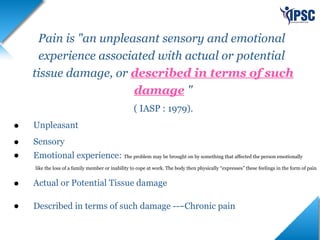
Pain is "an unpleasant sensory and emotional
experience associated with actual or potential
tissue damage, or described in terms of such
damage "
( IASP : 1979).
• Unpleasant
• Sensory
• Emotional experience: The problem may be brought on by something that affected the person emotionally
like the loss of a family member or inability to cope at work. The body then physically “expresses” these feelings in the form of pain
• Actual or Potential Tissue damage
• Described in terms of such damage ---Chronic pain
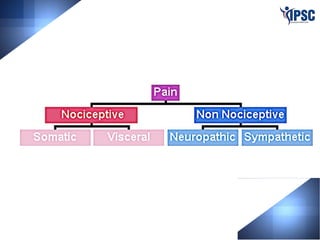
Types of Pain
· Acute Pain /Physiological
Pain
· Nociceptive
· Symptom of a disease
· Treatment of diseases cures
pain & it is self-limiting.
· Simple relationship between
pain and tissue damage
· Proportionate to the clinical
finding
· Chronic Pain /Pathological
Pain
· Neuropathic
· A disease itself, a disease of
nervous system.
· Difficult to treat & sustaining.
· Dissociated relationship
between pain and tissue damage
· Disproportionate to the
clinical finding
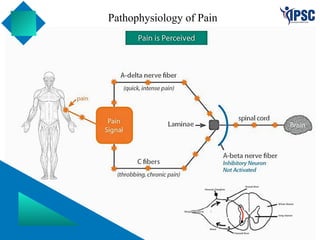
Pathophysiology of Pain
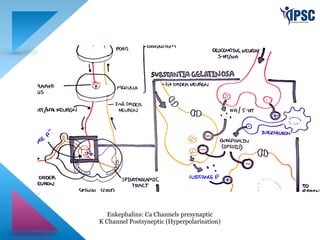
Enkephalins: Ca Channels presynaptic
K Channel Postsyneptic (Hyperpolarisation)
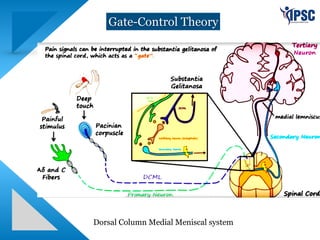
Gate-Control Theory
DCML
Dorsal Column Medial Meniscal system
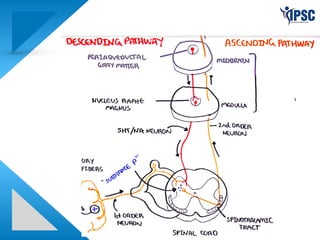
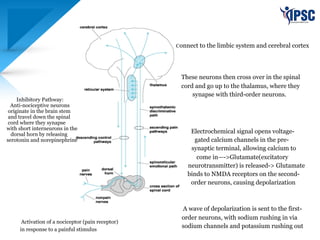
Inhibitory Pathway:
Anti-nociceptive neurons
originate in the brain stem
and travel down the spinal
cord where they synapse
with short interneurons in the
dorsal horn by releasing
serotonin and norepinephrine
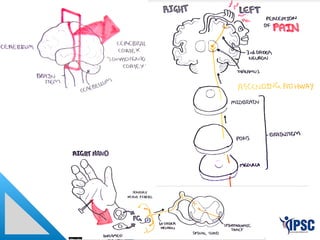
Connect to the limbic system and cerebral cortex
These neurons then cross over in the spinal
cord and go up to the thalamus, where they
synapse with third-order neurons.
Electrochemical signal opens voltage-
gated calcium channels in the pre-
synaptic terminal, allowing calcium to
come in—->Glutamate(excitatory
neurotransmitter) is released-> Glutamate
binds to NMDA receptors on the second-
order neurons, causing depolarization
A wave of depolarization is sent to the first-
order neurons, with sodium rushing in via
sodium channels and potassium rushing out
Activation of a nociceptor (pain receptor)
in response to a painful stimulus
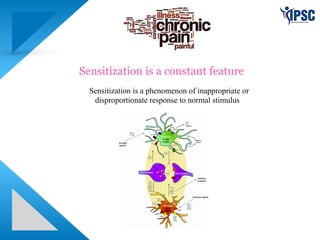
Sensitization is a constant feature
Sensitization is a phenomenon of inappropriate or
disproportionate response to normal stimulus
0
1
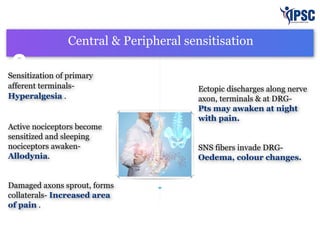
Central & Peripheral sensitisation
Ectopic discharges along nerve
axon, terminals & at DRG-
Pts may awaken at night
with pain.
SNS fibers invade DRG-
Oedema, colour changes.
Sensitization of primary
afferent terminals-
Hyperalgesia .
Active nociceptors become
sensitized and sleeping
nociceptors awaken-
Allodynia.
Damaged axons sprout, forms
collaterals- Increased area
of pain .
1
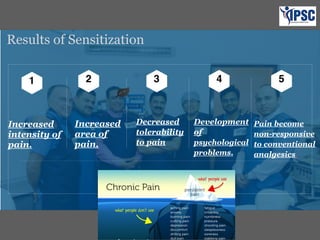
Results of Sensitization
Increased
area of
pain.
Decreased
tolerability
to pain
Increased
intensity of
pain.
Curabitur id velit eget turpis scelerisque ultricies a
id lectus. Lorem ipsum dolor sit amet, consectetur
adipiscing elit.
Development
of
psychological
problems.
2 3 4 5
Pain become
non-responsive
to conventional
analgesics.
Interventional
Pain
Management
Interventions are Minimally Invasive, Non
Surgical and Target Specific and Guided
procedures to Diagnose and to treat Various
painful conditions
It fills the gap between pharmacologic management
and more invasive operative procedure
Important facts about pain management as the Speciality
Recognised as a 34 th Speciality in USA: American
society of Interventional pain physician
Pain as fifth vital
sign
Pain relief a human right – WHO
(world health organization)
Intenational Association for study of Pain-1973
World Institute of Pain-1993
Fellowship -2001
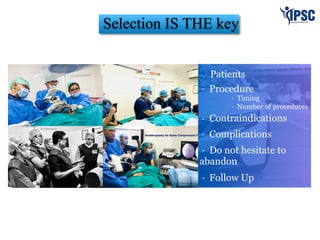
· Patients
· Procedure
· Timing
· Number of procedures
· Contraindications
· Complications
· Do not hesitate to
abandon
· Follow Up
Selection IS THE key

1. introduction to Interventional Pain Management

  • 2.
  • 3.
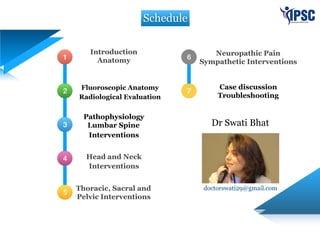
    7 61 2 3 4 Introduction Anatomy Fluoroscopic Anatomy Radiological Evaluation Pathophysiology LumbarSpine Interventions Thoracic, Sacral and Pelvic Interventions Neuropathic Pain Sympathetic Interventions 5 Head and Neck Interventions Case discussion Troubleshooting Schedule Dr Swati Bhat doctorswati29@gmail.com
  • 4.
  • 5.
    Pain is "anunpleasant sensory and emotional experience associated with actual or potential tissue damage, or described in terms of such damage " ( IASP : 1979). • Unpleasant • Sensory • Emotional experience: The problem may be brought on by something that affected the person emotionally like the loss of a family member or inability to cope at work. The body then physically “expresses” these feelings in the form of pain • Actual or Potential Tissue damage • Described in terms of such damage ---Chronic pain
  • 7.
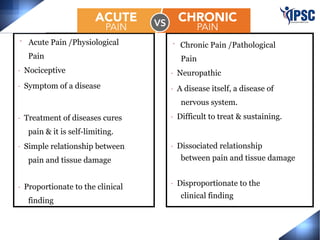
    Types of Pain ·Acute Pain /Physiological Pain · Nociceptive · Symptom of a disease · Treatment of diseases cures pain & it is self-limiting. · Simple relationship between pain and tissue damage · Proportionate to the clinical finding · Chronic Pain /Pathological Pain · Neuropathic · A disease itself, a disease of nervous system. · Difficult to treat & sustaining. · Dissociated relationship between pain and tissue damage · Disproportionate to the clinical finding
  • 8.
  • 11.
    Enkephalins: Ca Channelspresynaptic K Channel Postsyneptic (Hyperpolarisation)
  • 12.
  • 13.
    Inhibitory Pathway: Anti-nociceptive neurons originatein the brain stem and travel down the spinal cord where they synapse with short interneurons in the dorsal horn by releasing serotonin and norepinephrine Connect to the limbic system and cerebral cortex These neurons then cross over in the spinal cord and go up to the thalamus, where they synapse with third-order neurons. Electrochemical signal opens voltage- gated calcium channels in the pre- synaptic terminal, allowing calcium to come in—->Glutamate(excitatory neurotransmitter) is released-> Glutamate binds to NMDA receptors on the second- order neurons, causing depolarization A wave of depolarization is sent to the first- order neurons, with sodium rushing in via sodium channels and potassium rushing out Activation of a nociceptor (pain receptor) in response to a painful stimulus
  • 14.
    Sensitization is aconstant feature Sensitization is a phenomenon of inappropriate or disproportionate response to normal stimulus
  • 15.
    0 1 Central & Peripheralsensitisation Ectopic discharges along nerve axon, terminals & at DRG- Pts may awaken at night with pain. SNS fibers invade DRG- Oedema, colour changes. Sensitization of primary afferent terminals- Hyperalgesia . Active nociceptors become sensitized and sleeping nociceptors awaken- Allodynia. Damaged axons sprout, forms collaterals- Increased area of pain .
  • 16.
    1 Results of Sensitization Increased areaof pain. Decreased tolerability to pain Increased intensity of pain. Curabitur id velit eget turpis scelerisque ultricies a id lectus. Lorem ipsum dolor sit amet, consectetur adipiscing elit. Development of psychological problems. 2 3 4 5 Pain become non-responsive to conventional analgesics.
  • 17.
    Interventional Pain Management Interventions are MinimallyInvasive, Non Surgical and Target Specific and Guided procedures to Diagnose and to treat Various painful conditions It fills the gap between pharmacologic management and more invasive operative procedure
  • 18.
    Important facts aboutpain management as the Speciality Recognised as a 34 th Speciality in USA: American society of Interventional pain physician Pain as fifth vital sign Pain relief a human right – WHO (world health organization)
  • 19.
    Intenational Association forstudy of Pain-1973 World Institute of Pain-1993 Fellowship -2001
  • 20.
    · Patients · Procedure ·Timing · Number of procedures · Contraindications · Complications · Do not hesitate to abandon · Follow Up Selection IS THE key