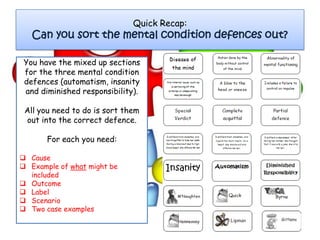
Quick Recap:
   Can you sort the mental condition defences out?

 You have the mixed up sections
 for the three mental condition
 defences (automatism, insanity
 and diminished responsibility).

 All you need to do is sort them
 out into the correct defence.

       For each you need:

 Cause
 Example of what might be
  included
 Outcome
 Label
 Scenario
 Two case examples
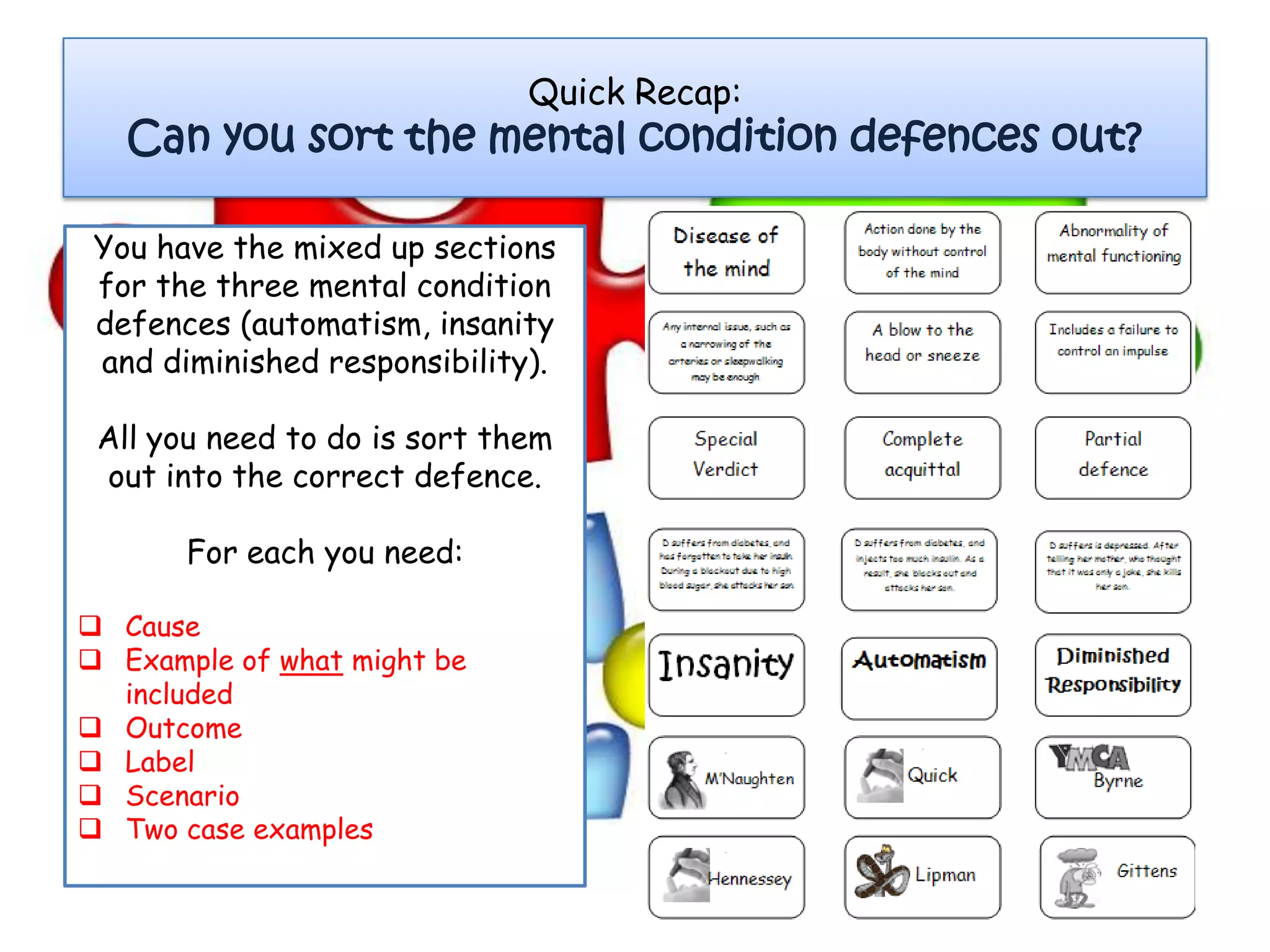
So what can you tell me about mental condition defences?
Complete the brainstorm below to show your understanding of the AO1 for this
                                   topic


                         Means?                Means?
        Result?
                                                                   Result?


                                    Mental
                  automatism                            Insanity
                                   condition
                                   defences
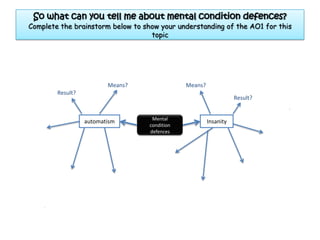
Any areas you have put nothing for...                   Plenary
        Were you missing?                 How confident are you?
           Did you ask?
       Have you researched?
                                          I know what       I can       I can evaluate
                                             this is.   describe this   or discuss this

 The implications of pleading insanity

 The definition of insanity from
 M’Naughten

 The interpretation of defect of reason

 The interpretation of disease of the
 mind

 What is meant by nature and quality
 and wrong

 The definition of non-insane
 automatism

 The approach of the court to self
 induced automatism

 The problems with the current law on
 insanity and automatism.
General Defences:


Intoxication


                       Miss M. Hart
                       G153 [2012]
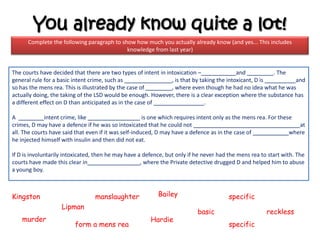
You already know quite a lot!
      Complete the following paragraph to show how much you actually already know (and yes... This includes
                                            knowledge from last year)


The courts have decided that there are two types of intent in intoxication –                and          . The
general rule for a basic intent crime, such as                  , is that by taking the intoxicant, D is       and
so has the mens rea. This is illustrated by the case of         , where even though he had no idea what he was
actually doing, the taking of the LSD would be enough. However, there is a clear exception where the substance has
a different effect on D than anticipated as in the case of                     .

A             intent crime, like                       is one which requires intent only as the mens rea. For these
crimes, D may have a defence if he was so intoxicated that he could not                                              at
all. The courts have said that even if it was self-induced, D may have a defence as in the case of                where
he injected himself with insulin and then did not eat.

If D is involuntarily intoxicated, then he may have a defence, but only if he never had the mens rea to start with. The
courts have made this clear in                       , where the Private detective drugged D and helped him to abuse
a young boy.


Kingston                         manslaughter              Bailey                       specific
                    Lipman
                                                                           basic                       reckless
    murder                                              Hardie
                         form a mens rea                                                specific
So, let’s build on this:

                                  The basics
         An intoxicant is....


     It is not a ‘true defence’
             because....


   When argued it is because ....


                 Or....


  It is governed very strictly by....


The general rule is....
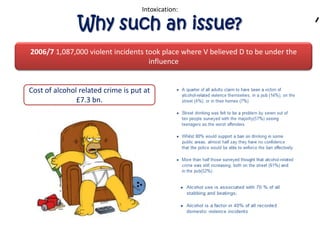
Intoxication:

               Why such an issue?
2006/7 1,087,000 violent incidents took place where V believed D to be under the
                                    influence


Cost of alcohol related crime is put at
               £7.3 bn.
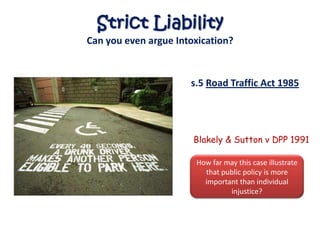
Strict Liability
Can you even argue Intoxication?


                      s.5 Road Traffic Act 1985


                       Blakely & Sutton v DPP 1991

                       How far may this case illustrate
                         that public policy is more
                         important than individual
                                injustice?
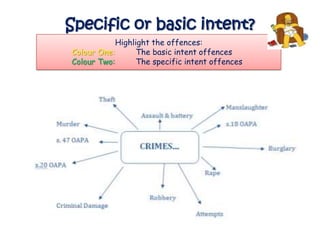
Specific or basic intent?
            Highlight the offences:
Colour One:       The basic intent offences
Colour Two:       The specific intent offences
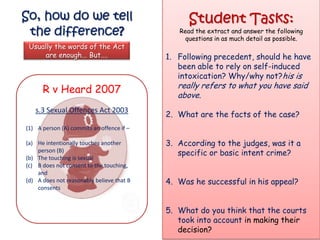
So, how do we tell                               Student Tasks:
 the difference?                              Read the extract and answer the following
                                                questions in as much detail as possible.
 Usually the words of the Act
     are enough... But....                 1. Following precedent, should he have
                                              been able to rely on self-induced
                                              intoxication? Why/why not?his is
                                              really refers to what you have said
      R v Heard 2007                          above.
   s.3 Sexual Offences Act 2003
                                           2. What are the facts of the case?
(1) A person (A) commits an offence if –

(a) He intentionally touches another       3. According to the judges, was it a
    person (B)                                specific or basic intent crime?
(b) The touching is sexual
(c) B does not consent to the touching,
    and
(d) A does not reasonably believe that B   4. Was he successful in his appeal?
    consents


                                           5. What do you think that the courts
                                              took into account in making their
                                              decision?
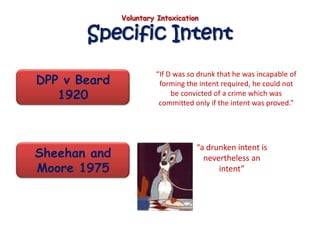
Voluntary Intoxication

       Specific Intent

DPP v Beard
                       “If D was so drunk that he was incapable of
                        forming the intent required, he could not
   1920                     be convicted of a crime which was
                        committed only if the intent was proved.”


                                   “a drunken intent is
Sheehan and                          nevertheless an
Moore 1975                               intent”
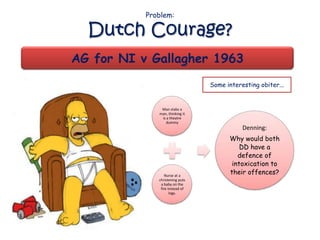
Problem:

  Dutch Courage?
AG for NI v Gallagher 1963
                                 Some interesting obiter...


               Man stabs a
              man, thinking it
               is a theatre
                 dummy
                                            Denning:
                                       Why would both
                                           DD have a
                                          defence of
                                        intoxication to
                  Nurse at a
                                       their offences?
              christening puts
               a baby on the
               fire instead of
                     logs.
Plenary:
How much have you learnt this lesson?
   How many of these sentences can you complete without notes?


          A. R v Heard has created confusion because...

          B. Intoxication is not a true defence because...

          C. D generally may have a defence to a specific
             intent crime because...

          D. Explain why intoxication cannot be a defence to a
             strict liability offence…

          E. In deciding whether D can rely on a defence of
             intoxication, the courts are most worried about...
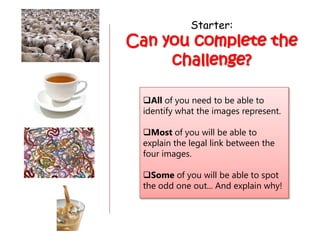
Starter:
Can you complete the
     challenge?

  All of you need to be able to
  identify what the images represent.

  Most of you will be able to
  explain the legal link between the
  four images.

  Some of you will be able to spot
  the odd one out... And explain why!
Re-sitting and want some help?


G151 English Legal
     System
     Wednesdays p.6


G152 Sources of Law
   Thursdays p.6 Week B
    Fridays p.6 Week A
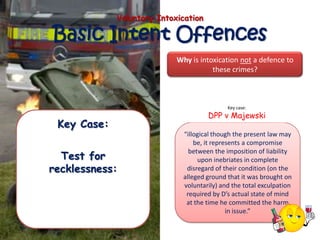
Voluntary Intoxication

Basic Intent Offences
                            Why is intoxication not a defence to
                                       these crimes?


                                             Key case:
                                      DPP v Majewski
 Key Case:
                              “illogical though the present law may
                                  be, it represents a compromise

  Test for
                                between the imposition of liability
                                   upon inebriates in complete
recklessness:                  disregard of their condition (on the
                              alleged ground that it was brought on
                              voluntarily) and the total exculpation
                               required by D’s actual state of mind
                               at the time he committed the harm
                                              in issue.”
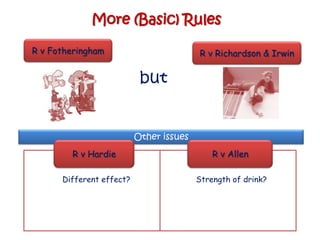
More (Basic) Rules

R v Fotheringham                         R v Richardson & Irwin


                           but


                          Other issues
        R v Hardie                           R v Allen

      Different effect?                  Strength of drink?
Involuntary Intoxication


                                General Rules:

    If the drink is spiked...


   But: What if it has a very
       different effect?


But: What if it merely removes
boundaries in your behaviour?
Key Case:

R v Kingston 1994

      1.   What are the facts of the offences?

      2.   What were D’s impulses, the
           resistance to which was lowered by
           the intoxicant?

      3.   Name two of the problems with the
           Court of Appeals quashing of the
           conviction.

      4.   What is meant by a ‘spurious’ defence?

      5.   Do you agree with the decision of the
           Court of Appeal or the House of
           Lords? Why?
Intoxicated Mistake
  This is where as a result of D’s intoxication, he made a mistake as to a key fact or to the
                                     amount of force used.


             The rule is...
Specific
 intent

             The rule is...
  Basic
 intent


          Can you name these
           mistaken cases?
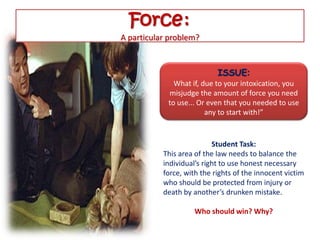
Force:
A particular problem?


                            ISSUE:
              What if, due to your intoxication, you
            misjudge the amount of force you need
            to use... Or even that you needed to use
                        any to start with!”


                           Student Task:
           This area of the law needs to balance the
           individual’s right to use honest necessary
           force, with the rights of the innocent victim
           who should be protected from injury or
           death by another’s drunken mistake.

                     Who should win? Why?
The approach of the Courts

R v O’Grady           R v Hutton                 Jaggard v
                                                 Dickinson


                                        s.5 Criminal Damage
                                               Act 1971
                                          “if at the time of the act or acts
                                       alleged to constitute the offence he
                                       believed that the person or persons
                                       whom he believed to be entitled to
                                         consent to the destruction of or
                                       damage to the property in question
                                       had so consented... it is immaterial
                                       whether a belief is justified or not if
R v O’Connor                                      it is honestly held.”
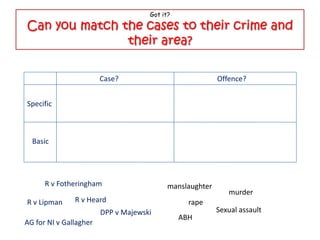
Got it?

Can you match the cases to their crime and
               their area?

                        Case?                             Offence?


Specific


  Basic


      R v Fotheringham                     manslaughter
                                                             murder
R v Lipman     R v Heard                         rape
                        DPP v Majewski                    Sexual assault
                                               ABH
AG for NI v Gallagher
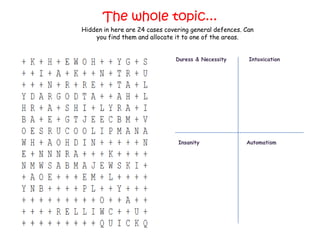
The whole topic...
Hidden in here are 24 cases covering general defences. Can
    you find them and allocate it to one of the areas.


                               Duress & Necessity       Intoxication


                                Insanity               Automatism
Homework
     You will be a given a short pack which
  includes articles on reform and evaluation
    of the law on insanity and automatism.

 You need to read the articles and consider
 their arguments.

 Using your own words, produce at least
 two sides evaluating the current law, and
 the proposals for change.

            Are you aiming for the top?
  You are strongly advised to read chapter two on
insanity from the Law Commission’s recent scoping
                       paper.
http://lawcommission.justice.gov.uk/docs/insanity_
                  scoping.pdf
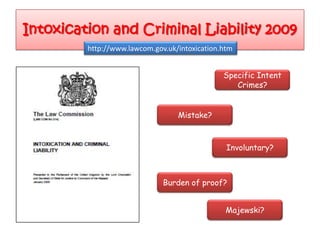
Intoxication and Criminal Liability 2009
         http://www.lawcom.gov.uk/intoxication.htm


                                               Specific Intent
                                                  Crimes?


                                  Mistake?


                                                Involuntary?


                              Burden of proof?


                                                Majewski?
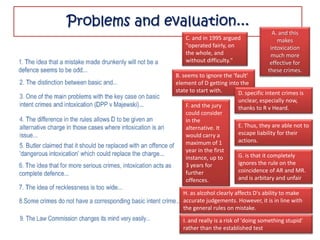
Problems and evaluation...
                                                        A. and this
                   C. and in 1995 argued                  makes
                   "operated fairly, on                intoxication
                   the whole, and                      much more
                   without difficulty."                effective for
                                                      these crimes.
               B. seems to ignore the 'fault'
               element of D getting into the
               state to start with.     D. specific intent crimes is
                                         unclear, especially now,
                   F. and the jury       thanks to R v Heard.
                   could consider
                   in the
                   alternative. It       E. Thus, they are able not to
                   would carry a         escape liability for their
                   maximum of 1          actions.
                   year in the first
                   instance, up to       G. is that it completely
                   3 years for           ignores the rule on the
                   further               coincidence of AR and MR.
                   offences.             and is arbitary and unfair

                  H. as alcohol clearly affects D's ability to make
                  accurate judgements. However, it is in line with
                  the general rules on mistake.

                  I. and really is a risk of 'doing something stupid'
                  rather than the established test
What about the rest of the world?
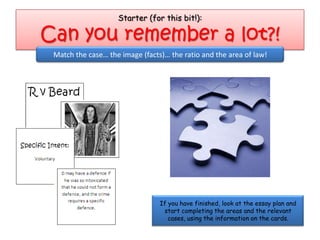
Starter (for this bit!):

Can you remember a lot?!
 Match the case… the image (facts)… the ratio and the area of law!


                                 If you have finished, look at the essay plan and
                                  start completing the areas and the relevant
                                    cases, using the information on the cards.
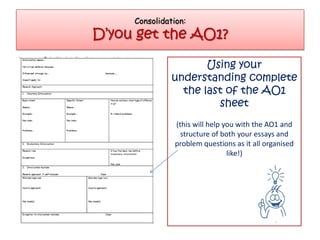
Consolidation:
D’you get the AO1?

                      Using your
               understanding complete
                 the last of the AO1
                         sheet
                (this will help you with the AO1 and
                  structure of both your essays and
                problem questions as it all organised
                                 like!)
Finally:
     What’s wrong with each of the following
                  statements?


1. Intoxication is a general defence to any offence in theory.

2. Crimes are divided into basic and specific offences, and it
   depends on the words of the Act, as to which it is.

3. Kingston was found not guilty, because his drink was spiked.

4. If the drink is stronger than D thinks, then he has a defence if
   he subsequently couldn’t form the MR for the offence.

5. Whilst taking the intoxicant is enough for the mens rea for a
   basic intent offence, if the intoxicant has a different effect, D
   may not be liable.
Homework
        Complete a plan for the
     essay detailed below. You will
       be writing this up in timed
      conditions, and should make
          sure that your plan
        addresses both AO1 and
                  AO2

      “Discuss the view that the
       defence of intoxication
        strikes a fair balance
     between legal principle and
            public policy.”

Intoxication 2012 3

  • 1.
    Quick Recap: Can you sort the mental condition defences out? You have the mixed up sections for the three mental condition defences (automatism, insanity and diminished responsibility). All you need to do is sort them out into the correct defence. For each you need:  Cause  Example of what might be included  Outcome  Label  Scenario  Two case examples
  • 2.
    So what canyou tell me about mental condition defences? Complete the brainstorm below to show your understanding of the AO1 for this topic Means? Means? Result? Result? Mental automatism Insanity condition defences
  • 3.
    Any areas youhave put nothing for... Plenary Were you missing? How confident are you? Did you ask? Have you researched? I know what I can I can evaluate this is. describe this or discuss this The implications of pleading insanity The definition of insanity from M’Naughten The interpretation of defect of reason The interpretation of disease of the mind What is meant by nature and quality and wrong The definition of non-insane automatism The approach of the court to self induced automatism The problems with the current law on insanity and automatism.
  • 4.
    General Defences: Intoxication Miss M. Hart G153 [2012]
  • 5.
    You already knowquite a lot! Complete the following paragraph to show how much you actually already know (and yes... This includes knowledge from last year) The courts have decided that there are two types of intent in intoxication – and . The general rule for a basic intent crime, such as , is that by taking the intoxicant, D is and so has the mens rea. This is illustrated by the case of , where even though he had no idea what he was actually doing, the taking of the LSD would be enough. However, there is a clear exception where the substance has a different effect on D than anticipated as in the case of . A intent crime, like is one which requires intent only as the mens rea. For these crimes, D may have a defence if he was so intoxicated that he could not at all. The courts have said that even if it was self-induced, D may have a defence as in the case of where he injected himself with insulin and then did not eat. If D is involuntarily intoxicated, then he may have a defence, but only if he never had the mens rea to start with. The courts have made this clear in , where the Private detective drugged D and helped him to abuse a young boy. Kingston manslaughter Bailey specific Lipman basic reckless murder Hardie form a mens rea specific
  • 6.
    So, let’s buildon this: The basics An intoxicant is.... It is not a ‘true defence’ because.... When argued it is because .... Or.... It is governed very strictly by.... The general rule is....
  • 7.
    Intoxication: Why such an issue? 2006/7 1,087,000 violent incidents took place where V believed D to be under the influence Cost of alcohol related crime is put at £7.3 bn.
  • 8.
    Strict Liability Can youeven argue Intoxication? s.5 Road Traffic Act 1985 Blakely & Sutton v DPP 1991 How far may this case illustrate that public policy is more important than individual injustice?
  • 9.
    Specific or basicintent? Highlight the offences: Colour One: The basic intent offences Colour Two: The specific intent offences
  • 10.
    So, how dowe tell Student Tasks: the difference? Read the extract and answer the following questions in as much detail as possible. Usually the words of the Act are enough... But.... 1. Following precedent, should he have been able to rely on self-induced intoxication? Why/why not?his is really refers to what you have said R v Heard 2007 above. s.3 Sexual Offences Act 2003 2. What are the facts of the case? (1) A person (A) commits an offence if – (a) He intentionally touches another 3. According to the judges, was it a person (B) specific or basic intent crime? (b) The touching is sexual (c) B does not consent to the touching, and (d) A does not reasonably believe that B 4. Was he successful in his appeal? consents 5. What do you think that the courts took into account in making their decision?
  • 11.
    Voluntary Intoxication Specific Intent DPP v Beard “If D was so drunk that he was incapable of forming the intent required, he could not 1920 be convicted of a crime which was committed only if the intent was proved.” “a drunken intent is Sheehan and nevertheless an Moore 1975 intent”
  • 12.
    Problem: DutchCourage? AG for NI v Gallagher 1963 Some interesting obiter... Man stabs a man, thinking it is a theatre dummy Denning: Why would both DD have a defence of intoxication to Nurse at a their offences? christening puts a baby on the fire instead of logs.
  • 13.
    Plenary: How much haveyou learnt this lesson? How many of these sentences can you complete without notes? A. R v Heard has created confusion because... B. Intoxication is not a true defence because... C. D generally may have a defence to a specific intent crime because... D. Explain why intoxication cannot be a defence to a strict liability offence… E. In deciding whether D can rely on a defence of intoxication, the courts are most worried about...
  • 14.
    Starter: Can you completethe challenge? All of you need to be able to identify what the images represent. Most of you will be able to explain the legal link between the four images. Some of you will be able to spot the odd one out... And explain why!
  • 15.
    Re-sitting and wantsome help? G151 English Legal System Wednesdays p.6 G152 Sources of Law Thursdays p.6 Week B Fridays p.6 Week A
  • 16.
    Voluntary Intoxication Basic IntentOffences Why is intoxication not a defence to these crimes? Key case: DPP v Majewski Key Case: “illogical though the present law may be, it represents a compromise Test for between the imposition of liability upon inebriates in complete recklessness: disregard of their condition (on the alleged ground that it was brought on voluntarily) and the total exculpation required by D’s actual state of mind at the time he committed the harm in issue.”
  • 17.
    More (Basic) Rules Rv Fotheringham R v Richardson & Irwin but Other issues R v Hardie R v Allen Different effect? Strength of drink?
  • 18.
    Involuntary Intoxication General Rules: If the drink is spiked... But: What if it has a very different effect? But: What if it merely removes boundaries in your behaviour?
  • 19.
    Key Case: R vKingston 1994 1. What are the facts of the offences? 2. What were D’s impulses, the resistance to which was lowered by the intoxicant? 3. Name two of the problems with the Court of Appeals quashing of the conviction. 4. What is meant by a ‘spurious’ defence? 5. Do you agree with the decision of the Court of Appeal or the House of Lords? Why?
  • 20.
    Intoxicated Mistake This is where as a result of D’s intoxication, he made a mistake as to a key fact or to the amount of force used. The rule is... Specific intent The rule is... Basic intent Can you name these mistaken cases?
  • 21.
    Force: A particular problem? ISSUE: What if, due to your intoxication, you misjudge the amount of force you need to use... Or even that you needed to use any to start with!” Student Task: This area of the law needs to balance the individual’s right to use honest necessary force, with the rights of the innocent victim who should be protected from injury or death by another’s drunken mistake. Who should win? Why?
  • 22.
    The approach ofthe Courts R v O’Grady R v Hutton Jaggard v Dickinson s.5 Criminal Damage Act 1971 “if at the time of the act or acts alleged to constitute the offence he believed that the person or persons whom he believed to be entitled to consent to the destruction of or damage to the property in question had so consented... it is immaterial whether a belief is justified or not if R v O’Connor it is honestly held.”
  • 23.
    Got it? Can youmatch the cases to their crime and their area? Case? Offence? Specific Basic R v Fotheringham manslaughter murder R v Lipman R v Heard rape DPP v Majewski Sexual assault ABH AG for NI v Gallagher
  • 24.
    The whole topic... Hiddenin here are 24 cases covering general defences. Can you find them and allocate it to one of the areas. Duress & Necessity Intoxication Insanity Automatism
  • 25.
    Homework You will be a given a short pack which includes articles on reform and evaluation of the law on insanity and automatism. You need to read the articles and consider their arguments. Using your own words, produce at least two sides evaluating the current law, and the proposals for change. Are you aiming for the top? You are strongly advised to read chapter two on insanity from the Law Commission’s recent scoping paper. http://lawcommission.justice.gov.uk/docs/insanity_ scoping.pdf
  • 26.
    Intoxication and CriminalLiability 2009 http://www.lawcom.gov.uk/intoxication.htm Specific Intent Crimes? Mistake? Involuntary? Burden of proof? Majewski?
  • 27.
    Problems and evaluation... A. and this C. and in 1995 argued makes "operated fairly, on intoxication the whole, and much more without difficulty." effective for these crimes. B. seems to ignore the 'fault' element of D getting into the state to start with. D. specific intent crimes is unclear, especially now, F. and the jury thanks to R v Heard. could consider in the alternative. It E. Thus, they are able not to would carry a escape liability for their maximum of 1 actions. year in the first instance, up to G. is that it completely 3 years for ignores the rule on the further coincidence of AR and MR. offences. and is arbitary and unfair H. as alcohol clearly affects D's ability to make accurate judgements. However, it is in line with the general rules on mistake. I. and really is a risk of 'doing something stupid' rather than the established test
  • 28.
    What about therest of the world?
  • 29.
    Starter (for thisbit!): Can you remember a lot?! Match the case… the image (facts)… the ratio and the area of law! If you have finished, look at the essay plan and start completing the areas and the relevant cases, using the information on the cards.
  • 30.
    Consolidation: D’you get theAO1? Using your understanding complete the last of the AO1 sheet (this will help you with the AO1 and structure of both your essays and problem questions as it all organised like!)
  • 31.
    Finally: What’s wrong with each of the following statements? 1. Intoxication is a general defence to any offence in theory. 2. Crimes are divided into basic and specific offences, and it depends on the words of the Act, as to which it is. 3. Kingston was found not guilty, because his drink was spiked. 4. If the drink is stronger than D thinks, then he has a defence if he subsequently couldn’t form the MR for the offence. 5. Whilst taking the intoxicant is enough for the mens rea for a basic intent offence, if the intoxicant has a different effect, D may not be liable.
  • 32.
    Homework Complete a plan for the essay detailed below. You will be writing this up in timed conditions, and should make sure that your plan addresses both AO1 and AO2 “Discuss the view that the defence of intoxication strikes a fair balance between legal principle and public policy.”

Editor's Notes

  • #25 BAILEYBEARDBOWENBRATTYCLARKECOLECONWAYGRAHAMHARDIEHASANHEARDHOWEJOHNSONKEMPKINGSTONLIPMANMAJEWSKIMNAUGHTENOGRADYQUAYLEQUICKREASULLIVANWILLER