
Some Criminal Case Law
R v Malcherek and Steel
Death occurs when the victim is 'brain dead’
AG Reference no 3 1994
A human is capable of having an existence
      independent of its mother
R v White
 Causation in Fact: 'but for' the actions of the
defendant the victim would still have still been
                     alive
R v Smith
Causation in Law: If the injury caused by the
defendant was an operative and substantial
 cause of death the defendant will be guilty
R v Jordan
     Novus actus interveniens: If medical
intervention is palpably wrong there may be a
       break in the chain of causation
R v Paggett
   Novus actus interveniens: A reasonably
foreseeable intervention of a third party will
      not break the chain of causation
R v Roberts
   Novus actus interveniens: A reasonably
foreseeable intervention of a third party will
      not break the chain of causation.
R v Dear
 Novus actus interveniens: Where a victim
neglects their injuries, the chain of causation
 will not be broken if it worsens the injury
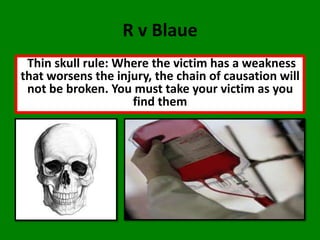
R v Blaue
 Thin skull rule: Where the victim has a weakness
that worsens the injury, the chain of causation will
 not be broken. You must take your victim as you
                    find them
R v Woollin
Oblique intent: occurs where the consequence
             is a virtual certainty
R v Vickers
MR for Murder: Where the defendant intended
to cause GBH and the victim died, the correct
charge is murder.
R v Byrne
Diminished Responsibility: The leading case
that illustrates irresistible impulses that cannot
be controlled and may amount to diminished
responsibility
R v Dietschmann
Diminished Responsibility: D was intoxicated
and pleading diminished responsibility, the
courts should consider whether despite being
drunk whether the mental responsibility was
impaired
R v Duffy
Provocation (Now Loss of Control): Under the
common law the 'loss of control' has to be
sudden and temporary
R v Pearson
Provocation (Now Loss of Control): Third party
provocation could cause a defendant to lose
self control
R v Ahluwalia
Provocation (Now Loss of Control): Where
there is a time delay between the provocative
act and the behavior of D the D will not be able
to rely on the defence as set out in s3 of the
Homicide Act 1957. One of the factors that led
to reform.
R v Thornton
Provocation (Now Loss of Control):A minor
incident could act as the last straw and trigger
and sudden final loss of control, following a
long build up of provocation
R v Camplin
Provocation (Now Loss of Control):The case
that developed the rule that age and sex may
be taken into consideration when considering
the objective test aspect for provocation
R v Holley
Provocation (Now Loss of Control):This Privy
Council case states that the jury must consider
the effect of provocation of a person of the
same age and sex, but with ordinary powers of
self control
R v Stone and Dobinson
GNM and Omissions: Ds failure to feed or get
medical attention for the Ds sister amounted to
an assumed responsibility where by they were
convicted of gross negligence
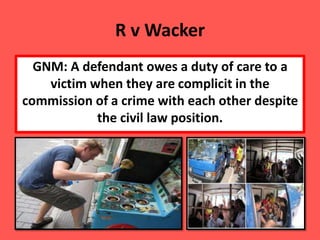
R v Wacker
  GNM: A defendant owes a duty of care to a
    victim when they are complicit in the
commission of a crime with each other despite
            the civil law position.
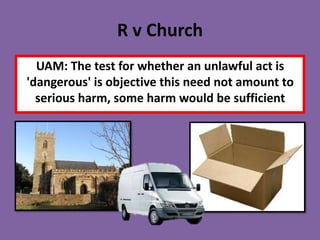
R v Church
  UAM: The test for whether an unlawful act is
'dangerous' is objective this need not amount to
  serious harm, some harm would be sufficient
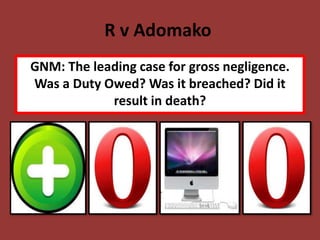
R v Adomako
GNM: The leading case for gross negligence.
Was a Duty Owed? Was it breached? Did it
            result in death?
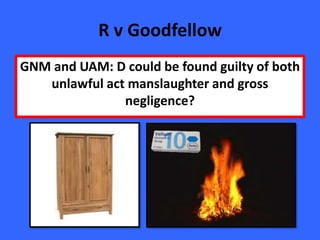
R v Goodfellow
GNM and UAM: D could be found guilty of both
   unlawful act manslaughter and gross
               negligence?
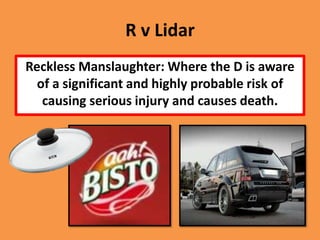
R v Lidar
Reckless Manslaughter: Where the D is aware
  of a significant and highly probable risk of
   causing serious injury and causes death.

Some Criminal Case Law

  • 1.
  • 2.
    R v Malcherekand Steel Death occurs when the victim is 'brain dead’
  • 3.
    AG Reference no3 1994 A human is capable of having an existence independent of its mother
  • 4.
    R v White Causation in Fact: 'but for' the actions of the defendant the victim would still have still been alive
  • 5.
    R v Smith Causationin Law: If the injury caused by the defendant was an operative and substantial cause of death the defendant will be guilty
  • 6.
    R v Jordan Novus actus interveniens: If medical intervention is palpably wrong there may be a break in the chain of causation
  • 7.
    R v Paggett Novus actus interveniens: A reasonably foreseeable intervention of a third party will not break the chain of causation
  • 8.
    R v Roberts Novus actus interveniens: A reasonably foreseeable intervention of a third party will not break the chain of causation.
  • 9.
    R v Dear Novus actus interveniens: Where a victim neglects their injuries, the chain of causation will not be broken if it worsens the injury
  • 10.
    R v Blaue Thin skull rule: Where the victim has a weakness that worsens the injury, the chain of causation will not be broken. You must take your victim as you find them
  • 11.
    R v Woollin Obliqueintent: occurs where the consequence is a virtual certainty
  • 12.
    R v Vickers MRfor Murder: Where the defendant intended to cause GBH and the victim died, the correct charge is murder.
  • 13.
    R v Byrne DiminishedResponsibility: The leading case that illustrates irresistible impulses that cannot be controlled and may amount to diminished responsibility
  • 14.
    R v Dietschmann DiminishedResponsibility: D was intoxicated and pleading diminished responsibility, the courts should consider whether despite being drunk whether the mental responsibility was impaired
  • 15.
    R v Duffy Provocation(Now Loss of Control): Under the common law the 'loss of control' has to be sudden and temporary
  • 16.
    R v Pearson Provocation(Now Loss of Control): Third party provocation could cause a defendant to lose self control
  • 17.
    R v Ahluwalia Provocation(Now Loss of Control): Where there is a time delay between the provocative act and the behavior of D the D will not be able to rely on the defence as set out in s3 of the Homicide Act 1957. One of the factors that led to reform.
  • 18.
    R v Thornton Provocation(Now Loss of Control):A minor incident could act as the last straw and trigger and sudden final loss of control, following a long build up of provocation
  • 19.
    R v Camplin Provocation(Now Loss of Control):The case that developed the rule that age and sex may be taken into consideration when considering the objective test aspect for provocation
  • 20.
    R v Holley Provocation(Now Loss of Control):This Privy Council case states that the jury must consider the effect of provocation of a person of the same age and sex, but with ordinary powers of self control
  • 21.
    R v Stoneand Dobinson GNM and Omissions: Ds failure to feed or get medical attention for the Ds sister amounted to an assumed responsibility where by they were convicted of gross negligence
  • 22.
    R v Wacker GNM: A defendant owes a duty of care to a victim when they are complicit in the commission of a crime with each other despite the civil law position.
  • 23.
    R v Church UAM: The test for whether an unlawful act is 'dangerous' is objective this need not amount to serious harm, some harm would be sufficient
  • 24.
    R v Adomako GNM:The leading case for gross negligence. Was a Duty Owed? Was it breached? Did it result in death?
  • 25.
    R v Goodfellow GNMand UAM: D could be found guilty of both unlawful act manslaughter and gross negligence?
  • 26.
    R v Lidar RecklessManslaughter: Where the D is aware of a significant and highly probable risk of causing serious injury and causes death.