
Introduction to TV ProductionIntroduction to TV Production
• TV System
• Four Stages of Production
• Staff and Crew
• Producing for Television
Television System
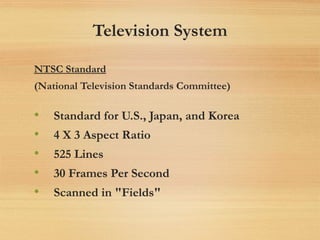
NTSC Standard
(National Television Standards Committee)
• Standard for U.S., Japan, and Korea
• 4 X 3 Aspect Ratio
• 525 Lines
• 30 Frames Per Second
• Scanned in "Fields"
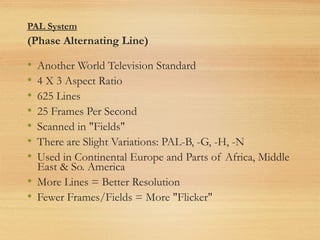
PAL System
(Phase Alternating Line)
• Another World Television Standard
• 4 X 3 Aspect Ratio
• 625 Lines
• 25 Frames Per Second
• Scanned in "Fields"
• There are Slight Variations: PAL-B, -G, -H, -N
• Used in Continental Europe and Parts of Africa, Middle
East & So. America
• More Lines = Better Resolution
• Fewer Frames/Fields = More "Flicker"
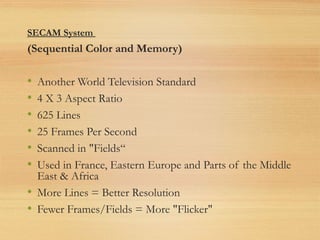
SECAM System
(Sequential Color and Memory)
• Another World Television Standard
• 4 X 3 Aspect Ratio
• 625 Lines
• 25 Frames Per Second
• Scanned in "Fields“
• Used in France, Eastern Europe and Parts of the Middle
East & Africa
• More Lines = Better Resolution
• Fewer Frames/Fields = More "Flicker"
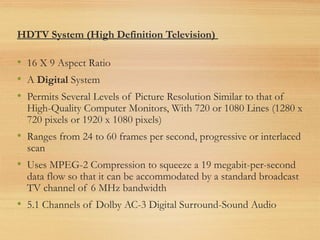
HDTV System (High Definition Television)
• 16 X 9 Aspect Ratio
• A Digital System
• Permits Several Levels of Picture Resolution Similar to that of
High-Quality Computer Monitors, With 720 or 1080 Lines (1280 x
720 pixels or 1920 x 1080 pixels)
• Ranges from 24 to 60 frames per second, progressive or interlaced
scan
• Uses MPEG-2 Compression to squeeze a 19 megabit-per-second
data flow so that it can be accommodated by a standard broadcast
TV channel of 6 MHz bandwidth
• 5.1 Channels of Dolby AC-3 Digital Surround-Sound Audio
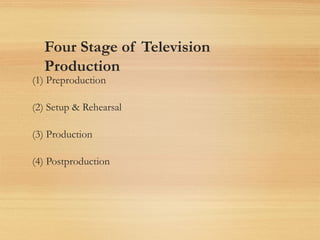
Four Stage of Television
Production
(1) Preproduction
(2) Setup & Rehearsal
(3) Production
(4) Postproduction
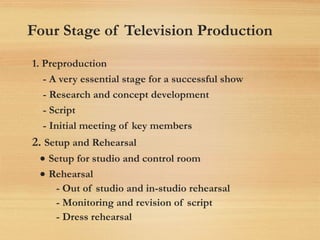
Four Stage of Television Production
1. Preproduction
- A very essential stage for a successful show
- Research and concept development
- Script
- Initial meeting of key members
2. Setup and Rehearsal
• Setup for studio and control room
• Rehearsal
- Out of studio and in-studio rehearsal
- Monitoring and revision of script
- Dress rehearsal
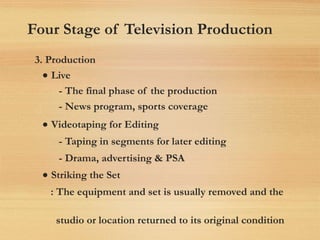
Four Stage of Television Production
3. Production
• Live
- The final phase of the production
- News program, sports coverage
• Videotaping for Editing
- Taping in segments for later editing
- Drama, advertising & PSA
• Striking the Set
: The equipment and set is usually removed and the
studio or location returned to its original condition
Four Stage of Television Production
4. Postproduction
• Creative control
- Selection of shots
- Juxtaposition
• Special effects and graphics
- Computer technology: Non-linear editing
• Audio
- Enhancement and modification or addition
The Television Team
• Production Staff
- PD, DIR, AD, PA
• Production Crew
- TD, AUD, FM, FA, CAM, CG, LD, SET, TAL
• Golden Rule
“Try to be a good crew person for your fellow classmates
when they direct, just as you will most certainly want
them to be a good crew for you when you direct.”
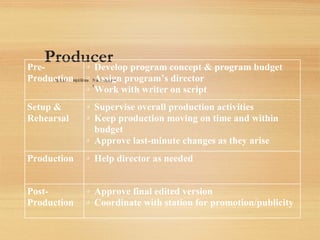
Producer
Preproduction Setup&Rehearsal Productio
n
Postproduction
Pre-
Production

Develop program concept & program budget

Assign program’s director

Work with writer on script
Setup &
Rehearsal

Supervise overall production activities

Keep production moving on time and within
budget

Approve last-minute changes as they arise
Production 
Help director as needed
Post-
Production

Approve final edited version

Coordinate with station for promotion/publicity
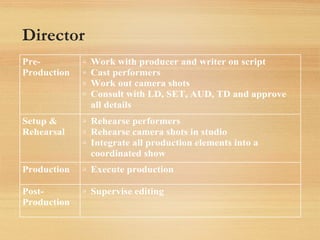
Director
Pre-
Production

Work with producer and writer on script

Cast performers

Work out camera shots

Consult with LD, SET, AUD, TD and approve
all details
Setup &
Rehearsal

Rehearse performers

Rehearse camera shots in studio

Integrate all production elements into a
coordinated show
Production 
Execute production
Post-
Production

Supervise editing
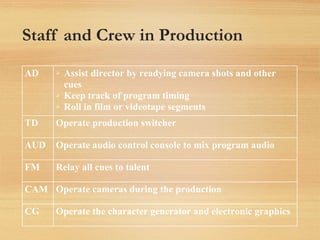
Staff and Crew in Production
AD 
Assist director by readying camera shots and other
cues

Keep track of program timing

Roll in film or videotape segments
TD Operate production switcher
AUD Operate audio control console to mix program audio
FM Relay all cues to talent
CAM Operate cameras during the production
CG Operate the character generator and electronic graphics
Producing for Television
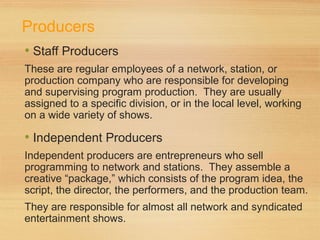
Producers
• Staff Producers
These are regular employees of a network, station, or
production company who are responsible for developing
and supervising program production. They are usually
assigned to a specific division, or in the local level, working
on a wide variety of shows.
• Independent Producers
Independent producers are entrepreneurs who sell
programming to network and stations. They assemble a
creative “package,” which consists of the program idea, the
script, the director, the performers, and the production team.
They are responsible for almost all network and syndicated
entertainment shows.
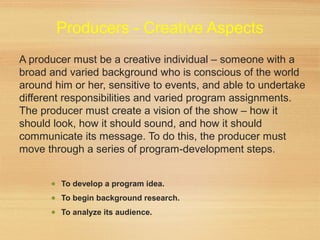
Producers - Creative Aspects
A producer must be a creative individual – someone with a
broad and varied background who is conscious of the world
around him or her, sensitive to events, and able to undertake
different responsibilities and varied program assignments.
The producer must create a vision of the show – how it
should look, how it should sound, and how it should
communicate its message. To do this, the producer must
move through a series of program-development steps.
• To develop a program idea.
• To begin background research.
• To analyze its audience.
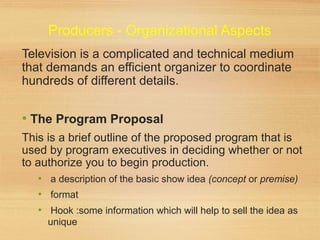
Producers - Organizational Aspects
Television is a complicated and technical medium
that demands an efficient organizer to coordinate
hundreds of different details.
• The Program Proposal
This is a brief outline of the proposed program that is
used by program executives in deciding whether or not
to authorize you to begin production.
• a description of the basic show idea (concept or premise)
• format
• Hook :some information which will help to sell the idea as
unique
The Production Book
The production book is a blueprint of the entire production
process, and it offers in minute detail who, what, when,
where, and how of a production.
• treatment
• shooting script
• staff and crew (including contracts)
• complete budget information
• schedules
• memos and meeting notes
• lighting plot and set design plan
Producers - Business Aspects
The producer organizes a creative idea within financial constraints.
Among the business aspects of the producer’s role are (1) creating
budgets, (2) selling the ideas, and (3) understanding
contractual obligations.
The producer’s roles
• Developing an idea and analyzing audience.
• Researching the idea and production feasibility.
• Determining the production mode.
• Developing the program outline.
• Preparing the program budget.
Question to ask as a Producer
• Who is target audience?
• Why should audience watch?
• When should audience watch?
• How long should program be?
• How should program be produced?
• What are the production costs?
• Is the idea doable?
• Can you sell the idea?
• How will you know if you’ve succeeded?

Intoduction to tv

  • 1.
    Introduction to TVProductionIntroduction to TV Production • TV System • Four Stages of Production • Staff and Crew • Producing for Television
  • 2.
    Television System NTSC Standard (NationalTelevision Standards Committee) • Standard for U.S., Japan, and Korea • 4 X 3 Aspect Ratio • 525 Lines • 30 Frames Per Second • Scanned in "Fields"
  • 3.
    PAL System (Phase AlternatingLine) • Another World Television Standard • 4 X 3 Aspect Ratio • 625 Lines • 25 Frames Per Second • Scanned in "Fields" • There are Slight Variations: PAL-B, -G, -H, -N • Used in Continental Europe and Parts of Africa, Middle East & So. America • More Lines = Better Resolution • Fewer Frames/Fields = More "Flicker"
  • 4.
    SECAM System (Sequential Colorand Memory) • Another World Television Standard • 4 X 3 Aspect Ratio • 625 Lines • 25 Frames Per Second • Scanned in "Fields“ • Used in France, Eastern Europe and Parts of the Middle East & Africa • More Lines = Better Resolution • Fewer Frames/Fields = More "Flicker"
  • 5.
    HDTV System (HighDefinition Television) • 16 X 9 Aspect Ratio • A Digital System • Permits Several Levels of Picture Resolution Similar to that of High-Quality Computer Monitors, With 720 or 1080 Lines (1280 x 720 pixels or 1920 x 1080 pixels) • Ranges from 24 to 60 frames per second, progressive or interlaced scan • Uses MPEG-2 Compression to squeeze a 19 megabit-per-second data flow so that it can be accommodated by a standard broadcast TV channel of 6 MHz bandwidth • 5.1 Channels of Dolby AC-3 Digital Surround-Sound Audio
  • 6.
    Four Stage ofTelevision Production (1) Preproduction (2) Setup & Rehearsal (3) Production (4) Postproduction
  • 7.
    Four Stage ofTelevision Production 1. Preproduction - A very essential stage for a successful show - Research and concept development - Script - Initial meeting of key members 2. Setup and Rehearsal • Setup for studio and control room • Rehearsal - Out of studio and in-studio rehearsal - Monitoring and revision of script - Dress rehearsal
  • 8.
    Four Stage ofTelevision Production 3. Production • Live - The final phase of the production - News program, sports coverage • Videotaping for Editing - Taping in segments for later editing - Drama, advertising & PSA • Striking the Set : The equipment and set is usually removed and the studio or location returned to its original condition
  • 9.
    Four Stage ofTelevision Production 4. Postproduction • Creative control - Selection of shots - Juxtaposition • Special effects and graphics - Computer technology: Non-linear editing • Audio - Enhancement and modification or addition
  • 10.
    The Television Team •Production Staff - PD, DIR, AD, PA • Production Crew - TD, AUD, FM, FA, CAM, CG, LD, SET, TAL • Golden Rule “Try to be a good crew person for your fellow classmates when they direct, just as you will most certainly want them to be a good crew for you when you direct.”
  • 11.
    Producer Preproduction Setup&Rehearsal Productio n Postproduction Pre- Production  Developprogram concept & program budget  Assign program’s director  Work with writer on script Setup & Rehearsal  Supervise overall production activities  Keep production moving on time and within budget  Approve last-minute changes as they arise Production  Help director as needed Post- Production  Approve final edited version  Coordinate with station for promotion/publicity
  • 12.
    Director Pre- Production  Work with producerand writer on script  Cast performers  Work out camera shots  Consult with LD, SET, AUD, TD and approve all details Setup & Rehearsal  Rehearse performers  Rehearse camera shots in studio  Integrate all production elements into a coordinated show Production  Execute production Post- Production  Supervise editing
  • 13.
    Staff and Crewin Production AD  Assist director by readying camera shots and other cues  Keep track of program timing  Roll in film or videotape segments TD Operate production switcher AUD Operate audio control console to mix program audio FM Relay all cues to talent CAM Operate cameras during the production CG Operate the character generator and electronic graphics
  • 14.
  • 15.
    Producers • Staff Producers Theseare regular employees of a network, station, or production company who are responsible for developing and supervising program production. They are usually assigned to a specific division, or in the local level, working on a wide variety of shows. • Independent Producers Independent producers are entrepreneurs who sell programming to network and stations. They assemble a creative “package,” which consists of the program idea, the script, the director, the performers, and the production team. They are responsible for almost all network and syndicated entertainment shows.
  • 16.
    Producers - CreativeAspects A producer must be a creative individual – someone with a broad and varied background who is conscious of the world around him or her, sensitive to events, and able to undertake different responsibilities and varied program assignments. The producer must create a vision of the show – how it should look, how it should sound, and how it should communicate its message. To do this, the producer must move through a series of program-development steps. • To develop a program idea. • To begin background research. • To analyze its audience.
  • 17.
    Producers - OrganizationalAspects Television is a complicated and technical medium that demands an efficient organizer to coordinate hundreds of different details. • The Program Proposal This is a brief outline of the proposed program that is used by program executives in deciding whether or not to authorize you to begin production. • a description of the basic show idea (concept or premise) • format • Hook :some information which will help to sell the idea as unique
  • 18.
    The Production Book Theproduction book is a blueprint of the entire production process, and it offers in minute detail who, what, when, where, and how of a production. • treatment • shooting script • staff and crew (including contracts) • complete budget information • schedules • memos and meeting notes • lighting plot and set design plan
  • 19.
    Producers - BusinessAspects The producer organizes a creative idea within financial constraints. Among the business aspects of the producer’s role are (1) creating budgets, (2) selling the ideas, and (3) understanding contractual obligations. The producer’s roles • Developing an idea and analyzing audience. • Researching the idea and production feasibility. • Determining the production mode. • Developing the program outline. • Preparing the program budget.
  • 20.
    Question to askas a Producer • Who is target audience? • Why should audience watch? • When should audience watch? • How long should program be? • How should program be produced? • What are the production costs? • Is the idea doable? • Can you sell the idea? • How will you know if you’ve succeeded?