Interview Preparation
Iram Sial
Careers Consultant
Objectives
This session will provide:
• Knowledge on how to prepare for job interviews
• Different types of interview/questions
• Importance of first impressions
• Role play questions
• Tips and useful resources
http://www2.askgrapevine.com/news/hr/article/2013-02-27-heineken-give-
graduate-interviewees-insane-experience/?utm_source=Sign-
Up.to&utm_medium=email&utm_campaign=7962-289204-
Graduate+Recruitment+-+28%2F02%2F13
Expect the unexpected…
http://mycareer.wmin.ac.uk/units/unit-int051.shtml
Interview Etiquette
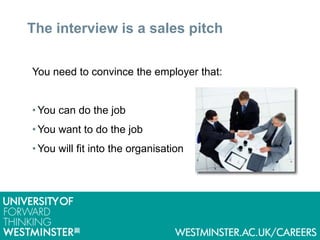
The interview is a sales pitch
You need to convince the employer that:
• You can do the job
• You want to do the job
• You will fit into the organisation
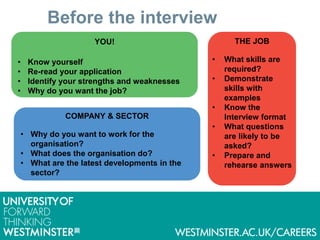
Before the interview
YOU!
• Know yourself
• Re-read your application
• Identify your strengths and weaknesses
• Why do you want the job?
COMPANY & SECTOR
• Why do you want to work for the
organisation?
• What does the organisation do?
• What are the latest developments in the
sector?
THE JOB
• What skills are
required?
• Demonstrate
skills with
examples
• Know the
Interview format
• What questions
are likely to be
asked?
• Prepare and
rehearse answers
Brainstorm: preparing the interview
• Research company/sector
• Analyse job description & person profile
• Study your application form/CV
• Match requirements of job to your attributes
• Prepare examples your experience using CAR
model
• Prepare outline answers to motivation,
knowledge & competency questions
Know yourself
• Re-read your application form
• Identify your strengths and
weaknesses
• Why do you want the job?
Preparation!
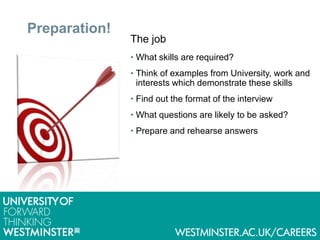
The job
• What skills are required?
• Think of examples from University, work and
interests which demonstrate these skills
• Find out the format of the interview
• What questions are likely to be asked?
• Prepare and rehearse answers
Preparation!
The organisation and the sector
• Why do you want to work for the organisation?
• What does the organisation do?
• What’s happening within the sector right now?
• Westminster Library systems – journals/reports??
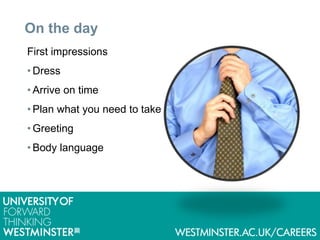
On the day
First impressions
• Dress
• Arrive on time
• Plan what you need to take
• Greeting
• Body language
Top tips for success
1. Preparation, preparation, preparation!
2. Shake hands in a firm and positive
manner
3. Check posture – avoid slouching
4. Maintain good eye contact
5. Listen carefully
6. Give clear and concise answers
7. Smile!
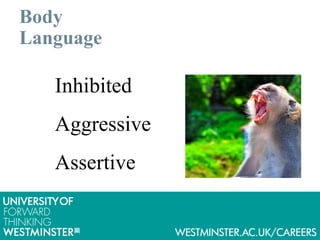
Body
Language
Inhibited
Aggressive
Assertive
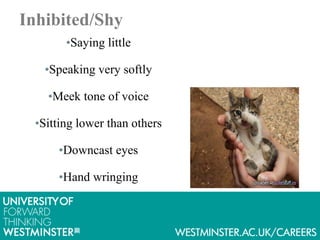
Inhibited/Shy
•Saying little
•Speaking very softly
•Meek tone of voice
•Sitting lower than others
•Downcast eyes
•Hand wringing
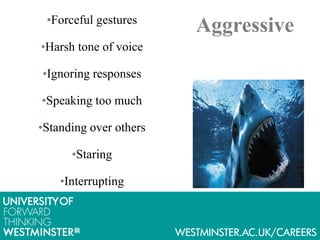
Aggressive•Forceful gestures
•Harsh tone of voice
•Ignoring responses
•Speaking too much
•Standing over others
•Staring
•Interrupting
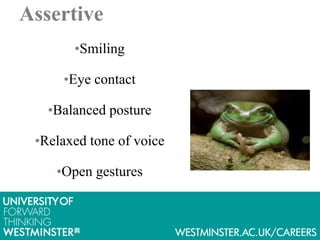
Assertive
•Smiling
•Eye contact
•Balanced posture
•Relaxed tone of voice
•Open gestures
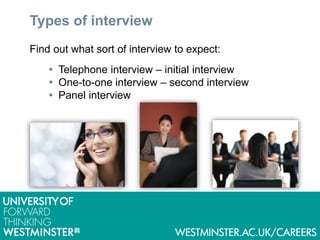
Types of interview
Find out what sort of interview to expect:
 Telephone interview – initial interview
 One-to-one interview – second interview
 Panel interview
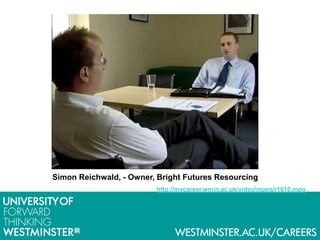
Simon Reichwald, - Owner, Bright Futures Resourcing
http://mycareer.wmin.ac.uk/video/mpeg/r1610.mpg
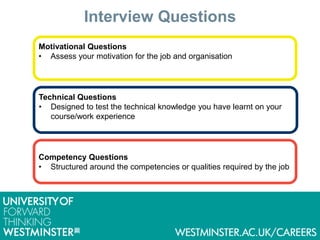
Interview Questions
Motivational Questions
• Assess your motivation for the job and organisation
Technical Questions
• Designed to test the technical knowledge you have learnt on your
course/work experience
Competency Questions
• Structured around the competencies or qualities required by the job
Types of questions
• Tell me about yourself – prepare 30 second summary
• Motivational questions – course, jobs
• Competency based questions – use the CAR model to
describe your experiences of the different transferable skills.
• Prepare a question of your own at the end
Test your Motivation for the Job & Organisation
• Why do you
want to work
here?
• How much do
you know
about our
organisation?
• Where do you
see yourself in
5/10 years
time?
Technical
Questions
Your ability to use
the technology
you have learnt
from your
course/work
experience:
“What systems
and software are
you competent
in”?
Competency
Questions
Questions based on
the general
competencies all
employers expect
from graduates (team
work, communication,
problem solving etc..)
“Can you tell us about
a time when
you...worked in a
team/dealt with a
difficult customer/met
a deadline”?
Examples of questions
• How did you come to choose your degree?
• What will you bring to the job?
Competency questions:
• What experience do you have of working in a team
environment?
• Can you tell us about a time when you have had to ease
yourself in to new team?
 How did you go about this?
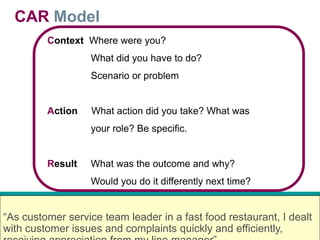
CAR Model
Context Where were you?
What did you have to do?
Scenario or problem
Action What action did you take? What was
your role? Be specific.
Result What was the outcome and why?
Would you do it differently next time?
“As customer service team leader in a fast food restaurant, I dealt
with customer issues and complaints quickly and efficiently,
Take virtual interview test:
Test your interview skills
http://mycareer.wmin.ac.uk/units/unit-int052.shtml
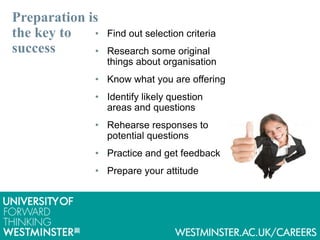
Preparation is
the key to
success
• Find out selection criteria
• Research some original
things about organisation
• Know what you are offering
• Identify likely question
areas and questions
• Rehearse responses to
potential questions
• Practice and get feedback
• Prepare your attitude
More Advice
• Career development centre – interviews, assessment centres and tests
 Career player – http://www.careerplayer.com/
• Targetjobs - http://targetjobs.co.uk/
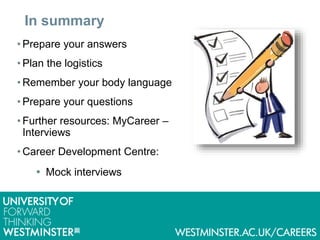
In summary
• Prepare your answers
• Plan the logistics
• Remember your body language
• Prepare your questions
• Further resources: MyCareer –
Interviews
• Career Development Centre:
 Mock interviews
Further information and guidance
Career Development Centre services:
• 20 minute quick queries:
CV, covering letter, application form checks
• 45 minute individual career coaching:
detailed career planning, mock interviews
Career Development Centre resources:
• CV Guide
• Videos and DVDs
• Free sector-specific and general careers publications
Contact us
Career Development Centre
1st Floor Cavendish House
101 New Cavendish Street, W1W 6XH
Tel: 020 7911 5184
E-mail: careers@westminster.ac.uk
www.westminster.ac.uk/careers
mycareer.wmin.ac.uk
Follow us on
facebook.com/uowcareers
twitter.com/uw_careers
blog.westminster.ac.uk/careers
Slides download from:
slideshare
www.slideshare.net/cdcwestminster
Evaluation
How did we do?

Interviews preparation - Skills Academy 6 June 2014

  • 1.
  • 2.
    Objectives This session willprovide: • Knowledge on how to prepare for job interviews • Different types of interview/questions • Importance of first impressions • Role play questions • Tips and useful resources
  • 3.
  • 4.
    The interview isa sales pitch You need to convince the employer that: • You can do the job • You want to do the job • You will fit into the organisation
  • 5.
    Before the interview YOU! •Know yourself • Re-read your application • Identify your strengths and weaknesses • Why do you want the job? COMPANY & SECTOR • Why do you want to work for the organisation? • What does the organisation do? • What are the latest developments in the sector? THE JOB • What skills are required? • Demonstrate skills with examples • Know the Interview format • What questions are likely to be asked? • Prepare and rehearse answers
  • 6.
    Brainstorm: preparing theinterview • Research company/sector • Analyse job description & person profile • Study your application form/CV • Match requirements of job to your attributes • Prepare examples your experience using CAR model • Prepare outline answers to motivation, knowledge & competency questions
  • 7.
    Know yourself • Re-readyour application form • Identify your strengths and weaknesses • Why do you want the job?
  • 8.
    Preparation! The job • Whatskills are required? • Think of examples from University, work and interests which demonstrate these skills • Find out the format of the interview • What questions are likely to be asked? • Prepare and rehearse answers
  • 9.
    Preparation! The organisation andthe sector • Why do you want to work for the organisation? • What does the organisation do? • What’s happening within the sector right now? • Westminster Library systems – journals/reports??
  • 10.
    On the day Firstimpressions • Dress • Arrive on time • Plan what you need to take • Greeting • Body language
  • 11.
    Top tips forsuccess 1. Preparation, preparation, preparation! 2. Shake hands in a firm and positive manner 3. Check posture – avoid slouching 4. Maintain good eye contact 5. Listen carefully 6. Give clear and concise answers 7. Smile!
  • 12.
  • 13.
    Inhibited/Shy •Saying little •Speaking verysoftly •Meek tone of voice •Sitting lower than others •Downcast eyes •Hand wringing
  • 14.
    Aggressive•Forceful gestures •Harsh toneof voice •Ignoring responses •Speaking too much •Standing over others •Staring •Interrupting
  • 15.
  • 16.
    Types of interview Findout what sort of interview to expect:  Telephone interview – initial interview  One-to-one interview – second interview  Panel interview
  • 17.
    Simon Reichwald, -Owner, Bright Futures Resourcing http://mycareer.wmin.ac.uk/video/mpeg/r1610.mpg
  • 18.
    Interview Questions Motivational Questions •Assess your motivation for the job and organisation Technical Questions • Designed to test the technical knowledge you have learnt on your course/work experience Competency Questions • Structured around the competencies or qualities required by the job
  • 19.
    Types of questions •Tell me about yourself – prepare 30 second summary • Motivational questions – course, jobs • Competency based questions – use the CAR model to describe your experiences of the different transferable skills. • Prepare a question of your own at the end
  • 20.
    Test your Motivationfor the Job & Organisation • Why do you want to work here? • How much do you know about our organisation? • Where do you see yourself in 5/10 years time?
  • 21.
    Technical Questions Your ability touse the technology you have learnt from your course/work experience: “What systems and software are you competent in”?
  • 22.
    Competency Questions Questions based on thegeneral competencies all employers expect from graduates (team work, communication, problem solving etc..) “Can you tell us about a time when you...worked in a team/dealt with a difficult customer/met a deadline”?
  • 23.
    Examples of questions •How did you come to choose your degree? • What will you bring to the job? Competency questions: • What experience do you have of working in a team environment? • Can you tell us about a time when you have had to ease yourself in to new team?  How did you go about this?
  • 24.
    CAR Model Context Wherewere you? What did you have to do? Scenario or problem Action What action did you take? What was your role? Be specific. Result What was the outcome and why? Would you do it differently next time? “As customer service team leader in a fast food restaurant, I dealt with customer issues and complaints quickly and efficiently,
  • 25.
    Take virtual interviewtest: Test your interview skills http://mycareer.wmin.ac.uk/units/unit-int052.shtml
  • 26.
    Preparation is the keyto success • Find out selection criteria • Research some original things about organisation • Know what you are offering • Identify likely question areas and questions • Rehearse responses to potential questions • Practice and get feedback • Prepare your attitude
  • 27.
    More Advice • Careerdevelopment centre – interviews, assessment centres and tests  Career player – http://www.careerplayer.com/ • Targetjobs - http://targetjobs.co.uk/
  • 28.
    In summary • Prepareyour answers • Plan the logistics • Remember your body language • Prepare your questions • Further resources: MyCareer – Interviews • Career Development Centre:  Mock interviews
  • 29.
    Further information andguidance Career Development Centre services: • 20 minute quick queries: CV, covering letter, application form checks • 45 minute individual career coaching: detailed career planning, mock interviews Career Development Centre resources: • CV Guide • Videos and DVDs • Free sector-specific and general careers publications
  • 30.
    Contact us Career DevelopmentCentre 1st Floor Cavendish House 101 New Cavendish Street, W1W 6XH Tel: 020 7911 5184 E-mail: careers@westminster.ac.uk www.westminster.ac.uk/careers mycareer.wmin.ac.uk
  • 31.
  • 32.

Editor's Notes

  • #2 1
  • #3 2
  • #5 4
  • #6 Preparation is everything! Self-knowledge is an essential ingredient of your preparation for the interview. Know yourself – you the person, your skills, your limitations, your strengths, understand your achievements - the essence of you. Although your company research forms the foundation of your interview preparation, you should also build role/job-specific information on top of it. Try and research some original things about the employer.
  • #7 6
  • #8 7
  • #9 8
  • #11 10
  • #12 9 Top tips for success Preparation, preparation, preparation – failing to plan is planning to fail
  • #17 16
  • #19 Motivational Questions Why do you want to work here? How much do you know about our organisation? Where do you see yourself in 5/10 years time? Technical Questions If you have applied for a job that requires technical knowledge, it is likely that you will be asked technical questions or have a separate technical interview. Questions may focus on your final year project or on real or hypothetical technical problems. Don’t worry if you don’t know the exact answer - interviewers are interested in your thought process and logic. What do you know about working in a photographic laboratory? What experience do you have using the following…? Competency Questions The interviewers are looking for evidence of your skills and abilities and will expect you to support your answers with examples of your experience from your life to date. Can you tell me about a time when you …worked in team/dealt with a difficult customer/met a challenging deadline? Use evidence based examples. A useful technique is CAR – Context, Action, Result
  • #24 23
  • #25 CAR Model Employers and recruiters love to see evidence of when you have used your skills and experience. Use positive, powerful and simple language Provide evidence of your skills and experience using the CAR model Context – where were you? What did you have to do? Action – what action did you take? Be explicit about your role Result – what was the outcome and why? Would there be anything you would do differently next time?
  • #32 Follow us on Facebook – facebook.com/uowcareers Twitter – twitter.com/uw_careers Blog – blog.westminster.ac.uk/careers
  • #33 Slideshare - Slides will be available to download from Slideshare by the close of play on Friday Evaluation – it would be really helpful to have your feedback on what you thought of today’s session and to assist us in our planning for future sessions.