Interviews: good, bad, efficient. Tips
for technical interviewers.
2015 Artem Trofimov
Few words about me
Trofimov Artem
Senior team manager HP Ops QA,
QA technical interviewer, has been
working for Lohika since 2008,
conducted 100500 interviews ,
attends interviews since 2000, not
all of them passed. My opinion
about efficiency & professionalism
of the interviewers is changing
over the time, so we’ll talk about
what I think of it now 
Introduction
Interviews: good, bad, efficient… what’s that?
• What is interview itself?
• What interview would you consider as “Good” (high quality,
correct, professional)?
• And what interview would you consider as “Efficient”? 
To stay efficient – set the GOAL
For different kind of interviews goals would be… 
What is the goal of the technical interview (TI) itself ?
TI is critically important for global processes like hiring,
dramatically affecting the efficiency of those global processes.
Piece of advice: it is much, much better to reject a good
candidate, than to accept a bad candidate (Joel Spolsky)
Being part of BIGGER process
The technical interview usually isn’t a standalone process.
Let’s have a look at the integration of TI using “hiring” as an
example of global process.
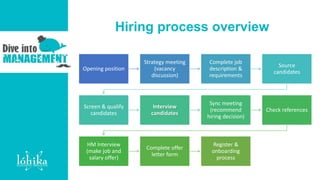
Hiring process overview
Opening position
Strategy meeting
(vacancy
discussion)
Complete job
description &
requirements
Source
candidates
Screen & qualify
candidates
Interview
candidates
Sync meeting
(recommend
hiring decision)
Check references
HM Interview
(make job and
salary offer)
Complete offer
letter form
Register &
onboarding
process
3 phases of integration
• Preparation
• Interview
• Post-interview
Preparation: sync stakeholders
The stakeholders: TL, PM, recruitment, interviewers
Sync meeting should bring us on the same page regarding:
1. Opening position (including dates & budgeting)
2. Project goals, main tasks, technologies in use
3. Project specifics (good/bad sides)
4. Interviews schedule
5. Estimation from recruitment
The main outcome is written job description & running recruiters
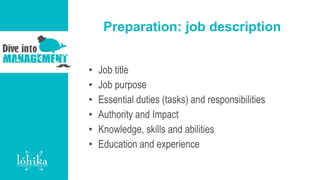
Preparation: job description
• Job title
• Job purpose
• Essential duties (tasks) and responsibilities
• Authority and Impact
• Knowledge, skills and abilities
• Education and experience
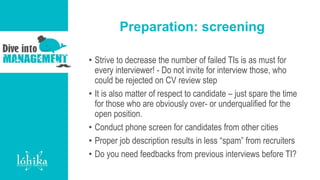
Preparation: screening
• Strive to decrease the number of failed TIs is as must for
every interviewer! - Do not invite for interview those, who
could be rejected on CV review step
• It is also matter of respect to candidate – just spare the time
for those who are obviously over- or underqualified for the
open position.
• Conduct phone screen for candidates from other cities
• Proper job description results in less “spam” from recruiters
• Do you need feedbacks from previous interviews before TI?
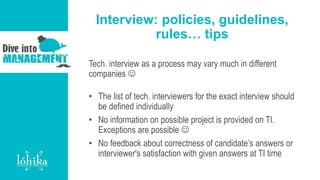
Interview: policies, guidelines,
rules… tips
Tech. interview as a process may vary much in different
companies 
• The list of tech. interviewers for the exact interview should
be defined individually
• No information on possible project is provided on TI.
Exceptions are possible 
• No feedback about correctness of candidate’s answers or
interviewer's satisfaction with given answers at TI time
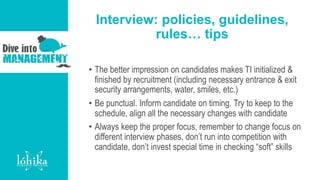
Interview: policies, guidelines,
rules… tips
• The better impression on candidates makes TI initialized &
finished by recruitment (including necessary entrance & exit
security arrangements, water, smiles, etc.)
• Be punctual. Inform candidate on timing. Try to keep to the
schedule, align all the necessary changes with candidate
• Always keep the proper focus, remember to change focus on
different interview phases, don’t run into competition with
candidate, don’t invest special time in checking “soft” skills
Interview: policies, guidelines,
rules… tips
• Problem solving is crucial (smart & push things to be done).
We are not interested in a candidate who is not able to
resolve problem.
• Ability to write code/scripts is crucial. Problem should-be
resolved only with close-to-working code.
• Hold respect to candidate, avoid familiarities
• Candidate may be smarter than you.
• Do not interrupt candidate.
• Questions should be well stated and be in correct context.
Interview: policies, guidelines,
rules… tips
• Questions should be helpful for assessment. Avoid questions
required rare-used knowledge of specific details.
• Questions should be practical. It is always better to ask
person to resolve a small problem required specific
knowledge, than ask for theoretical knowledge.
• Should we answer questions? Is it ok if there are no
questions? Why do we need to create good impression about
interview, company & ourselves?
• Don’t forget to thank the candidate for his time & patience 
After interview
Interviewers should sync to be aligned on joint
recommendation for hiring decision. What is the best time?
Each interviewer should have own opinion – don’t share, don’t
shy, but justify & convince in case of disagreement.
Remember: you should be able to say “No” in case of concerns
– there is no reason to recommend to hire bad candidate, as
it’s much worse, than to reject the good one 
The TI results should be shared to the stakeholders &
persisted.
Q&A
Let’s stay connected 
Skype: art.trofimov
Thank you!

«Interviews: good, bad, efficient. Tips for technical interviewers» by Atrem Trofimov

  • 1.
    Interviews: good, bad,efficient. Tips for technical interviewers. 2015 Artem Trofimov
  • 2.
    Few words aboutme Trofimov Artem Senior team manager HP Ops QA, QA technical interviewer, has been working for Lohika since 2008, conducted 100500 interviews , attends interviews since 2000, not all of them passed. My opinion about efficiency & professionalism of the interviewers is changing over the time, so we’ll talk about what I think of it now 
  • 3.
    Introduction Interviews: good, bad,efficient… what’s that? • What is interview itself? • What interview would you consider as “Good” (high quality, correct, professional)? • And what interview would you consider as “Efficient”? 
  • 4.
    To stay efficient– set the GOAL For different kind of interviews goals would be…  What is the goal of the technical interview (TI) itself ? TI is critically important for global processes like hiring, dramatically affecting the efficiency of those global processes. Piece of advice: it is much, much better to reject a good candidate, than to accept a bad candidate (Joel Spolsky)
  • 5.
    Being part ofBIGGER process The technical interview usually isn’t a standalone process. Let’s have a look at the integration of TI using “hiring” as an example of global process.
  • 6.
    Hiring process overview Openingposition Strategy meeting (vacancy discussion) Complete job description & requirements Source candidates Screen & qualify candidates Interview candidates Sync meeting (recommend hiring decision) Check references HM Interview (make job and salary offer) Complete offer letter form Register & onboarding process
  • 7.
    3 phases ofintegration • Preparation • Interview • Post-interview
  • 8.
    Preparation: sync stakeholders Thestakeholders: TL, PM, recruitment, interviewers Sync meeting should bring us on the same page regarding: 1. Opening position (including dates & budgeting) 2. Project goals, main tasks, technologies in use 3. Project specifics (good/bad sides) 4. Interviews schedule 5. Estimation from recruitment The main outcome is written job description & running recruiters
  • 9.
    Preparation: job description •Job title • Job purpose • Essential duties (tasks) and responsibilities • Authority and Impact • Knowledge, skills and abilities • Education and experience
  • 10.
    Preparation: screening • Striveto decrease the number of failed TIs is as must for every interviewer! - Do not invite for interview those, who could be rejected on CV review step • It is also matter of respect to candidate – just spare the time for those who are obviously over- or underqualified for the open position. • Conduct phone screen for candidates from other cities • Proper job description results in less “spam” from recruiters • Do you need feedbacks from previous interviews before TI?
  • 11.
    Interview: policies, guidelines, rules…tips Tech. interview as a process may vary much in different companies  • The list of tech. interviewers for the exact interview should be defined individually • No information on possible project is provided on TI. Exceptions are possible  • No feedback about correctness of candidate’s answers or interviewer's satisfaction with given answers at TI time
  • 12.
    Interview: policies, guidelines, rules…tips • The better impression on candidates makes TI initialized & finished by recruitment (including necessary entrance & exit security arrangements, water, smiles, etc.) • Be punctual. Inform candidate on timing. Try to keep to the schedule, align all the necessary changes with candidate • Always keep the proper focus, remember to change focus on different interview phases, don’t run into competition with candidate, don’t invest special time in checking “soft” skills
  • 13.
    Interview: policies, guidelines, rules…tips • Problem solving is crucial (smart & push things to be done). We are not interested in a candidate who is not able to resolve problem. • Ability to write code/scripts is crucial. Problem should-be resolved only with close-to-working code. • Hold respect to candidate, avoid familiarities • Candidate may be smarter than you. • Do not interrupt candidate. • Questions should be well stated and be in correct context.
  • 14.
    Interview: policies, guidelines, rules…tips • Questions should be helpful for assessment. Avoid questions required rare-used knowledge of specific details. • Questions should be practical. It is always better to ask person to resolve a small problem required specific knowledge, than ask for theoretical knowledge. • Should we answer questions? Is it ok if there are no questions? Why do we need to create good impression about interview, company & ourselves? • Don’t forget to thank the candidate for his time & patience 
  • 15.
    After interview Interviewers shouldsync to be aligned on joint recommendation for hiring decision. What is the best time? Each interviewer should have own opinion – don’t share, don’t shy, but justify & convince in case of disagreement. Remember: you should be able to say “No” in case of concerns – there is no reason to recommend to hire bad candidate, as it’s much worse, than to reject the good one  The TI results should be shared to the stakeholders & persisted.
  • 16.
    Q&A Let’s stay connected Skype: art.trofimov
  • 17.

Editor's Notes

  • #4 An interview is a conversation between two or more people where questions are asked by the interviewer to elicit facts or statements from the interviewee. Good – eventually it’s the one, which pass company policies & legal guidelines  Efficient – reaching the goal with careful use of resources (time, efforts, #stakeholders, etc.), not consuming extra. (Usually policies take into account experience & best practices, so following them will help you stay efficient)
  • #5 The goal of the technical interview (TI) itself is to define the technical level of the interviewee based on company positions requirements
  • #6 TI is part of some global (e.g. hiring, promotion, etc.) process, so it should be completely integrated to the bigger process, being solid & mandatory sub-process of it.
  • #8 a. All preparations should be done timely: written job description & pos. requirements, sync between recruiters/TL/PM/interviewers, preliminary CV screening b. Tech interview guidelines could affect: feedback during TI itself, interview structure, timing & strategy c. Post-interview actions: TIs sync to agree on recommendation for hiring decision, ext./int. references are checked, formalities like TI results form/offer letter, HR DB update and onboarding process
  • #9 TL have to justify opening position & clarify on tasks & tech. PM should find the budget & align it with customer Tech. interviewers should confirm they are able to interview candidate for the exact tech. level Recruiters to be aligned on the requirements, interviewers’ schedule
  • #10 JOB TITLE: keep the title short and descriptive, E.G. SENIOR JAVA ENGINEER JOB PURPOSE: this is summary statement about the purpose of this job, its scope and how it fits into the organization. E.G. Perform research, design, implementation and support tasks as a member of Lohika R&D team. Work in a close contact with team members and customers while developing. MAIN TASKS AND RESPONSIBILITIES: what are the key duties that this position is responsible for achieving? What are the tasks? List in order of importance. E.G. Participate in functional and architectural design of content that is developed for new releases of the product Perform implementation, review and debugging of new content Directly communicate with customer support engineers and customer representatives Collaborate with other R&D, QA, PM both on Lohika and customer side Proactively raise technical risks and suggest measures against them Suggest technical and functional improvements to add value to the product Be technical mentor for less experienced team members AUTHORITY & IMPACT: how much authority does this position have? What kind of decisions, if any, can this position make on its own? What’s the impact of those decisions (on the unit, company)? E.G. Has authority to make decisions on most efficient way to execute the assigned tasks. High impact associated with the following responsibilities … KNOWLEDGE, SKILLS AND ABILITIES: what knowledge, skills and abilities are required to do this job? Include both technical and non-technical skills as well as any physical demands (e.g. ability to lift 30kilos) E.G. (must have) OOP, OO Design Patterns, Deep knowledge of Java Core, Java EE, Spring Core, REST API, Good English (oral & written) and communication skills in general, Fast research and learning skills (optional) Presentation skills, Familiarity with Linux/Unix EDUCATION & EXPERIENCE: what king of prior experience is required for this position? Specify minimum number of years. Avoid specifying an academic degree is required unless a particular certification is essential. E.G. experience with different Java garbage collectors, thread analysis, Jprofiler, Commercial Java development experience (5+ years), , Real experience developing SaaS solutions, Experience and readiness to work in pure Agile, Experience of working with MongoDB or other noSQL solutions, Unit testing fan & guru, Familiarity with Linux/Unix, Experience of integration with Mobile clients, Experience of usage AWS as deployment platform, Experience with Maven, Experience with TestNG and Mockito, Experience with Jersey and Jackson
  • #11 Do you need feedbacks from previous interviews before TI? – that’s actually a very tricky question, formally you don’t need it for TI, but it would be great to screen candidates which could be rejected on HM even in case of successful TI.
  • #13 Keep the proper focus all the time, e.g. just break the ice during intro/ build rapport; don’t run into competition with candidate or the opposite – don’t start to teach/study. The time of the interview is limited – don’t invest special time in checking candidate's: communication skills, English, team compatibility, any other non-technical skills and knowledge
  • #14 Ability to write code – we need see how candidate thinks Hold respect to candidate – use “Вы”, instead of “ты”