


Interviewing
Sample
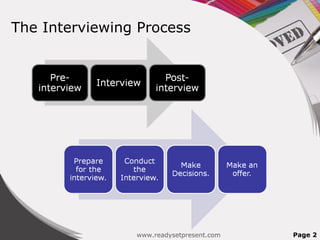
The Interviewing Process
www.readysetpresent.com Page 2
Definitions
INTERVIEWING:
 A set of verbal and nonverbal
interactions between two or more
people, focused on gathering
information to decide on a
course of action (i.e. hiring for a
job).
www.readysetpresent.com Page 3
A Definition Of An Interview
An interview
 is a “presentation of self” for the
interviewer, the interviewee, and
the organization.
www.readysetpresent.com Page 4
www.readysetpresent.com Page 5
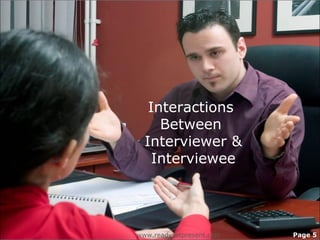
Interactions
Between
Interviewer &
Interviewee
Job Descriptions Importance
(1 of 2)
Importance
 Clarify who is responsible for what
within the company.
 Help the jobholder understand the
responsibilities of the position.
 Be helpful to job applicants,
employees, managers, and human
resources professionals at every
stage in the employment
relationship, from recruitment to
retirement.
www.readysetpresent.com Page 6
Probing the Resumé
 Probe the resumé information. Ask:
“What steps do you take at ABC
Manufacturing to conduct a needs
analysis?”
 Use resumé information to probe
the person’s background: “It seems
you achieved a lot on your own at
ABC.”
 “Which do you prefer: to work
alone or under close supervision?”
www.readysetpresent.com Page 7
Types of Interviews (1 of 9)
 Selection Interview: An interview
for selecting an applicant based on
predicted job success.
 Appraisal Interview: An interview
for discussing performance after a
performance appraisal.
 Exit: An interview for discussing
the reasons for removal (mutual or
otherwise) from an organization.
www.readysetpresent.com Page 8
Adapted
From:
“Interviewing
Candidates” by
Prentice Hall
Seven Types of Questions
1. Behaviors
2. Opinions
3. Values
4. Feelings
5. Knowledge
6. Sensory Experience
7. Background/Demographics
www.readysetpresent.com Page 9
Job Knowledge Questions
 Ask questions to test job
knowledge.
– “What are the procedures for…”
– “What is the standard operation for…”
– “What is the goal when…”
– “What must be done when…”
– “How do you do…”
www.readysetpresent.com Page 10
Adapted
From:
“Interviewing
Candidates” by
Prentice Hall
3-Part Task Statement
 The Task: Conduct a recruitment
interviewing seminar.
 The Time-Frame: 8 hours
 The Means: Prepared materials, a
structured teaching plan,
transparencies and student
handouts.
 The Conditions: Work with 15 to 20
managers who often make hiring
decisions. Hold the session on site.
www.readysetpresent.com Page 11
The
Team
www.readysetpresent.com Page 12
The Team (2 of 8)
 Based upon the research/
interviews and organizational
needs, your team will prepare a job
description to detail skills,
behaviors, and experiences
required.
 The team may use a job description
questionnaire,
intra/interdepartmental interviews
and/or a management position
audit to get a complete and
comprehensive picture.
www.readysetpresent.com Page 13
22 Steps to Success (3 of 9)
4. We, as a team, allow adequate
time to do the
job right. We build a schedule and
stick to it.
5. We take resumés with a grain of
salt, always searching for
inconsistencies.
6. Whenever possible, we create a
qualifications questionnaire that
every candidate must complete.
www.readysetpresent.com Page 14
Download “Interviewing”
PowerPoint presentation
at ReadySetPresent.com
Slides include: 6 pre-interview, interview, and post-interview
objectives, a 4 point process for interviewing, a 3 point process for
interviewing and another 4 point process for interviewing, 4 points on
the importance of effective interviewing, 4 points on interfering
factors, 5 points on preparation, 4 tools for interviews, 5 points on the
importance of job descriptions, 3 points on the purpose of job
descriptions, 4 steps for creating job descriptions, 5 points on
preparation, 3 points on probing the resume, 18 types of interviews, 4
points on interview ideas, 6 points on the opening, 8 points on
interviewing for what, 6 points on why interviewers take charge, 3
points to embrace, 8 prohibited questions, 7 types of questions, 5
points on the sequence of questions, 6 types of permissible questions,
5 points on behaviors, 4 points on goal of a job, 7 points on
observable factors, 16 points on unobservable factors, 5 points on not
priming the pump, 5 offensive words, 3 points on setting the stage, 10
points on ground rules, 8 key points, 4 points on a 3-part task
statement, 3 practice tips, 17 points on the team, 7 points on the
power interview, 22 steps to success and 16 action steps.
Royalty Free - Use Them Over and Over Again.
Now: more content, graphics, and diagrams
www.readysetpresent.com Page 15

Interviewing

  • 1.
  • 2.
  • 3.
    Definitions INTERVIEWING:  A setof verbal and nonverbal interactions between two or more people, focused on gathering information to decide on a course of action (i.e. hiring for a job). www.readysetpresent.com Page 3
  • 4.
    A Definition OfAn Interview An interview  is a “presentation of self” for the interviewer, the interviewee, and the organization. www.readysetpresent.com Page 4
  • 5.
  • 6.
    Job Descriptions Importance (1of 2) Importance  Clarify who is responsible for what within the company.  Help the jobholder understand the responsibilities of the position.  Be helpful to job applicants, employees, managers, and human resources professionals at every stage in the employment relationship, from recruitment to retirement. www.readysetpresent.com Page 6
  • 7.
    Probing the Resumé Probe the resumé information. Ask: “What steps do you take at ABC Manufacturing to conduct a needs analysis?”  Use resumé information to probe the person’s background: “It seems you achieved a lot on your own at ABC.”  “Which do you prefer: to work alone or under close supervision?” www.readysetpresent.com Page 7
  • 8.
    Types of Interviews(1 of 9)  Selection Interview: An interview for selecting an applicant based on predicted job success.  Appraisal Interview: An interview for discussing performance after a performance appraisal.  Exit: An interview for discussing the reasons for removal (mutual or otherwise) from an organization. www.readysetpresent.com Page 8 Adapted From: “Interviewing Candidates” by Prentice Hall
  • 9.
    Seven Types ofQuestions 1. Behaviors 2. Opinions 3. Values 4. Feelings 5. Knowledge 6. Sensory Experience 7. Background/Demographics www.readysetpresent.com Page 9
  • 10.
    Job Knowledge Questions Ask questions to test job knowledge. – “What are the procedures for…” – “What is the standard operation for…” – “What is the goal when…” – “What must be done when…” – “How do you do…” www.readysetpresent.com Page 10 Adapted From: “Interviewing Candidates” by Prentice Hall
  • 11.
    3-Part Task Statement The Task: Conduct a recruitment interviewing seminar.  The Time-Frame: 8 hours  The Means: Prepared materials, a structured teaching plan, transparencies and student handouts.  The Conditions: Work with 15 to 20 managers who often make hiring decisions. Hold the session on site. www.readysetpresent.com Page 11
  • 12.
  • 13.
    The Team (2of 8)  Based upon the research/ interviews and organizational needs, your team will prepare a job description to detail skills, behaviors, and experiences required.  The team may use a job description questionnaire, intra/interdepartmental interviews and/or a management position audit to get a complete and comprehensive picture. www.readysetpresent.com Page 13
  • 14.
    22 Steps toSuccess (3 of 9) 4. We, as a team, allow adequate time to do the job right. We build a schedule and stick to it. 5. We take resumés with a grain of salt, always searching for inconsistencies. 6. Whenever possible, we create a qualifications questionnaire that every candidate must complete. www.readysetpresent.com Page 14
  • 15.
    Download “Interviewing” PowerPoint presentation atReadySetPresent.com Slides include: 6 pre-interview, interview, and post-interview objectives, a 4 point process for interviewing, a 3 point process for interviewing and another 4 point process for interviewing, 4 points on the importance of effective interviewing, 4 points on interfering factors, 5 points on preparation, 4 tools for interviews, 5 points on the importance of job descriptions, 3 points on the purpose of job descriptions, 4 steps for creating job descriptions, 5 points on preparation, 3 points on probing the resume, 18 types of interviews, 4 points on interview ideas, 6 points on the opening, 8 points on interviewing for what, 6 points on why interviewers take charge, 3 points to embrace, 8 prohibited questions, 7 types of questions, 5 points on the sequence of questions, 6 types of permissible questions, 5 points on behaviors, 4 points on goal of a job, 7 points on observable factors, 16 points on unobservable factors, 5 points on not priming the pump, 5 offensive words, 3 points on setting the stage, 10 points on ground rules, 8 key points, 4 points on a 3-part task statement, 3 practice tips, 17 points on the team, 7 points on the power interview, 22 steps to success and 16 action steps. Royalty Free - Use Them Over and Over Again. Now: more content, graphics, and diagrams www.readysetpresent.com Page 15