The Power of Feedback:
Pave the Way to Enhance Productivity
Leadership Strategies
with Hilary Potts
Discover…
• 3 important benefits of giving feedback
• How to increase positive feedback
• How to turn criticism into a constructive dialogue
Why is Feedback Important?
A recent poll of millennials,
who by 2020 will make up over 70% of the workforce
said they WANT feedback but aren’t receiving enough
feedback from their managers.
Source: Gallup June 2016
Only 19% of millennials say they receive routine feedback
With only 17% saying the feedback is meaningful
Source: Gallup June 2016
Despite the importance of (and desire for)
feedback in the workplace only 21% of millennials
and 18% of non-millennials said that they meet
with their manager on a weekly basis.
Source: http://news.gallup.com/businessjournal/192038/managers-millennials-feedback-won-ask.aspx
“Feedback is the breakfast of champions.”
—Ken Blanchard
Lessons from Sports Coaches
Coaches monitor and give input on small actions
They look for ways to reinforce incremental progress
They look for ways to bring out what to do vs. harping on what not to do
Professional athletes have teams of coaches helping them
assess, analyze, and advance their performance
What are the Benefits?
Benefits Encourages people to do more actions which
enhance productivity.
When people feel acknowledged and rewarded for
their actions, they want to go above and beyond the
minimum.
Positive feedback builds harmony and collaboration
within the group and creates trust and respect with
colleagues.
No “News” is a Problem
No News is NOT Good News
When leaders are not involved, people don’t always ‘figure it out’ for
themselves
Too often actions don’t align with what’s needed
Implementation of a strategy, process, or customer solution is left to
flounder
A Practical Approach to
Improving Feedback
Strengthen How You Give Positive Feedback
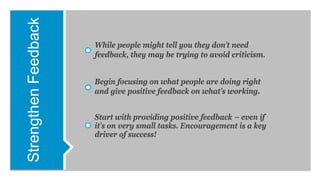
StrengthenFeedback
While people might tell you they don’t need
feedback, they may be trying to avoid criticism.
Begin focusing on what people are doing right
and give positive feedback on what’s working.
Start with providing positive feedback – even if
it’s on very small tasks. Encouragement is a key
driver of success!
Turn Criticism into Constructive Feedback
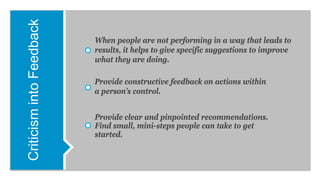
CriticismintoFeedback When people are not performing in a way that leads to
results, it helps to give specific suggestions to improve
what they are doing.
Provide constructive feedback on actions within
a person’s control.
Provide clear and pinpointed recommendations.
Find small, mini-steps people can take to get
started.
Achieving the Right Balance
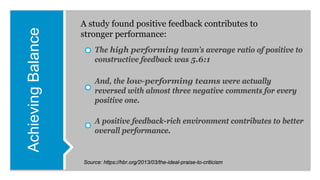
AchievingBalance
The high performing team’s average ratio of positive to
constructive feedback was 5.6:1
A positive feedback-rich environment contributes to better
overall performance.
And, the low-performing teams were actually
reversed with almost three negative comments for every
positive one.
A study found positive feedback contributes to
stronger performance:
Source: https://hbr.org/2013/03/the-ideal-praise-to-criticism
Putting Feedback
into Action
1. Set Mutual
Expectations
With a clear set of
expectations and defined
actions, people know what to
do and it becomes easier to
provide positive and
constructive feedback.
2. Be Objective vs.
Subjective
Be very clear and use
objective, fact-based
language versus what you
think about the person.
Express what you see in
terms of observable actions
versus your opinion or
intuition.
3. Graciously Receive
Feedback
If you want people to keep
giving you feedback, then
listen, acknowledge their
comments, be gracious, and
politely say thank you.
4. Create a Feedback-Rich
Environment
Own your feedback.
Encourage others to share
their feedback.
Increase giving positive
feedback.
Refrain from criticizing and
reframe your comments as
constructive feedback.
.
5. Measure Your Progress
• Set a feedback goal
• Share your positive feedback
with a colleague
• Track the number of times
you provide feedback in a day
• Track your delivery of positive
feedback by individual
Moving Toward Success
www.HilaryPotts.com/Resources.html
Download the
Leader Change
Toolkit Now…
Inside the Toolkit You’ll Find…
www.HilaryPotts.com/Resources.html
• Ways to Prepare for a Significant Change
• A Leader Change Framework to Successfully Lead
Business Changes
• Five Change Leader Behaviors to Lead Your Next
Strategic Initiative
For more information contact:
Hilary Potts
The HAP Group
www.hilarypotts.com
info@hapgrp.com
© The HAP Group, All Rights Reserved

Give More Feedback to Enhance Productivity

  • 1.
    The Power ofFeedback: Pave the Way to Enhance Productivity Leadership Strategies with Hilary Potts
  • 2.
    Discover… • 3 importantbenefits of giving feedback • How to increase positive feedback • How to turn criticism into a constructive dialogue
  • 3.
    Why is FeedbackImportant?
  • 4.
    A recent pollof millennials, who by 2020 will make up over 70% of the workforce said they WANT feedback but aren’t receiving enough feedback from their managers. Source: Gallup June 2016
  • 5.
    Only 19% ofmillennials say they receive routine feedback With only 17% saying the feedback is meaningful Source: Gallup June 2016
  • 6.
    Despite the importanceof (and desire for) feedback in the workplace only 21% of millennials and 18% of non-millennials said that they meet with their manager on a weekly basis. Source: http://news.gallup.com/businessjournal/192038/managers-millennials-feedback-won-ask.aspx
  • 7.
    “Feedback is thebreakfast of champions.” —Ken Blanchard
  • 8.
    Lessons from SportsCoaches Coaches monitor and give input on small actions They look for ways to reinforce incremental progress They look for ways to bring out what to do vs. harping on what not to do Professional athletes have teams of coaches helping them assess, analyze, and advance their performance
  • 9.
    What are theBenefits?
  • 10.
    Benefits Encourages peopleto do more actions which enhance productivity. When people feel acknowledged and rewarded for their actions, they want to go above and beyond the minimum. Positive feedback builds harmony and collaboration within the group and creates trust and respect with colleagues.
  • 11.
  • 12.
    No News isNOT Good News When leaders are not involved, people don’t always ‘figure it out’ for themselves Too often actions don’t align with what’s needed Implementation of a strategy, process, or customer solution is left to flounder
  • 13.
    A Practical Approachto Improving Feedback
  • 14.
    Strengthen How YouGive Positive Feedback
  • 15.
    StrengthenFeedback While people mighttell you they don’t need feedback, they may be trying to avoid criticism. Begin focusing on what people are doing right and give positive feedback on what’s working. Start with providing positive feedback – even if it’s on very small tasks. Encouragement is a key driver of success!
  • 16.
    Turn Criticism intoConstructive Feedback
  • 17.
    CriticismintoFeedback When peopleare not performing in a way that leads to results, it helps to give specific suggestions to improve what they are doing. Provide constructive feedback on actions within a person’s control. Provide clear and pinpointed recommendations. Find small, mini-steps people can take to get started.
  • 18.
  • 19.
    AchievingBalance The high performingteam’s average ratio of positive to constructive feedback was 5.6:1 A positive feedback-rich environment contributes to better overall performance. And, the low-performing teams were actually reversed with almost three negative comments for every positive one. A study found positive feedback contributes to stronger performance: Source: https://hbr.org/2013/03/the-ideal-praise-to-criticism
  • 20.
  • 21.
    1. Set Mutual Expectations Witha clear set of expectations and defined actions, people know what to do and it becomes easier to provide positive and constructive feedback.
  • 22.
    2. Be Objectivevs. Subjective Be very clear and use objective, fact-based language versus what you think about the person. Express what you see in terms of observable actions versus your opinion or intuition.
  • 23.
    3. Graciously Receive Feedback Ifyou want people to keep giving you feedback, then listen, acknowledge their comments, be gracious, and politely say thank you.
  • 24.
    4. Create aFeedback-Rich Environment Own your feedback. Encourage others to share their feedback. Increase giving positive feedback. Refrain from criticizing and reframe your comments as constructive feedback. .
  • 25.
    5. Measure YourProgress • Set a feedback goal • Share your positive feedback with a colleague • Track the number of times you provide feedback in a day • Track your delivery of positive feedback by individual
  • 26.
  • 27.
    Inside the ToolkitYou’ll Find… www.HilaryPotts.com/Resources.html • Ways to Prepare for a Significant Change • A Leader Change Framework to Successfully Lead Business Changes • Five Change Leader Behaviors to Lead Your Next Strategic Initiative
  • 28.
    For more informationcontact: Hilary Potts The HAP Group www.hilarypotts.com info@hapgrp.com © The HAP Group, All Rights Reserved