9
8
7
6
5
4
3
2
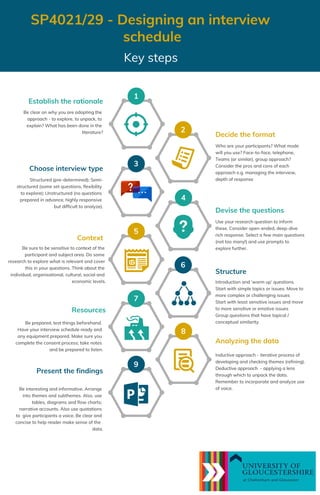
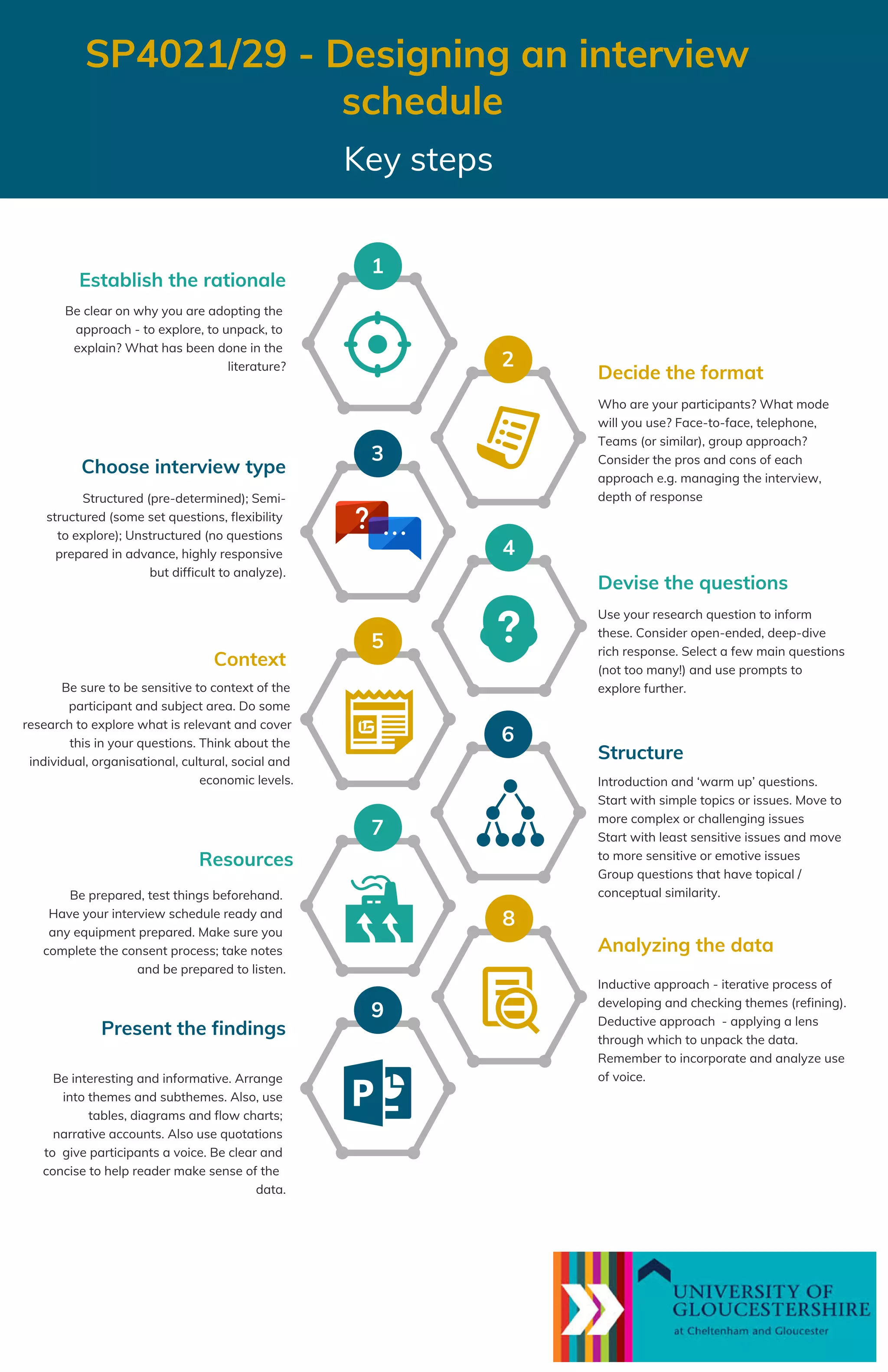
SP4021/29 - Designing an interview
schedule
Be clear on why you are adopting the
approach - to explore, to unpack, to
explain? What has been done in the
literature?
Establish the rationale
Who are your participants? What mode
will you use? Face-to-face, telephone,
Teams (or similar), group approach?
Consider the pros and cons of each
approach e.g. managing the interview,
depth of response
Decide the format
Structured (pre-determined); Semi-
structured (some set questions, flexibility
to explore); Unstructured (no questions
prepared in advance, highly responsive
but difficult to analyze).
Choose interview type
Use your research question to inform
these. Consider open-ended, deep-dive
rich response. Select a few main questions
(not too many!) and use prompts to
explore further.
Devise the questions
Be sure to be sensitive to context of the
participant and subject area. Do some
research to explore what is relevant and cover
this in your questions. Think about the
individual, organisational, cultural, social and
economic levels.
Context
Introduction and ‘warm up’ questions.
Start with simple topics or issues. Move to
more complex or challenging issues
Start with least sensitive issues and move
to more sensitive or emotive issues
Group questions that have topical /
conceptual similarity.
Structure
Be prepared, test things beforehand.
Have your interview schedule ready and
any equipment prepared. Make sure you
complete the consent process; take notes
and be prepared to listen.
Resources
Inductive approach - iterative process of
developing and checking themes (refining).
Deductive approach - applying a lens
through which to unpack the data.
Remember to incorporate and analyze use
of voice.
Analyzing the data
Be interesting and informative. Arrange
into themes and subthemes. Also, use
tables, diagrams and flow charts;
narrative accounts. Also use quotations
to give participants a voice. Be clear and
concise to help reader make sense of the
data.
Present the findings
Key steps
1

Interview design quick guide

  • 1.
    9 8 7 6 5 4 3 2 SP4021/29 - Designingan interview schedule Be clear on why you are adopting the approach - to explore, to unpack, to explain? What has been done in the literature? Establish the rationale Who are your participants? What mode will you use? Face-to-face, telephone, Teams (or similar), group approach? Consider the pros and cons of each approach e.g. managing the interview, depth of response Decide the format Structured (pre-determined); Semi- structured (some set questions, flexibility to explore); Unstructured (no questions prepared in advance, highly responsive but difficult to analyze). Choose interview type Use your research question to inform these. Consider open-ended, deep-dive rich response. Select a few main questions (not too many!) and use prompts to explore further. Devise the questions Be sure to be sensitive to context of the participant and subject area. Do some research to explore what is relevant and cover this in your questions. Think about the individual, organisational, cultural, social and economic levels. Context Introduction and ‘warm up’ questions. Start with simple topics or issues. Move to more complex or challenging issues Start with least sensitive issues and move to more sensitive or emotive issues Group questions that have topical / conceptual similarity. Structure Be prepared, test things beforehand. Have your interview schedule ready and any equipment prepared. Make sure you complete the consent process; take notes and be prepared to listen. Resources Inductive approach - iterative process of developing and checking themes (refining). Deductive approach - applying a lens through which to unpack the data. Remember to incorporate and analyze use of voice. Analyzing the data Be interesting and informative. Arrange into themes and subthemes. Also, use tables, diagrams and flow charts; narrative accounts. Also use quotations to give participants a voice. Be clear and concise to help reader make sense of the data. Present the findings Key steps 1