Download to read offline

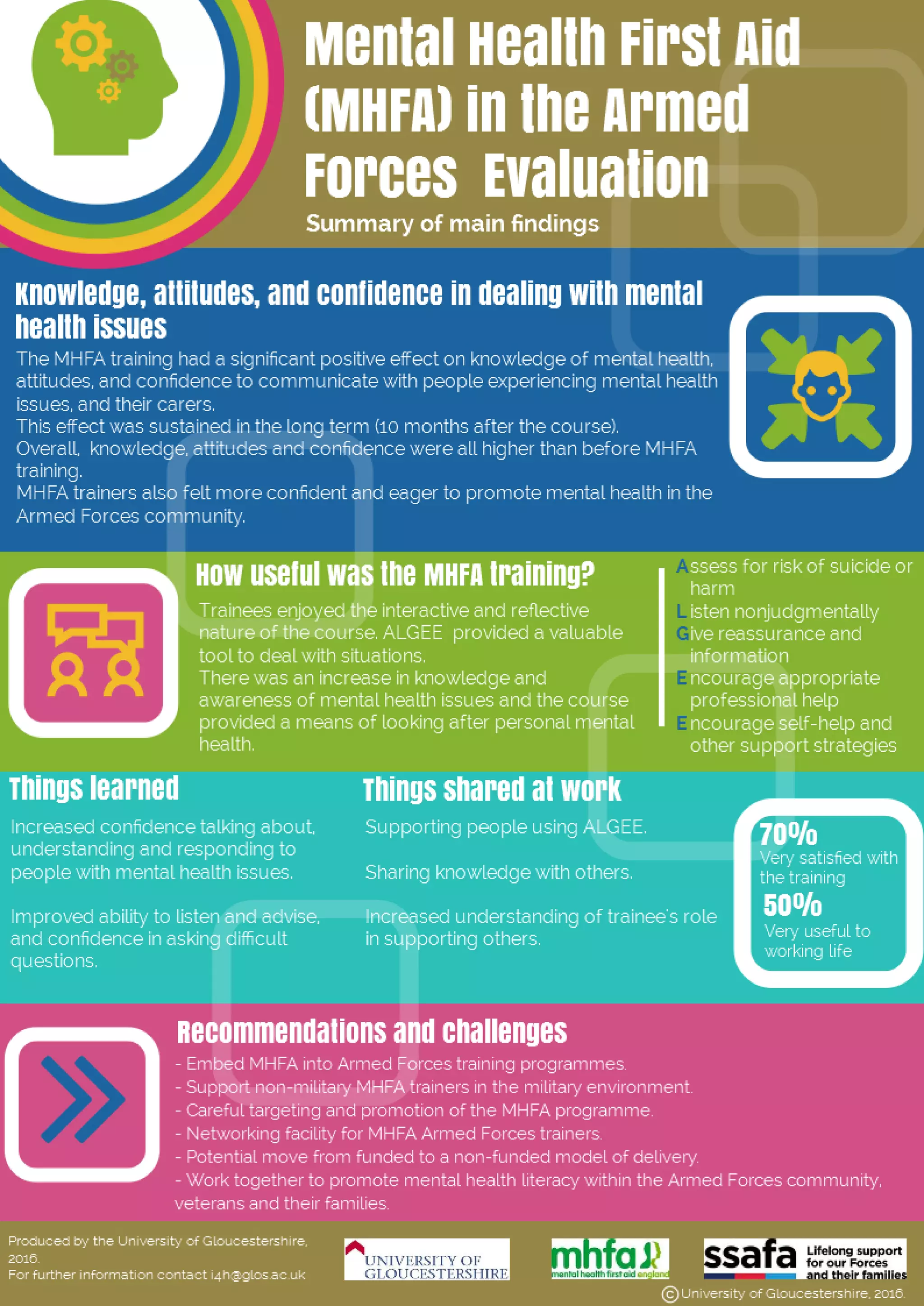

This slide Summary presents a summary of findings from an evaluation of the Mental Health First Aid (MHFA) intervention to support mental health literacy among members of the Armed Forces community in the UK. A mixed method evaluation included both quantitative (surveys) and qualitative (observations, interviews, and focus groups) elements. The quantitative aspect of the evaluation involved the development of a pre- and post-training survey which assessed shifts in trainee (n=602) knowledge, attitudes, and confidence around mental health issues from pre-training to post-training, including a follow up survey 10 months after the course to establish whether the course had a sustainable impact. Of the 602 trainees who completed the initial survey, n=120 completed the follow-up survey. The qualitative aspect of the evaluation comprised course observations (n= 13), semi-structured telephone interviews with trainees post-training (n=13), focus groups with trainers (n =14) and a focus group with an expert reference group (n=4). Quantitative findings revealed that: - immediately following training, from pre- to post-intervention (the training course) trainees showed a significant increase in knowledge, attitudes, and confidence. Importantly, this effect was sustained at the 10 month follow-up. - there was a small but significant decrease in knowledge which occurred from post training to follow-up. Despite the decrease from post training to follow-up, overall, knowledge, attitudes, and confidence were all significantly higher than at baseline. Qualitative findings reported that trainees: - increased their knowledge, understanding and confidence in talking about and communicating with people who have mental health issues; - had improved listening skills, advice giving, and confidence in asking difficult questions regarding mental health issues. Trainers reported: - increased learning and confidence in understanding and managing mental health through the training experience; - shared feeling with other trainers and trainees of wanting to support and help the promotion of mental health and its awareness in the Armed Forces community; and the need to manage military and civilian dynamics within the courses.


![ONFH[AVN HIP] -TRIPLE REGIME -A NOVAL SURGICAL CONCEPT .pptx](https://cdn.slidesharecdn.com/ss_thumbnails/onfhavnhip2026koaconcalicutdrgokuldevdrmashraf-260210064517-213ec005-thumbnail.jpg?width=640&height=640&fit=bounds)


