Module A – Comparative Study
of Texts and Contexts
Elective 2: Intertextual Perspectives
What the syllabus says…
• This module requires students to compare texts in order to explore
them in relation to their contexts. It develops students’
understanding of the effects of context and questions of value.
• Each elective in this module requires the study of groups of texts
which are to be selected from a prescribed text list. These texts may
be in different forms or media.
• Students examine ways in which social, cultural and historical
context influences aspects of texts, or the ways in which changes in
context lead to changed values being reflected in texts. This
includes study and use of the language of texts, consideration of
purposes and audiences, and analysis of the content, values and
attitudes conveyed through a range of readings.
• Students develop a range of imaginative, interpretive and analytical
compositions that relate to the comparative study of texts and
context. These compositions may be realised in a variety of forms
and media.
Elective 2: Intertextual Perspectives
• In this elective, students compare the content and
perspectives in a pair of texts in order to develop
their understanding of the effects of context,
purpose and audience on the shaping of meaning.
• Through exploring and comparing perspectives
offered by a pair of texts, students examine the
ways in which particular social, cultural and
historical contexts can influence the composer’s
choice of language forms and features and the
ideas, values and attitudes conveyed in each text.
• In their responding and composing, students
consider how the treatment of similar content in a
pair of texts can heighten our understanding of the
values, significance and context of both texts.
BOSTES definition of “intertextuality”
Intertextuality:
• The associations or connections between one text and other
texts.
• Parody and plagiarism are clear and extreme forms of
intertextuality.
• An overt reference to another text, as in a direct quote from
another text, is another example of intertextuality.
• More subtle forms of intertextuality include the intertextual use
of iconic or well-known images (for example, an image of a sports
star in an Australian tourism advertisement).
• There are also intertextual connections that responders might
make between texts, connections unintended by the composer;
for example, a description of a seascape that conjures up a
particular song or visual image in the mind of a responder.
So… what does the syllabus rubric
actually mean?
What do you actually have to “do”
with the texts?
Where do you need to focus your
attention and analysis??
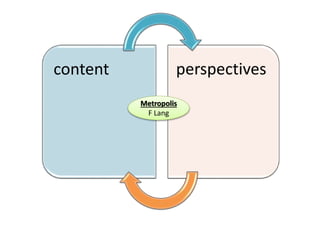
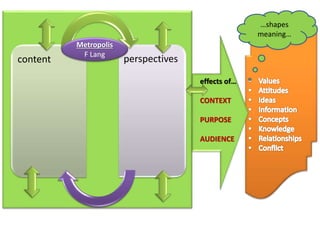
content perspectives
Metropolis
F Lang
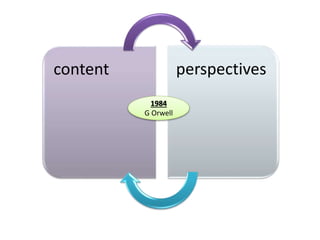
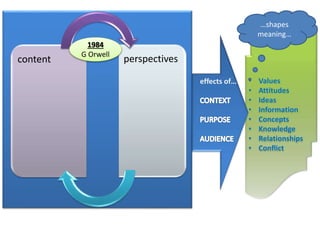
content perspectives
1984
G Orwell
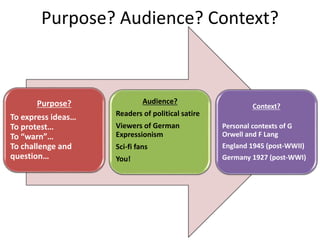
Purpose? Audience? Context?
Purpose?
To express ideas…
To protest…
To “warn”…
To challenge and
question…
Audience?
Readers of political satire
Viewers of German
Expressionism
Sci-fi fans
You!
Context?
Personal contexts of G
Orwell and F Lang
England 1945 (post-WWII)
Germany 1927 (post-WWI)
content perspectives
Metropolis
F Lang
effects of…
CONTEXT
PURPOSE
AUDIENCE
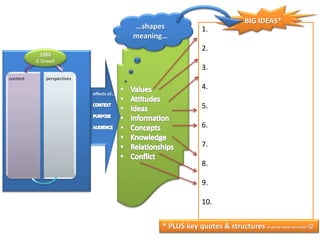
…shapes
meaning…
content perspectives
• Values
• Attitudes
• Ideas
• Information
• Concepts
• Knowledge
• Relationships
• Conflict
1984
G Orwell
effects of…
…shapes
meaning…
content perspectives
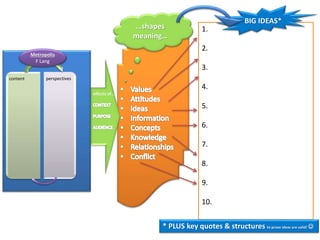
Metropolis
F Lang
effects of…
…shapes
meaning…
1.
2.
3.
4.
5.
6.
7.
8.
9.
10.
BIG IDEAS*
* PLUS key quotes & structures to prove ideas are valid! 
content perspectives
1984
G Orwell
effects of…
…shapes
meaning…
1.
2.
3.
4.
5.
6.
7.
8.
9.
10.
BIG IDEAS*
* PLUS key quotes & structures to prove ideas are valid! 
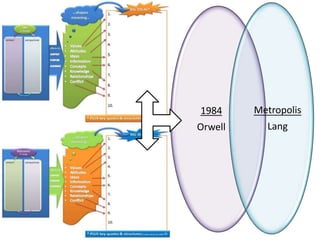
1984
Orwell
Metropolis
Lang
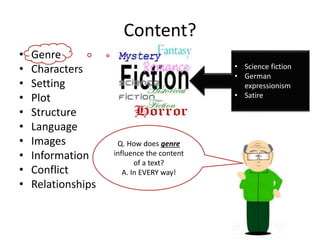
Content?
• Genre
• Characters
• Setting
• Plot
• Structure
• Language
• Images
• Information
• Conflict
• Relationships
• Science fiction
• German
expressionism
• Satire
Q. How does genre
influence the content
of a text?
A. In EVERY way!
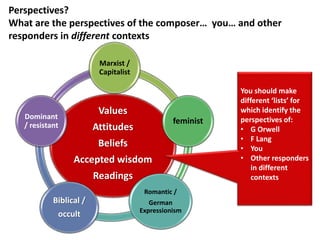
Perspectives?
What are the perspectives of the composer… you… and other
responders in different contexts
Values
Attitudes
Beliefs
Accepted wisdom
Readings
Marxist /
Capitalist
feminist
Romantic /
German
Expressionism
Biblical /
occult
Dominant
/ resistant
You should make
different ‘lists’ for
which identify the
perspectives of:
• G Orwell
• F Lang
• You
• Other responders
in different
contexts
Comparative Study of Texts and Context,
Elective 2: Intertextual Perspectives
• PRESCRIBED TEXT:
Lang, Fritz. Metropolis (1927/2010) Madman

Intertextual Perspectives - according to the 2015 HSC Syllabus rubric

  • 1.
    Module A –Comparative Study of Texts and Contexts Elective 2: Intertextual Perspectives
  • 2.
    What the syllabussays… • This module requires students to compare texts in order to explore them in relation to their contexts. It develops students’ understanding of the effects of context and questions of value. • Each elective in this module requires the study of groups of texts which are to be selected from a prescribed text list. These texts may be in different forms or media. • Students examine ways in which social, cultural and historical context influences aspects of texts, or the ways in which changes in context lead to changed values being reflected in texts. This includes study and use of the language of texts, consideration of purposes and audiences, and analysis of the content, values and attitudes conveyed through a range of readings. • Students develop a range of imaginative, interpretive and analytical compositions that relate to the comparative study of texts and context. These compositions may be realised in a variety of forms and media.
  • 3.
    Elective 2: IntertextualPerspectives • In this elective, students compare the content and perspectives in a pair of texts in order to develop their understanding of the effects of context, purpose and audience on the shaping of meaning. • Through exploring and comparing perspectives offered by a pair of texts, students examine the ways in which particular social, cultural and historical contexts can influence the composer’s choice of language forms and features and the ideas, values and attitudes conveyed in each text. • In their responding and composing, students consider how the treatment of similar content in a pair of texts can heighten our understanding of the values, significance and context of both texts.
  • 4.
    BOSTES definition of“intertextuality” Intertextuality: • The associations or connections between one text and other texts. • Parody and plagiarism are clear and extreme forms of intertextuality. • An overt reference to another text, as in a direct quote from another text, is another example of intertextuality. • More subtle forms of intertextuality include the intertextual use of iconic or well-known images (for example, an image of a sports star in an Australian tourism advertisement). • There are also intertextual connections that responders might make between texts, connections unintended by the composer; for example, a description of a seascape that conjures up a particular song or visual image in the mind of a responder.
  • 5.
    So… what doesthe syllabus rubric actually mean? What do you actually have to “do” with the texts? Where do you need to focus your attention and analysis??
  • 6.
  • 7.
  • 8.
    Purpose? Audience? Context? Purpose? Toexpress ideas… To protest… To “warn”… To challenge and question… Audience? Readers of political satire Viewers of German Expressionism Sci-fi fans You! Context? Personal contexts of G Orwell and F Lang England 1945 (post-WWII) Germany 1927 (post-WWI)
  • 9.
    content perspectives Metropolis F Lang effectsof… CONTEXT PURPOSE AUDIENCE …shapes meaning…
  • 10.
    content perspectives • Values •Attitudes • Ideas • Information • Concepts • Knowledge • Relationships • Conflict 1984 G Orwell effects of… …shapes meaning…
  • 11.
    content perspectives Metropolis F Lang effectsof… …shapes meaning… 1. 2. 3. 4. 5. 6. 7. 8. 9. 10. BIG IDEAS* * PLUS key quotes & structures to prove ideas are valid! 
  • 12.
    content perspectives 1984 G Orwell effectsof… …shapes meaning… 1. 2. 3. 4. 5. 6. 7. 8. 9. 10. BIG IDEAS* * PLUS key quotes & structures to prove ideas are valid! 
  • 13.
  • 14.
    Content? • Genre • Characters •Setting • Plot • Structure • Language • Images • Information • Conflict • Relationships • Science fiction • German expressionism • Satire Q. How does genre influence the content of a text? A. In EVERY way!
  • 15.
    Perspectives? What are theperspectives of the composer… you… and other responders in different contexts Values Attitudes Beliefs Accepted wisdom Readings Marxist / Capitalist feminist Romantic / German Expressionism Biblical / occult Dominant / resistant You should make different ‘lists’ for which identify the perspectives of: • G Orwell • F Lang • You • Other responders in different contexts
  • 16.
    Comparative Study ofTexts and Context, Elective 2: Intertextual Perspectives • PRESCRIBED TEXT: Lang, Fritz. Metropolis (1927/2010) Madman