REGRESSION
ANALYSIS
Dr.BalamuruganM
AssociateProfessor
AcharyaInstituteofGraduateStudies
Bangalore
Regression
• Regression analysis measures the nature and extent of the
relationship between two or more variables, thus enables
us to make predictions.
• Regression is the measure of the average relationship
between two or more variables.
Correlation vs. Regression
• Degree & Nature of Relationship
 Correlation is a measure of degree of relationship between X
& Y.
 Regression studies the nature of relationship between the
variables so that one may be able to predict the value of one
variable on the basis of another.
• Cause & Effect Relationship
 Correlation does not assume cause and effect relationship
between two variables.
 Regression clearly expresses the cause and effect relationship
between two variables. The independent variable is the cause
and dependent variable is effect.
Correlation vs. Regression
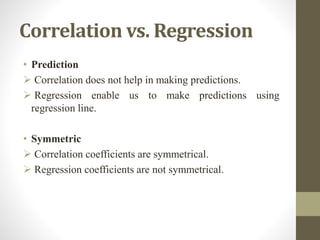
• Prediction
 Correlation does not help in making predictions.
 Regression enable us to make predictions using
regression line.
• Symmetric
 Correlation coefficients are symmetrical.
 Regression coefficients are not symmetrical.
Copyright © 2016 Pearson Education, Ltd. Chapter 12, Slide 5
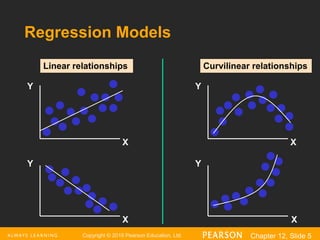
Regression Models
Y
X
Y
X
Y
Y
X
X
Linear relationships Curvilinear relationships
Copyright © 2016 Pearson Education, Ltd. Chapter 12, Slide 6
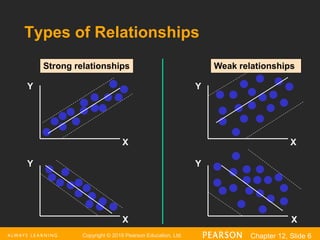
Types of Relationships
Y
X
Y
X
Y
Y
X
X
Strong relationships Weak relationships
Copyright © 2016 Pearson Education, Ltd. Chapter 12, Slide 7
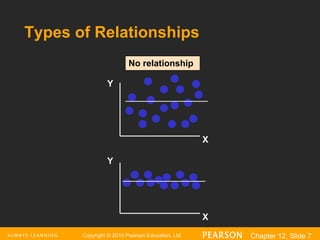
Types of Relationships
Y
X
Y
X
No relationship
Regression Analysis
 Regression analysis is used to:
 Predict the value of a dependent variable based on the value of at
least one independent variable.
 Explain the impact of changes in an independent variable on the
dependent variable.
 Dependent variable: The variable we wish to predict or
explain.
 Independent variable: The variable used to predict or explain
the dependent variable.
Simple Linear Regression
Model
• Only one independent variable, X
• Relationship between X and Y is described by a linear
function
• Changes in Y are assumed to be related to changes in X
Copyright © 2016 Pearson Education, Ltd. Chapter 12, Slide 10
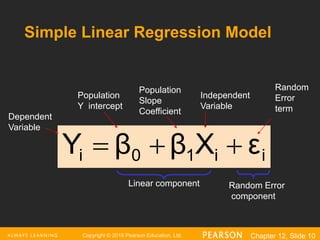
i
i
1
0
i ε
X
β
β
Y 


Linear component
Simple Linear Regression Model
Population
Y intercept
Population
Slope
Coefficient
Random
Error
term
Dependent
Variable
Independent
Variable
Random Error
component
Copyright © 2016 Pearson Education, Ltd. Chapter 12, Slide 11
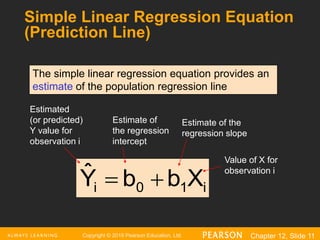
Simple Linear Regression Equation
(Prediction Line)
i
1
0
i X
b
b
Ŷ 

The simple linear regression equation provides an
estimate of the population regression line
Estimate of
the regression
intercept
Estimate of the
regression slope
Estimated
(or predicted)
Y value for
observation i
Value of X for
observation i
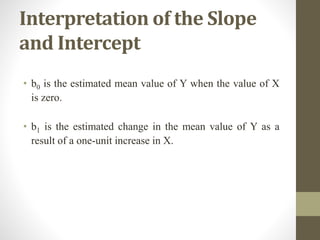
Interpretation of the Slope
and Intercept
• b0 is the estimated mean value of Y when the value of X
is zero.
• b1 is the estimated change in the mean value of Y as a
result of a one-unit increase in X.
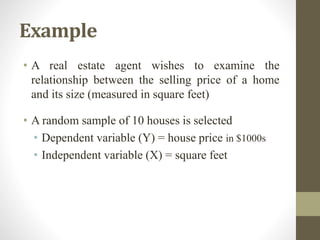
Example
• A real estate agent wishes to examine the
relationship between the selling price of a home
and its size (measured in square feet)
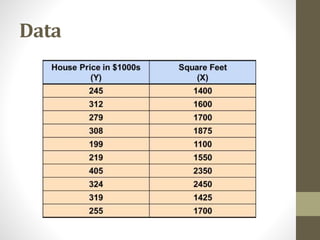
• A random sample of 10 houses is selected
• Dependent variable (Y) = house price in $1000s
• Independent variable (X) = square feet
Data
0
50
100
150
200
250
300
350
400
450
0 500 1000 1500 2000 2500 3000
House
Price
($1000s)
Square Feet
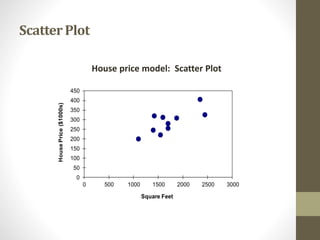
ScatterPlot
House price model: Scatter Plot
0
50
100
150
200
250
300
350
400
450
0 500 1000 1500 2000 2500 3000
Square Feet
House
Price
($1000s)
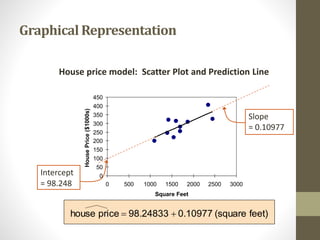
GraphicalRepresentation
House price model: Scatter Plot and Prediction Line
feet)
(square
0.10977
98.24833
price
house 

Slope
= 0.10977
Intercept
= 98.248
Simple Linear Regression
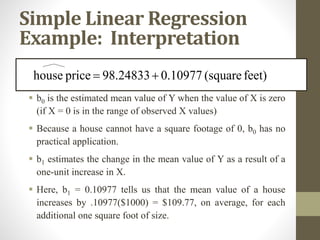
Example: Interpretation
 b0 is the estimated mean value of Y when the value of X is zero
(if X = 0 is in the range of observed X values)
 Because a house cannot have a square footage of 0, b0 has no
practical application.
 b1 estimates the change in the mean value of Y as a result of a
one-unit increase in X.
 Here, b1 = 0.10977 tells us that the mean value of a house
increases by .10977($1000) = $109.77, on average, for each
additional one square foot of size.
feet)
(square
0.10977
98.24833
price
house 

317.85
0)
0.1098(200
98.25
(sq.ft.)
0.1098
98.25
price
house





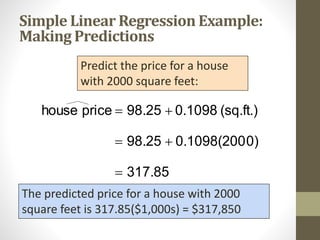
Predict the price for a house
with 2000 square feet:
The predicted price for a house with 2000
square feet is 317.85($1,000s) = $317,850
Simple Linear Regression Example:
Making Predictions
THANK YOU

Regression analysis in Research Methodology.pptx

  • 1.
  • 2.
    Regression • Regression analysismeasures the nature and extent of the relationship between two or more variables, thus enables us to make predictions. • Regression is the measure of the average relationship between two or more variables.
  • 3.
    Correlation vs. Regression •Degree & Nature of Relationship  Correlation is a measure of degree of relationship between X & Y.  Regression studies the nature of relationship between the variables so that one may be able to predict the value of one variable on the basis of another. • Cause & Effect Relationship  Correlation does not assume cause and effect relationship between two variables.  Regression clearly expresses the cause and effect relationship between two variables. The independent variable is the cause and dependent variable is effect.
  • 4.
    Correlation vs. Regression •Prediction  Correlation does not help in making predictions.  Regression enable us to make predictions using regression line. • Symmetric  Correlation coefficients are symmetrical.  Regression coefficients are not symmetrical.
  • 5.
    Copyright © 2016Pearson Education, Ltd. Chapter 12, Slide 5 Regression Models Y X Y X Y Y X X Linear relationships Curvilinear relationships
  • 6.
    Copyright © 2016Pearson Education, Ltd. Chapter 12, Slide 6 Types of Relationships Y X Y X Y Y X X Strong relationships Weak relationships
  • 7.
    Copyright © 2016Pearson Education, Ltd. Chapter 12, Slide 7 Types of Relationships Y X Y X No relationship
  • 8.
    Regression Analysis  Regressionanalysis is used to:  Predict the value of a dependent variable based on the value of at least one independent variable.  Explain the impact of changes in an independent variable on the dependent variable.  Dependent variable: The variable we wish to predict or explain.  Independent variable: The variable used to predict or explain the dependent variable.
  • 9.
    Simple Linear Regression Model •Only one independent variable, X • Relationship between X and Y is described by a linear function • Changes in Y are assumed to be related to changes in X
  • 10.
    Copyright © 2016Pearson Education, Ltd. Chapter 12, Slide 10 i i 1 0 i ε X β β Y    Linear component Simple Linear Regression Model Population Y intercept Population Slope Coefficient Random Error term Dependent Variable Independent Variable Random Error component
  • 11.
    Copyright © 2016Pearson Education, Ltd. Chapter 12, Slide 11 Simple Linear Regression Equation (Prediction Line) i 1 0 i X b b Ŷ   The simple linear regression equation provides an estimate of the population regression line Estimate of the regression intercept Estimate of the regression slope Estimated (or predicted) Y value for observation i Value of X for observation i
  • 12.
    Interpretation of theSlope and Intercept • b0 is the estimated mean value of Y when the value of X is zero. • b1 is the estimated change in the mean value of Y as a result of a one-unit increase in X.
  • 13.
    Example • A realestate agent wishes to examine the relationship between the selling price of a home and its size (measured in square feet) • A random sample of 10 houses is selected • Dependent variable (Y) = house price in $1000s • Independent variable (X) = square feet
  • 14.
  • 15.
    0 50 100 150 200 250 300 350 400 450 0 500 10001500 2000 2500 3000 House Price ($1000s) Square Feet ScatterPlot House price model: Scatter Plot
  • 16.
    0 50 100 150 200 250 300 350 400 450 0 500 10001500 2000 2500 3000 Square Feet House Price ($1000s) GraphicalRepresentation House price model: Scatter Plot and Prediction Line feet) (square 0.10977 98.24833 price house   Slope = 0.10977 Intercept = 98.248
  • 17.
    Simple Linear Regression Example:Interpretation  b0 is the estimated mean value of Y when the value of X is zero (if X = 0 is in the range of observed X values)  Because a house cannot have a square footage of 0, b0 has no practical application.  b1 estimates the change in the mean value of Y as a result of a one-unit increase in X.  Here, b1 = 0.10977 tells us that the mean value of a house increases by .10977($1000) = $109.77, on average, for each additional one square foot of size. feet) (square 0.10977 98.24833 price house  
  • 18.
    317.85 0) 0.1098(200 98.25 (sq.ft.) 0.1098 98.25 price house      Predict the pricefor a house with 2000 square feet: The predicted price for a house with 2000 square feet is 317.85($1,000s) = $317,850 Simple Linear Regression Example: Making Predictions
  • 19.