Intra-Personal
and
Interpersonal Skills
Self-Concept and Self-Awareness
A. Self-concept
The self is a reflexive phenomenon that develops in social
interaction and is based on the social character of human
language. The concept of self provides the philosophical
underpinning for social-psychological inquiries into the self-
concept. The "self-concept," on the other hand, is a product of
this reflexive activity. It is the concept the individual has of
himself/herself as a physical, social, and spiritual or moral being.
(Gecas, 1982)
2
Self-Concept and Self-Awareness
B. Self- awareness
Self-awareness is having a clear perception of your personality,
including strengths, weaknesses, thoughts, beliefs, motivation, and
emotions. It is an attribute of one‘s self-concept that allows
understanding other people‘s attitudes and responses to them.
3
Self-esteem and Self-confidence
A. Self-esteem
"Esteem" is derived from the Latin aestimare, meaning "to appraise,
value, rate, weigh, estimate," and self-esteem is our cognitive and,
above all, emotional appraisal of our own worth. Self-esteem deals
with the evaluative and emotional dimensions of the self-concept.
4
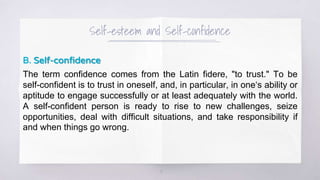
Self-esteem and Self-confidence
B. Self-confidence
The term confidence comes from the Latin fidere, "to trust." To be
self-confident is to trust in oneself, and, in particular, in one‘s ability or
aptitude to engage successfully or at least adequately with the world.
A self-confident person is ready to rise to new challenges, seize
opportunities, deal with difficult situations, and take responsibility if
and when things go wrong.
5
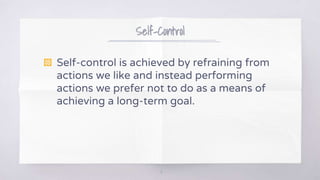
Self-Control
▧ Self-control is achieved by refraining from
actions we like and instead performing
actions we prefer not to do as a means of
achieving a long-term goal.
6
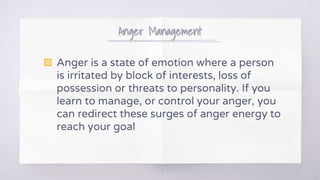
Anger Management
▧ Anger is a state of emotion where a person
is irritated by block of interests, loss of
possession or threats to personality. If you
learn to manage, or control your anger, you
can redirect these surges of anger energy to
reach your goal
7
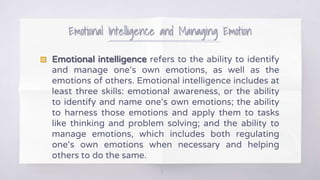
Emotional Intelligence and Managing Emotion
8
▧ Emotional intelligence refers to the ability to identify
and manage one‘s own emotions, as well as the
emotions of others. Emotional intelligence includes at
least three skills: emotional awareness, or the ability
to identify and name one‘s own emotions; the ability
to harness those emotions and apply them to tasks
like thinking and problem solving; and the ability to
manage emotions, which includes both regulating
one‘s own emotions when necessary and helping
others to do the same.
Stress, Coping with Stress and Resilience
9
▧ Stress generally refers to two things: the
psychological perception of pressure, on the one
hand, and the body's response to it, on the other,
which involves multiple systems from metabolism to
muscles and memory.
▧ Three Categories of Stressors:
○ Catastrophes
○ Significant Life Changes
○ Daily Life Events
Stress, Coping with Stress and Resilience
10
▧ Coping With Stress two ways:
○ Problem focused - when we feel a sense of
control over a situation and think we can change
the circumstances or change ourselves, we may
address stressors directly, with problem - focused
coping.
○ Emotion-focused - When we cannot handle the
problem or believe that we cannot change a
situation, we may turn to emotion-focused
coping.
Resilience
Resilience is the process of adapting well in the
face of adversity, trauma, tragedy, threats or
significant sources of stress such as family and
relationship problems, serious health problems
or workplace and financial stressors. It means
"bouncing back" from difficult experiences
(APA definition)
11
Critical and Creative Thinking
Critical thinking skills includes decision-
making/problem solving skills and information
gathering skills. The individual must also be
skilled at evaluating the future consequences of
their present actions and the actions of others.
12
Problem Solving and Decision Making
Problem solving is a process in which we
perceive and resolve a gap between a present
situation and a desired goal, with the path to
the goal blocked by known or unknown
obstacles.
13
Problem Solving and Decision Making
Decision-making people often turn to groups
when they must make key decisions, for groups
can draw on more resources than one
individual. Groups can generate more ideas and
possible solutions by discussing the problem.
14
End of discussion.
15

Interpersonal Intrapersonal.pptx

  • 1.
  • 2.
    Self-Concept and Self-Awareness A.Self-concept The self is a reflexive phenomenon that develops in social interaction and is based on the social character of human language. The concept of self provides the philosophical underpinning for social-psychological inquiries into the self- concept. The "self-concept," on the other hand, is a product of this reflexive activity. It is the concept the individual has of himself/herself as a physical, social, and spiritual or moral being. (Gecas, 1982) 2
  • 3.
    Self-Concept and Self-Awareness B.Self- awareness Self-awareness is having a clear perception of your personality, including strengths, weaknesses, thoughts, beliefs, motivation, and emotions. It is an attribute of one‘s self-concept that allows understanding other people‘s attitudes and responses to them. 3
  • 4.
    Self-esteem and Self-confidence A.Self-esteem "Esteem" is derived from the Latin aestimare, meaning "to appraise, value, rate, weigh, estimate," and self-esteem is our cognitive and, above all, emotional appraisal of our own worth. Self-esteem deals with the evaluative and emotional dimensions of the self-concept. 4
  • 5.
    Self-esteem and Self-confidence B.Self-confidence The term confidence comes from the Latin fidere, "to trust." To be self-confident is to trust in oneself, and, in particular, in one‘s ability or aptitude to engage successfully or at least adequately with the world. A self-confident person is ready to rise to new challenges, seize opportunities, deal with difficult situations, and take responsibility if and when things go wrong. 5
  • 6.
    Self-Control ▧ Self-control isachieved by refraining from actions we like and instead performing actions we prefer not to do as a means of achieving a long-term goal. 6
  • 7.
    Anger Management ▧ Angeris a state of emotion where a person is irritated by block of interests, loss of possession or threats to personality. If you learn to manage, or control your anger, you can redirect these surges of anger energy to reach your goal 7
  • 8.
    Emotional Intelligence andManaging Emotion 8 ▧ Emotional intelligence refers to the ability to identify and manage one‘s own emotions, as well as the emotions of others. Emotional intelligence includes at least three skills: emotional awareness, or the ability to identify and name one‘s own emotions; the ability to harness those emotions and apply them to tasks like thinking and problem solving; and the ability to manage emotions, which includes both regulating one‘s own emotions when necessary and helping others to do the same.
  • 9.
    Stress, Coping withStress and Resilience 9 ▧ Stress generally refers to two things: the psychological perception of pressure, on the one hand, and the body's response to it, on the other, which involves multiple systems from metabolism to muscles and memory. ▧ Three Categories of Stressors: ○ Catastrophes ○ Significant Life Changes ○ Daily Life Events
  • 10.
    Stress, Coping withStress and Resilience 10 ▧ Coping With Stress two ways: ○ Problem focused - when we feel a sense of control over a situation and think we can change the circumstances or change ourselves, we may address stressors directly, with problem - focused coping. ○ Emotion-focused - When we cannot handle the problem or believe that we cannot change a situation, we may turn to emotion-focused coping.
  • 11.
    Resilience Resilience is theprocess of adapting well in the face of adversity, trauma, tragedy, threats or significant sources of stress such as family and relationship problems, serious health problems or workplace and financial stressors. It means "bouncing back" from difficult experiences (APA definition) 11
  • 12.
    Critical and CreativeThinking Critical thinking skills includes decision- making/problem solving skills and information gathering skills. The individual must also be skilled at evaluating the future consequences of their present actions and the actions of others. 12
  • 13.
    Problem Solving andDecision Making Problem solving is a process in which we perceive and resolve a gap between a present situation and a desired goal, with the path to the goal blocked by known or unknown obstacles. 13
  • 14.
    Problem Solving andDecision Making Decision-making people often turn to groups when they must make key decisions, for groups can draw on more resources than one individual. Groups can generate more ideas and possible solutions by discussing the problem. 14
  • 15.