12/06/2024 1
In
The
Name
of
GodBehavioural
Psychology
Unit # 04;
Interpersonal
Communication
Course: Behavioural Psychology
Batch:2021
By: Nida Ghaffar
12/06/2024 2
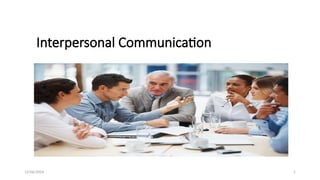
Interpersonal Communication
12/06/2024 3
Objective
At the end of this unit learners will be able to:
• Demonstrate the understanding of the ways involved in achieving
effective communication.
• Demonstrate understanding of using effective communication in
complex situations.
• Identify circumstances leading to self-disclosure.
• Develop understanding of the role of self-closure in psychological
health and its use in interpersonal conflicts.
12/06/2024 4
Communication
• Communication is simply the act of transferring information from
one place, person or group to another.
• Every communication involves (at least) one sender, a message and a
recipient.
• This may sound simple, but communication is actually a very complex
subject.
12/06/2024 5
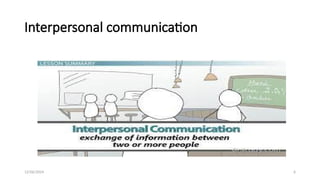
Interpersonal Communication
• Interpersonal communication is the process by which people
exchange information, feelings, and meaning through verbal and non-
verbal messages: it is face-to-face communication.
• Although no communication may be intended, people receive
messages through such forms of non-verbal behavior.
• Interpersonal communication skills build strong and positive
relationships with your colleagues and complete team projects
smoothly and effectively.
12/06/2024 6
Interpersonal communication
12/06/2024 7
Effective Communication
• Communicating effectively means that your ideas and concepts are
being heard and people are acting upon them.
• It also means you are able to listen, understand, and take action on
what other people say.
12/06/2024 8
Effective Communication guidelines
• Practice active listening.
• Ask for feedback.
• Focus on nonverbal communication.
• Try to send a clear message
• Manage your own emotions
• Develop a filter.
12/06/2024 9
Use of effective communication in difficult
Situation
• Listen for full understanding of the person’s perspective.
• Allow them the opportunity to give you a clear picture of what they
are trying to say.
• Put the person at ease using nonverbal cues that show interest and
concern.
• Take the time you need to really understand the situation.
12/06/2024 10
Use of effective communication in difficult
Situation
• Be straightforward and unemotional. The more you remain calm and
matter of fact, the sooner you gain another’s confidence.
• People want to feel you are leveling with them, that they can trust
you. Remember that respect from others begin with self-respect.
• Be gracious. Someone else’s rudeness does not give us the right to be
rude.
• Treat the other with the kindness you would like to be shown and
allow them to feel important. When our own egos are healthy, we are
rich; we can afford to be generous.
12/06/2024 11
Use of effective communication in
difficult Situation
• Learn to respond as well as listen.
• Ask questions instead of making accusations.
• Be honest about your next steps.
• If you cannot fix the problem outright, do not make promises that you
cannot keep. If there are consequences to the behavior, let the
consumer know.
12/06/2024 12
Self Disclosure
• Self-disclosure is the process of passing on information about yourself
to someone else.
• The information can be descriptive or evaluative, and can include
thoughts, feelings, inspirations, goals, failures, successes, fears, and
dreams, as well as one's likes, dislikes, and favorites.
12/06/2024 13
Self disclosure
• Research suggests that self-disclosure plays a key role in forming
strong relationships.
• It can make people feel closer, understand one another better, and
cooperate more effectively.
• Emotional (rather than factual) disclosures are particularly important
for boosting empathy and building trust.
12/06/2024 14
Social Penetration Theory
• Social penetration theory was developed to explain how information
exchange functions in the development and dissolution of
interpersonal relationships.
• Social penetration describes the process of bonding that moves a
relationship from superficial to more intimate (Altman & Taylor,
1973). Social penetration is specifically accomplished through self‐
disclosure, the purposeful process of revealing information about
oneself (Derlega, Metts, Petronio, & Margulis, 1993
12/06/2024 15
Social Penetration Theory
• Self disclosure increases intimacy in relationships to a certain point.
‐
• Social penetration can occur in different contexts including romantic
relationships (e.g., Taylor & Altman, 1975, 1987), friendships, social
groups (for example, religious groups or soccer clubs), and work
relationships.
• The theory has also been applied in computer mediated
‐
communication contexts such as online dating and virtual teams.
12/06/2024 16
Stages of social penetration
• Self disclosure passes through a number of phases as an interpersonal
‐
relationship progresses (Taylor & Altman, 1987).
• These stages of social penetration theory include
• Orientation
• Exploratory
• Affective exchange,
• Stable exchange
12/06/2024 17
The first stage is orientation
• The first stage is orientation, when people share only superficial
information, or the outermost layer, about themselves.
• In this initial stage, people are cautious and careful when disclosing
information.
12/06/2024 18
The second stage of social penetration theory
is exploratory
• The second stage of social penetration theory is exploratory in which
people share details beyond the most superficial information and use
less caution when self disclosing.
‐
• There may be an increase in the breadth of topics discussed, but
these topics still generally reveal the public self (Taylor & Altman,
1987).
12/06/2024 19
The third stage of social penetration theory is
affective exchange
• The third stage of social penetration theory is affective exchange, in
which information from the more intermediate layers is shared and
interactions are increasingly casual (Taylor & Altman, 1987).
• Here, people likely reveal some information about the private self or
more intimate information
12/06/2024 20
The final stage of social penetration theory is
stable exchange
• The final stage of social penetration theory is stable exchange,
characterized by openness, breadth, and depth across conversation
topics (Taylor & Altman, 1987).
• The most intimate information about the private self is continuously
disclosed at this stage.
• This stage is characterized by honesty and intimacy, a high degree of
spontaneity, and 3 open expression of thoughts, feelings, and
behaviors. People maintain few relationships at this stage, generally
romantic relationships, close family members, and close friends.
12/06/2024 21
Role of self disclosure in interpersonal conflict
• Conflict management is the process for handling disputes and
disagreements between two or multiple parties.
• The goal of this system is to minimize the negative factors that are
influencing the conflict and encourage all participants to come to an
agreement.
• Successful conflict management results in a mutually beneficial
outcome that's agreed upon by each party.
12/06/2024 22
Questions to Ask Before Choosing a Conflict Management Style
• 1. How much do you value the person or issue?
• It may influence you to choose one strategy over another based on
how much you value the person with whom you have a conflict or the
issue over which you are conflicted.
• In addition, you can judge the importance of the conflict based on
how close to whom the issue sits.
• Perhaps it's a matter of your morals or personal values, in which case
it may be essential for you to prolong the conflict, If the issue is of
little significance to you, though, it may be easier to let it go.
12/06/2024 23
2. Do you understand the consequences?
• You should be prepared for whatever consequences may entail either
entering or not taking part in the conflict.
• Especially in a professional environment, there could be serious
consequences for continuing a conflict with a higher-up.
• As long as you are made aware of the potential risks, you can decide
whether or not to prolong the conflict.
12/06/2024 24
Continue…….
• Similarly, you may feel consequences if you don't enter the conflict.
• Perhaps, those will be personal, moral consequences for not standing
up for your beliefs.
• Or, maybe, a wrong decision is made and executed because you didn't
bring in a conflicting perspective.
• Regardless, give yourself a clear overview of all the positive and
negative consequences beforehand.
12/06/2024 25
3. Do you have the necessary time and energy to contribute?
• By entering a conflict with a firm stance, you are preparing yourself for
what could be a long-term ordeal requiring research, presentations,
conversations, and stress. Before diving in, ensure that you have the
time in your schedule to dedicate yourself to the conflict.
• Ensure that you care enough about the conflict that it's worth the
energy you will need to pour into it every day.
12/06/2024 26
The 5 Conflict Management Styles
• 1. Accommodating
• An accommodating style forsakes your own needs or desires in
exchange for those of others.
• You would be putting the concerns of others before your own. This
style usually takes place when you either simply give in or are
persuaded to give in.
12/06/2024 27
Continue……………
• This style could be appropriate to use when you care less about the
issue than the others,
• If you want to keep the peace, feel as though you are in the wrong, or
feel like you have no choice but to agree to the other point-of-view.
12/06/2024 28
2. Avoiding
• An avoiding style completely evades the conflict.
• You would neither pursue your beliefs nor those of the others
involved.
• Simply, you would continuously postpone or completely dodge the
conflict whenever it comes up.
12/06/2024 29
Continue………..
• This style could be appropriate to use when the conflict seems trivial.
• you don't have the time or need more time to think, you feel as
though you have no chance of winning, or you're afraid of being met
with resentment.
12/06/2024 30
3. Compromising
• A compromising style attempts to find a solution that will at least
partially please all parties.
• You would work to find a middle ground between all the needs, which
would typically leave people unsatisfied or satisfied to a certain
extent.
• This style could be appropriate to use when it's more important to
reach a solution than for the solution to be great, a deadline is rapidly
approaching, you're at an impasse, or you need a temporary solution
for the moment.
12/06/2024 31
4. Collaborating
• A collaborating style attempts to find a solution that will meet
the needs of all parties. Rather than trying to find a middle
ground solution, you would aim for a solution that actually
satisfies everyone and ends up being a win-win situation.
• This style could be appropriate when multiple perspectives
need to be addressed, there is an important relationship
present between the parties, the final solution is too important
for anyone to be displeased, or the beliefs of multiple
stakeholders must be represented.
12/06/2024 32
5. Competing
• A competing style takes a firm stance and refuses to see the
perspectives of the other parties. You would keep pushing your
viewpoint at others or keep rejecting their ideas until you get your
way.
• This style could be appropriate when you have to stand up for your
rights or morals, need to make a quick decision and force others to
get on board, need to end a long-term conflict, or have to prevent a
terrible, opposing decision from being made.
12/06/2024 33
References
• Introduction to Psychology by Atikinson and hikgards’s 14th
edition
• https://www.google.com/search?q=
how+to+acheive+effective+communication&oq=
how+to+acheive+effective+communication&aqs
=chrome..69i57j0i13l9.10941j0j7&sourceid=chrome&ie=UTF-8
• https://www.masterclass.com/articles/how-to-improve-your-commun
ication-skills#4-skills-that-are-necessary-for-effective-communication
12/06/2024 34
References
• https://www.cdss.ca.gov/agedblinddisabled/res/VPTC2/3%20Commu
nication%20Skills/Communicating_in_Difficult_Situations_and_Handli
ng_Hostility.pdf
• https://blog.hubspot.com/service/conflict-management-styleshttps
://www.google.com/search?q=self+disclosure&oq=
self+disclosure&aqs=chrome..69i57j0i512l9.4658j0j7&sourceid=
chrome&ie=UTF-8
• https://www.google.com/search?
q=why+we+need+to+be+self+disclosure&oq=why+we+need+to+be+s
elf+disclosure&aqs=chrome..69i57j33i10i160.13414j0j7&sourceid=ch
rome&ie=UTF-8

Interpersonal Communication in behavioral psychology

  • 1.
    12/06/2024 1 In The Name of GodBehavioural Psychology Unit #04; Interpersonal Communication Course: Behavioural Psychology Batch:2021 By: Nida Ghaffar
  • 2.
  • 3.
    12/06/2024 3 Objective At theend of this unit learners will be able to: • Demonstrate the understanding of the ways involved in achieving effective communication. • Demonstrate understanding of using effective communication in complex situations. • Identify circumstances leading to self-disclosure. • Develop understanding of the role of self-closure in psychological health and its use in interpersonal conflicts.
  • 4.
    12/06/2024 4 Communication • Communicationis simply the act of transferring information from one place, person or group to another. • Every communication involves (at least) one sender, a message and a recipient. • This may sound simple, but communication is actually a very complex subject.
  • 5.
    12/06/2024 5 Interpersonal Communication •Interpersonal communication is the process by which people exchange information, feelings, and meaning through verbal and non- verbal messages: it is face-to-face communication. • Although no communication may be intended, people receive messages through such forms of non-verbal behavior. • Interpersonal communication skills build strong and positive relationships with your colleagues and complete team projects smoothly and effectively.
  • 6.
  • 7.
    12/06/2024 7 Effective Communication •Communicating effectively means that your ideas and concepts are being heard and people are acting upon them. • It also means you are able to listen, understand, and take action on what other people say.
  • 8.
    12/06/2024 8 Effective Communicationguidelines • Practice active listening. • Ask for feedback. • Focus on nonverbal communication. • Try to send a clear message • Manage your own emotions • Develop a filter.
  • 9.
    12/06/2024 9 Use ofeffective communication in difficult Situation • Listen for full understanding of the person’s perspective. • Allow them the opportunity to give you a clear picture of what they are trying to say. • Put the person at ease using nonverbal cues that show interest and concern. • Take the time you need to really understand the situation.
  • 10.
    12/06/2024 10 Use ofeffective communication in difficult Situation • Be straightforward and unemotional. The more you remain calm and matter of fact, the sooner you gain another’s confidence. • People want to feel you are leveling with them, that they can trust you. Remember that respect from others begin with self-respect. • Be gracious. Someone else’s rudeness does not give us the right to be rude. • Treat the other with the kindness you would like to be shown and allow them to feel important. When our own egos are healthy, we are rich; we can afford to be generous.
  • 11.
    12/06/2024 11 Use ofeffective communication in difficult Situation • Learn to respond as well as listen. • Ask questions instead of making accusations. • Be honest about your next steps. • If you cannot fix the problem outright, do not make promises that you cannot keep. If there are consequences to the behavior, let the consumer know.
  • 12.
    12/06/2024 12 Self Disclosure •Self-disclosure is the process of passing on information about yourself to someone else. • The information can be descriptive or evaluative, and can include thoughts, feelings, inspirations, goals, failures, successes, fears, and dreams, as well as one's likes, dislikes, and favorites.
  • 13.
    12/06/2024 13 Self disclosure •Research suggests that self-disclosure plays a key role in forming strong relationships. • It can make people feel closer, understand one another better, and cooperate more effectively. • Emotional (rather than factual) disclosures are particularly important for boosting empathy and building trust.
  • 14.
    12/06/2024 14 Social PenetrationTheory • Social penetration theory was developed to explain how information exchange functions in the development and dissolution of interpersonal relationships. • Social penetration describes the process of bonding that moves a relationship from superficial to more intimate (Altman & Taylor, 1973). Social penetration is specifically accomplished through self‐ disclosure, the purposeful process of revealing information about oneself (Derlega, Metts, Petronio, & Margulis, 1993
  • 15.
    12/06/2024 15 Social PenetrationTheory • Self disclosure increases intimacy in relationships to a certain point. ‐ • Social penetration can occur in different contexts including romantic relationships (e.g., Taylor & Altman, 1975, 1987), friendships, social groups (for example, religious groups or soccer clubs), and work relationships. • The theory has also been applied in computer mediated ‐ communication contexts such as online dating and virtual teams.
  • 16.
    12/06/2024 16 Stages ofsocial penetration • Self disclosure passes through a number of phases as an interpersonal ‐ relationship progresses (Taylor & Altman, 1987). • These stages of social penetration theory include • Orientation • Exploratory • Affective exchange, • Stable exchange
  • 17.
    12/06/2024 17 The firststage is orientation • The first stage is orientation, when people share only superficial information, or the outermost layer, about themselves. • In this initial stage, people are cautious and careful when disclosing information.
  • 18.
    12/06/2024 18 The secondstage of social penetration theory is exploratory • The second stage of social penetration theory is exploratory in which people share details beyond the most superficial information and use less caution when self disclosing. ‐ • There may be an increase in the breadth of topics discussed, but these topics still generally reveal the public self (Taylor & Altman, 1987).
  • 19.
    12/06/2024 19 The thirdstage of social penetration theory is affective exchange • The third stage of social penetration theory is affective exchange, in which information from the more intermediate layers is shared and interactions are increasingly casual (Taylor & Altman, 1987). • Here, people likely reveal some information about the private self or more intimate information
  • 20.
    12/06/2024 20 The finalstage of social penetration theory is stable exchange • The final stage of social penetration theory is stable exchange, characterized by openness, breadth, and depth across conversation topics (Taylor & Altman, 1987). • The most intimate information about the private self is continuously disclosed at this stage. • This stage is characterized by honesty and intimacy, a high degree of spontaneity, and 3 open expression of thoughts, feelings, and behaviors. People maintain few relationships at this stage, generally romantic relationships, close family members, and close friends.
  • 21.
    12/06/2024 21 Role ofself disclosure in interpersonal conflict • Conflict management is the process for handling disputes and disagreements between two or multiple parties. • The goal of this system is to minimize the negative factors that are influencing the conflict and encourage all participants to come to an agreement. • Successful conflict management results in a mutually beneficial outcome that's agreed upon by each party.
  • 22.
    12/06/2024 22 Questions toAsk Before Choosing a Conflict Management Style • 1. How much do you value the person or issue? • It may influence you to choose one strategy over another based on how much you value the person with whom you have a conflict or the issue over which you are conflicted. • In addition, you can judge the importance of the conflict based on how close to whom the issue sits. • Perhaps it's a matter of your morals or personal values, in which case it may be essential for you to prolong the conflict, If the issue is of little significance to you, though, it may be easier to let it go.
  • 23.
    12/06/2024 23 2. Doyou understand the consequences? • You should be prepared for whatever consequences may entail either entering or not taking part in the conflict. • Especially in a professional environment, there could be serious consequences for continuing a conflict with a higher-up. • As long as you are made aware of the potential risks, you can decide whether or not to prolong the conflict.
  • 24.
    12/06/2024 24 Continue……. • Similarly,you may feel consequences if you don't enter the conflict. • Perhaps, those will be personal, moral consequences for not standing up for your beliefs. • Or, maybe, a wrong decision is made and executed because you didn't bring in a conflicting perspective. • Regardless, give yourself a clear overview of all the positive and negative consequences beforehand.
  • 25.
    12/06/2024 25 3. Doyou have the necessary time and energy to contribute? • By entering a conflict with a firm stance, you are preparing yourself for what could be a long-term ordeal requiring research, presentations, conversations, and stress. Before diving in, ensure that you have the time in your schedule to dedicate yourself to the conflict. • Ensure that you care enough about the conflict that it's worth the energy you will need to pour into it every day.
  • 26.
    12/06/2024 26 The 5Conflict Management Styles • 1. Accommodating • An accommodating style forsakes your own needs or desires in exchange for those of others. • You would be putting the concerns of others before your own. This style usually takes place when you either simply give in or are persuaded to give in.
  • 27.
    12/06/2024 27 Continue…………… • Thisstyle could be appropriate to use when you care less about the issue than the others, • If you want to keep the peace, feel as though you are in the wrong, or feel like you have no choice but to agree to the other point-of-view.
  • 28.
    12/06/2024 28 2. Avoiding •An avoiding style completely evades the conflict. • You would neither pursue your beliefs nor those of the others involved. • Simply, you would continuously postpone or completely dodge the conflict whenever it comes up.
  • 29.
    12/06/2024 29 Continue……….. • Thisstyle could be appropriate to use when the conflict seems trivial. • you don't have the time or need more time to think, you feel as though you have no chance of winning, or you're afraid of being met with resentment.
  • 30.
    12/06/2024 30 3. Compromising •A compromising style attempts to find a solution that will at least partially please all parties. • You would work to find a middle ground between all the needs, which would typically leave people unsatisfied or satisfied to a certain extent. • This style could be appropriate to use when it's more important to reach a solution than for the solution to be great, a deadline is rapidly approaching, you're at an impasse, or you need a temporary solution for the moment.
  • 31.
    12/06/2024 31 4. Collaborating •A collaborating style attempts to find a solution that will meet the needs of all parties. Rather than trying to find a middle ground solution, you would aim for a solution that actually satisfies everyone and ends up being a win-win situation. • This style could be appropriate when multiple perspectives need to be addressed, there is an important relationship present between the parties, the final solution is too important for anyone to be displeased, or the beliefs of multiple stakeholders must be represented.
  • 32.
    12/06/2024 32 5. Competing •A competing style takes a firm stance and refuses to see the perspectives of the other parties. You would keep pushing your viewpoint at others or keep rejecting their ideas until you get your way. • This style could be appropriate when you have to stand up for your rights or morals, need to make a quick decision and force others to get on board, need to end a long-term conflict, or have to prevent a terrible, opposing decision from being made.
  • 33.
    12/06/2024 33 References • Introductionto Psychology by Atikinson and hikgards’s 14th edition • https://www.google.com/search?q= how+to+acheive+effective+communication&oq= how+to+acheive+effective+communication&aqs =chrome..69i57j0i13l9.10941j0j7&sourceid=chrome&ie=UTF-8 • https://www.masterclass.com/articles/how-to-improve-your-commun ication-skills#4-skills-that-are-necessary-for-effective-communication
  • 34.
    12/06/2024 34 References • https://www.cdss.ca.gov/agedblinddisabled/res/VPTC2/3%20Commu nication%20Skills/Communicating_in_Difficult_Situations_and_Handli ng_Hostility.pdf •https://blog.hubspot.com/service/conflict-management-styleshttps ://www.google.com/search?q=self+disclosure&oq= self+disclosure&aqs=chrome..69i57j0i512l9.4658j0j7&sourceid= chrome&ie=UTF-8 • https://www.google.com/search? q=why+we+need+to+be+self+disclosure&oq=why+we+need+to+be+s elf+disclosure&aqs=chrome..69i57j33i10i160.13414j0j7&sourceid=ch rome&ie=UTF-8