European Quality Assurance
Register for Higher Education
Making quality assurance more European
– where are we and
where do we want to go?
Peer-Learning Activity on Quality Assurance
1 October 2014, Budapest
Colin Tück
Outline
1. Where we are: EHEA infrastructure
 European Standards and Guidelines (ESG)
 European Quality Assurance Register (EQAR)
2. Where we are heading: current policy context
 Quality assurance crossing borders
 Revision of the ESG
3. Where do we want to go?
Where we are ...
 Diversity in terms of objectives
 Accountability
 Enhancement
 Public information
 … in terms of balance between internal and external
 Institutions self-responsible for their programmes and degrees
 External approval of new programmes or changes
 … in terms of level
 Institutional accreditation, evaluation or audit
 External accreditation or evaluation of individual programmes
 Combinations or variations of the two
European Standards and
Guidelines for QA (ESG)
 Adopted by Bologna ministers in 2005
 Based on a proposal by E4 Group (main stakeholders: ENQA -
agencies, ESU - students, EUA & EURASHE - institutions)
 Agreed reference point for internal and external quality
assurance (QA) in the European Higher Education Area (EHEA)
 Twin purposes: accountability and enhancement
 Standards for QA processes – education content tackled by
qualifications frameworks (national, EQF-LLL & QF-EHEA)
 ESG are the “common denominator”
 Set a common framework
 Facilitate trust and recognition
 Enable assurance and improvement of quality
European Quality Assurance
Register for Higher Education
(EQAR)
Register of quality assurance agencies that comply
substantially with European Standards and Guidelines
for Quality Assurance (ESG)
 Established by E4 at Ministers' request
 Jointly governed by stakeholders (E4, social
partners) and EHEA governments
 External review of agencies by independent experts
 Independent Register Committee
 Composed of 11 quality assurance experts
 Nominated by E4, but not representatives
 Takes all decisions related to registration
EQAR Mission and Objectives
Transparency and Information
 Information on bona fide agencies
 Prevent „accreditation mills“ from gaining credibility
Trust and Recognition
 Enhance trust in and recognition of QA results
 Support recognition of qualifications/periods of study
 Allow registered QA agencies to operate across the
entire EHEA, HE institution to choose agency
HEI
“coherent quality assurance framework for the
EHEA in which HEIs have the freedom to turn to
any EQAR-registered agency [...], and in which
qualifications are thus universally recognised“
HEI
Agencies and Governments
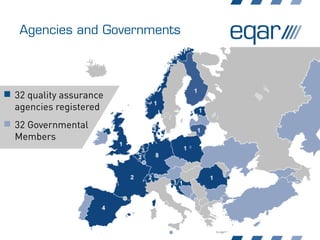
 32 quality assurance
agencies registered
 32 Governmental
Members
Current Policy Context
 Bucharest Communiqué (2012) – Ministers agreed to:
 allow EQAR-registered agencies to perform their activities across the EHEA,
while complying with national requirements
 recognise quality assurance decisions of EQAR-registered agencies on joint and
double degree programmes
 automatic recognition of comparable academic degrees [...] as a long-term goal
 revise the ESG […]
 EU Education, Youth, Culture and Sport Council (2014):
 allowing EQAR-registered agencies to evaluate institutions offering cross-border
and franchised provision
 opening up opportunities for quality assurance agencies to offer cross-border
quality assurance through [EQAR] [...] to stimulate a European dimension in
quality assurance and to facilitate cross-border evaluation and simpler
procedures for joint programmes
 support […] the ongoing revision of the ESG
Quality Assurance
Crossing Borders
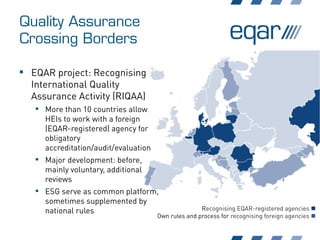
 EQAR project: Recognising
International Quality
Assurance Activity (RIQAA)
 More than 10 countries allow
HEIs to work with a foreign
(EQAR-registered) agency for
obligatory
accreditation/audit/evaluation
 Major development: before,
mainly voluntary, additional
reviews
 ESG serve as common platform,
sometimes supplemented by
national rules Recognising EQAR-registered agencies 
Own rules and process for recognising foreign agencies 
Quality Assurance
Crossing Borders
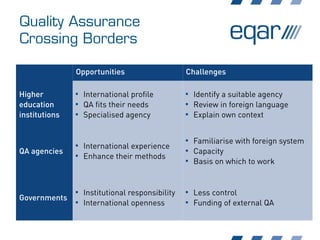
Opportunities Challenges
Higher
education
institutions

International profile

QA fits their needs

Specialised agency

Identify a suitable agency

Review in foreign language

Explain own context
QA agencies

International experience

Enhance their methods

Familiarise with foreign system

Capacity

Basis on which to work
Governments

Institutional responsibility

International openness

Less control

Funding of external QA
ESG Revision
 Process
 E4 together with BusinessEurope, Education International, EQAR
 Proposal agreed by BFUG, to be published soon
 Adoption by Ministers in May 2015 (Yerevan)
 Changes
 Close link to national qualifications frameworks and QF-EHEA
 Most significant changes to part 1 on internal QA
 Increased clarity and consistency
 Embrace diversity in external QA
 Transition
 All agencies (re-)registered based on revised ESG by 2020
Where do we want to go?
 EHEA is converging more
 ESG set out the “EHEA model” for quality assurance
 Objectives to become more similar?
 External QA processes to become more similar?
 ESG and QF-EHEA are no longer meta frameworks
 More and more used directly, in cross-border QA and also in European
Approach for QA of Joint Programmes
 Recognised by those maintaining them?
 Are they fit for that use?
 Need for transparency, professionalism and integrity
 Governments: transparent national rules for cross-border QA
 QAAs: clear and transparent set of processes and criteria
 Need for additional European rules or guidelines?

Making quality assurance more European – where are we and where do we want to go?

  • 1.
    European Quality Assurance Registerfor Higher Education Making quality assurance more European – where are we and where do we want to go? Peer-Learning Activity on Quality Assurance 1 October 2014, Budapest Colin Tück
  • 2.
    Outline 1. Where weare: EHEA infrastructure  European Standards and Guidelines (ESG)  European Quality Assurance Register (EQAR) 2. Where we are heading: current policy context  Quality assurance crossing borders  Revision of the ESG 3. Where do we want to go?
  • 3.
    Where we are...  Diversity in terms of objectives  Accountability  Enhancement  Public information  … in terms of balance between internal and external  Institutions self-responsible for their programmes and degrees  External approval of new programmes or changes  … in terms of level  Institutional accreditation, evaluation or audit  External accreditation or evaluation of individual programmes  Combinations or variations of the two
  • 4.
    European Standards and Guidelinesfor QA (ESG)  Adopted by Bologna ministers in 2005  Based on a proposal by E4 Group (main stakeholders: ENQA - agencies, ESU - students, EUA & EURASHE - institutions)  Agreed reference point for internal and external quality assurance (QA) in the European Higher Education Area (EHEA)  Twin purposes: accountability and enhancement  Standards for QA processes – education content tackled by qualifications frameworks (national, EQF-LLL & QF-EHEA)  ESG are the “common denominator”  Set a common framework  Facilitate trust and recognition  Enable assurance and improvement of quality
  • 5.
    European Quality Assurance Registerfor Higher Education (EQAR) Register of quality assurance agencies that comply substantially with European Standards and Guidelines for Quality Assurance (ESG)  Established by E4 at Ministers' request  Jointly governed by stakeholders (E4, social partners) and EHEA governments  External review of agencies by independent experts  Independent Register Committee  Composed of 11 quality assurance experts  Nominated by E4, but not representatives  Takes all decisions related to registration
  • 6.
    EQAR Mission andObjectives Transparency and Information  Information on bona fide agencies  Prevent „accreditation mills“ from gaining credibility Trust and Recognition  Enhance trust in and recognition of QA results  Support recognition of qualifications/periods of study  Allow registered QA agencies to operate across the entire EHEA, HE institution to choose agency HEI “coherent quality assurance framework for the EHEA in which HEIs have the freedom to turn to any EQAR-registered agency [...], and in which qualifications are thus universally recognised“ HEI
  • 7.
    Agencies and Governments 32 quality assurance agencies registered  32 Governmental Members
  • 8.
    Current Policy Context Bucharest Communiqué (2012) – Ministers agreed to:  allow EQAR-registered agencies to perform their activities across the EHEA, while complying with national requirements  recognise quality assurance decisions of EQAR-registered agencies on joint and double degree programmes  automatic recognition of comparable academic degrees [...] as a long-term goal  revise the ESG […]  EU Education, Youth, Culture and Sport Council (2014):  allowing EQAR-registered agencies to evaluate institutions offering cross-border and franchised provision  opening up opportunities for quality assurance agencies to offer cross-border quality assurance through [EQAR] [...] to stimulate a European dimension in quality assurance and to facilitate cross-border evaluation and simpler procedures for joint programmes  support […] the ongoing revision of the ESG
  • 9.
    Quality Assurance Crossing Borders EQAR project: Recognising International Quality Assurance Activity (RIQAA)  More than 10 countries allow HEIs to work with a foreign (EQAR-registered) agency for obligatory accreditation/audit/evaluation  Major development: before, mainly voluntary, additional reviews  ESG serve as common platform, sometimes supplemented by national rules Recognising EQAR-registered agencies  Own rules and process for recognising foreign agencies 
  • 10.
    Quality Assurance Crossing Borders OpportunitiesChallenges Higher education institutions  International profile  QA fits their needs  Specialised agency  Identify a suitable agency  Review in foreign language  Explain own context QA agencies  International experience  Enhance their methods  Familiarise with foreign system  Capacity  Basis on which to work Governments  Institutional responsibility  International openness  Less control  Funding of external QA
  • 11.
    ESG Revision  Process E4 together with BusinessEurope, Education International, EQAR  Proposal agreed by BFUG, to be published soon  Adoption by Ministers in May 2015 (Yerevan)  Changes  Close link to national qualifications frameworks and QF-EHEA  Most significant changes to part 1 on internal QA  Increased clarity and consistency  Embrace diversity in external QA  Transition  All agencies (re-)registered based on revised ESG by 2020
  • 12.
    Where do wewant to go?  EHEA is converging more  ESG set out the “EHEA model” for quality assurance  Objectives to become more similar?  External QA processes to become more similar?  ESG and QF-EHEA are no longer meta frameworks  More and more used directly, in cross-border QA and also in European Approach for QA of Joint Programmes  Recognised by those maintaining them?  Are they fit for that use?  Need for transparency, professionalism and integrity  Governments: transparent national rules for cross-border QA  QAAs: clear and transparent set of processes and criteria  Need for additional European rules or guidelines?