
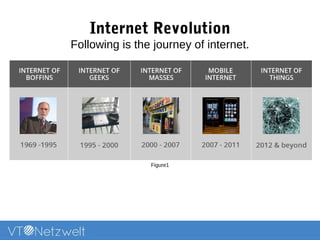

Internet Revolution
Following is the journey of internet.
Figure1
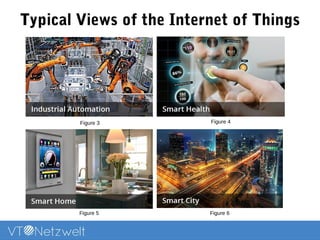
Typical Views of the Internet of Things
Figure 3 Figure 4
Figure 5 Figure 6
Table of Content
•
Introduction/Overview
•
How it works
•
Scope of IoT
•
Challenges in IoT
•
Footnotes
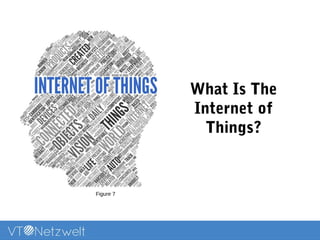
What Is The
Internet of
Things?
Figure 7
1. INTRODUCTION
It is also known as: Internet of Objects, Machine-to-
Machine Era, Internet of Everything
The Internet of Things (IoT) is a scenario in which
objects, animals or people are provided with unique
identifiers and the ability to transfer data over a network
without requiring human-to-human or human-to-
computer interaction. IoT has evolved from the
convergence of wireless technologies,
micro-electromechanical systems (MEMS) and the
Internet.
1.1 Terminology
• The term Internet of Things was first used by Kevin
Ashton in 1999.
• Refers to uniquely identifiable objects (things) and
their virtual representations
1.2 What is a thing?
A thing, in the Internet of Things, can be a person with a
heart monitor implant, a farm animal with a biochip
transponder, an automobile that has
built-in sensors to alert the driver when tire pressure is
low -- or any other natural or man-made object that can
be assigned an IP address and provided with the ability
to transfer data over a network.
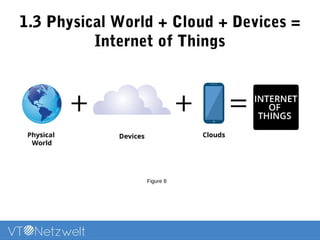
1.3 Physical World + Cloud + Devices =
Internet of Things
Figure 8
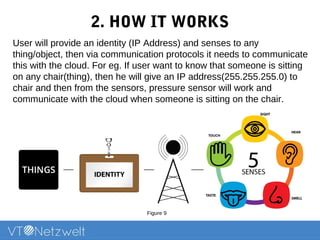
2. HOW IT WORKS
User will provide an identity (IP Address) and senses to any
thing/object, then via communication protocols it needs to communicate
this with the cloud. For eg. If user want to know that someone is sitting
on any chair(thing), then he will give an IP address(255.255.255.0) to
chair and then from the sensors, pressure sensor will work and
communicate with the cloud when someone is sitting on the chair.
Figure 9
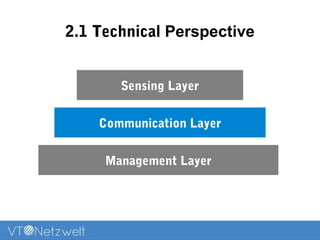
2.1 Technical Perspective
Sensing Layer
Communication Layer
Management Layer
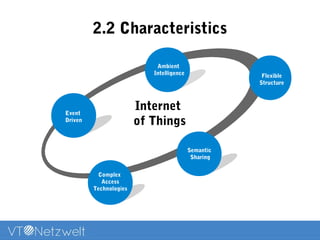
2.2 Characteristics
Event
Driven
Ambient
Intelligence Flexible
Structure
Semantic
Sharing
Complex
Access
Technologies
Internet
of Things
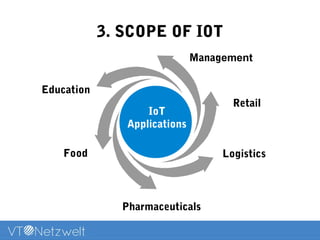
3. SCOPE OF IOT
Education
Food
Management
IoT
Applications
Retail
Logistics
Pharmaceuticals
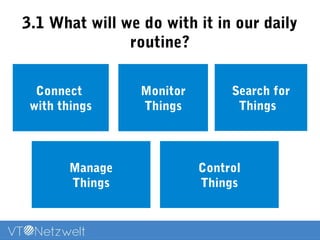
3.1 What will we do with it in our daily
routine?
Connect
with things
Monitor
Things
Manage
Things
Control
Things
Search for
Things
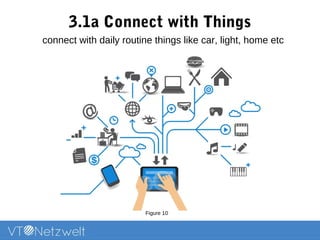
3.1a Connect with Things
Figure 10
connect with daily routine things like car, light, home etc
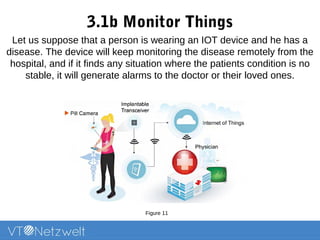
3.1b Monitor Things
Figure 11
Let us suppose that a person is wearing an IOT device and he has a
disease. The device will keep monitoring the disease remotely from the
hospital, and if it finds any situation where the patients condition is no
stable, it will generate alarms to the doctor or their loved ones.
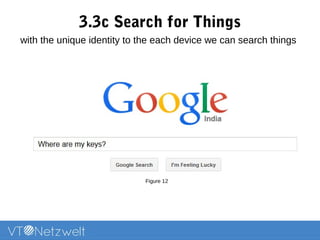
3.3c Search for Things
Figure 12
with the unique identity to the each device we can search things
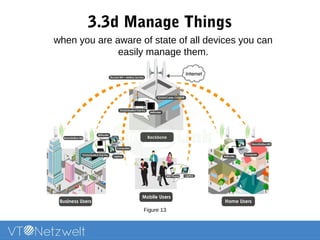
3.3d Manage Things
Figure 13
when you are aware of state of all devices you can
easily manage them.
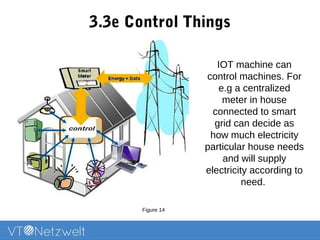
3.3e Control Things
Figure 14
IOT machine can
control machines. For
e.g a centralized
meter in house
connected to smart
grid can decide as
how much electricity
particular house needs
and will supply
electricity according to
need.
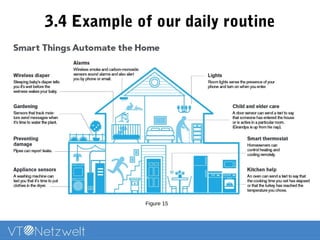
3.4 Example of our daily routine
Figure 15
4. CHALLENGES IN IOT
Society: People, security, privacy
•
A policy for people in the Internet of Things:
•
Security
•
Privacy
Environmental aspects
• Resource efficiency
• Pollution and disaster avoidance
Technological
•
Architecture (edge devices, servers, discovery services,
security, etc.)
•
Governance, naming, identity, interfaces
•
Standards
Footnotes
Title page: http://www.smartdatacollective.com/rick-delgado/285576/scary-security-concerns-internet-
things
1. https://riteshjagzape.wordpress.com/2013/11/24/internet-of-things-2/
2. http://www.applicationdelivery.com.au/2014/03/11/security-sidebar-defending-the-internet-of-things/
3. http://www.aptinex.com/services/industrial-automation/
4. http://inbioveritas.com/category/future-healthcare/
5. http://smp.businesswire.com/pages/hgtv-smart-home-2013-giveaway-opens-entries-april-11
6. http://nayaraipur.in/smart-cities-can-create-30-40-billion-business-opportunity-for-it-sector-nasscom/
7. http://blog.lnsresearch.com/blog/bid/197239/MA-s-First-Internet-of-Things-Week-and-Millennials-on-
the-Shop-Floor
10. https://growthcap.co/articles/?p=360
11. http://www.mouser.com/
13. http://how-service.com/wireless-internet-services/
14.http://islandbreath.blogspot.in/2011/04/kiuc-smart-grid-plan.html
15. http://market-intel.info/cgi-sys/suspendedpage.cgi
About VT Netzwelt
VT Netzwelt provides services in the field of bespoke
and open source Software application development,
support and maintenance. Our focus is on ecommerce,
enterprise and mobility solutions.
With our offices in Berlin (Germany) and Mohali (India),
we are serving our clients in US, Europe and Australia
Thanks for watching our presentation.

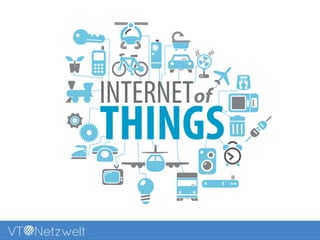
Internet of things

  • 3.
    Internet Revolution Following isthe journey of internet. Figure1
  • 4.
    Typical Views ofthe Internet of Things Figure 3 Figure 4 Figure 5 Figure 6
  • 5.
    Table of Content • Introduction/Overview • Howit works • Scope of IoT • Challenges in IoT • Footnotes
  • 6.
    What Is The Internetof Things? Figure 7
  • 7.
    1. INTRODUCTION It isalso known as: Internet of Objects, Machine-to- Machine Era, Internet of Everything The Internet of Things (IoT) is a scenario in which objects, animals or people are provided with unique identifiers and the ability to transfer data over a network without requiring human-to-human or human-to- computer interaction. IoT has evolved from the convergence of wireless technologies, micro-electromechanical systems (MEMS) and the Internet.
  • 8.
    1.1 Terminology • Theterm Internet of Things was first used by Kevin Ashton in 1999. • Refers to uniquely identifiable objects (things) and their virtual representations
  • 9.
    1.2 What isa thing? A thing, in the Internet of Things, can be a person with a heart monitor implant, a farm animal with a biochip transponder, an automobile that has built-in sensors to alert the driver when tire pressure is low -- or any other natural or man-made object that can be assigned an IP address and provided with the ability to transfer data over a network.
  • 10.
    1.3 Physical World+ Cloud + Devices = Internet of Things Figure 8
  • 11.
    2. HOW ITWORKS User will provide an identity (IP Address) and senses to any thing/object, then via communication protocols it needs to communicate this with the cloud. For eg. If user want to know that someone is sitting on any chair(thing), then he will give an IP address(255.255.255.0) to chair and then from the sensors, pressure sensor will work and communicate with the cloud when someone is sitting on the chair. Figure 9
  • 12.
    2.1 Technical Perspective SensingLayer Communication Layer Management Layer
  • 13.
  • 14.
    3. SCOPE OFIOT Education Food Management IoT Applications Retail Logistics Pharmaceuticals
  • 15.
    3.1 What willwe do with it in our daily routine? Connect with things Monitor Things Manage Things Control Things Search for Things
  • 16.
    3.1a Connect withThings Figure 10 connect with daily routine things like car, light, home etc
  • 17.
    3.1b Monitor Things Figure11 Let us suppose that a person is wearing an IOT device and he has a disease. The device will keep monitoring the disease remotely from the hospital, and if it finds any situation where the patients condition is no stable, it will generate alarms to the doctor or their loved ones.
  • 18.
    3.3c Search forThings Figure 12 with the unique identity to the each device we can search things
  • 19.
    3.3d Manage Things Figure13 when you are aware of state of all devices you can easily manage them.
  • 20.
    3.3e Control Things Figure14 IOT machine can control machines. For e.g a centralized meter in house connected to smart grid can decide as how much electricity particular house needs and will supply electricity according to need.
  • 21.
    3.4 Example ofour daily routine Figure 15
  • 22.
    4. CHALLENGES INIOT Society: People, security, privacy • A policy for people in the Internet of Things: • Security • Privacy Environmental aspects • Resource efficiency • Pollution and disaster avoidance Technological • Architecture (edge devices, servers, discovery services, security, etc.) • Governance, naming, identity, interfaces • Standards
  • 23.
    Footnotes Title page: http://www.smartdatacollective.com/rick-delgado/285576/scary-security-concerns-internet- things 1.https://riteshjagzape.wordpress.com/2013/11/24/internet-of-things-2/ 2. http://www.applicationdelivery.com.au/2014/03/11/security-sidebar-defending-the-internet-of-things/ 3. http://www.aptinex.com/services/industrial-automation/ 4. http://inbioveritas.com/category/future-healthcare/ 5. http://smp.businesswire.com/pages/hgtv-smart-home-2013-giveaway-opens-entries-april-11 6. http://nayaraipur.in/smart-cities-can-create-30-40-billion-business-opportunity-for-it-sector-nasscom/ 7. http://blog.lnsresearch.com/blog/bid/197239/MA-s-First-Internet-of-Things-Week-and-Millennials-on- the-Shop-Floor 10. https://growthcap.co/articles/?p=360 11. http://www.mouser.com/ 13. http://how-service.com/wireless-internet-services/ 14.http://islandbreath.blogspot.in/2011/04/kiuc-smart-grid-plan.html 15. http://market-intel.info/cgi-sys/suspendedpage.cgi
  • 24.
    About VT Netzwelt VTNetzwelt provides services in the field of bespoke and open source Software application development, support and maintenance. Our focus is on ecommerce, enterprise and mobility solutions. With our offices in Berlin (Germany) and Mohali (India), we are serving our clients in US, Europe and Australia
  • 25.
    Thanks for watchingour presentation.

Editor's Notes

  • #15 AI: the autonomous and intelligent entities will act in full interoperability & will be able to auto-organize themselves depending on the context, circumstances or environment. ED is to design the scheme depending on the need FS means that hundreds and thousands of nodes will be disable and will be set to run. CAT means that there’s several kinds of media such as vehicle stone that they need different access technologies. SS is the machine can rend and send by themselves. No need to tell humanbeings
  • #16 Logistics – Tagging items on a UPS truck (now they use barcodes to be scanned) but not real-time. Using the newer technology all is in realtime.
  • #24 Legislation: mandatory that policy keeps up with technology so that citizens gain confidence in the new technology People’s momentarily context and roles can determine their attitudes towards new technology. An employee will resist his boss’ access to his or her mailbox while the same person may demand the same insight into the mailboxes of subordinates.
  • #25 Legislation: mandatory that policy keeps up with technology so that citizens gain confidence in the new technology People’s momentarily context and roles can determine their attitudes towards new technology. An employee will resist his boss’ access to his or her mailbox while the same person may demand the same insight into the mailboxes of subordinates.