ESA UNCLASSIFIED - For Official Use
A COMMUNICATIONS AND PNT
INTEGRATED NETWORK
INFRASTRUCTURE
FOR THE MOON VILLAGE
Pietro Giordano(1), Marco Lisi(1), Andrea Modenini(1),
José A. del Peral-Rosado(2)
(1)European Space Agency - European Space Research Technology Centre (ESTEC)
(2) Universitat Autònoma de Barcelona (UAB)
NAVITEC workshop 2016, ESTEC, 16/12/2016
Slide 2
ESA UNCLASSIFIED - For Official Use
Summary
• The exploration of Moon and Mars with human and robotic
missions and their colonization, through the establishment of
permanent bases, will require planetary communications and
navigation infrastructures;
• All architectural approaches considered so far by NASA and ESA
can be divided in two main categories:
 Comprehensive, well structured and forward looking (but
costly) architectures, based on constellations of orbiters and
relay satellites
 “ad hoc”, flexible, expandable architectures, based on a fusion
of all available resources and on COTS technologies
Slide 3
ESA UNCLASSIFIED - For Official Use
Moon Village
Slide 4
ESA UNCLASSIFIED - For Official Use
Moon Village
“Moon Village is not a single
project, nor a fixed plan with a
defined time table. It’s a vision for
an open architecture and an
international community
initiative.”
From the ESA Ministerial Council 2016 minisite
Slide 5
ESA UNCLASSIFIED - For Official Use
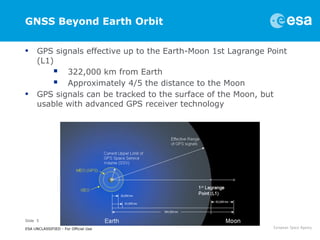
GNSS Beyond Earth Orbit
• GPS signals effective up to the Earth-Moon 1st Lagrange Point
(L1)
 322,000 km from Earth
 Approximately 4/5 the distance to the Moon
• GPS signals can be tracked to the surface of the Moon, but
usable with advanced GPS receiver technology
Slide 6
ESA UNCLASSIFIED - For Official Use
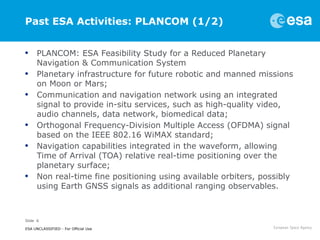
Past ESA Activities: PLANCOM (1/2)
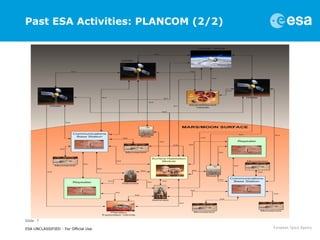
• PLANCOM: ESA Feasibility Study for a Reduced Planetary
Navigation & Communication System
• Planetary infrastructure for future robotic and manned missions
on Moon or Mars;
• Communication and navigation network using an integrated
signal to provide in-situ services, such as high-quality video,
audio channels, data network, biomedical data;
• Orthogonal Frequency-Division Multiple Access (OFDMA) signal
based on the IEEE 802.16 WiMAX standard;
• Navigation capabilities integrated in the waveform, allowing
Time of Arrival (TOA) relative real-time positioning over the
planetary surface;
• Non real-time fine positioning using available orbiters, possibly
using Earth GNSS signals as additional ranging observables.
Slide 7
ESA UNCLASSIFIED - For Official Use
Past ESA Activities: PLANCOM (2/2)
Slide 8
ESA UNCLASSIFIED - For Official Use
Past ESA Activities: PLANCOM (2/2)
“In the timeframe considered by
this study it is possible that
WiMAX will have been
replaced by other
technologies offering similar
capabilities.”
Slide 9
ESA UNCLASSIFIED - For Official Use
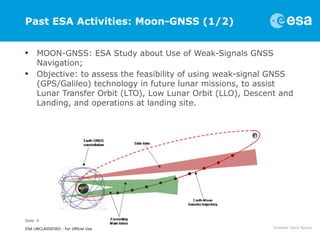
Past ESA Activities: Moon-GNSS (1/2)
• MOON-GNSS: ESA Study about Use of Weak-Signals GNSS
Navigation;
• Objective: to assess the feasibility of using weak-signal GNSS
(GPS/Galileo) technology in future lunar missions, to assist
Lunar Transfer Orbit (LTO), Low Lunar Orbit (LLO), Descent and
Landing, and operations at landing site.
Slide 10
ESA UNCLASSIFIED - For Official Use
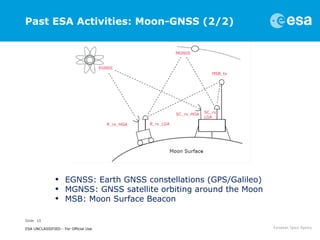
Past ESA Activities: Moon-GNSS (2/2)
• EGNSS: Earth GNSS constellations (GPS/Galileo)
• MGNSS: GNSS satellite orbiting around the Moon
• MSB: Moon Surface Beacon
Slide 11
ESA UNCLASSIFIED - For Official Use
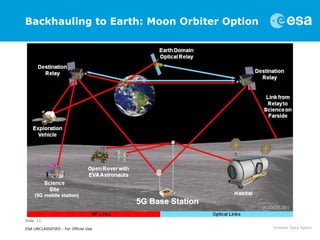
Backhauling to Earth: Moon Orbiter Option
Slide 12
ESA UNCLASSIFIED - For Official Use
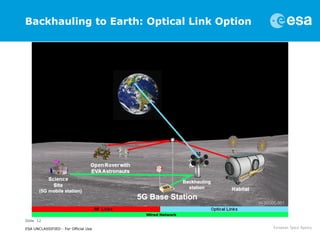
Backhauling to Earth: Optical Link Option
Slide 13
ESA UNCLASSIFIED - For Official Use
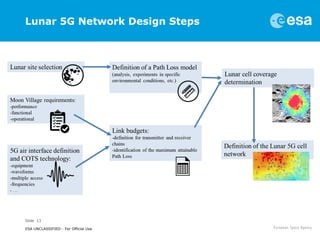
Lunar 5G Network Design Steps
Slide 14
ESA UNCLASSIFIED - For Official Use
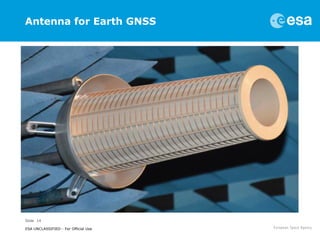
Antenna for Earth GNSS
Slide 15
ESA UNCLASSIFIED - For Official Use
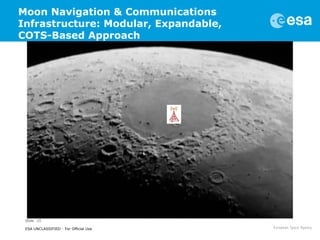
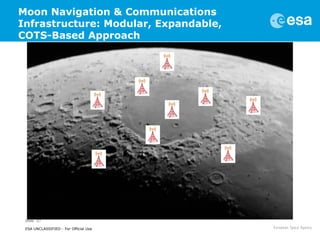
Moon Navigation & Communications
Infrastructure: Modular, Expandable,
COTS-Based Approach
Slide 16
ESA UNCLASSIFIED - For Official Use
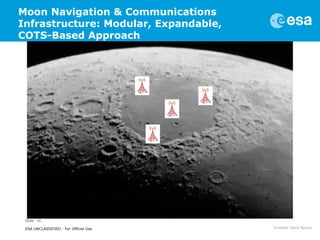
Moon Navigation & Communications
Infrastructure: Modular, Expandable,
COTS-Based Approach
Slide 17
ESA UNCLASSIFIED - For Official Use
Moon Navigation & Communications
Infrastructure: Modular, Expandable,
COTS-Based Approach
Slide 18
ESA UNCLASSIFIED - For Official Use
Conclusion
• The colonization of our solar system, first step of human kind
towards the stars, will need establishing permanent base
stations on Moon and Mars;
• Planetary infrastructures will provide communications and
navigation support to both human and robotic explorers;
• The approach presented relies on the use of COTS components
for communication and navigation on the Moon surface;
• The use of LTE technology, currently deployed on Earth, and of
the forthcoming 5G technology will allow communication and
navigation on the Moon, largely satisfying the requirements for
performance, reliability, affordability and sustainability (being
based on commercial technology and incrementally expandable
over time).
ESA UNCLASSIFIED - For Official Use
THANK YOU.
Questions?

A COMMUNICATIONS AND PNT INTEGRATED NETWORK INFRASTRUCTURE FOR THE MOON VILLAGE

  • 1.
    ESA UNCLASSIFIED -For Official Use A COMMUNICATIONS AND PNT INTEGRATED NETWORK INFRASTRUCTURE FOR THE MOON VILLAGE Pietro Giordano(1), Marco Lisi(1), Andrea Modenini(1), José A. del Peral-Rosado(2) (1)European Space Agency - European Space Research Technology Centre (ESTEC) (2) Universitat Autònoma de Barcelona (UAB) NAVITEC workshop 2016, ESTEC, 16/12/2016
  • 2.
    Slide 2 ESA UNCLASSIFIED- For Official Use Summary • The exploration of Moon and Mars with human and robotic missions and their colonization, through the establishment of permanent bases, will require planetary communications and navigation infrastructures; • All architectural approaches considered so far by NASA and ESA can be divided in two main categories:  Comprehensive, well structured and forward looking (but costly) architectures, based on constellations of orbiters and relay satellites  “ad hoc”, flexible, expandable architectures, based on a fusion of all available resources and on COTS technologies
  • 3.
    Slide 3 ESA UNCLASSIFIED- For Official Use Moon Village
  • 4.
    Slide 4 ESA UNCLASSIFIED- For Official Use Moon Village “Moon Village is not a single project, nor a fixed plan with a defined time table. It’s a vision for an open architecture and an international community initiative.” From the ESA Ministerial Council 2016 minisite
  • 5.
    Slide 5 ESA UNCLASSIFIED- For Official Use GNSS Beyond Earth Orbit • GPS signals effective up to the Earth-Moon 1st Lagrange Point (L1)  322,000 km from Earth  Approximately 4/5 the distance to the Moon • GPS signals can be tracked to the surface of the Moon, but usable with advanced GPS receiver technology
  • 6.
    Slide 6 ESA UNCLASSIFIED- For Official Use Past ESA Activities: PLANCOM (1/2) • PLANCOM: ESA Feasibility Study for a Reduced Planetary Navigation & Communication System • Planetary infrastructure for future robotic and manned missions on Moon or Mars; • Communication and navigation network using an integrated signal to provide in-situ services, such as high-quality video, audio channels, data network, biomedical data; • Orthogonal Frequency-Division Multiple Access (OFDMA) signal based on the IEEE 802.16 WiMAX standard; • Navigation capabilities integrated in the waveform, allowing Time of Arrival (TOA) relative real-time positioning over the planetary surface; • Non real-time fine positioning using available orbiters, possibly using Earth GNSS signals as additional ranging observables.
  • 7.
    Slide 7 ESA UNCLASSIFIED- For Official Use Past ESA Activities: PLANCOM (2/2)
  • 8.
    Slide 8 ESA UNCLASSIFIED- For Official Use Past ESA Activities: PLANCOM (2/2) “In the timeframe considered by this study it is possible that WiMAX will have been replaced by other technologies offering similar capabilities.”
  • 9.
    Slide 9 ESA UNCLASSIFIED- For Official Use Past ESA Activities: Moon-GNSS (1/2) • MOON-GNSS: ESA Study about Use of Weak-Signals GNSS Navigation; • Objective: to assess the feasibility of using weak-signal GNSS (GPS/Galileo) technology in future lunar missions, to assist Lunar Transfer Orbit (LTO), Low Lunar Orbit (LLO), Descent and Landing, and operations at landing site.
  • 10.
    Slide 10 ESA UNCLASSIFIED- For Official Use Past ESA Activities: Moon-GNSS (2/2) • EGNSS: Earth GNSS constellations (GPS/Galileo) • MGNSS: GNSS satellite orbiting around the Moon • MSB: Moon Surface Beacon
  • 11.
    Slide 11 ESA UNCLASSIFIED- For Official Use Backhauling to Earth: Moon Orbiter Option
  • 12.
    Slide 12 ESA UNCLASSIFIED- For Official Use Backhauling to Earth: Optical Link Option
  • 13.
    Slide 13 ESA UNCLASSIFIED- For Official Use Lunar 5G Network Design Steps
  • 14.
    Slide 14 ESA UNCLASSIFIED- For Official Use Antenna for Earth GNSS
  • 15.
    Slide 15 ESA UNCLASSIFIED- For Official Use Moon Navigation & Communications Infrastructure: Modular, Expandable, COTS-Based Approach
  • 16.
    Slide 16 ESA UNCLASSIFIED- For Official Use Moon Navigation & Communications Infrastructure: Modular, Expandable, COTS-Based Approach
  • 17.
    Slide 17 ESA UNCLASSIFIED- For Official Use Moon Navigation & Communications Infrastructure: Modular, Expandable, COTS-Based Approach
  • 18.
    Slide 18 ESA UNCLASSIFIED- For Official Use Conclusion • The colonization of our solar system, first step of human kind towards the stars, will need establishing permanent base stations on Moon and Mars; • Planetary infrastructures will provide communications and navigation support to both human and robotic explorers; • The approach presented relies on the use of COTS components for communication and navigation on the Moon surface; • The use of LTE technology, currently deployed on Earth, and of the forthcoming 5G technology will allow communication and navigation on the Moon, largely satisfying the requirements for performance, reliability, affordability and sustainability (being based on commercial technology and incrementally expandable over time).
  • 19.
    ESA UNCLASSIFIED -For Official Use THANK YOU. Questions?