KARMVEER Bhaurov Patil
Collegeof Engginearing Satara.
Presentation On
SPACE COMMUNICATION
By
Somnath Shankar Mane
Class :- SY E&TC
Prn:-23062701372017
Under The Guidanace Of
Mrs.P.N.Sabale
Accademic Year :-2024-25
Introduction to Space
Communication
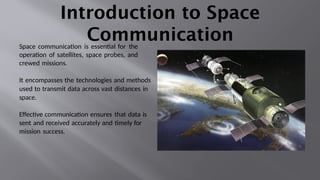
Spacecommunication is essential for the
operation of satellites, space probes, and
crewed missions.
It encompasses the technologies and methods
used to transmit data across vast distances in
space.
Effective communication ensures that data is
sent and received accurately and timely for
mission success.
4.
Importance of Space
Communication
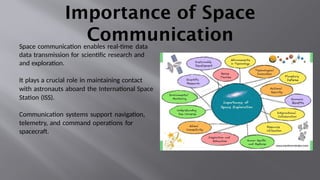
Spacecommunication enables real-time data
data transmission for scientific research and
and exploration.
It plays a crucial role in maintaining contact
with astronauts aboard the International Space
Station (ISS).
Communication systems support navigation,
telemetry, and command operations for
spacecraft.
5.
Types of Space
Communication
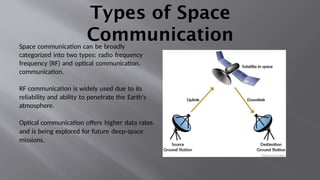
Spacecommunication can be broadly
categorized into two types: radio frequency
frequency (RF) and optical communication.
communication.
RF communication is widely used due to its
reliability and ability to penetrate the Earth's
atmosphere.
Optical communication offers higher data rates
and is being explored for future deep-space
missions.
6.
Communication Satellites
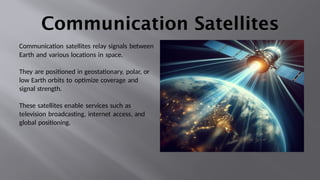
Communication satellitesrelay signals between
Earth and various locations in space.
They are positioned in geostationary, polar, or
low Earth orbits to optimize coverage and
signal strength.
These satellites enable services such as
television broadcasting, internet access, and
global positioning.
7.
Deep Space Communication
Networks
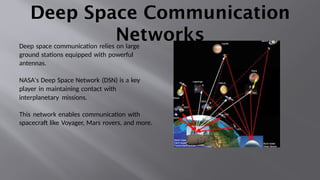
Deepspace communication relies on large
ground stations equipped with powerful
antennas.
NASA's Deep Space Network (DSN) is a key
player in maintaining contact with
interplanetary missions.
This network enables communication with
spacecraft like Voyager, Mars rovers, and more.
8.
Challenges of Space
Communication
Thevast distances in space cause significant
delays in signal transmission, known as latency.
Space communication systems must withstand
harsh environmental conditions, including
radiation and extreme temperatures.
Interference from cosmic events and terrestrial
signals can disrupt communication channels.
9.
Advances in Space
CommunicationTechnology
Recent developments include the use of laser
communication systems to increase data
transfer rates.
Enhanced coding and modulation techniques
improve the efficiency and reliability of signals.
Innovations in antenna design and satellite
constellations are shaping the future of space
communication.
10.
Future of Space
Communication
Thefuture of space communication will see
an increased reliance on inter-satellite links
within constellations.
Research is ongoing to develop quantum
communication for secure data
transmission.
Missions to Mars and beyond will require
robust communication networks to
support exploration.
11.
International Collaboration in
SpaceCommunication
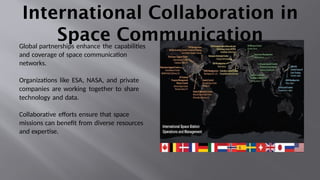
Global partnerships enhance the capabilities
and coverage of space communication
networks.
Organizations like ESA, NASA, and private
companies are working together to share
technology and data.
Collaborative efforts ensure that space
missions can benefit from diverse resources
and expertise.
12.
Conclusion
Space communication isa vital
component of modern space
exploration and satellite operations.
As technology evolves, so too will
the methods and systems used for
communication in space.
Continued innovation will pave the
way for deeper exploration and more
complex missions beyond Earth.



![venom_alert_ppt[1].pdfggbvvffffffffm mdd](https://cdn.slidesharecdn.com/ss_thumbnails/venomalertppt1-250925121759-14129677-thumbnail.jpg?width=640&height=640&fit=bounds)


![SIH2025-IDEA-Presentation-[2]final .pptx](https://cdn.slidesharecdn.com/ss_thumbnails/sih2025-idea-presentation-format2-250925134001-d24b6f36-thumbnail.jpg?width=640&height=640&fit=bounds)


