INDEX
TOPIC
INTRODUCTION
WORKING
WIRING THE SOLAR SYSTEM
DSN
SIX SATELLITE CONSTILLATION
PROTOCOL FOR TRANSFERING DATA
ASTRONOMAL CHALLENGES
SUMMARY
INTRODUCTION
At present we can communicate instantly to any one in any corner of the world due to
the internet, while next phase of internet will take us beyond the earth ,i.e.
“interplanetary internet(IPN)” which will provide basis for communication system for a
manned mission to the mars and planets beyond.
The existing internet on the earth and similar one on other
planet linked by gateways, which will relay the information between the internets
,forms interplanetary internet. Thus interplanetary internet can be thought as “the
network of disconnected internets”.
Deep space Network satellites around mars and new
protocols constitute interplanetary Internet. Where DSN will serve as gate way of
earth. A group of six micro satellites and a large mars at satellite is to be placed for
implementation of interplanetary internet (IPN). IPN deals with new protocols like
SCPS (Space Communication Protocols Standards), NTP (Network Time Protocol) and
PTP(Parcel Transfer Protocol ).
The objective of interplanetary project is to define the architecture
and protocols necessary to permit interoperation of the internet resident on the earth
with other remotely located internets resident on the other planets or spacecrafts in
transit.
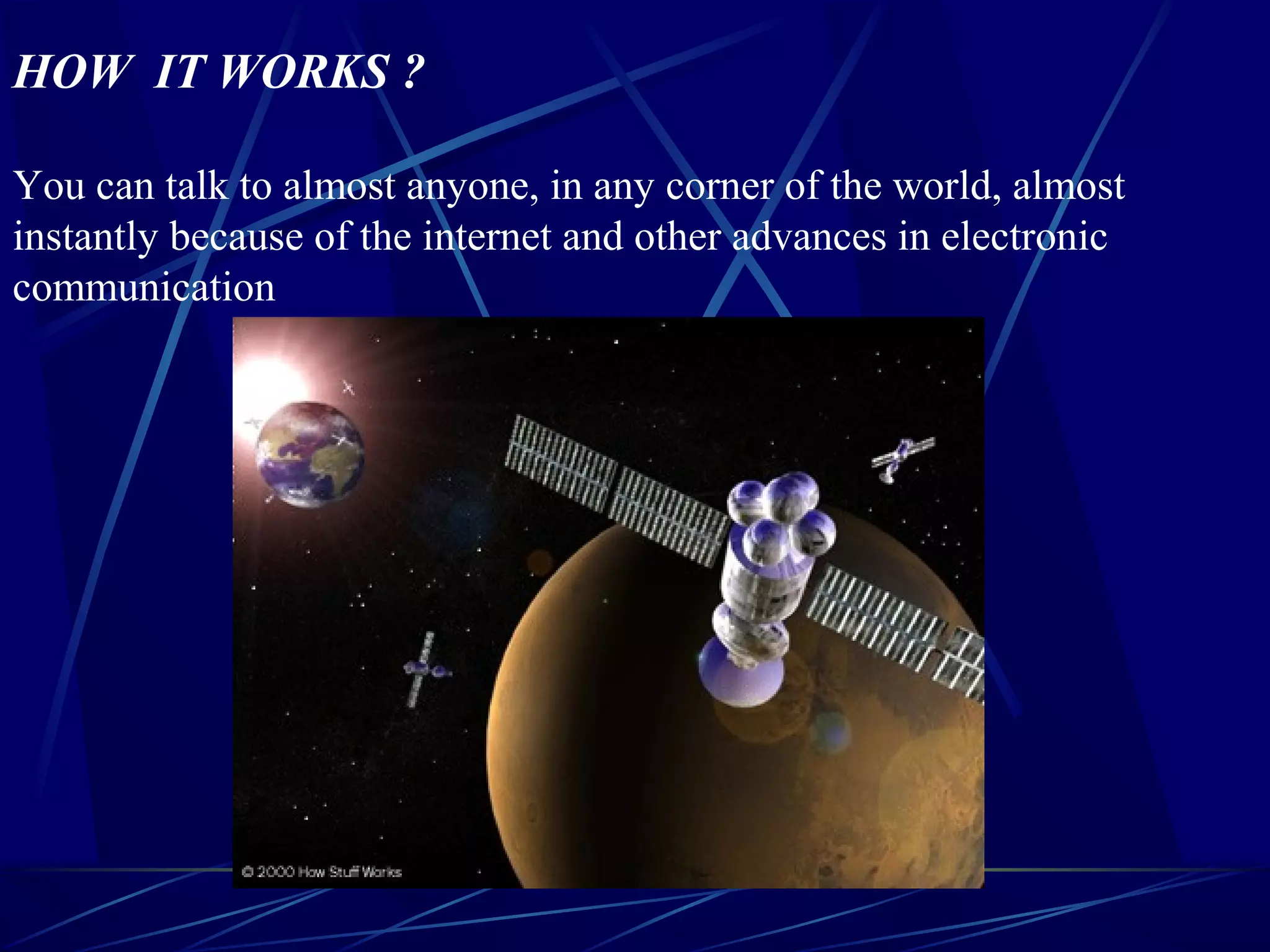
HOW IT WORKS ?
You can talk to almost anyone, in any corner of the world, almost
instantly because of the internet and other advances in electronic
communication
If we ever want to find out more about other planets, we will
need a better communication system for future space missions.
Today, communication in space moves at a snail's pace
compared to communication on Earth. There are several
reasons for this:
Scientists and space explorers now are looking for a way to
communicate almost instantly beyond Earth. The next phase of
the Internet will take us to far reaches of our solar system, and
lay the groundwork for a communications system for a
manned missions to Mars and planets beyond
DISTANCE
LINE OF SIGHT OF OBSTRUCTION
WEIGHT
Wiring the Solar System
Take a look at the 1997 Mars Pathfinder rover mission and you will
understand space explorers need an interplanetary Internet for deep
space communications. Data from the Pathfinder trickled back at an
average rate of about 300 bits per second during its mission. Most likely,
your computer can transfer data at least 200 times faster than that. An
Internet between Mars and Earth would likely yield a data transfer rate
of 11,000 bits per second.
That is still much slower than your computer's transfer rate, but it
would be enough to send back more detailed images of the Mars
surface. Mars Network researchers think that the transfer rate could
eventually go to about 1 Megabyte (8,288,608 bits) per second and
allow anyone to take a virtual trip to Mars
Basic components:
•NASA's Deep Space Network (DSN).
•A six-satellite constellation around Mars.
•A new protocol for transferring data.
Deep Space Network
The NASA Deep Space Network - or DSN - is an international
network of antennas that supports interplanetary spacecraft missions
and radio and radar astronomy observations for the exploration of the
solar system and the universe. The network also supports selected
Earth-orbiting missions.
The DSN array of antennas would be used to
send and receive data over the interplanetary
Internet.
The DSN currently consists of three deep-space communications
facilities placed approximately 120 degrees apart around the world: at
Goldstone, in California's Mojave Desert; near Madrid, Spain; and near
Canberra, Australia. This strategic placement permits constant
observation of spacecraft as the Earth rotates, and helps to make the
DSN the largest and most sensitive scientific telecommunications system
in the world.
NASA's scientific investigation of the Solar System is being
accomplished mainly through the use of unmanned automated
spacecraft. The DSN provides the vital two-way communications link
that guides and controls these planetary explorers, and brings back the
images and new scientific information they collect. All DSN antennas
are steer able, high-gain, parabolic reflector antennas
The antennas and data delivery systems make it possible to:
•Acquire telemetry data from spacecraft.
•Transmit commands to spacecraft.
•Track spacecraft position and velocity
•Perform very-long-baseline interferometer observations
•Measure variations in radio waves for radio science experiments
•Gather science data.
•Monitor and control the performance of the network
The network is a facility of NASA, and is managed and operated for
NASA by the Jet Propulsion Laboratory. The Interplanetary Network
Directorate (IND) manages the program within JPL.
A six-satellite constellation around Mars
Under the Mars Network plan, the DSN will interact with a constellation
of six micro satellites and one large Mar sat satellite placed in low Mars
orbit. These six microsats are relay satellites for spacecraft on or near the
surface of the planet, and they will allow more data to come back from
Mars missions. The Marsat will collect data from each of the smaller
satellites and beam it to Earth. It will also keep Earth and distant
spacecraft connected continuously and allow for high-bandwidth data
and video of the planet, according to Mars Network officials. NASA
could launch a microsat as early as 2003, with the six-microsat
constellation orbiting Mars by 2009. In 2007, the Marsat is scheduled to
be placed in a slightly higher orbit than the constellation. All of these
dates are still very tentative.
Six micro satellites like this one might be put into low
Mars orbit to increase data return from Mars missions.
Protocol for transferring data.
Programmers are developing an Internet file transfer protocol to transmit the messages
and overcome delays and interruptions. This protocol will act as the backbone of the
entire system much as the Internet protocol (IP) and transmission control protocol
(TCP) operate on Earth. IP and TCP, co-developed in the 1970s by Dr. Vinton Cerf, are
the messenger service for our Earth-based Internet. These two protocols break up
transmitted messages into packets of small data units and route them to a specified
destination.
Cerf is part of the team of scientists who are developing a new protocol to enable
reliable file transfer over the long distances between planets and spacecraft. This new
space protocol must keep the Internet running even if some packets of data are lost
during transmission. It must also block out noise picked up while crossing millions of
miles. One idea for the space protocol is called the parcel transfer protocol (PTP),
which will store and forward data at the gateway of each planet. The protocol would
process an information request sent to a gateway and forward it to a final destination.
The gateway would then check, process and forward information back down the path it
came.
Astronomical Challenges
An interplanetary Internet will make data move drastically faster
between Earth and the probes and other spacecraft that are millions of
miles away. Engineers need to overcome several challenges before we
plan our virtual journey to Mars through cyberspace. These challenges
are:
•Satellite maintenance.
•The speed-of-light delay.
•The possibility of hacker break-ins.
On Earth, two computers connected to the Internet are only a few
thousand miles away at the most. Because light travels at 186,000 miles
per second, it takes only a few fractions of a second to send a packet of
data from one computer to another. In contrast, distances between a
station on Earth and one on Mars can be between 38 million miles (56
million km) and 248 million miles (400 million km). At these distances,
it can take several minutes or hours for a radio signal to reach a receiving
station. An interplanetary Internet will not be able to duplicate the real-
time immediacy of the Internet that you use. The store-and-forward
method will allow information to be sent in bundles and overcome the
concern of data being lost due to delays.
The satellites of the Mars Network will be tens or hundreds of millions
of miles from Earth and that means that it will be hard to get up there to
fix things when they go wrong. The components of these satellites would
have to be much more reliable than those circling Earth.
Hackers pose the biggest threat to an interplanetary Internet. Break-ins
and corruption of navigation or communication systems could be
disastrous for space missions, and even cause deaths in manned-
spacecraft missions. Developers are taking every precaution to design a
system that will be able to control access. The protocol selected will
have to be impenetrable to hackers, something that has not been possible
on Earth. Developers may look at the Secure Sockets Layer (SSL)
protocol used for financial transactions as a model for securing the
interplanetary Internet.
The interplanetary Internet will possibly wire us to Mars within the
decade and to other planets in the decades to follow. It will no longer be
necessary to go into space to experience space travel. Instead, space will
be brought right to your desktop. With enhancements made to boost data
rate transfers, you and I might soon be able to take a a virtual space trip
to the mountains of Mars, the rings of Saturn or the giant spot on Jupiter.
As from this paper it can be concluded that interplanetary
internet is the next phase of internet that will take us beyond
the earth which will provide us basis communication system
for the manned mission to mars and beyond other planets
interplanetary internet

interplanetary internet

  • 3.
    INDEX TOPIC INTRODUCTION WORKING WIRING THE SOLARSYSTEM DSN SIX SATELLITE CONSTILLATION PROTOCOL FOR TRANSFERING DATA ASTRONOMAL CHALLENGES SUMMARY
  • 4.
    INTRODUCTION At present wecan communicate instantly to any one in any corner of the world due to the internet, while next phase of internet will take us beyond the earth ,i.e. “interplanetary internet(IPN)” which will provide basis for communication system for a manned mission to the mars and planets beyond. The existing internet on the earth and similar one on other planet linked by gateways, which will relay the information between the internets ,forms interplanetary internet. Thus interplanetary internet can be thought as “the network of disconnected internets”. Deep space Network satellites around mars and new protocols constitute interplanetary Internet. Where DSN will serve as gate way of earth. A group of six micro satellites and a large mars at satellite is to be placed for implementation of interplanetary internet (IPN). IPN deals with new protocols like SCPS (Space Communication Protocols Standards), NTP (Network Time Protocol) and PTP(Parcel Transfer Protocol ). The objective of interplanetary project is to define the architecture and protocols necessary to permit interoperation of the internet resident on the earth with other remotely located internets resident on the other planets or spacecrafts in transit.
  • 5.
    HOW IT WORKS? You can talk to almost anyone, in any corner of the world, almost instantly because of the internet and other advances in electronic communication
  • 6.
    If we everwant to find out more about other planets, we will need a better communication system for future space missions. Today, communication in space moves at a snail's pace compared to communication on Earth. There are several reasons for this: Scientists and space explorers now are looking for a way to communicate almost instantly beyond Earth. The next phase of the Internet will take us to far reaches of our solar system, and lay the groundwork for a communications system for a manned missions to Mars and planets beyond
  • 7.
    DISTANCE LINE OF SIGHTOF OBSTRUCTION WEIGHT
  • 8.
    Wiring the SolarSystem Take a look at the 1997 Mars Pathfinder rover mission and you will understand space explorers need an interplanetary Internet for deep space communications. Data from the Pathfinder trickled back at an average rate of about 300 bits per second during its mission. Most likely, your computer can transfer data at least 200 times faster than that. An Internet between Mars and Earth would likely yield a data transfer rate of 11,000 bits per second. That is still much slower than your computer's transfer rate, but it would be enough to send back more detailed images of the Mars surface. Mars Network researchers think that the transfer rate could eventually go to about 1 Megabyte (8,288,608 bits) per second and allow anyone to take a virtual trip to Mars
  • 9.
    Basic components: •NASA's DeepSpace Network (DSN). •A six-satellite constellation around Mars. •A new protocol for transferring data.
  • 10.
    Deep Space Network TheNASA Deep Space Network - or DSN - is an international network of antennas that supports interplanetary spacecraft missions and radio and radar astronomy observations for the exploration of the solar system and the universe. The network also supports selected Earth-orbiting missions. The DSN array of antennas would be used to send and receive data over the interplanetary Internet.
  • 11.
    The DSN currentlyconsists of three deep-space communications facilities placed approximately 120 degrees apart around the world: at Goldstone, in California's Mojave Desert; near Madrid, Spain; and near Canberra, Australia. This strategic placement permits constant observation of spacecraft as the Earth rotates, and helps to make the DSN the largest and most sensitive scientific telecommunications system in the world. NASA's scientific investigation of the Solar System is being accomplished mainly through the use of unmanned automated spacecraft. The DSN provides the vital two-way communications link that guides and controls these planetary explorers, and brings back the images and new scientific information they collect. All DSN antennas are steer able, high-gain, parabolic reflector antennas
  • 12.
    The antennas anddata delivery systems make it possible to: •Acquire telemetry data from spacecraft. •Transmit commands to spacecraft. •Track spacecraft position and velocity •Perform very-long-baseline interferometer observations •Measure variations in radio waves for radio science experiments •Gather science data. •Monitor and control the performance of the network The network is a facility of NASA, and is managed and operated for NASA by the Jet Propulsion Laboratory. The Interplanetary Network Directorate (IND) manages the program within JPL.
  • 13.
    A six-satellite constellationaround Mars Under the Mars Network plan, the DSN will interact with a constellation of six micro satellites and one large Mar sat satellite placed in low Mars orbit. These six microsats are relay satellites for spacecraft on or near the surface of the planet, and they will allow more data to come back from Mars missions. The Marsat will collect data from each of the smaller satellites and beam it to Earth. It will also keep Earth and distant spacecraft connected continuously and allow for high-bandwidth data and video of the planet, according to Mars Network officials. NASA could launch a microsat as early as 2003, with the six-microsat constellation orbiting Mars by 2009. In 2007, the Marsat is scheduled to be placed in a slightly higher orbit than the constellation. All of these dates are still very tentative.
  • 14.
    Six micro satelliteslike this one might be put into low Mars orbit to increase data return from Mars missions.
  • 15.
    Protocol for transferringdata. Programmers are developing an Internet file transfer protocol to transmit the messages and overcome delays and interruptions. This protocol will act as the backbone of the entire system much as the Internet protocol (IP) and transmission control protocol (TCP) operate on Earth. IP and TCP, co-developed in the 1970s by Dr. Vinton Cerf, are the messenger service for our Earth-based Internet. These two protocols break up transmitted messages into packets of small data units and route them to a specified destination. Cerf is part of the team of scientists who are developing a new protocol to enable reliable file transfer over the long distances between planets and spacecraft. This new space protocol must keep the Internet running even if some packets of data are lost during transmission. It must also block out noise picked up while crossing millions of miles. One idea for the space protocol is called the parcel transfer protocol (PTP), which will store and forward data at the gateway of each planet. The protocol would process an information request sent to a gateway and forward it to a final destination. The gateway would then check, process and forward information back down the path it came.
  • 16.
    Astronomical Challenges An interplanetaryInternet will make data move drastically faster between Earth and the probes and other spacecraft that are millions of miles away. Engineers need to overcome several challenges before we plan our virtual journey to Mars through cyberspace. These challenges are: •Satellite maintenance. •The speed-of-light delay. •The possibility of hacker break-ins.
  • 17.
    On Earth, twocomputers connected to the Internet are only a few thousand miles away at the most. Because light travels at 186,000 miles per second, it takes only a few fractions of a second to send a packet of data from one computer to another. In contrast, distances between a station on Earth and one on Mars can be between 38 million miles (56 million km) and 248 million miles (400 million km). At these distances, it can take several minutes or hours for a radio signal to reach a receiving station. An interplanetary Internet will not be able to duplicate the real- time immediacy of the Internet that you use. The store-and-forward method will allow information to be sent in bundles and overcome the concern of data being lost due to delays. The satellites of the Mars Network will be tens or hundreds of millions of miles from Earth and that means that it will be hard to get up there to fix things when they go wrong. The components of these satellites would have to be much more reliable than those circling Earth.
  • 18.
    Hackers pose thebiggest threat to an interplanetary Internet. Break-ins and corruption of navigation or communication systems could be disastrous for space missions, and even cause deaths in manned- spacecraft missions. Developers are taking every precaution to design a system that will be able to control access. The protocol selected will have to be impenetrable to hackers, something that has not been possible on Earth. Developers may look at the Secure Sockets Layer (SSL) protocol used for financial transactions as a model for securing the interplanetary Internet. The interplanetary Internet will possibly wire us to Mars within the decade and to other planets in the decades to follow. It will no longer be necessary to go into space to experience space travel. Instead, space will be brought right to your desktop. With enhancements made to boost data rate transfers, you and I might soon be able to take a a virtual space trip to the mountains of Mars, the rings of Saturn or the giant spot on Jupiter.
  • 19.
    As from thispaper it can be concluded that interplanetary internet is the next phase of internet that will take us beyond the earth which will provide us basis communication system for the manned mission to mars and beyond other planets