History of the Internet
                BA 212
             Richard Smith

NEXT
What is the Internet?


NEXT   PREVIOUS
What is the Internet?
   A network of networks, joining many government,
    university and private computers together and
    providing an infrastructure for the use of E-mail,
    bulletin boards, file archives, hypertext documents,
    databases and other computational resources
   The vast collection of computer networks which form
    and act as a single huge network for transport of data
    and messages across distances which can be
    anywhere from the same office to anywhere in the
    world.


    NEXT            PREVIOUS
1960’s

NEXT   PREVIOUS
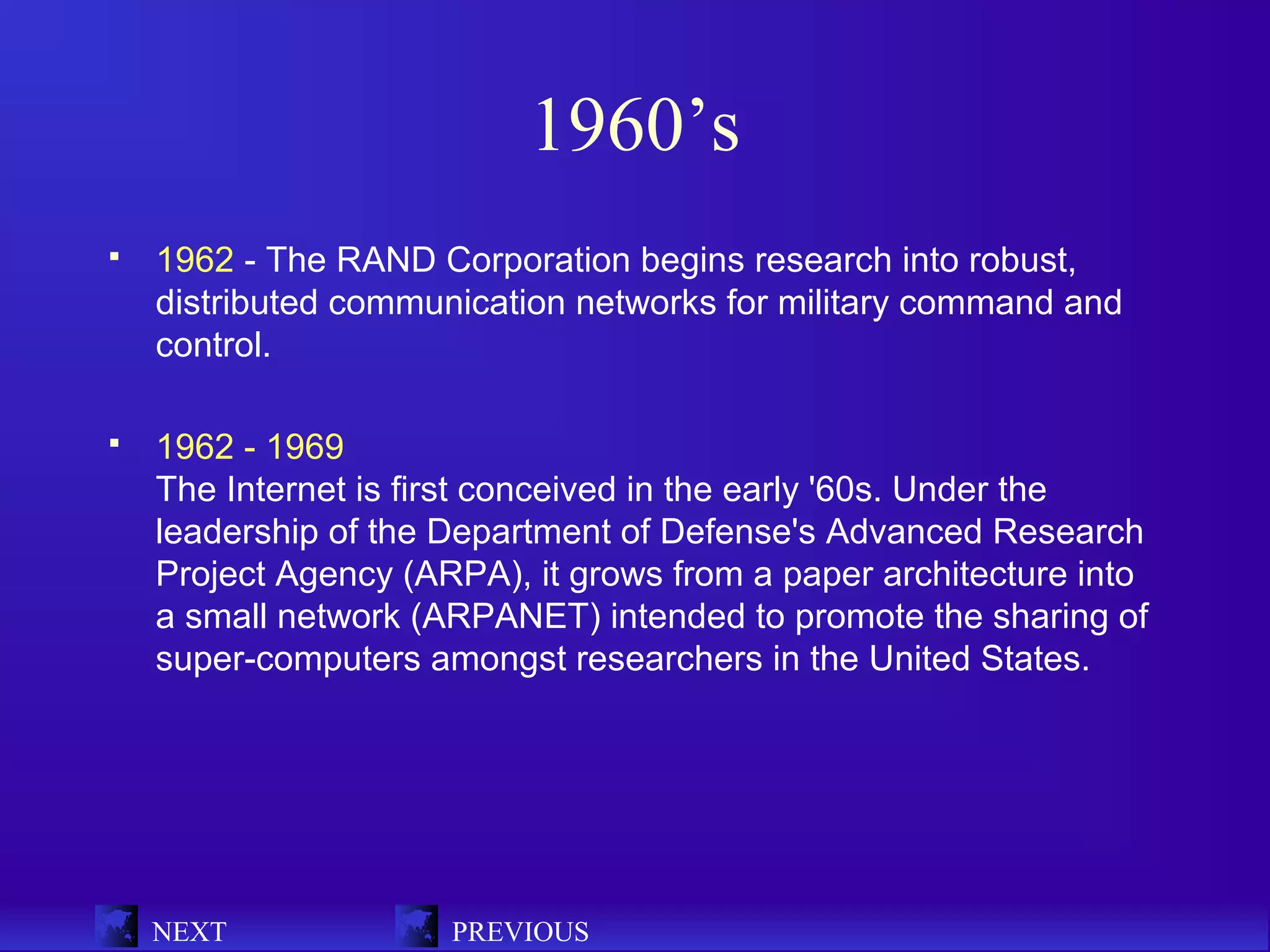
1960’s
   1962 - The RAND Corporation begins research into robust,
    distributed communication networks for military command and
    control.

   1962 - 1969
    The Internet is first conceived in the early '60s. Under the
    leadership of the Department of Defense's Advanced Research
    Project Agency (ARPA), it grows from a paper architecture into
    a small network (ARPANET) intended to promote the sharing of
    super-computers amongst researchers in the United States.


    NEXT              PREVIOUS
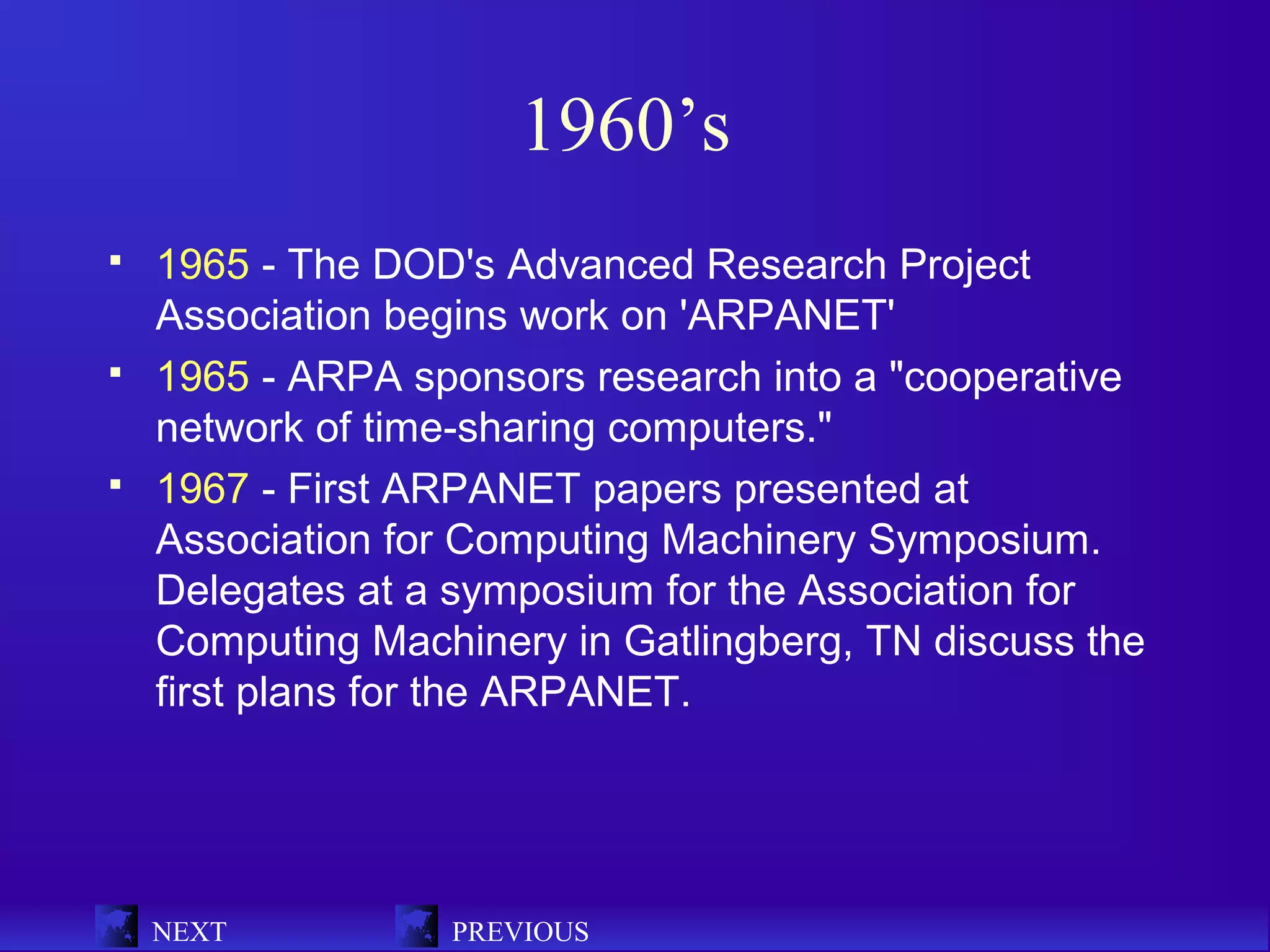
1960’s
   1965 - The DOD's Advanced Research Project
    Association begins work on 'ARPANET'
   1965 - ARPA sponsors research into a "cooperative
    network of time-sharing computers."
   1967 - First ARPANET papers presented at
    Association for Computing Machinery Symposium.
    Delegates at a symposium for the Association for
    Computing Machinery in Gatlingberg, TN discuss the
    first plans for the ARPANET.


    NEXT          PREVIOUS
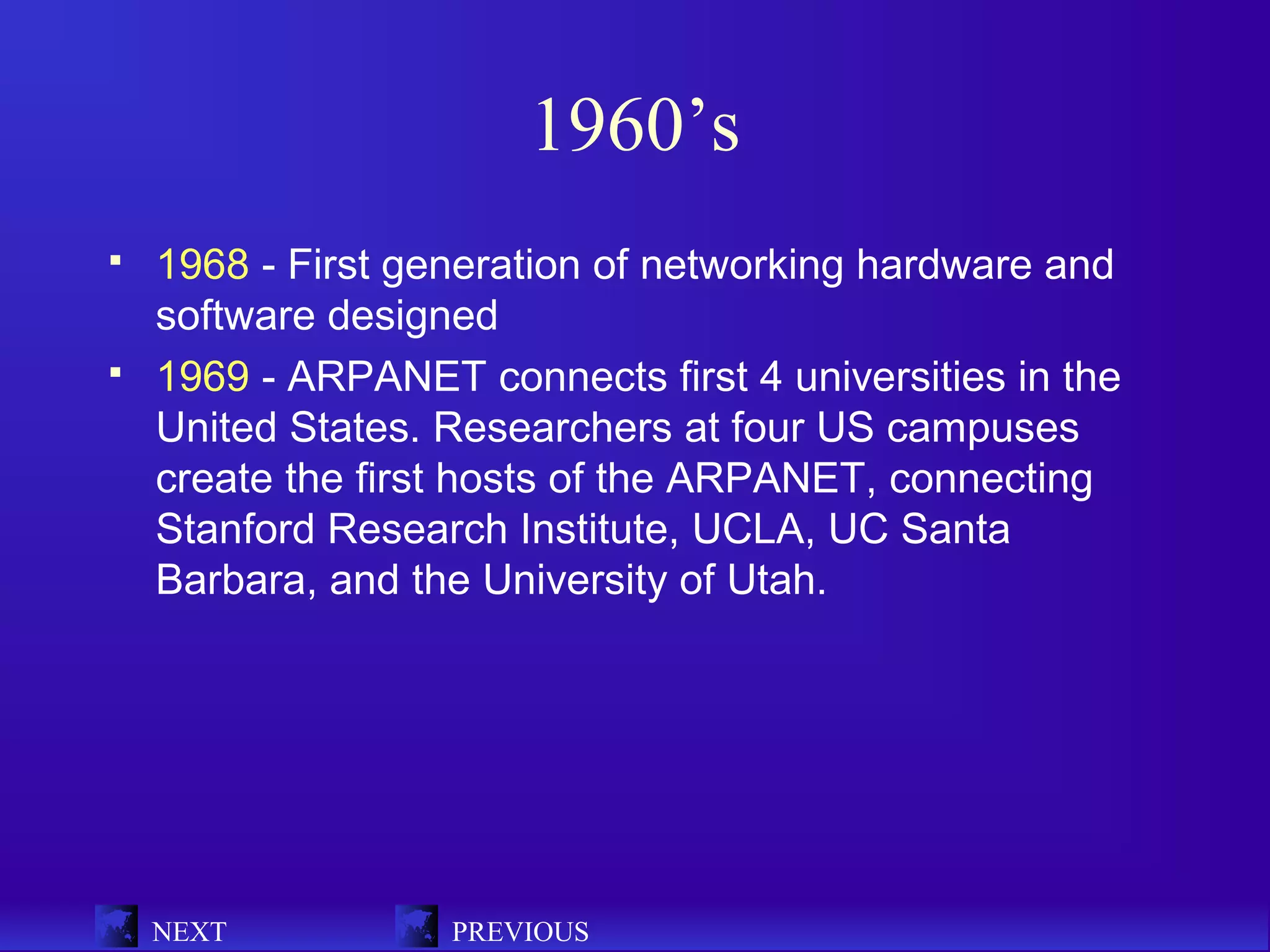
1960’s
   1968 - First generation of networking hardware and
    software designed
   1969 - ARPANET connects first 4 universities in the
    United States. Researchers at four US campuses
    create the first hosts of the ARPANET, connecting
    Stanford Research Institute, UCLA, UC Santa
    Barbara, and the University of Utah.


    NEXT           PREVIOUS
1970’s

NEXT   PREVIOUS
1970’s
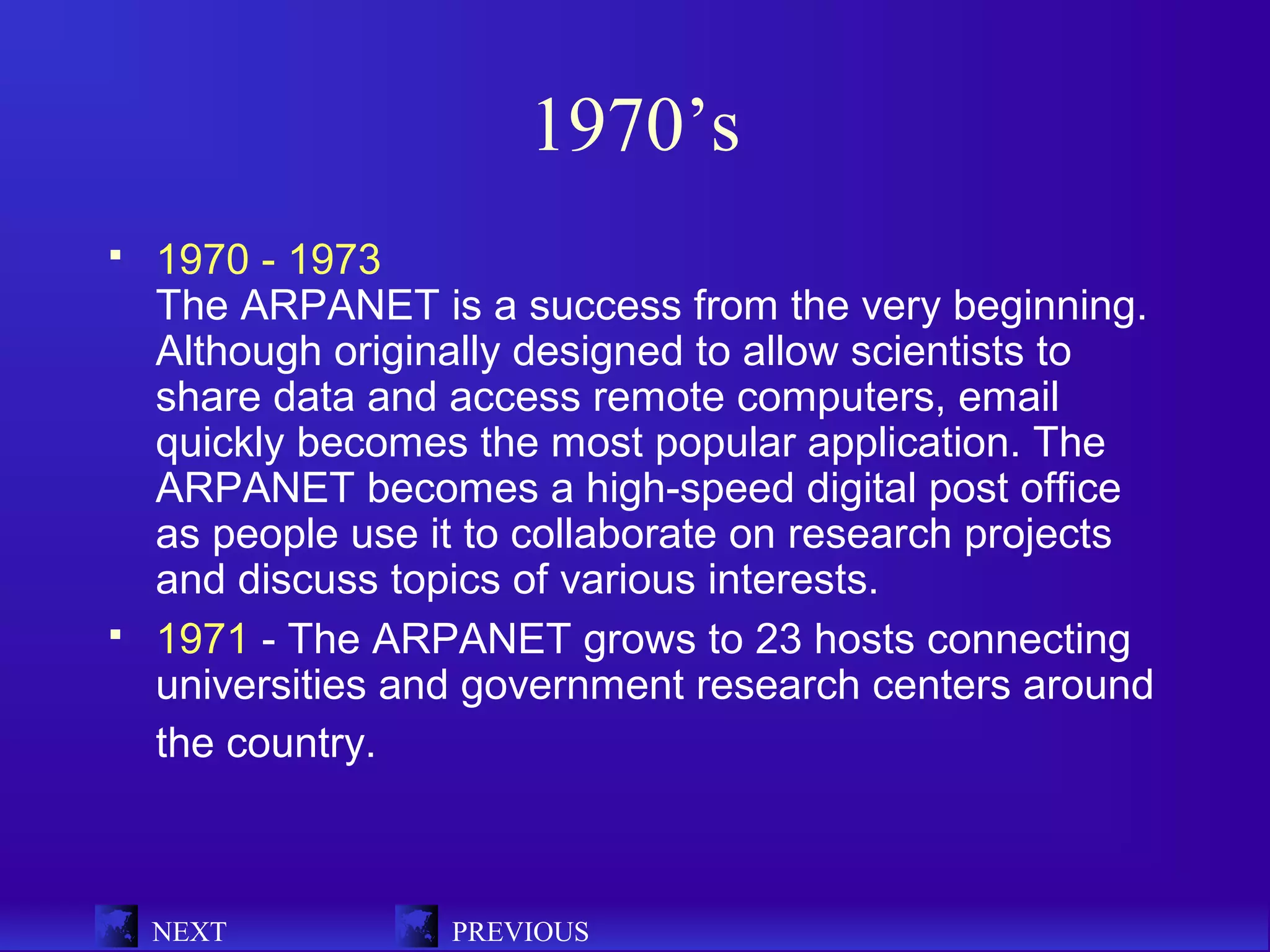
   1970 - 1973
    The ARPANET is a success from the very beginning.
    Although originally designed to allow scientists to
    share data and access remote computers, email
    quickly becomes the most popular application. The
    ARPANET becomes a high-speed digital post office
    as people use it to collaborate on research projects
    and discuss topics of various interests.
   1971 - The ARPANET grows to 23 hosts connecting
    universities and government research centers around
    the country.


    NEXT           PREVIOUS
1970’s
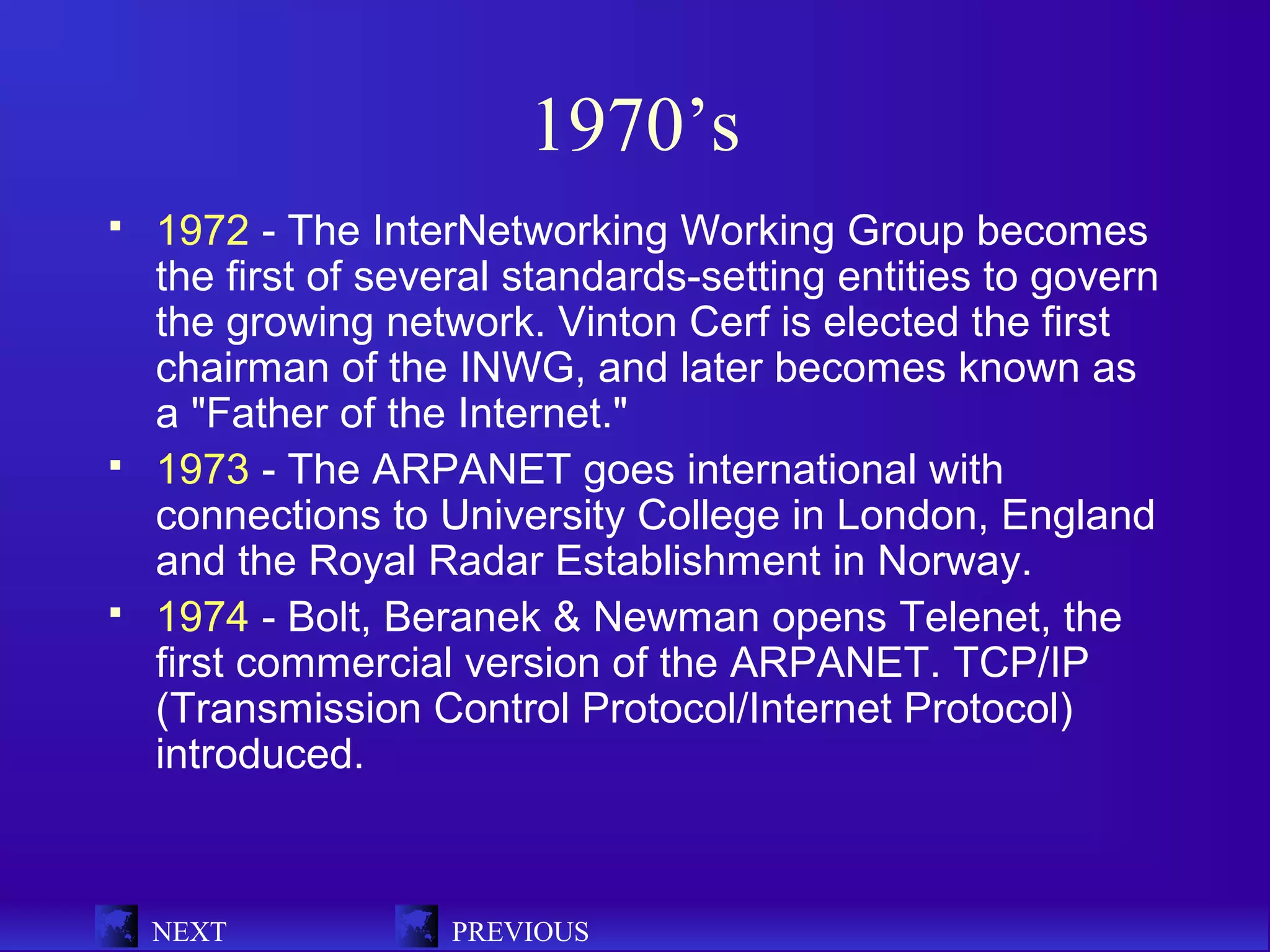
   1972 - The InterNetworking Working Group becomes
    the first of several standards-setting entities to govern
    the growing network. Vinton Cerf is elected the first
    chairman of the INWG, and later becomes known as
    a "Father of the Internet."
   1973 - The ARPANET goes international with
    connections to University College in London, England
    and the Royal Radar Establishment in Norway.
   1974 - Bolt, Beranek & Newman opens Telenet, the
    first commercial version of the ARPANET. TCP/IP
    (Transmission Control Protocol/Internet Protocol)
    introduced.


    NEXT            PREVIOUS
1970’s
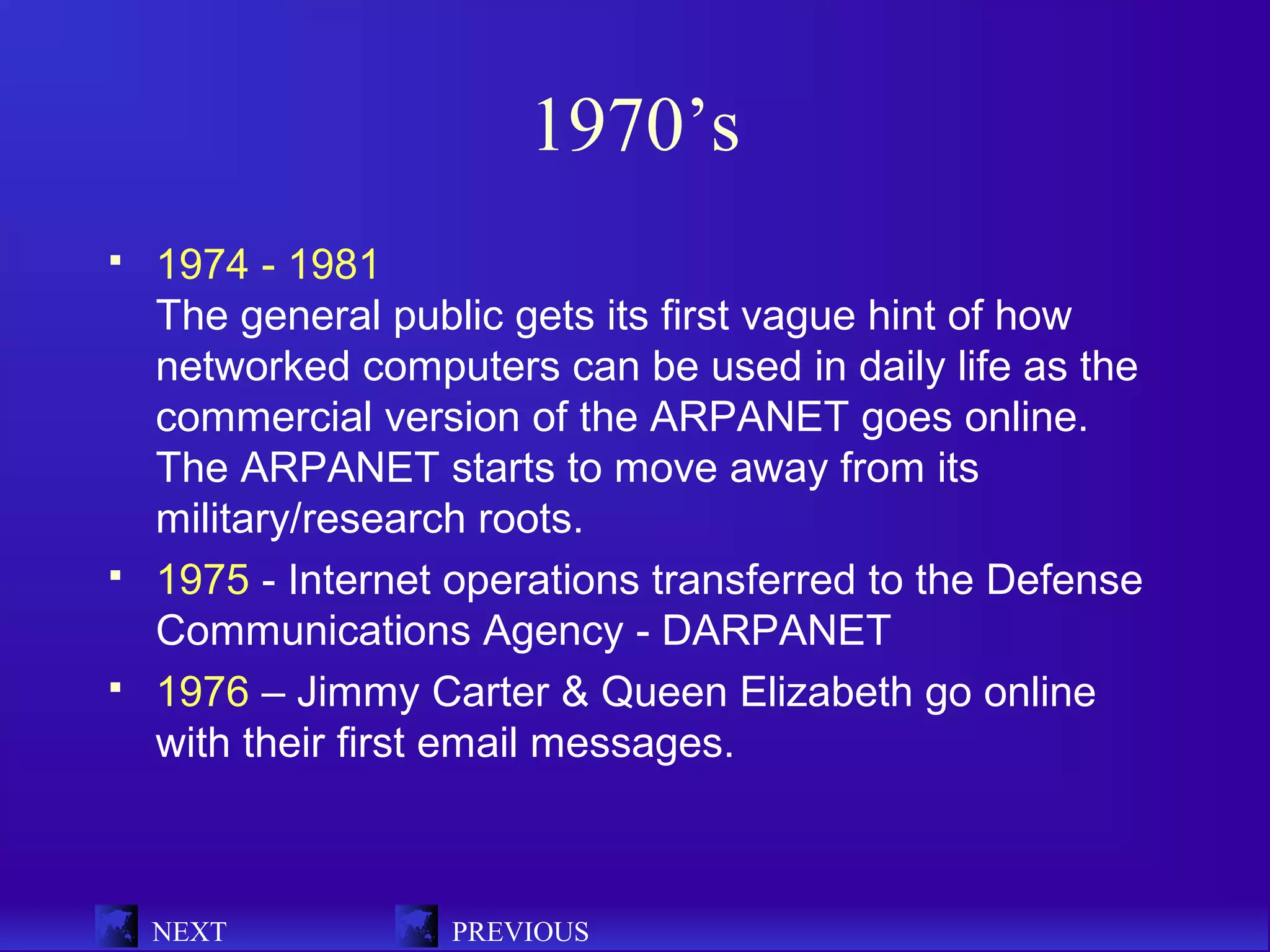
   1974 - 1981
    The general public gets its first vague hint of how
    networked computers can be used in daily life as the
    commercial version of the ARPANET goes online.
    The ARPANET starts to move away from its
    military/research roots.
   1975 - Internet operations transferred to the Defense
    Communications Agency - DARPANET
   1976 – Jimmy Carter & Queen Elizabeth go online
    with their first email messages.


    NEXT           PREVIOUS
1970’s
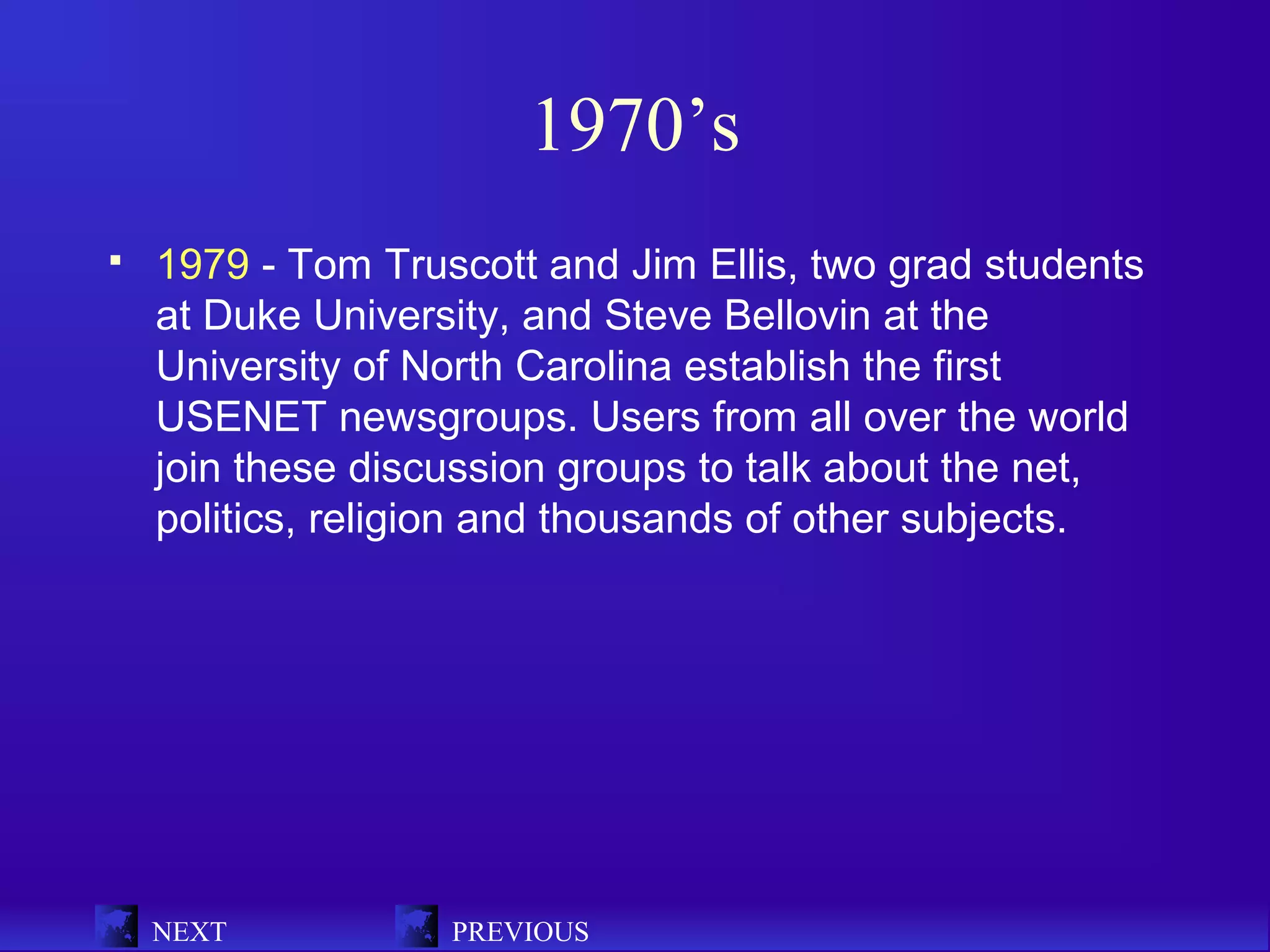
   1979 - Tom Truscott and Jim Ellis, two grad students
    at Duke University, and Steve Bellovin at the
    University of North Carolina establish the first
    USENET newsgroups. Users from all over the world
    join these discussion groups to talk about the net,
    politics, religion and thousands of other subjects.


    NEXT           PREVIOUS
1980’s

NEXT   PREVIOUS
1980’s
   1980 - Mark Andreesen turns 8. 14 more years till he
    revolutionizes the Web
   1981 - ARPANET has 213 hosts. A new host is
    added approximately once every 20 days.
   1982 - The term 'Internet' is used for the first time.


    NEXT            PREVIOUS
1980’s
   1982 - 1987
    Bob Kahn and Vint Cerf are key members of a team
    which creates TCP/IP, the common language of all
    Internet computers. For the first time the loose
    collection of networks which made up the ARPANET
    is seen as an "internet", and the Internet as we know
    it today is born.


    NEXT           PREVIOUS
1980’s
   The mid-80s marks a boom in the personal
    computer and super-minicomputer industries.
    The combination of inexpensive desktop
    machines and powerful, network-ready
    servers allows many companies to join the
    Internet for the first time. Corporations begin
    to use the Internet to communicate with each
    other and with their customers.


    NEXT          PREVIOUS
1980’s
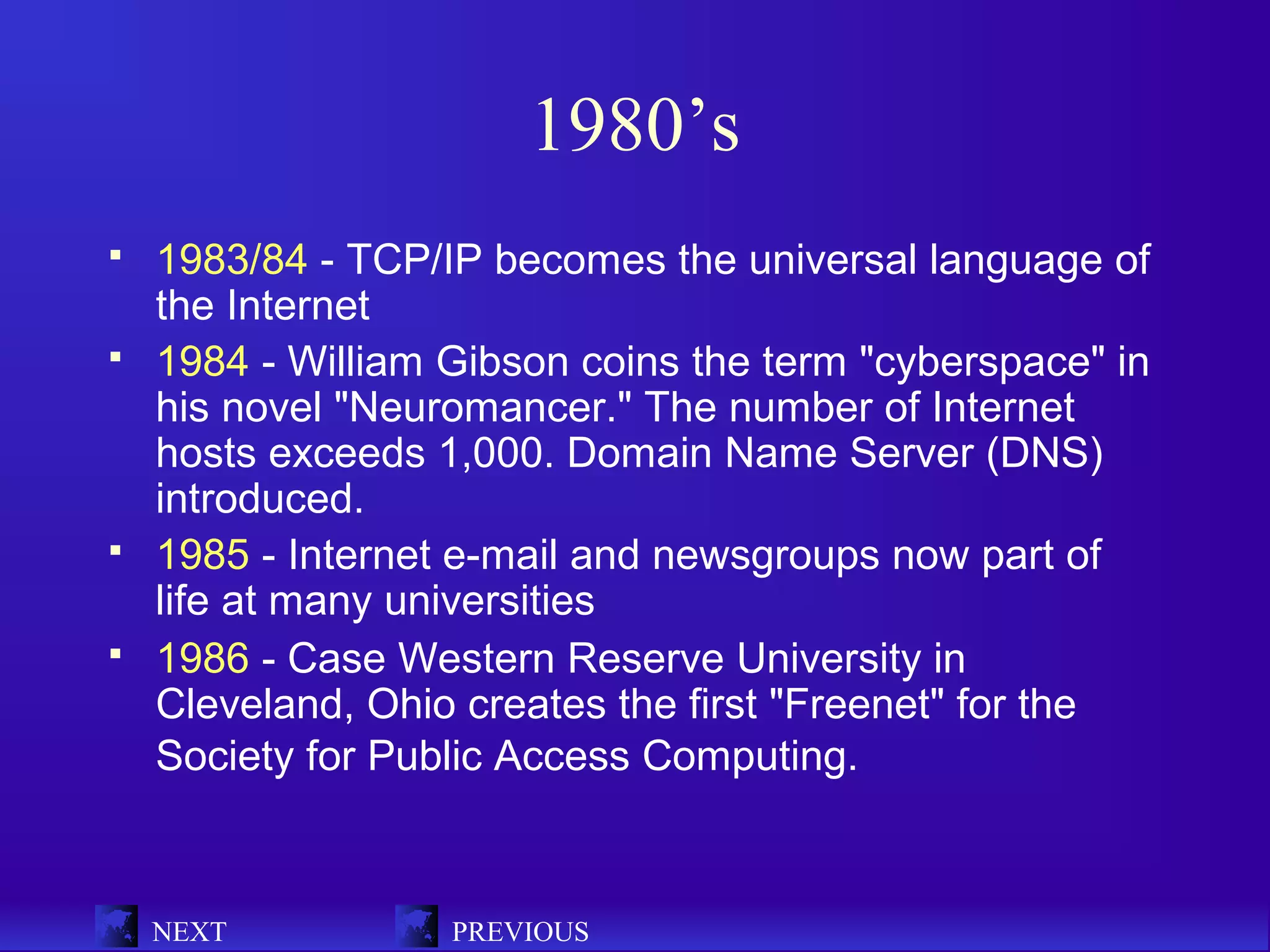
   1983/84 - TCP/IP becomes the universal language of
    the Internet
   1984 - William Gibson coins the term "cyberspace" in
    his novel "Neuromancer." The number of Internet
    hosts exceeds 1,000. Domain Name Server (DNS)
    introduced.
   1985 - Internet e-mail and newsgroups now part of
    life at many universities
   1986 - Case Western Reserve University in
    Cleveland, Ohio creates the first "Freenet" for the
    Society for Public Access Computing.


    NEXT           PREVIOUS
1980’s
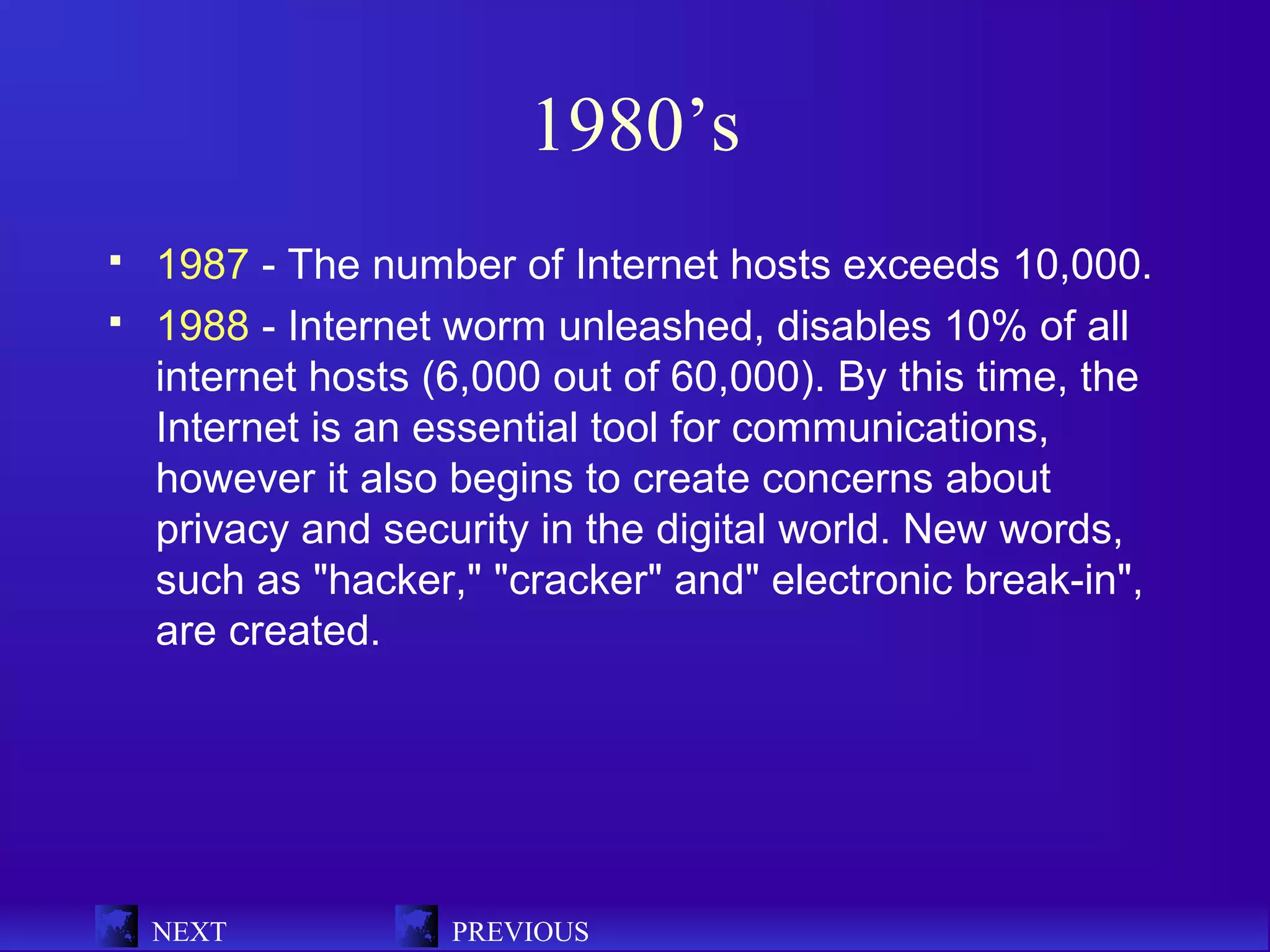
   1987 - The number of Internet hosts exceeds 10,000.
   1988 - Internet worm unleashed, disables 10% of all
    internet hosts (6,000 out of 60,000). By this time, the
    Internet is an essential tool for communications,
    however it also begins to create concerns about
    privacy and security in the digital world. New words,
    such as "hacker," "cracker" and" electronic break-in",
    are created.


    NEXT            PREVIOUS
1980’s
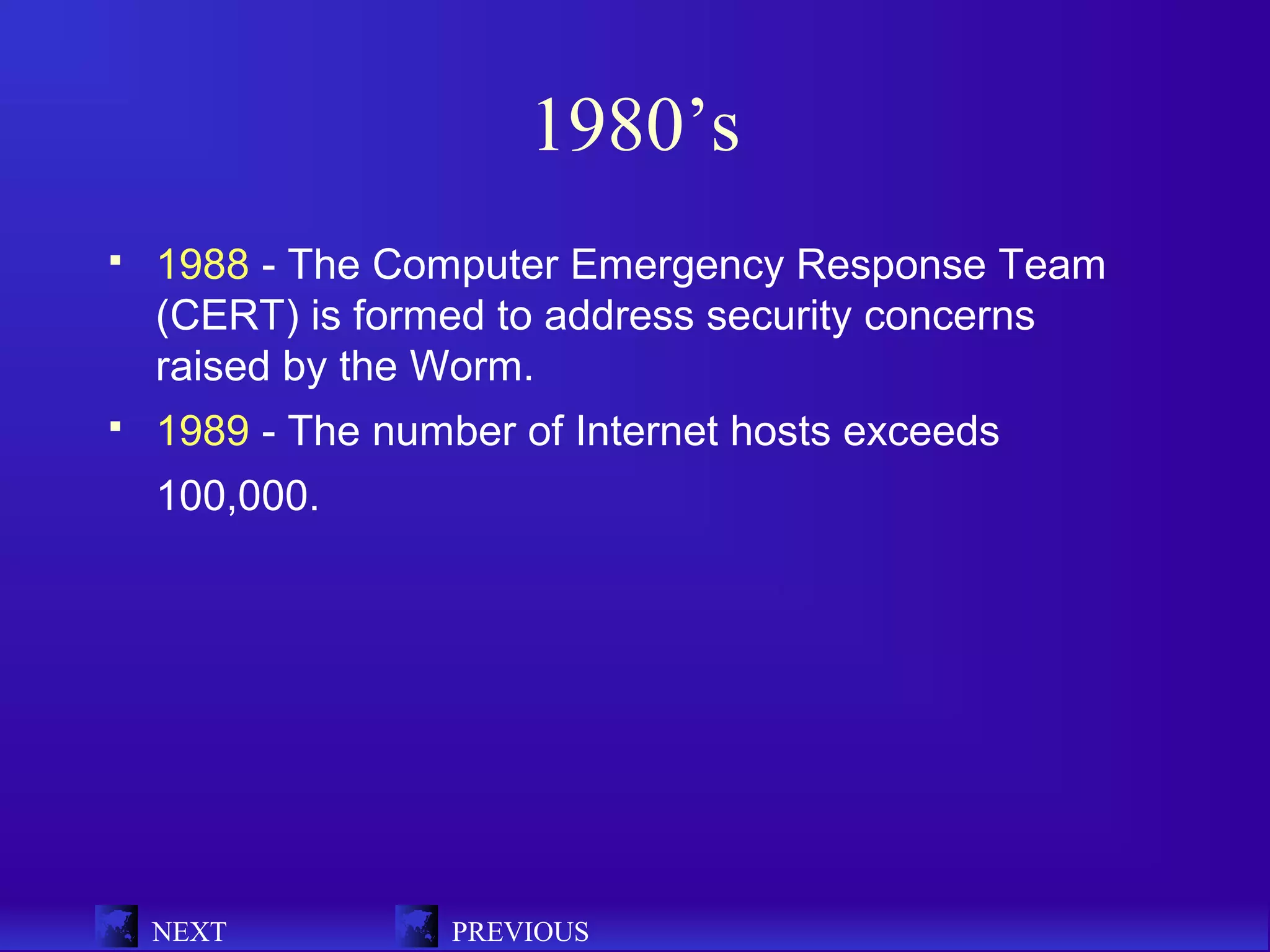
   1988 - The Computer Emergency Response Team
    (CERT) is formed to address security concerns
    raised by the Worm.
   1989 - The number of Internet hosts exceeds
    100,000.


    NEXT           PREVIOUS
1990’s:
       The Age of the Internet


NEXT         PREVIOUS
1990’s
   1990 - A happy victim of its own unplanned, unexpected
    success, the ARPANET is decommissioned, leaving only the
    vast network-of-networks called the Internet. The number of
    hosts exceeds 300,000.
   1991 - Hyper Text Transfer Protocol (HTTP)
           -Hyper Text Markup Language (HTML)
           -The World Wide Web is born!
   1991 - 1993
    Corporations wishing to use the Internet face a serious problem:
    commercial network traffic is banned from the National Science
    Foundation's NSFNET, the backbone of the Internet. In 1991
    the NSF lifts the restriction on commercial use, clearing the way
    for the age of electronic commerce.


    NEXT               PREVIOUS
1990’s
   1991- At the University of Minnesota, a team led by
    computer programmer Mark MaCahill releases
    "gopher," the first point-and-click way of navigating
    the files of the Internet in 1991. Originally designed to
    ease campus communications, gopher is freely
    distributed on the Internet. MaCahill calls it "the first
    Internet application my mom can use."


    NEXT            PREVIOUS
1990’s
   1991 the first computer code of the World Wide Web
    is posted in the newsgroup, "alt.hypertext." The ability
    to combine words, pictures, and sounds on Web
    pages excites many computer programmers who see
    the potential for publishing information on the Internet
    in a way that can be as easy as using a word
    processor.


    NEXT            PREVIOUS
1990’s
   1991 - Marc Andreesen and a group of student
    programmers at NCSA (the National Center for
    Supercomputing Applications located on the campus
    of University of Illinois at Urbana Champaign) begin
    work on a graphical browser for the World Wide Web
    called Mosaic.


    NEXT             PREVIOUS
1990’s
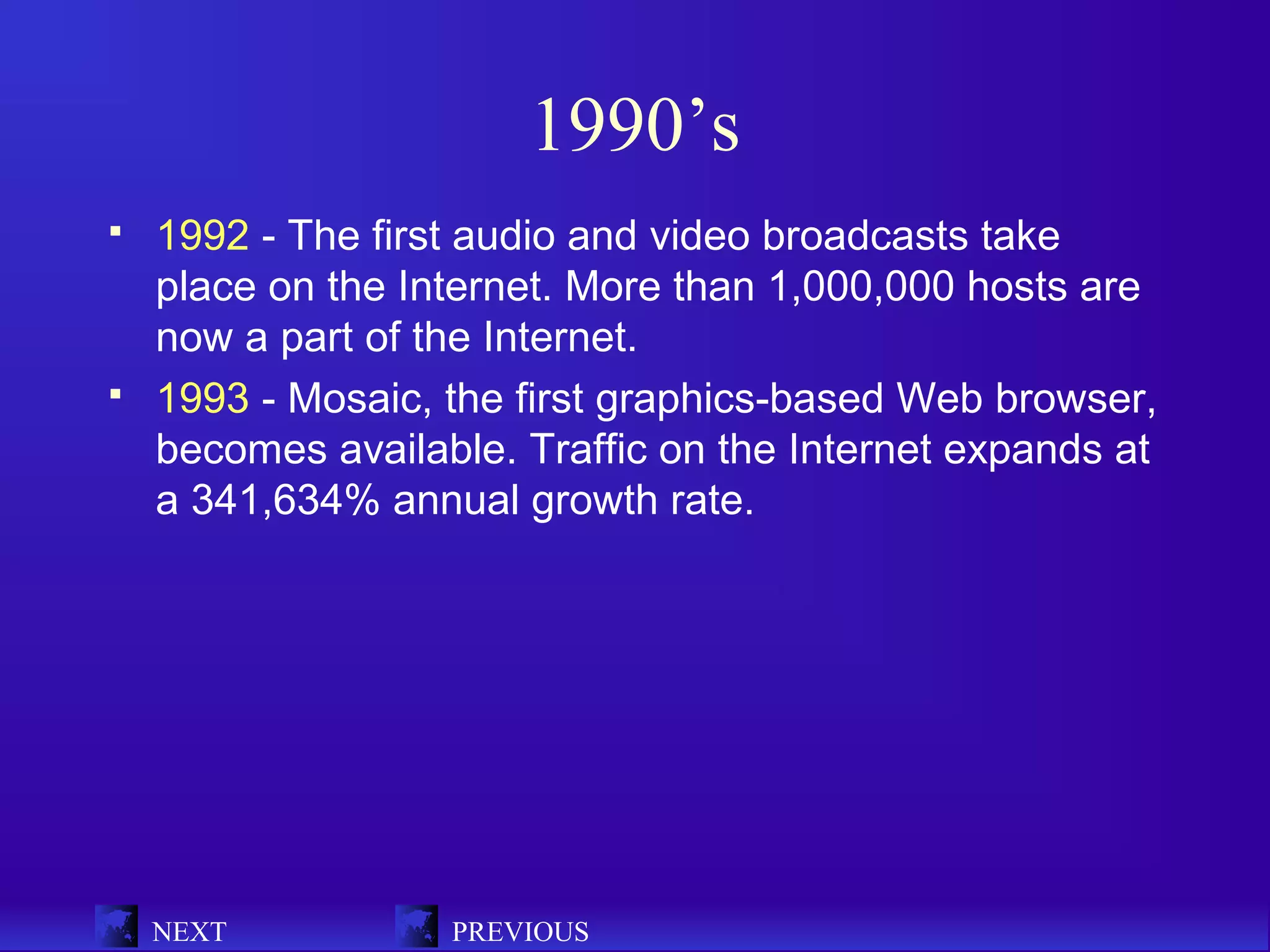
   1992 - The first audio and video broadcasts take
    place on the Internet. More than 1,000,000 hosts are
    now a part of the Internet.
   1993 - Mosaic, the first graphics-based Web browser,
    becomes available. Traffic on the Internet expands at
    a 341,634% annual growth rate.


    NEXT           PREVIOUS
1990’s
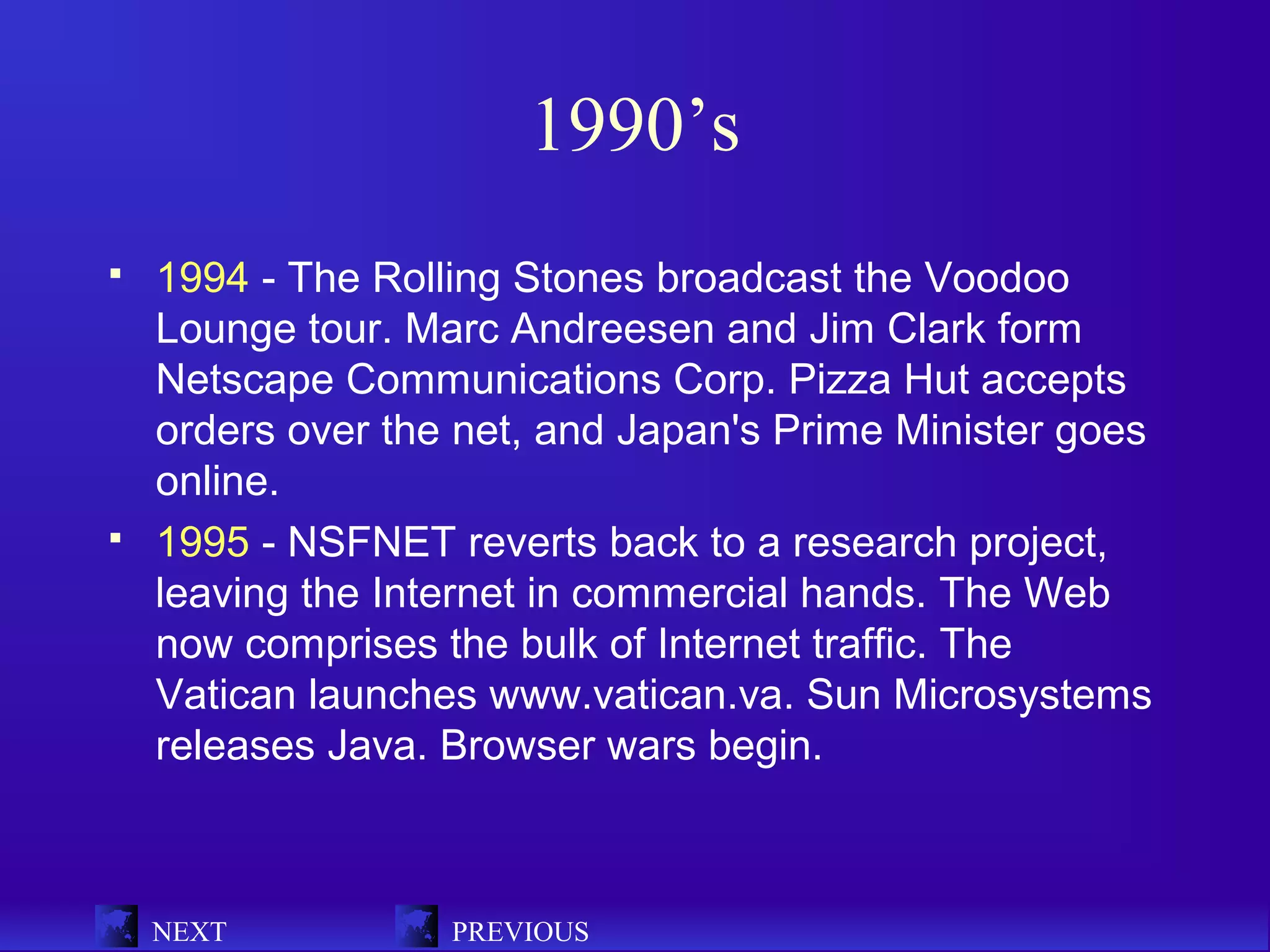
   1994 - The Rolling Stones broadcast the Voodoo
    Lounge tour. Marc Andreesen and Jim Clark form
    Netscape Communications Corp. Pizza Hut accepts
    orders over the net, and Japan's Prime Minister goes
    online.
   1995 - NSFNET reverts back to a research project,
    leaving the Internet in commercial hands. The Web
    now comprises the bulk of Internet traffic. The
    Vatican launches www.vatican.va. Sun Microsystems
    releases Java. Browser wars begin.


    NEXT           PREVIOUS
1990’s
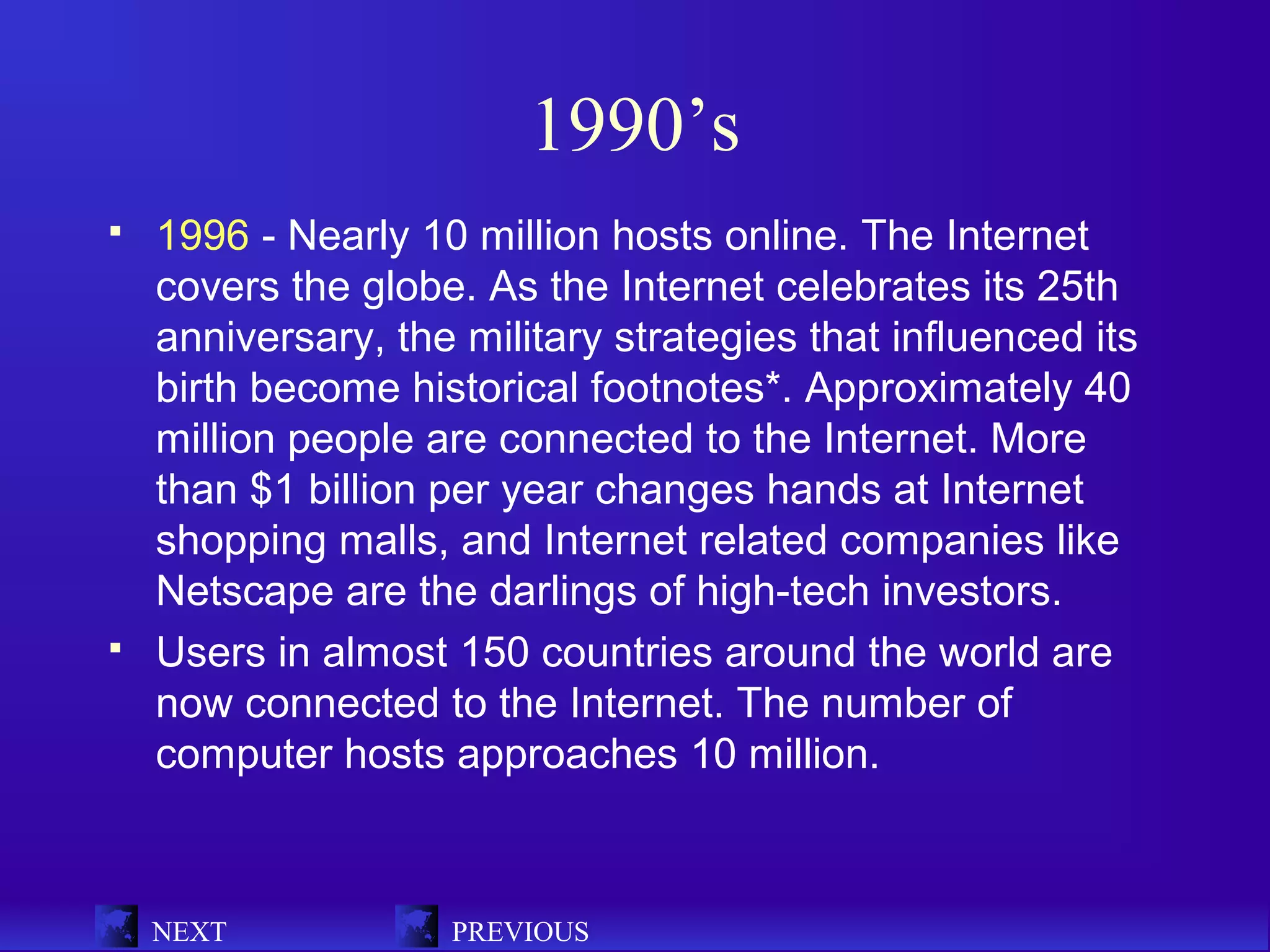
   1996 - Nearly 10 million hosts online. The Internet
    covers the globe. As the Internet celebrates its 25th
    anniversary, the military strategies that influenced its
    birth become historical footnotes*. Approximately 40
    million people are connected to the Internet. More
    than $1 billion per year changes hands at Internet
    shopping malls, and Internet related companies like
    Netscape are the darlings of high-tech investors.
   Users in almost 150 countries around the world are
    now connected to the Internet. The number of
    computer hosts approaches 10 million.


    NEXT            PREVIOUS
1990’s
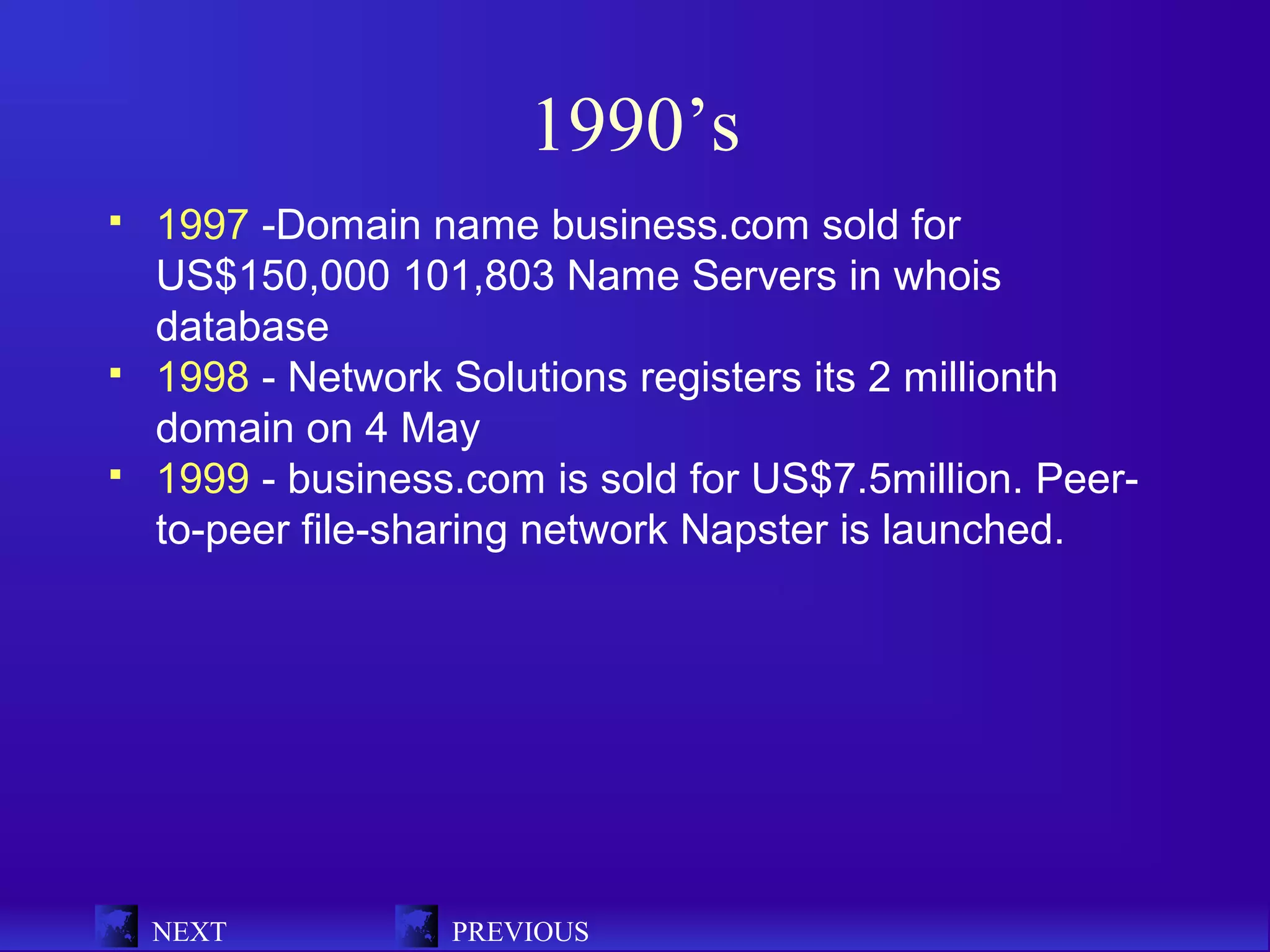
   1997 -Domain name business.com sold for
    US$150,000 101,803 Name Servers in whois
    database
   1998 - Network Solutions registers its 2 millionth
    domain on 4 May
   1999 - business.com is sold for US$7.5million. Peer-
    to-peer file-sharing network Napster is launched.


    NEXT           PREVIOUS
2000 - Today

NEXT      PREVIOUS
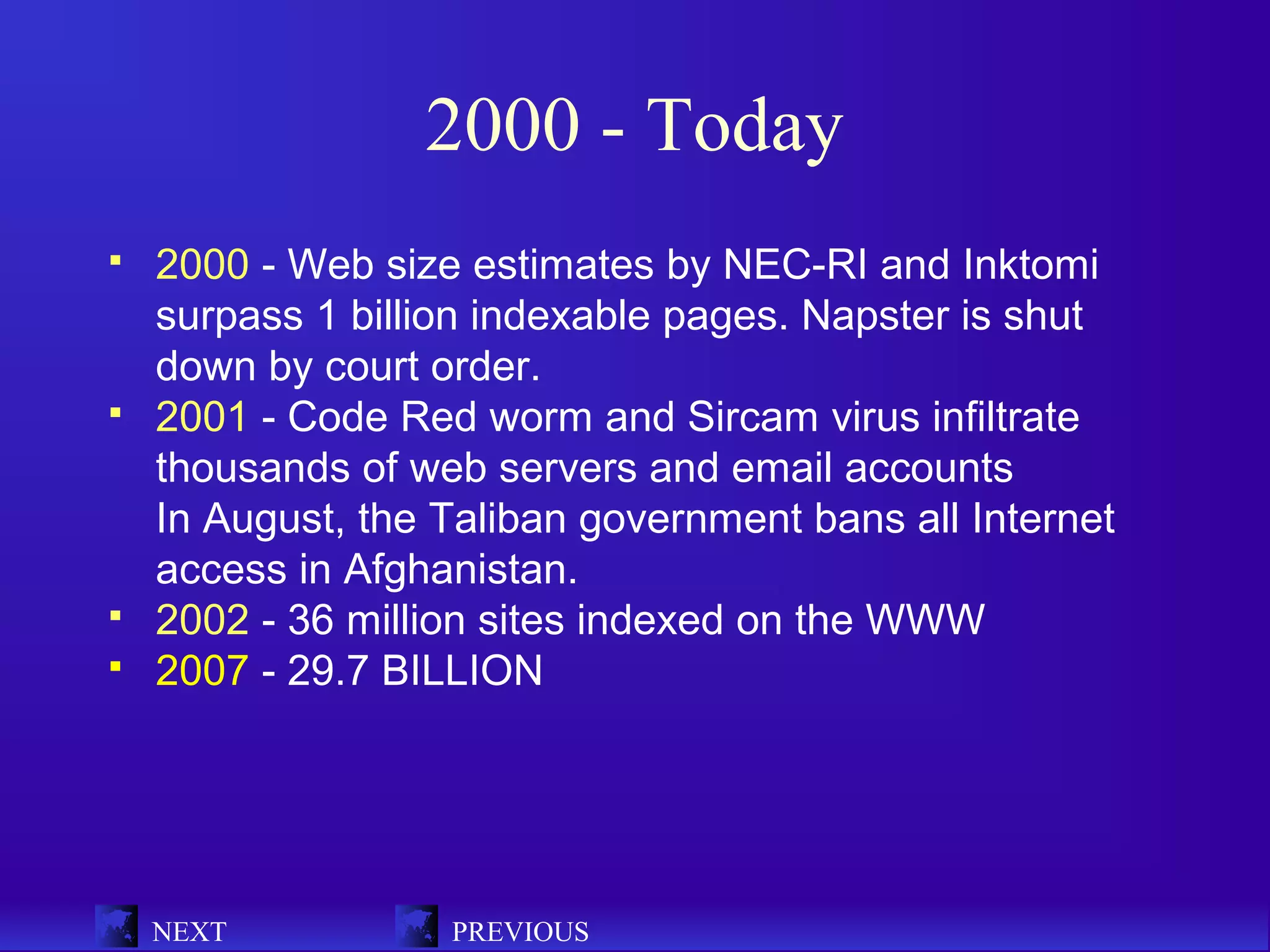
2000 - Today
   2000 - Web size estimates by NEC-RI and Inktomi
    surpass 1 billion indexable pages. Napster is shut
    down by court order.
   2001 - Code Red worm and Sircam virus infiltrate
    thousands of web servers and email accounts
    In August, the Taliban government bans all Internet
    access in Afghanistan.
   2002 - 36 million sites indexed on the WWW
   2007 - 29.7 BILLION


    NEXT           PREVIOUS

History of the Internet

  • 1.
    History of theInternet BA 212 Richard Smith NEXT
  • 2.
    What is theInternet? NEXT PREVIOUS
  • 3.
    What is theInternet?  A network of networks, joining many government, university and private computers together and providing an infrastructure for the use of E-mail, bulletin boards, file archives, hypertext documents, databases and other computational resources  The vast collection of computer networks which form and act as a single huge network for transport of data and messages across distances which can be anywhere from the same office to anywhere in the world. NEXT PREVIOUS
  • 4.
  • 5.
    1960’s  1962 - The RAND Corporation begins research into robust, distributed communication networks for military command and control.  1962 - 1969 The Internet is first conceived in the early '60s. Under the leadership of the Department of Defense's Advanced Research Project Agency (ARPA), it grows from a paper architecture into a small network (ARPANET) intended to promote the sharing of super-computers amongst researchers in the United States. NEXT PREVIOUS
  • 6.
    1960’s  1965 - The DOD's Advanced Research Project Association begins work on 'ARPANET'  1965 - ARPA sponsors research into a "cooperative network of time-sharing computers."  1967 - First ARPANET papers presented at Association for Computing Machinery Symposium. Delegates at a symposium for the Association for Computing Machinery in Gatlingberg, TN discuss the first plans for the ARPANET. NEXT PREVIOUS
  • 7.
    1960’s  1968 - First generation of networking hardware and software designed  1969 - ARPANET connects first 4 universities in the United States. Researchers at four US campuses create the first hosts of the ARPANET, connecting Stanford Research Institute, UCLA, UC Santa Barbara, and the University of Utah. NEXT PREVIOUS
  • 8.
  • 9.
    1970’s  1970 - 1973 The ARPANET is a success from the very beginning. Although originally designed to allow scientists to share data and access remote computers, email quickly becomes the most popular application. The ARPANET becomes a high-speed digital post office as people use it to collaborate on research projects and discuss topics of various interests.  1971 - The ARPANET grows to 23 hosts connecting universities and government research centers around the country. NEXT PREVIOUS
  • 10.
    1970’s  1972 - The InterNetworking Working Group becomes the first of several standards-setting entities to govern the growing network. Vinton Cerf is elected the first chairman of the INWG, and later becomes known as a "Father of the Internet."  1973 - The ARPANET goes international with connections to University College in London, England and the Royal Radar Establishment in Norway.  1974 - Bolt, Beranek & Newman opens Telenet, the first commercial version of the ARPANET. TCP/IP (Transmission Control Protocol/Internet Protocol) introduced. NEXT PREVIOUS
  • 11.
    1970’s  1974 - 1981 The general public gets its first vague hint of how networked computers can be used in daily life as the commercial version of the ARPANET goes online. The ARPANET starts to move away from its military/research roots.  1975 - Internet operations transferred to the Defense Communications Agency - DARPANET  1976 – Jimmy Carter & Queen Elizabeth go online with their first email messages. NEXT PREVIOUS
  • 12.
    1970’s  1979 - Tom Truscott and Jim Ellis, two grad students at Duke University, and Steve Bellovin at the University of North Carolina establish the first USENET newsgroups. Users from all over the world join these discussion groups to talk about the net, politics, religion and thousands of other subjects. NEXT PREVIOUS
  • 13.
  • 14.
    1980’s  1980 - Mark Andreesen turns 8. 14 more years till he revolutionizes the Web  1981 - ARPANET has 213 hosts. A new host is added approximately once every 20 days.  1982 - The term 'Internet' is used for the first time. NEXT PREVIOUS
  • 15.
    1980’s  1982 - 1987 Bob Kahn and Vint Cerf are key members of a team which creates TCP/IP, the common language of all Internet computers. For the first time the loose collection of networks which made up the ARPANET is seen as an "internet", and the Internet as we know it today is born. NEXT PREVIOUS
  • 16.
    1980’s  The mid-80s marks a boom in the personal computer and super-minicomputer industries. The combination of inexpensive desktop machines and powerful, network-ready servers allows many companies to join the Internet for the first time. Corporations begin to use the Internet to communicate with each other and with their customers. NEXT PREVIOUS
  • 17.
    1980’s  1983/84 - TCP/IP becomes the universal language of the Internet  1984 - William Gibson coins the term "cyberspace" in his novel "Neuromancer." The number of Internet hosts exceeds 1,000. Domain Name Server (DNS) introduced.  1985 - Internet e-mail and newsgroups now part of life at many universities  1986 - Case Western Reserve University in Cleveland, Ohio creates the first "Freenet" for the Society for Public Access Computing. NEXT PREVIOUS
  • 18.
    1980’s  1987 - The number of Internet hosts exceeds 10,000.  1988 - Internet worm unleashed, disables 10% of all internet hosts (6,000 out of 60,000). By this time, the Internet is an essential tool for communications, however it also begins to create concerns about privacy and security in the digital world. New words, such as "hacker," "cracker" and" electronic break-in", are created. NEXT PREVIOUS
  • 19.
    1980’s  1988 - The Computer Emergency Response Team (CERT) is formed to address security concerns raised by the Worm.  1989 - The number of Internet hosts exceeds 100,000. NEXT PREVIOUS
  • 20.
    1990’s: The Age of the Internet NEXT PREVIOUS
  • 21.
    1990’s  1990 - A happy victim of its own unplanned, unexpected success, the ARPANET is decommissioned, leaving only the vast network-of-networks called the Internet. The number of hosts exceeds 300,000.  1991 - Hyper Text Transfer Protocol (HTTP) -Hyper Text Markup Language (HTML) -The World Wide Web is born!  1991 - 1993 Corporations wishing to use the Internet face a serious problem: commercial network traffic is banned from the National Science Foundation's NSFNET, the backbone of the Internet. In 1991 the NSF lifts the restriction on commercial use, clearing the way for the age of electronic commerce. NEXT PREVIOUS
  • 22.
    1990’s  1991- At the University of Minnesota, a team led by computer programmer Mark MaCahill releases "gopher," the first point-and-click way of navigating the files of the Internet in 1991. Originally designed to ease campus communications, gopher is freely distributed on the Internet. MaCahill calls it "the first Internet application my mom can use." NEXT PREVIOUS
  • 23.
    1990’s  1991 the first computer code of the World Wide Web is posted in the newsgroup, "alt.hypertext." The ability to combine words, pictures, and sounds on Web pages excites many computer programmers who see the potential for publishing information on the Internet in a way that can be as easy as using a word processor. NEXT PREVIOUS
  • 24.
    1990’s  1991 - Marc Andreesen and a group of student programmers at NCSA (the National Center for Supercomputing Applications located on the campus of University of Illinois at Urbana Champaign) begin work on a graphical browser for the World Wide Web called Mosaic. NEXT PREVIOUS
  • 25.
    1990’s  1992 - The first audio and video broadcasts take place on the Internet. More than 1,000,000 hosts are now a part of the Internet.  1993 - Mosaic, the first graphics-based Web browser, becomes available. Traffic on the Internet expands at a 341,634% annual growth rate. NEXT PREVIOUS
  • 26.
    1990’s  1994 - The Rolling Stones broadcast the Voodoo Lounge tour. Marc Andreesen and Jim Clark form Netscape Communications Corp. Pizza Hut accepts orders over the net, and Japan's Prime Minister goes online.  1995 - NSFNET reverts back to a research project, leaving the Internet in commercial hands. The Web now comprises the bulk of Internet traffic. The Vatican launches www.vatican.va. Sun Microsystems releases Java. Browser wars begin. NEXT PREVIOUS
  • 27.
    1990’s  1996 - Nearly 10 million hosts online. The Internet covers the globe. As the Internet celebrates its 25th anniversary, the military strategies that influenced its birth become historical footnotes*. Approximately 40 million people are connected to the Internet. More than $1 billion per year changes hands at Internet shopping malls, and Internet related companies like Netscape are the darlings of high-tech investors.  Users in almost 150 countries around the world are now connected to the Internet. The number of computer hosts approaches 10 million. NEXT PREVIOUS
  • 28.
    1990’s  1997 -Domain name business.com sold for US$150,000 101,803 Name Servers in whois database  1998 - Network Solutions registers its 2 millionth domain on 4 May  1999 - business.com is sold for US$7.5million. Peer- to-peer file-sharing network Napster is launched. NEXT PREVIOUS
  • 29.
  • 30.
    2000 - Today  2000 - Web size estimates by NEC-RI and Inktomi surpass 1 billion indexable pages. Napster is shut down by court order.  2001 - Code Red worm and Sircam virus infiltrate thousands of web servers and email accounts In August, the Taliban government bans all Internet access in Afghanistan.  2002 - 36 million sites indexed on the WWW  2007 - 29.7 BILLION NEXT PREVIOUS