Internet


           20108004
           Rui Zeng
Directory
                   What’s the Internet


              History of the Internet


           The technology about Internet


            The importance of Internet


                       Reference
Page  2                                   2
What’s the Internet?
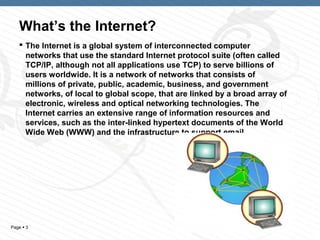
    The Internet is a global system of interconnected computer
     networks that use the standard Internet protocol suite (often called
     TCP/IP, although not all applications use TCP) to serve billions of
     users worldwide. It is a network of networks that consists of
     millions of private, public, academic, business, and government
     networks, of local to global scope, that are linked by a broad array of
     electronic, wireless and optical networking technologies. The
     Internet carries an extensive range of information resources and
     services, such as the inter-linked hypertext documents of the World
     Wide Web (WWW) and the infrastructure to support email.


Page  3                                                     3
History of the Internet

    In 1983, ARPA and the U.S. Department of Defense
     Communications Agency was successfully developed
     for heterogeneous networks, TCP / IP protocol, the
     United States to the agreement of California at
     Berkeley as part of BSD UNIX, which makes the
     agreement has been popular in the community, thus
     was born the real Internet.


Page  4                                  4
The technology about Internet------
   Protocols

        The communications infrastructure of the Internet consists of its
      hardware components and a system of software layers that control
      various aspects of the architecture. While the hardware can often be
      used to support other software systems, it is the design and the
      rigorous standardization process of the software architecture that
      characterizes the Internet and provides the foundation for its scalability
      and success. The responsibility for the architectural design of the
      Internet software systems has been delegated to the Internet
      Engineering Task Force.
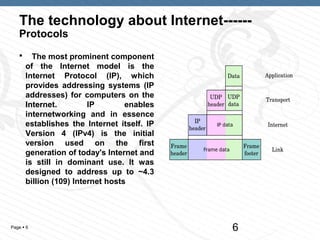
    The Internet standards describe a framework known as the Internet
    protocol suite. This is a model architecture that divides methods into a
    layered system of protocols


Page  5                                                      5
The technology about Internet------
   Protocols
        The most prominent component
       of the Internet model is the
       Internet Protocol (IP), which
       provides addressing systems (IP
       addresses) for computers on the
       Internet.         IP        enables
       internetworking and in essence
       establishes the Internet itself. IP
       Version 4 (IPv4) is the initial
       version used on the first
       generation of today's Internet and
       is still in dominant use. It was
       designed to address up to ~4.3
       billion (109) Internet hosts


Page  6                                     6
The technology about Internet------Routing
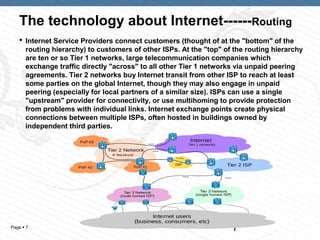
    Internet Service Providers connect customers (thought of at the "bottom" of the
     routing hierarchy) to customers of other ISPs. At the "top" of the routing hierarchy
     are ten or so Tier 1 networks, large telecommunication companies which
     exchange traffic directly "across" to all other Tier 1 networks via unpaid peering
     agreements. Tier 2 networks buy Internet transit from other ISP to reach at least
     some parties on the global Internet, though they may also engage in unpaid
     peering (especially for local partners of a similar size). ISPs can use a single
     "upstream" provider for connectivity, or use multihoming to provide protection
     from problems with individual links. Internet exchange points create physical
     connections between multiple ISPs, often hosted in buildings owned by
     independent third parties.


Page  7                                                           7
The importance of Internet
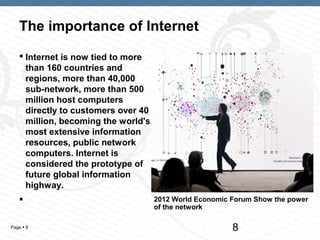
    Internet is now tied to more
     than 160 countries and
     regions, more than 40,000
     sub-network, more than 500
     million host computers
     directly to customers over 40
     million, becoming the world's
     most extensive information
     resources, public network
     computers. Internet is
     considered the prototype of
     future global information
     highway.
                                    2012 World Economic Forum Show the power
                                     of the network

Page  8                                                 8
Reference
    http://baike.baidu.com/view/11165.htm


    http://en.wikipedia.org/wiki/Internet


    http://zh.wikipedia.org/wiki/Internet


    http://baike.baidu.com/view/3487.htm


Page  9                                     9
THANKS

Internet

  • 1.
    Internet 20108004 Rui Zeng
  • 2.
    Directory What’s the Internet History of the Internet The technology about Internet The importance of Internet Reference Page  2 2
  • 3.
    What’s the Internet?  The Internet is a global system of interconnected computer networks that use the standard Internet protocol suite (often called TCP/IP, although not all applications use TCP) to serve billions of users worldwide. It is a network of networks that consists of millions of private, public, academic, business, and government networks, of local to global scope, that are linked by a broad array of electronic, wireless and optical networking technologies. The Internet carries an extensive range of information resources and services, such as the inter-linked hypertext documents of the World Wide Web (WWW) and the infrastructure to support email. Page  3 3
  • 4.
    History of theInternet  In 1983, ARPA and the U.S. Department of Defense Communications Agency was successfully developed for heterogeneous networks, TCP / IP protocol, the United States to the agreement of California at Berkeley as part of BSD UNIX, which makes the agreement has been popular in the community, thus was born the real Internet. Page  4 4
  • 5.
    The technology aboutInternet------ Protocols  The communications infrastructure of the Internet consists of its hardware components and a system of software layers that control various aspects of the architecture. While the hardware can often be used to support other software systems, it is the design and the rigorous standardization process of the software architecture that characterizes the Internet and provides the foundation for its scalability and success. The responsibility for the architectural design of the Internet software systems has been delegated to the Internet Engineering Task Force.  The Internet standards describe a framework known as the Internet protocol suite. This is a model architecture that divides methods into a layered system of protocols Page  5 5
  • 6.
    The technology aboutInternet------ Protocols  The most prominent component of the Internet model is the Internet Protocol (IP), which provides addressing systems (IP addresses) for computers on the Internet. IP enables internetworking and in essence establishes the Internet itself. IP Version 4 (IPv4) is the initial version used on the first generation of today's Internet and is still in dominant use. It was designed to address up to ~4.3 billion (109) Internet hosts Page  6 6
  • 7.
    The technology aboutInternet------Routing  Internet Service Providers connect customers (thought of at the "bottom" of the routing hierarchy) to customers of other ISPs. At the "top" of the routing hierarchy are ten or so Tier 1 networks, large telecommunication companies which exchange traffic directly "across" to all other Tier 1 networks via unpaid peering agreements. Tier 2 networks buy Internet transit from other ISP to reach at least some parties on the global Internet, though they may also engage in unpaid peering (especially for local partners of a similar size). ISPs can use a single "upstream" provider for connectivity, or use multihoming to provide protection from problems with individual links. Internet exchange points create physical connections between multiple ISPs, often hosted in buildings owned by independent third parties. Page  7 7
  • 8.
    The importance ofInternet  Internet is now tied to more than 160 countries and regions, more than 40,000 sub-network, more than 500 million host computers directly to customers over 40 million, becoming the world's most extensive information resources, public network computers. Internet is considered the prototype of future global information highway.  2012 World Economic Forum Show the power of the network Page  8 8
  • 9.
    Reference  http://baike.baidu.com/view/11165.htm  http://en.wikipedia.org/wiki/Internet  http://zh.wikipedia.org/wiki/Internet  http://baike.baidu.com/view/3487.htm Page  9 9
  • 10.