T O P I C 1 :
Operations strategy within the corporate strategy framework. The
globalization of Operations
B A R C E L O N A , F E B R U A R Y 2 0 2 2
Foundations of Operational Excellence
L E A R N I N G O B J E C T I V E S :
Study Operations
Management and
operational excellence
1
Define an Operations
strategy that supports the
general business strategy
and is related to other
functional area strategies
2
Analyse Operations’
globalisation
3
1
Operations Management and
Operational Excellence
O P E R A T I O N S M A N A G E M E N T A N D O P E R A T I O N A L E X C E L L E N C E
Definition of Operations Management
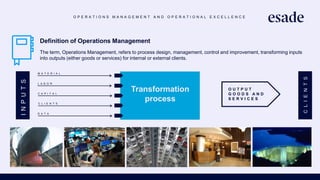
The term, Operations Management, refers to process design, management, control and improvement, transforming inputs
into outputs (either goods or services) for internal or external clients.
I
N
P
U
T
S
M A T E R I A L
L A B O R
C A P I T A L
C L I E N T S
D A T A
Transformation
process
O U T P U T
G O O D S A N D
S E R V I C E S
C
L
I
E
N
T
S
O P E R A T I O N S M A N A G E M E N T A N D O P E R A T I O N A L E X C E L L E N C E
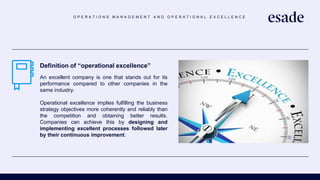
Definition of “operational excellence”
An excellent company is one that stands out for its
performance compared to other companies in the
same industry.
Operational excellence implies fulfilling the business
strategy objectives more coherently and reliably than
the competition and obtaining better results.
Companies can achieve this by designing and
implementing excellent processes followed later
by their continuous improvement.
O P E R A T I O N S M A N A G E M E N T A N D O P E R A T I O N A L E X C E L L E N C E
Operational Excellence class
This class aims to explore the basic pillars of
operational excellence which coincide with the
infrastructural elements –also known as the
“software”– of Operations strategy. These elements
are: Innovation, planning, quality management,
total quality and environmental quality. The class
will also study how to improve processes by means
of implementing the Lean and Six Sigma focuses.
1
2
3
4
5
O P E R A T I O N S M A N A G E M E N T A N D O P E R A T I O N A L E X C E L L E N C E
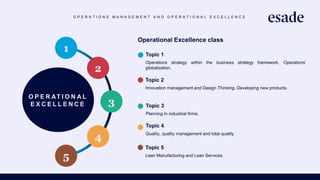
O P E R AT I O N A L
E X C E L L E N C E
Topic 1
Operations strategy within the business strategy framework. Operations’
globalization.
Operational Excellence class
Topic 2
Innovation management and Design Thinking. Developing new products.
Topic 3
Planning in industrial firms.
Topic 4
Quality, quality management and total quality.
Topic 5
Lean Manufacturing and Lean Services.
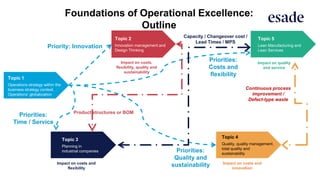
Continuous process
improvement /
Defect-type waste
Product structures or BOM
Impact on costs,
flexibility, quality and
sustainability
Priorities:
Costs and
flexibility
Topic 2
Innovation management and
Design Thinking
Topic 3
Planning in
industrial companies
Topic 4
Quality, quality management,
total quality and
sustainability
Foundations of Operational Excellence:
Outline
Priorities:
Time / Service
Priorities:
Quality and
sustainability
Priority: Innovation
Capacity / Changeover cost /
Lead Times / MPS
Impact on costs and
innovation
Impact on costs and
flexibility
Impact on quality
and service
Topic 1
Operations strategy within the
business strategy context.
Operations’ globalization
Topic 5
Lean Manufacturing and
Lean Services
W H A T I S O P E R A T I O N S M A N A G E M E N T ?
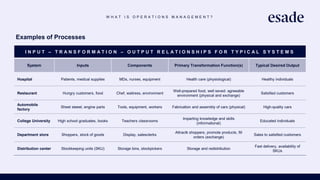
Examples of Processes
I N P U T – T R A N S F O R M A T I O N – O U T P U T R E L A T I O N S H I P S F O R T Y P I C A L S Y S T E M S
System Inputs Components Primary Transformation Function(s) Typical Desired Output
Hospital Patients, medical supplies MDs, nurses, equipment Health care (physiological) Healthy individuals
Restaurant Hungry customers, food Chef, waitress, environment
Well-prepared food, well seved: agreeable
environment (physical and exchange)
Satisfied customers
Automobile
factory
Sheet steeel, engine parts Tools, equipment, workers Fabrication and assembly of cars (physical) High-quality cars
College University High school graduates, books Teachers classrooms
Imparting knowledge and skills
(informational)
Educated individuals
Department store Shoppers, stock of goods Display, salesclerks
Attractk shoppers, promote products, fill
orders (exchange)
Sales to satisfied customers
Distribution center Stockkeeping units (SKU) Storage bins, stockpickers Storage and redistribution
Fast delivery, availability of
SKUs
W H A T I S O P E R A T I O N S M A N A G E M E N T ?
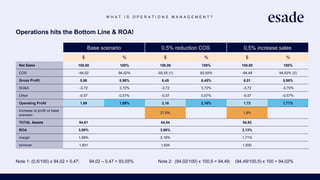
Operations hits the Bottom Line & ROA!
Base scenario 0,5% reduction COS 0,5% increase sales
$ % $ % $ %
Net Sales 100,00 100% 100,00 100% 100,50 100%
COS -94,02 94,02% -93,55 (1) 93,55% -94,49 94,02% (2)
Gross Profit 5,98 5,98% 6,45 6,45% 6,01 5,98%
SG&A -3,72 3,72% -3,72 3,72% -3,72 -3,70%
Other -0,57 0,57% -0,57 0,57% -0,57 -0,57%
Operating Profit 1,69 1,69% 2,16 2,16% 1,72 1,71%
Increase ot profit vs base
scenario
27,8% 1,8%
TOTAL Assets 54,61 54,54 54,92
ROA 3,09% 3,96% 3,13%
margin 1,69% 2,16% 1,71%
turnover 1,831 1,834 1,830
Note 1: (0,5/100) x 94,02 = 0,47; 94,02 – 0,47 = 93,55% Note 2: (94,02/100) x 100,5 = 94,49; (94,49/100,5) x 100 = 94,02%
W H A T I S O P E R A T I O N S M A N A G E M E N T ?
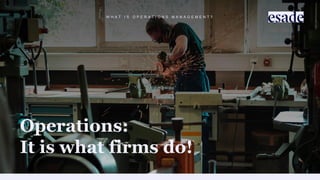
Operations:
It is what firms do!
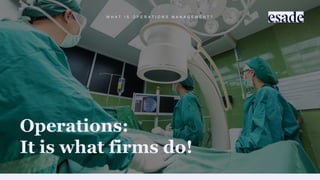
W H A T I S O P E R A T I O N S M A N A G E M E N T ?
Operations:
It is what firms do!
W H A T I S O P E R A T I O N S M A N A G E M E N T ?
Operations:
It is what firms do!
Operations:
It is what firms do!
W H A T I S O P E R A T I O N S M A N A G E M E N T ?
Operations:
It is what firms do!
W H A T I S O P E R A T I O N S M A N A G E M E N T ?
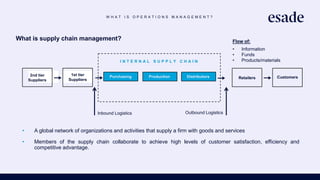
What is supply chain management?
2nd tier
Suppliers
1st tier
Suppliers
Purchasing
Flow of:
• Information
• Funds
• Products/materials
I N T E R N A L S U P P L Y C H A I N
Production Distributors Retailers Customers
Inbound Logistics Outbound Logistics
• A global network of organizations and activities that supply a firm with goods and services
• Members of the supply chain collaborate to achieve high levels of customer satisfaction, efficiency and
competitive advantage.
2
Operations Strategy as support to Company
Strategy and in relation to other functional
strategies
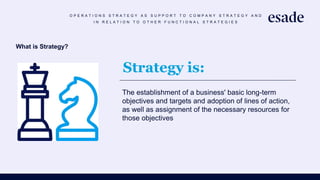
Strategy is:
The establishment of a business' basic long-term
objectives and targets and adoption of lines of action,
as well as assignment of the necessary resources for
those objectives
What is Strategy?
O P E R A T I O N S S T R A T E G Y A S S U P P O R T T O C O M P A N Y S T R A T E G Y A N D
I N R E L A T I O N T O O T H E R F U N C T I O N A L S T R A T E G I E S
O P E R A T I O N S S T R A T E G Y A S S U P P O R T T O C O M P A N Y S T R A T E G Y A N D
I N R E L A T I O N T O O T H E R F U N C T I O N A L S T R A T E G I E S
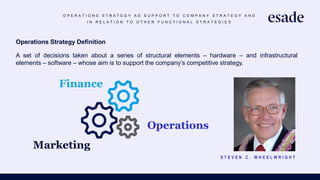
Operations Strategy Definition
A set of decisions taken about a series of structural elements – hardware – and infrastructural
elements – software – whose aim is to support the company’s competitive strategy.
Finance
Marketing
Operations
S T E V E N C . W H E E L W R I G H T
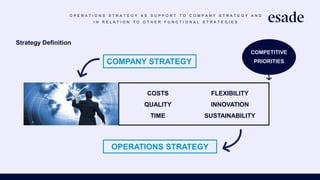
Strategy Definition
COMPANY STRATEGY
OPERATIONS STRATEGY
COSTS
QUALITY
TIME
FLEXIBILITY
INNOVATION
SUSTAINABILITY
COMPETITIVE
PRIORITIES
O P E R A T I O N S S T R A T E G Y A S S U P P O R T T O C O M P A N Y S T R A T E G Y A N D
I N R E L A T I O N T O O T H E R F U N C T I O N A L S T R A T E G I E S
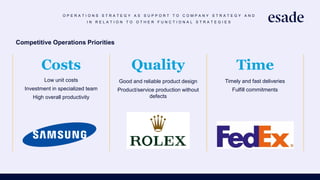
Competitive Operations Priorities
Costs Quality Time
Low unit costs
Investment in specialized team
High overall productivity
Good and reliable product design
Product/service production without
defects
Timely and fast deliveries
Fulfill commitments
O P E R A T I O N S S T R A T E G Y A S S U P P O R T T O C O M P A N Y S T R A T E G Y A N D
I N R E L A T I O N T O O T H E R F U N C T I O N A L S T R A T E G I E S
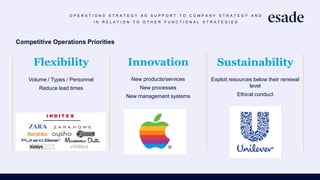
Competitive Operations Priorities
Flexibility Innovation Sustainability
Volume / Types / Personnel
Reduce lead times
New products/services
New processes
New management systems
Exploit resources below their renewal
level
Ethical conduct
O P E R A T I O N S S T R A T E G Y A S S U P P O R T T O C O M P A N Y S T R A T E G Y A N D
I N R E L A T I O N T O O T H E R F U N C T I O N A L S T R A T E G I E S
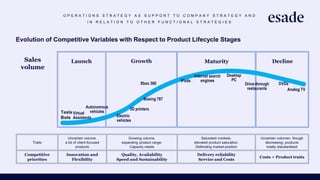
Evolution of Competitive Variables with Respect to Product Lifecycle Stages
O P E R A T I O N S S T R A T E G Y A S S U P P O R T T O C O M P A N Y S T R A T E G Y A N D
I N R E L A T I O N T O O T H E R F U N C T I O N A L S T R A T E G I E S
Virtual
Assistents Electric
vehicles
3D printers
Analog TV
Autonomous
vehicles
Boeing 787
DVDs
iPods
Xbox 360
Internet search
engines
Desktop
PC
Drive-through
restaurants
Launch Growth Maturity Decline
Sales
volume
Traits
Uncertain volume,
a lot of client-focused
products
Growing volume,
expanding product range.
Capacity needs
Saturated markets,
elevated product saturation.
Defending market position
Uncertain volumen, though
decreasing; products
totally standardized
Competitive
priorities
Innovation and
Flexibility
Quality, Availability
Speed and Sustainability
Delivery reliability
Service and Costs
Costs + Product traits
Tesla
Bots
O P E R A T I O N S S T R A T E G Y A S S U P P O R T T O C O M P A N Y S T R A T E G Y A N D
I N R E L A T I O N T O O T H E R F U N C T I O N A L S T R A T E G I E S
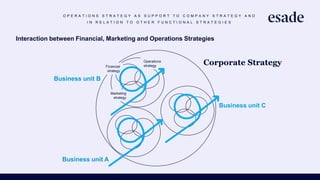
Interaction between Financial, Marketing and Operations Strategies
Financial
strategy
Operations
strategy
Marketing
strategy
Business unit B
Business unit C
Corporate Strategy
Business unit A
O P E R A T I O N S S T R A T E G Y A S S U P P O R T T O C O M P A N Y S T R A T E G Y A N D
I N R E L A T I O N T O O T H E R F U N C T I O N A L S T R A T E G I E S
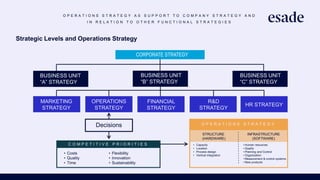
Strategic Levels and Operations Strategy
CORPORATE STRATEGY
BUSINESS UNIT
“A” STRATEGY
BUSINESS UNIT
“B” STRATEGY
BUSINESS UNIT
“C” STRATEGY
MARKETING
STRATEGY
OPERATIONS
STRATEGY
FINANCIAL
STRATEGY
R&D
STRATEGY
HR STRATEGY
Decisions
C O M P E T I T I V E P R I O R I T I E S
• Costs
• Quality
• Time
• Flexibility
• Innovation
• Sustainability
O P E R A T I O N S S T R A T E G Y
STRUCTURE
(HARDWARE)
INFRASTRUCTURE
(SOFTWARE)
• Capacity
• Location
• Process design
• Vertical integration
• Human resources
• Quality
• Planning and Control
• Organization
• Measurement & control systems
• New products
O P E R A T I O N S S T R A T E G Y A S S U P P O R T T O C O M P A N Y S T R A T E G Y A N D
I N R E L A T I O N T O O T H E R F U N C T I O N A L S T R A T E G I E S
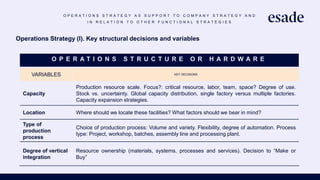
Operations Strategy (I). Key structural decisions and variables
O P E R A T I O N S S T R U C T U R E O R H A R D W A R E
VARIABLES KEY DECISIONS
Capacity
Production resource scale. Focus?: critical resource, labor, team, space? Degree of use.
Stock vs. uncertainty. Global capacity distribution, single factory versus multiple factories.
Capacity expansion strategies.
Location Where should we locate these facilities? What factors should we bear in mind?
Type of
production
process
Choice of production process: Volume and variety. Flexibility, degree of automation. Process
type: Project, workshop, batches, assembly line and processing plant.
Degree of vertical
integration
Resource ownership (materials, systems, processes and services). Decision to “Make or
Buy”
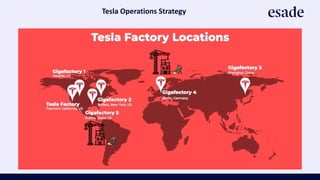
Tesla Operations Strategy
O P E R A T I O N S S T R A T E G Y A S S U P P O R T T O C O M P A N Y S T R A T E G Y A N D
I N R E L A T I O N T O O T H E R F U N C T I O N A L S T R A T E G I E S
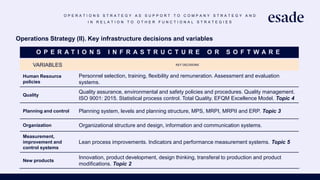
Operations Strategy (II). Key infrastructure decisions and variables
O P E R A T I O N S I N F R A S T R U C T U R E O R S O F T W A R E
VARIABLES KEY DECISIONS
Human Resource
policies
Personnel selection, training, flexibility and remuneration. Assessment and evaluation
systems.
Quality
Quality assurance, environmental and safety policies and procedures. Quality management.
ISO 9001: 2015. Statistical process control. Total Quality. EFQM Excellence Model. Topic 4
Planning and control Planning system, levels and planning structure, MPS, MRPI, MRPII and ERP. Topic 3
Organization Organizational structure and design, information and communication systems.
Measurement,
improvement and
control systems
Lean process improvements. Indicators and performance measurement systems. Topic 5
New products
Innovation, product development, design thinking, transferal to production and product
modifications. Topic 2
O P E R A T I O N S S T R A T E G Y A S S U P P O R T T O C O M P A N Y S T R A T E G Y A N D
I N R E L A T I O N T O O T H E R F U N C T I O N A L S T R A T E G I E S
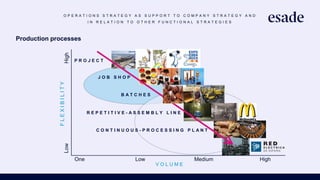
Production processes
High
F
L
E
X
I
B
I
L
I
T
Y
Low
One Low Medium High
V O L U M E
P R O J E C T
J O B S H O P
B A T C H E S
R E P E T I T I V E - A S S E M B L Y L I N E
C O N T I N U O U S - P R O C E S S I N G P L A N T
O P E R A T I O N S S T R A T E G Y A S S U P P O R T T O C O M P A N Y S T R A T E G Y A N D
I N R E L A T I O N T O O T H E R F U N C T I O N A L S T R A T E G I E S
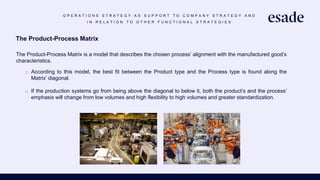
The Product-Process Matrix
The Product-Process Matrix is a model that describes the chosen process’ alignment with the manufactured good’s
characteristics.
o According to this model, the best fit between the Product type and the Process type is found along the
Matrix’ diagonal.
o If the production systems go from being above the diagonal to below it, both the product’s and the process’
emphasis will change from low volumes and high flexibility to high volumes and greater standardization.
O P E R A T I O N S S T R A T E G Y A S S U P P O R T T O C O M P A N Y S T R A T E G Y A N D
I N R E L A T I O N T O O T H E R F U N C T I O N A L S T R A T E G I E S
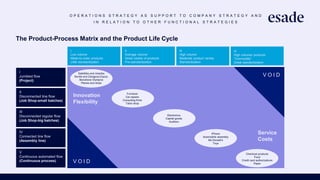
The Product-Process Matrix and the Product Life Cycle
a
I
Jumbled flow
(Project)
II
Disconnected line flow
(Job Shop-small batches)
III
Disconnected regular flow
(Job Shop-big batches)
IV
Connected line flow
(Assembly line)
V
Continuous automated flow
(Continuous process)
I
Low volume
Made-to-order products
Little standardization
II
Average volume
Great variety of products
Pre-standardization
III
High volume
Moderate product variety
Standardization
IV
High volumen products
“Commodity”
Great standardization
V O I D
V O I D
Innovation
Flexibility
Service
Costs
Furniture
Car repairs
Consulting firms
Tailor shop
Satellites and missiles
Seville and Zaragoza Expos,
Barcelona Olympics
Planes and ships
Electronics
Capital goods
Auditors
iPhone
Automobile assembly
Mc.Donald’s
Toys
Chemical products
Food
Credit card authorizations
Paper
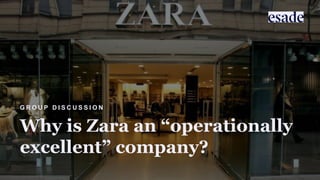
Why is Zara an “operationally
excellent” company?
G R O U P D I S C U S S I O N
3
Globalization of
Operations
G L O B A L I Z A T I O N O F O P E R A T I O N S
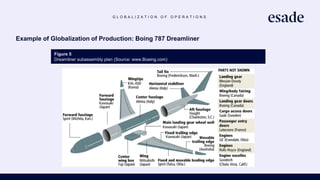
Example of Globalization of Production: Boing 787 Dreamliner
Figure 5
Dreamliner subassembly plan (Source: www.Boeing.com)
G L O B A L I Z A T I O N O F O P E R A T I O N S
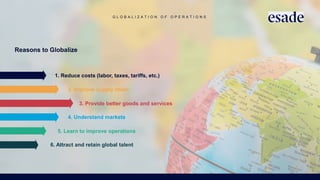
Reasons to Globalize
1. Reduce costs (labor, taxes, tariffs, etc.)
2. Improve supply chain
3. Provide better goods and services
4. Understand markets
5. Learn to improve operations
6. Attract and retain global talent
G L O B A L I Z A T I O N O F O P E R A T I O N S
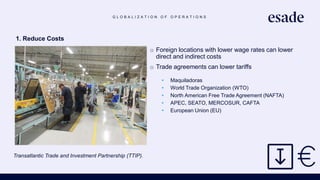
1. Reduce Costs
o Foreign locations with lower wage rates can lower
direct and indirect costs
o Trade agreements can lower tariffs
• Maquiladoras
• World Trade Organization (WTO)
• North American Free Trade Agreement (NAFTA)
• APEC, SEATO, MERCOSUR, CAFTA
• European Union (EU)
Transatlantic Trade and Investment Partnership (TTIP).
https://www.thebalance.com/transatlantic-trade-and-investment-partnership-ttip-3305582
G L O B A L I Z A T I O N O F O P E R A T I O N S
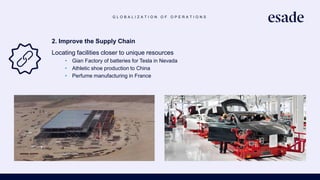
2. Improve the Supply Chain
Locating facilities closer to unique resources
• Gian Factory of batteries for Tesla in Nevada
• Athletic shoe production to China
• Perfume manufacturing in France
G L O B A L I Z A T I O N O F O P E R A T I O N S
3. Improve Products
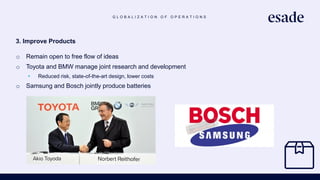
o Remain open to free flow of ideas
o Toyota and BMW manage joint research and development
• Reduced risk, state-of-the-art design, lower costs
o Samsung and Bosch jointly produce batteries
G L O B A L I Z A T I O N O F O P E R A T I O N S
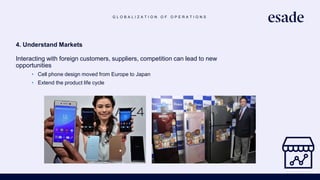
4. Understand Markets
Interacting with foreign customers, suppliers, competition can lead to new
opportunities
• Cell phone design moved from Europe to Japan
• Extend the product life cycle
G L O B A L I Z A T I O N O F O P E R A T I O N S
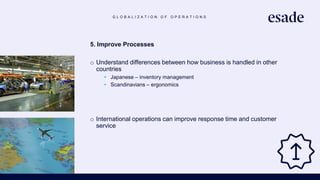
5. Improve Processes
o Understand differences between how business is handled in other
countries
• Japanese – inventory management
• Scandinavians – ergonomics
o International operations can improve response time and customer
service
G L O B A L I Z A T I O N O F O P E R A T I O N S
6. Attract and Retain Global Talent
Offer better employment opportunities
• Better growth opportunities and insulation against unemployment
• Relocate unneeded personnel to more prosperous locations
G L O B A L I Z A T I O N O F O P E R A T I O N S
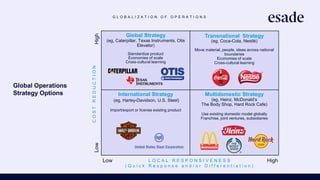
Global Operations
Strategy Options
Global Strategy
(eg, Caterpillar, Texas Instruments, Otis
Elevator)
Standardize product
Economies of scale
Cross-cultural learning
Transnational Strategy
(eg, Coca-Cola, Nestlé)
Move material, people, ideas across national
boundaries
Economies of scale
Cross-cultural learning
International Strategy
(eg, Harley-Davidson, U.S. Steel)
Import/export or license existing product
Multidomestic Strategy
(eg, Heinz, McDonald’s
The Body Shop, Hard Rock Cafe)
Use existing domestic model globally
Franchise, joint ventures, subsidiaries
L O C A L R E S P O N S I V E N E S S
( Q u i c k R e s p o n s e a n d / o r D i f f e r e n t i a t i o n )
Low
High
High
Low
C
O
S
T
R
E
D
U
C
T
I
O
N
G L O B A L I Z A T I O N O F O P E R A T I O N S
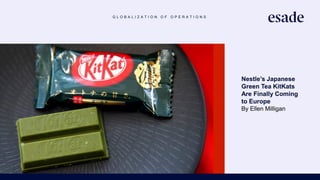
Nestle’s Japanese
Green Tea KitKats
Are Finally Coming
to Europe
By Ellen Milligan
https://www.bloomberg.com/
news/articles/2019-02-
19/nestle-s-taste-of-japan-is-
coming-to-europe-with-kitkat-
launch
G L O B A L I Z A T I O N O F O P E R A T I O N S
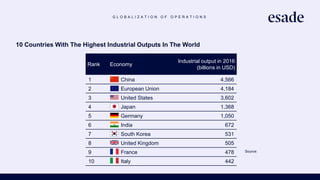
10 Countries With The Highest Industrial Outputs In The World
Rank Economy
Industrial output in 2016
(billions in USD)
1 China 4,566
2 European Union 4,184
3 United States 3,602
4 Japan 1,368
5 Germany 1,050
6 India 672
7 South Korea 531
8 United Kingdom 505
9 France 478
10 Italy 442
Source:
https://www.worldatlas.com/articles/10-
countries-with-the-highest-industrial-
outputs-in-the-world.html
G L O B A L I Z A T I O N O F O P E R A T I O N S
P L E N A R Y D I S C U S S I O N
What advantages and disadvantages
does globalisation pose?
GLOBALIZATION
GOOD OR BAD?
G L O B A L I Z A T I O N O F O P E R A T I O N S
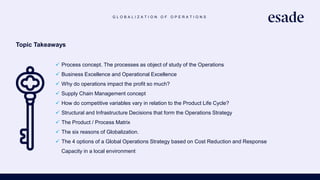
Topic Takeaways
✓ Process concept. The processes as object of study of the Operations
✓ Business Excellence and Operational Excellence
✓ Why do operations impact the profit so much?
✓ Supply Chain Management concept
✓ How do competitive variables vary in relation to the Product Life Cycle?
✓ Structural and Infrastructure Decisions that form the Operations Strategy
✓ The Product / Process Matrix
✓ The six reasons of Globalization.
✓ The 4 options of a Global Operations Strategy based on Cost Reduction and Response
Capacity in a local environment
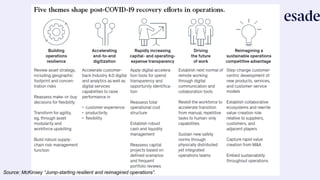
Source: McKinsey “Jump-starting resilient and reimagined operations”.
Topic 1. Operations Management within the Corporate Strategy Framework

Topic 1. Operations Management within the Corporate Strategy Framework

  • 1.
    T O PI C 1 : Operations strategy within the corporate strategy framework. The globalization of Operations B A R C E L O N A , F E B R U A R Y 2 0 2 2 Foundations of Operational Excellence
  • 2.
    L E AR N I N G O B J E C T I V E S : Study Operations Management and operational excellence 1 Define an Operations strategy that supports the general business strategy and is related to other functional area strategies 2 Analyse Operations’ globalisation 3
  • 3.
  • 4.
    O P ER A T I O N S M A N A G E M E N T A N D O P E R A T I O N A L E X C E L L E N C E Definition of Operations Management The term, Operations Management, refers to process design, management, control and improvement, transforming inputs into outputs (either goods or services) for internal or external clients. I N P U T S M A T E R I A L L A B O R C A P I T A L C L I E N T S D A T A Transformation process O U T P U T G O O D S A N D S E R V I C E S C L I E N T S
  • 5.
    O P ER A T I O N S M A N A G E M E N T A N D O P E R A T I O N A L E X C E L L E N C E Definition of “operational excellence” An excellent company is one that stands out for its performance compared to other companies in the same industry. Operational excellence implies fulfilling the business strategy objectives more coherently and reliably than the competition and obtaining better results. Companies can achieve this by designing and implementing excellent processes followed later by their continuous improvement.
  • 6.
    O P ER A T I O N S M A N A G E M E N T A N D O P E R A T I O N A L E X C E L L E N C E Operational Excellence class This class aims to explore the basic pillars of operational excellence which coincide with the infrastructural elements –also known as the “software”– of Operations strategy. These elements are: Innovation, planning, quality management, total quality and environmental quality. The class will also study how to improve processes by means of implementing the Lean and Six Sigma focuses.
  • 7.
    1 2 3 4 5 O P ER A T I O N S M A N A G E M E N T A N D O P E R A T I O N A L E X C E L L E N C E O P E R AT I O N A L E X C E L L E N C E Topic 1 Operations strategy within the business strategy framework. Operations’ globalization. Operational Excellence class Topic 2 Innovation management and Design Thinking. Developing new products. Topic 3 Planning in industrial firms. Topic 4 Quality, quality management and total quality. Topic 5 Lean Manufacturing and Lean Services.
  • 8.
    Continuous process improvement / Defect-typewaste Product structures or BOM Impact on costs, flexibility, quality and sustainability Priorities: Costs and flexibility Topic 2 Innovation management and Design Thinking Topic 3 Planning in industrial companies Topic 4 Quality, quality management, total quality and sustainability Foundations of Operational Excellence: Outline Priorities: Time / Service Priorities: Quality and sustainability Priority: Innovation Capacity / Changeover cost / Lead Times / MPS Impact on costs and innovation Impact on costs and flexibility Impact on quality and service Topic 1 Operations strategy within the business strategy context. Operations’ globalization Topic 5 Lean Manufacturing and Lean Services
  • 9.
    W H AT I S O P E R A T I O N S M A N A G E M E N T ? Examples of Processes I N P U T – T R A N S F O R M A T I O N – O U T P U T R E L A T I O N S H I P S F O R T Y P I C A L S Y S T E M S System Inputs Components Primary Transformation Function(s) Typical Desired Output Hospital Patients, medical supplies MDs, nurses, equipment Health care (physiological) Healthy individuals Restaurant Hungry customers, food Chef, waitress, environment Well-prepared food, well seved: agreeable environment (physical and exchange) Satisfied customers Automobile factory Sheet steeel, engine parts Tools, equipment, workers Fabrication and assembly of cars (physical) High-quality cars College University High school graduates, books Teachers classrooms Imparting knowledge and skills (informational) Educated individuals Department store Shoppers, stock of goods Display, salesclerks Attractk shoppers, promote products, fill orders (exchange) Sales to satisfied customers Distribution center Stockkeeping units (SKU) Storage bins, stockpickers Storage and redistribution Fast delivery, availability of SKUs
  • 10.
    W H AT I S O P E R A T I O N S M A N A G E M E N T ? Operations hits the Bottom Line & ROA! Base scenario 0,5% reduction COS 0,5% increase sales $ % $ % $ % Net Sales 100,00 100% 100,00 100% 100,50 100% COS -94,02 94,02% -93,55 (1) 93,55% -94,49 94,02% (2) Gross Profit 5,98 5,98% 6,45 6,45% 6,01 5,98% SG&A -3,72 3,72% -3,72 3,72% -3,72 -3,70% Other -0,57 0,57% -0,57 0,57% -0,57 -0,57% Operating Profit 1,69 1,69% 2,16 2,16% 1,72 1,71% Increase ot profit vs base scenario 27,8% 1,8% TOTAL Assets 54,61 54,54 54,92 ROA 3,09% 3,96% 3,13% margin 1,69% 2,16% 1,71% turnover 1,831 1,834 1,830 Note 1: (0,5/100) x 94,02 = 0,47; 94,02 – 0,47 = 93,55% Note 2: (94,02/100) x 100,5 = 94,49; (94,49/100,5) x 100 = 94,02%
  • 11.
    W H AT I S O P E R A T I O N S M A N A G E M E N T ? Operations: It is what firms do!
  • 12.
    W H AT I S O P E R A T I O N S M A N A G E M E N T ? Operations: It is what firms do!
  • 13.
    W H AT I S O P E R A T I O N S M A N A G E M E N T ? Operations: It is what firms do!
  • 14.
    Operations: It is whatfirms do! W H A T I S O P E R A T I O N S M A N A G E M E N T ?
  • 15.
    Operations: It is whatfirms do! W H A T I S O P E R A T I O N S M A N A G E M E N T ?
  • 16.
    W H AT I S O P E R A T I O N S M A N A G E M E N T ? What is supply chain management? 2nd tier Suppliers 1st tier Suppliers Purchasing Flow of: • Information • Funds • Products/materials I N T E R N A L S U P P L Y C H A I N Production Distributors Retailers Customers Inbound Logistics Outbound Logistics • A global network of organizations and activities that supply a firm with goods and services • Members of the supply chain collaborate to achieve high levels of customer satisfaction, efficiency and competitive advantage.
  • 17.
    2 Operations Strategy assupport to Company Strategy and in relation to other functional strategies
  • 18.
    Strategy is: The establishmentof a business' basic long-term objectives and targets and adoption of lines of action, as well as assignment of the necessary resources for those objectives What is Strategy? O P E R A T I O N S S T R A T E G Y A S S U P P O R T T O C O M P A N Y S T R A T E G Y A N D I N R E L A T I O N T O O T H E R F U N C T I O N A L S T R A T E G I E S
  • 19.
    O P ER A T I O N S S T R A T E G Y A S S U P P O R T T O C O M P A N Y S T R A T E G Y A N D I N R E L A T I O N T O O T H E R F U N C T I O N A L S T R A T E G I E S Operations Strategy Definition A set of decisions taken about a series of structural elements – hardware – and infrastructural elements – software – whose aim is to support the company’s competitive strategy. Finance Marketing Operations S T E V E N C . W H E E L W R I G H T
  • 20.
    Strategy Definition COMPANY STRATEGY OPERATIONSSTRATEGY COSTS QUALITY TIME FLEXIBILITY INNOVATION SUSTAINABILITY COMPETITIVE PRIORITIES O P E R A T I O N S S T R A T E G Y A S S U P P O R T T O C O M P A N Y S T R A T E G Y A N D I N R E L A T I O N T O O T H E R F U N C T I O N A L S T R A T E G I E S
  • 21.
    Competitive Operations Priorities CostsQuality Time Low unit costs Investment in specialized team High overall productivity Good and reliable product design Product/service production without defects Timely and fast deliveries Fulfill commitments O P E R A T I O N S S T R A T E G Y A S S U P P O R T T O C O M P A N Y S T R A T E G Y A N D I N R E L A T I O N T O O T H E R F U N C T I O N A L S T R A T E G I E S
  • 22.
    Competitive Operations Priorities FlexibilityInnovation Sustainability Volume / Types / Personnel Reduce lead times New products/services New processes New management systems Exploit resources below their renewal level Ethical conduct O P E R A T I O N S S T R A T E G Y A S S U P P O R T T O C O M P A N Y S T R A T E G Y A N D I N R E L A T I O N T O O T H E R F U N C T I O N A L S T R A T E G I E S
  • 23.
    Evolution of CompetitiveVariables with Respect to Product Lifecycle Stages O P E R A T I O N S S T R A T E G Y A S S U P P O R T T O C O M P A N Y S T R A T E G Y A N D I N R E L A T I O N T O O T H E R F U N C T I O N A L S T R A T E G I E S Virtual Assistents Electric vehicles 3D printers Analog TV Autonomous vehicles Boeing 787 DVDs iPods Xbox 360 Internet search engines Desktop PC Drive-through restaurants Launch Growth Maturity Decline Sales volume Traits Uncertain volume, a lot of client-focused products Growing volume, expanding product range. Capacity needs Saturated markets, elevated product saturation. Defending market position Uncertain volumen, though decreasing; products totally standardized Competitive priorities Innovation and Flexibility Quality, Availability Speed and Sustainability Delivery reliability Service and Costs Costs + Product traits Tesla Bots
  • 24.
    O P ER A T I O N S S T R A T E G Y A S S U P P O R T T O C O M P A N Y S T R A T E G Y A N D I N R E L A T I O N T O O T H E R F U N C T I O N A L S T R A T E G I E S Interaction between Financial, Marketing and Operations Strategies Financial strategy Operations strategy Marketing strategy Business unit B Business unit C Corporate Strategy Business unit A
  • 25.
    O P ER A T I O N S S T R A T E G Y A S S U P P O R T T O C O M P A N Y S T R A T E G Y A N D I N R E L A T I O N T O O T H E R F U N C T I O N A L S T R A T E G I E S Strategic Levels and Operations Strategy CORPORATE STRATEGY BUSINESS UNIT “A” STRATEGY BUSINESS UNIT “B” STRATEGY BUSINESS UNIT “C” STRATEGY MARKETING STRATEGY OPERATIONS STRATEGY FINANCIAL STRATEGY R&D STRATEGY HR STRATEGY Decisions C O M P E T I T I V E P R I O R I T I E S • Costs • Quality • Time • Flexibility • Innovation • Sustainability O P E R A T I O N S S T R A T E G Y STRUCTURE (HARDWARE) INFRASTRUCTURE (SOFTWARE) • Capacity • Location • Process design • Vertical integration • Human resources • Quality • Planning and Control • Organization • Measurement & control systems • New products
  • 26.
    O P ER A T I O N S S T R A T E G Y A S S U P P O R T T O C O M P A N Y S T R A T E G Y A N D I N R E L A T I O N T O O T H E R F U N C T I O N A L S T R A T E G I E S Operations Strategy (I). Key structural decisions and variables O P E R A T I O N S S T R U C T U R E O R H A R D W A R E VARIABLES KEY DECISIONS Capacity Production resource scale. Focus?: critical resource, labor, team, space? Degree of use. Stock vs. uncertainty. Global capacity distribution, single factory versus multiple factories. Capacity expansion strategies. Location Where should we locate these facilities? What factors should we bear in mind? Type of production process Choice of production process: Volume and variety. Flexibility, degree of automation. Process type: Project, workshop, batches, assembly line and processing plant. Degree of vertical integration Resource ownership (materials, systems, processes and services). Decision to “Make or Buy”
  • 27.
  • 28.
    O P ER A T I O N S S T R A T E G Y A S S U P P O R T T O C O M P A N Y S T R A T E G Y A N D I N R E L A T I O N T O O T H E R F U N C T I O N A L S T R A T E G I E S Operations Strategy (II). Key infrastructure decisions and variables O P E R A T I O N S I N F R A S T R U C T U R E O R S O F T W A R E VARIABLES KEY DECISIONS Human Resource policies Personnel selection, training, flexibility and remuneration. Assessment and evaluation systems. Quality Quality assurance, environmental and safety policies and procedures. Quality management. ISO 9001: 2015. Statistical process control. Total Quality. EFQM Excellence Model. Topic 4 Planning and control Planning system, levels and planning structure, MPS, MRPI, MRPII and ERP. Topic 3 Organization Organizational structure and design, information and communication systems. Measurement, improvement and control systems Lean process improvements. Indicators and performance measurement systems. Topic 5 New products Innovation, product development, design thinking, transferal to production and product modifications. Topic 2
  • 29.
    O P ER A T I O N S S T R A T E G Y A S S U P P O R T T O C O M P A N Y S T R A T E G Y A N D I N R E L A T I O N T O O T H E R F U N C T I O N A L S T R A T E G I E S Production processes High F L E X I B I L I T Y Low One Low Medium High V O L U M E P R O J E C T J O B S H O P B A T C H E S R E P E T I T I V E - A S S E M B L Y L I N E C O N T I N U O U S - P R O C E S S I N G P L A N T
  • 30.
    O P ER A T I O N S S T R A T E G Y A S S U P P O R T T O C O M P A N Y S T R A T E G Y A N D I N R E L A T I O N T O O T H E R F U N C T I O N A L S T R A T E G I E S The Product-Process Matrix The Product-Process Matrix is a model that describes the chosen process’ alignment with the manufactured good’s characteristics. o According to this model, the best fit between the Product type and the Process type is found along the Matrix’ diagonal. o If the production systems go from being above the diagonal to below it, both the product’s and the process’ emphasis will change from low volumes and high flexibility to high volumes and greater standardization.
  • 31.
    O P ER A T I O N S S T R A T E G Y A S S U P P O R T T O C O M P A N Y S T R A T E G Y A N D I N R E L A T I O N T O O T H E R F U N C T I O N A L S T R A T E G I E S The Product-Process Matrix and the Product Life Cycle a I Jumbled flow (Project) II Disconnected line flow (Job Shop-small batches) III Disconnected regular flow (Job Shop-big batches) IV Connected line flow (Assembly line) V Continuous automated flow (Continuous process) I Low volume Made-to-order products Little standardization II Average volume Great variety of products Pre-standardization III High volume Moderate product variety Standardization IV High volumen products “Commodity” Great standardization V O I D V O I D Innovation Flexibility Service Costs Furniture Car repairs Consulting firms Tailor shop Satellites and missiles Seville and Zaragoza Expos, Barcelona Olympics Planes and ships Electronics Capital goods Auditors iPhone Automobile assembly Mc.Donald’s Toys Chemical products Food Credit card authorizations Paper
  • 32.
    Why is Zaraan “operationally excellent” company? G R O U P D I S C U S S I O N
  • 33.
  • 34.
    G L OB A L I Z A T I O N O F O P E R A T I O N S Example of Globalization of Production: Boing 787 Dreamliner Figure 5 Dreamliner subassembly plan (Source: www.Boeing.com)
  • 35.
    G L OB A L I Z A T I O N O F O P E R A T I O N S Reasons to Globalize 1. Reduce costs (labor, taxes, tariffs, etc.) 2. Improve supply chain 3. Provide better goods and services 4. Understand markets 5. Learn to improve operations 6. Attract and retain global talent
  • 36.
    G L OB A L I Z A T I O N O F O P E R A T I O N S 1. Reduce Costs o Foreign locations with lower wage rates can lower direct and indirect costs o Trade agreements can lower tariffs • Maquiladoras • World Trade Organization (WTO) • North American Free Trade Agreement (NAFTA) • APEC, SEATO, MERCOSUR, CAFTA • European Union (EU) Transatlantic Trade and Investment Partnership (TTIP). https://www.thebalance.com/transatlantic-trade-and-investment-partnership-ttip-3305582
  • 37.
    G L OB A L I Z A T I O N O F O P E R A T I O N S 2. Improve the Supply Chain Locating facilities closer to unique resources • Gian Factory of batteries for Tesla in Nevada • Athletic shoe production to China • Perfume manufacturing in France
  • 38.
    G L OB A L I Z A T I O N O F O P E R A T I O N S 3. Improve Products o Remain open to free flow of ideas o Toyota and BMW manage joint research and development • Reduced risk, state-of-the-art design, lower costs o Samsung and Bosch jointly produce batteries
  • 39.
    G L OB A L I Z A T I O N O F O P E R A T I O N S 4. Understand Markets Interacting with foreign customers, suppliers, competition can lead to new opportunities • Cell phone design moved from Europe to Japan • Extend the product life cycle
  • 40.
    G L OB A L I Z A T I O N O F O P E R A T I O N S 5. Improve Processes o Understand differences between how business is handled in other countries • Japanese – inventory management • Scandinavians – ergonomics o International operations can improve response time and customer service
  • 41.
    G L OB A L I Z A T I O N O F O P E R A T I O N S 6. Attract and Retain Global Talent Offer better employment opportunities • Better growth opportunities and insulation against unemployment • Relocate unneeded personnel to more prosperous locations
  • 42.
    G L OB A L I Z A T I O N O F O P E R A T I O N S Global Operations Strategy Options Global Strategy (eg, Caterpillar, Texas Instruments, Otis Elevator) Standardize product Economies of scale Cross-cultural learning Transnational Strategy (eg, Coca-Cola, Nestlé) Move material, people, ideas across national boundaries Economies of scale Cross-cultural learning International Strategy (eg, Harley-Davidson, U.S. Steel) Import/export or license existing product Multidomestic Strategy (eg, Heinz, McDonald’s The Body Shop, Hard Rock Cafe) Use existing domestic model globally Franchise, joint ventures, subsidiaries L O C A L R E S P O N S I V E N E S S ( Q u i c k R e s p o n s e a n d / o r D i f f e r e n t i a t i o n ) Low High High Low C O S T R E D U C T I O N
  • 43.
    G L OB A L I Z A T I O N O F O P E R A T I O N S
  • 44.
    G L OB A L I Z A T I O N O F O P E R A T I O N S Nestle’s Japanese Green Tea KitKats Are Finally Coming to Europe By Ellen Milligan https://www.bloomberg.com/ news/articles/2019-02- 19/nestle-s-taste-of-japan-is- coming-to-europe-with-kitkat- launch
  • 45.
    G L OB A L I Z A T I O N O F O P E R A T I O N S 10 Countries With The Highest Industrial Outputs In The World Rank Economy Industrial output in 2016 (billions in USD) 1 China 4,566 2 European Union 4,184 3 United States 3,602 4 Japan 1,368 5 Germany 1,050 6 India 672 7 South Korea 531 8 United Kingdom 505 9 France 478 10 Italy 442 Source: https://www.worldatlas.com/articles/10- countries-with-the-highest-industrial- outputs-in-the-world.html
  • 46.
    G L OB A L I Z A T I O N O F O P E R A T I O N S P L E N A R Y D I S C U S S I O N What advantages and disadvantages does globalisation pose? GLOBALIZATION GOOD OR BAD?
  • 47.
    G L OB A L I Z A T I O N O F O P E R A T I O N S Topic Takeaways ✓ Process concept. The processes as object of study of the Operations ✓ Business Excellence and Operational Excellence ✓ Why do operations impact the profit so much? ✓ Supply Chain Management concept ✓ How do competitive variables vary in relation to the Product Life Cycle? ✓ Structural and Infrastructure Decisions that form the Operations Strategy ✓ The Product / Process Matrix ✓ The six reasons of Globalization. ✓ The 4 options of a Global Operations Strategy based on Cost Reduction and Response Capacity in a local environment
  • 48.
    Source: McKinsey “Jump-startingresilient and reimagined operations”.