Ray Fagan
Interview Presentation – Delivery of a Strategic Business Review
Ray Fagan
1
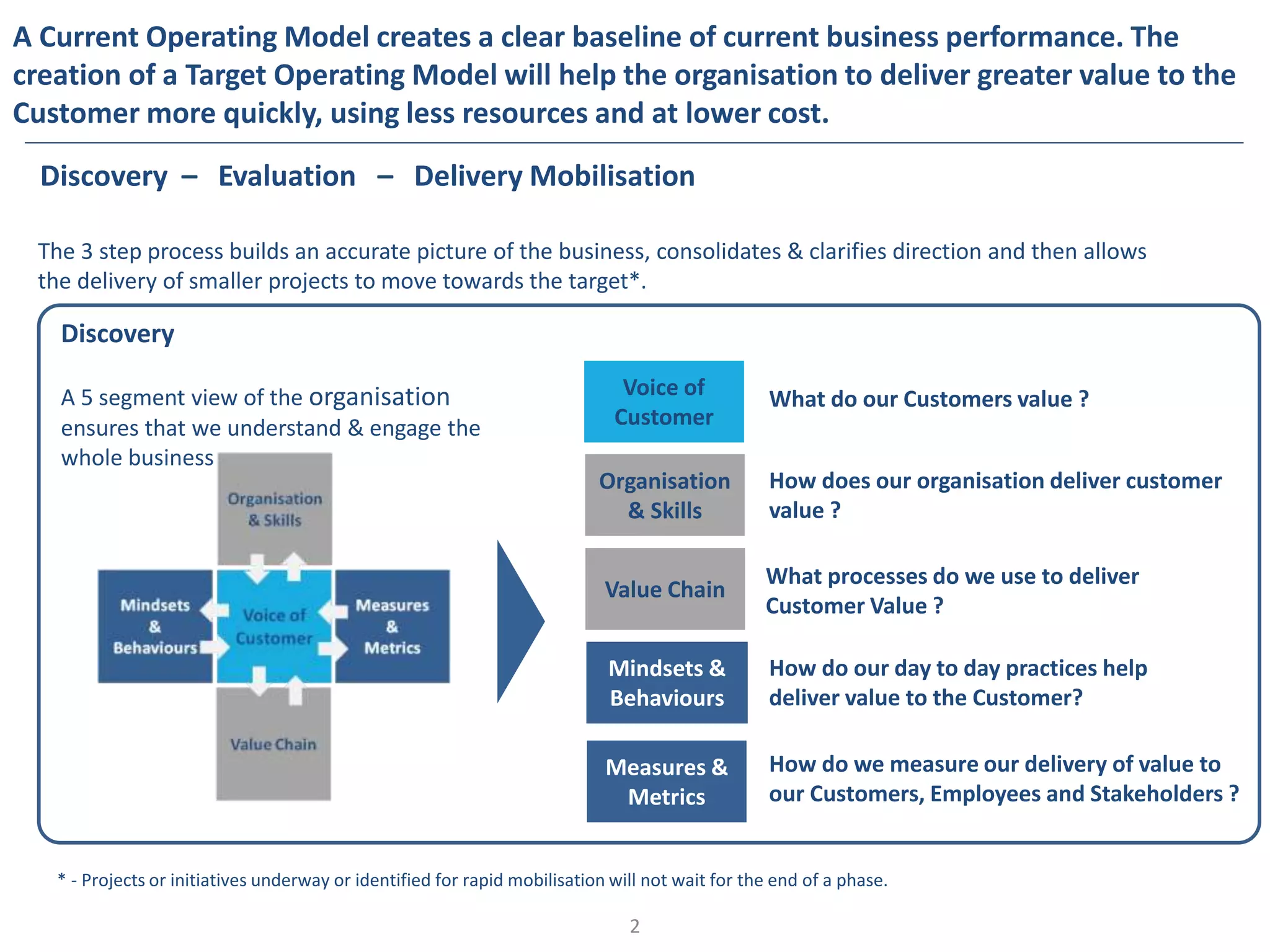
A Current Operating Model creates a clear baseline of current business performance. The
creation of a Target Operating Model will help the organisation to deliver greater value to the
Customer more quickly, using less resources and at lower cost.
The 3 step process builds an accurate picture of the business, consolidates & clarifies direction and then allows
the delivery of smaller projects to move towards the target*.
Voice of
Customer
What do our Customers value ?
Organisation
& Skills
How does our organisation deliver customer
value ?
Value Chain
What processes do we use to deliver
Customer Value ?
Mindsets &
Behaviours
How do our day to day practices help
deliver value to the Customer?
Measures &
Metrics
How do we measure our delivery of value to
our Customers, Employees and Stakeholders ?
A 5 segment view of the organisation
ensures that we understand & engage the
whole business
Discovery
Discovery – Evaluation Delivery Mobilisation–
* - Projects or initiatives underway or identified for rapid mobilisation will not wait for the end of a phase.
2
Discovery – Evaluation
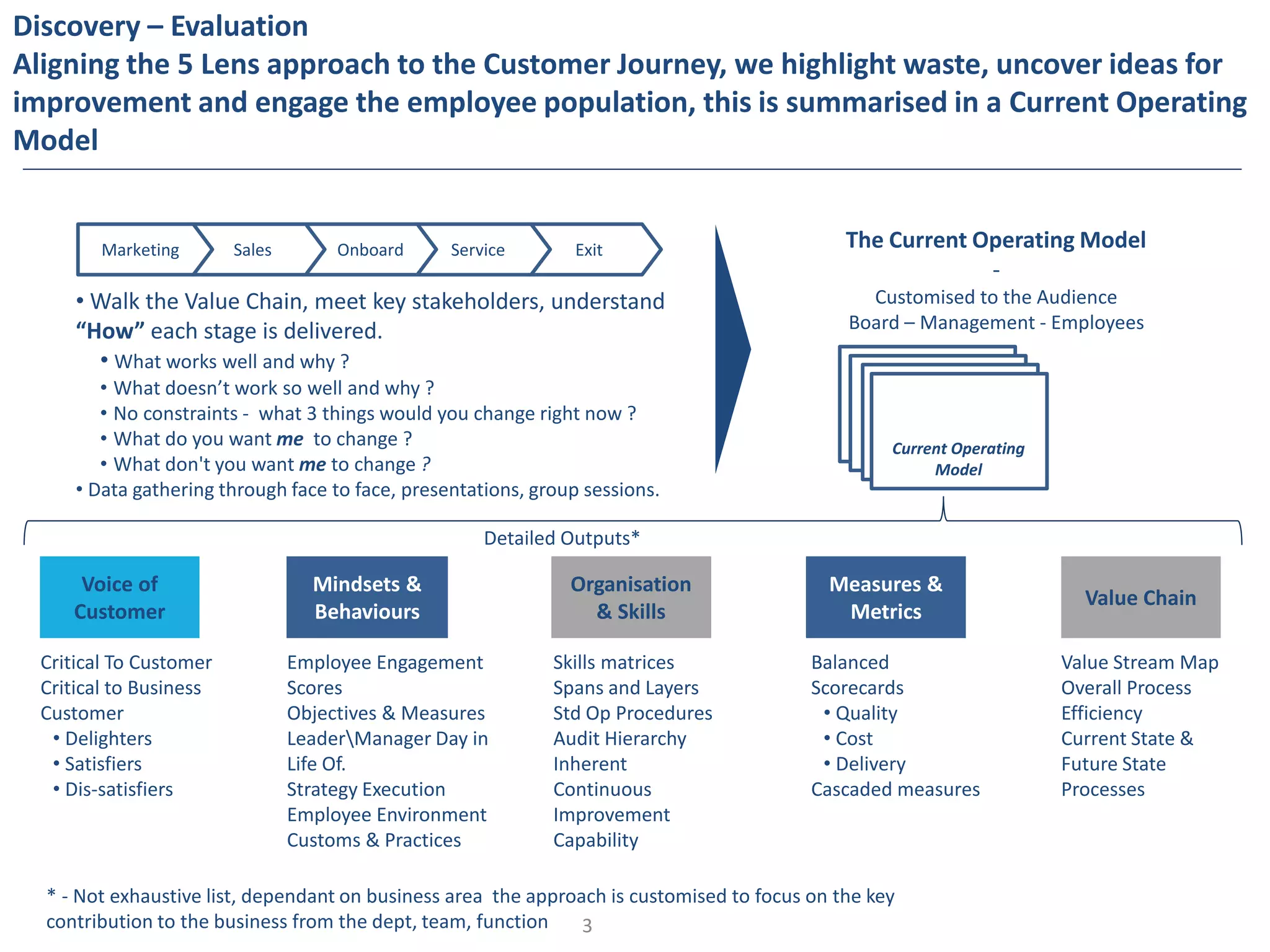
Aligning the 5 Lens approach to the Customer Journey, we highlight waste, uncover ideas for
improvement and engage the employee population, this is summarised in a Current Operating
Model
ExitServiceOnboardSalesMarketing
• Walk the Value Chain, meet key stakeholders, understand
“How” each stage is delivered.
• What works well and why ?
• What doesn’t work so well and why ?
• No constraints - what 3 things would you change right now ?
• What do you want me to change ?
• What don't you want me to change ?
• Data gathering through face to face, presentations, group sessions.
Current Operating
Model
The Current Operating Model
-
Customised to the Audience
Board – Management - Employees
Voice of
Customer
Organisation
& Skills
Value Chain
Mindsets &
Behaviours
Measures &
Metrics
Critical To Customer
Critical to Business
Customer
• Delighters
• Satisfiers
• Dis-satisfiers
Employee Engagement
Scores
Objectives & Measures
LeaderManager Day in
Life Of.
Strategy Execution
Employee Environment
Customs & Practices
Skills matrices
Spans and Layers
Std Op Procedures
Audit Hierarchy
Inherent
Continuous
Improvement
Capability
Balanced
Scorecards
• Quality
• Cost
• Delivery
Cascaded measures
Value Stream Map
Overall Process
Efficiency
Current State &
Future State
Processes
Detailed Outputs*
* - Not exhaustive list, dependant on business area the approach is customised to focus on the key
contribution to the business from the dept, team, function 3
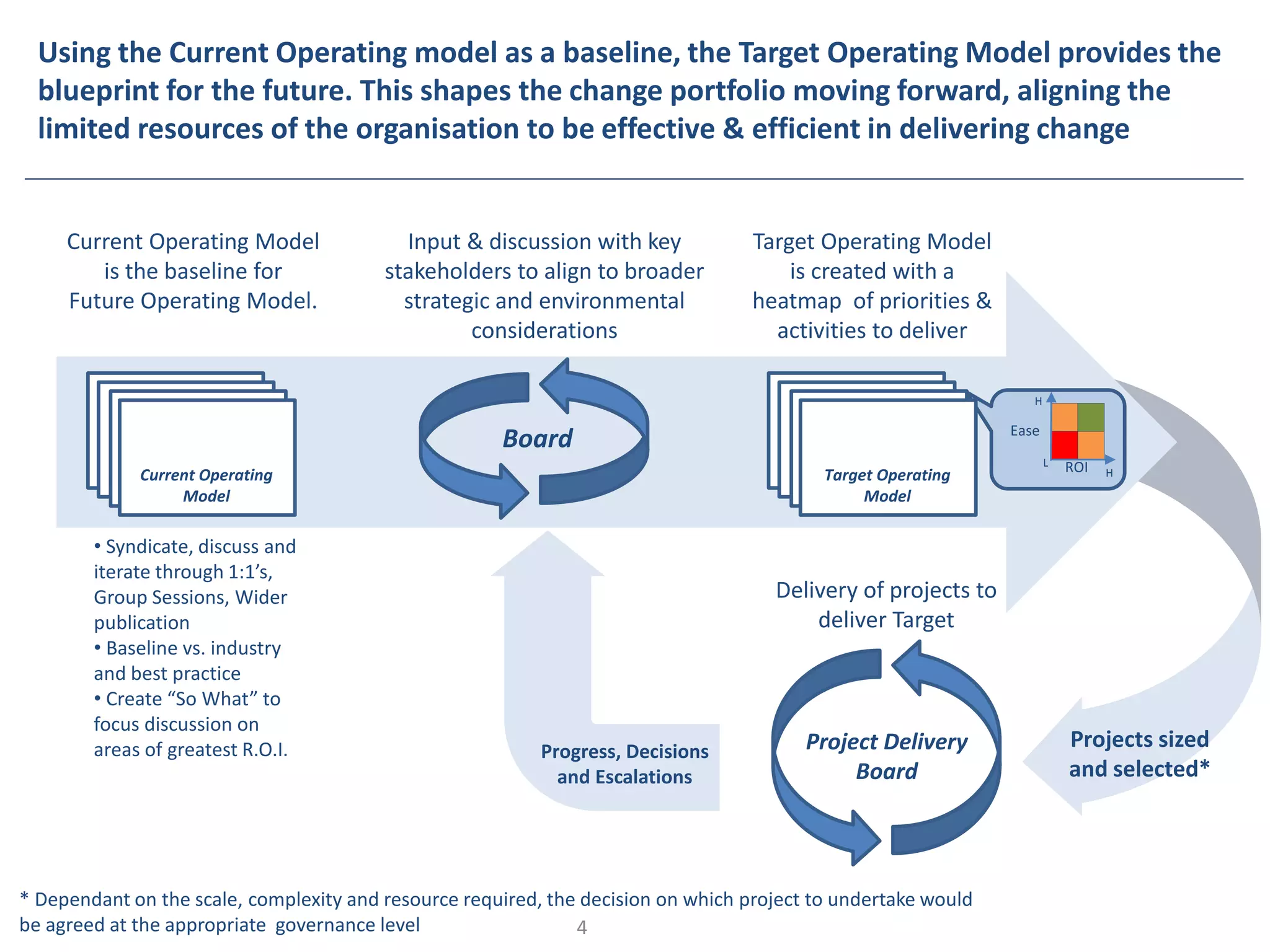
Using the Current Operating model as a baseline, the Target Operating Model provides the
blueprint for the future. This shapes the change portfolio moving forward, aligning the
limited resources of the organisation to be effective & efficient in delivering change
Delivery of projects to
deliver Target
Project Delivery
Board
Projects sized
and selected*
* Dependant on the scale, complexity and resource required, the decision on which project to undertake would
be agreed at the appropriate governance level
Progress, Decisions
and Escalations
• Syndicate, discuss and
iterate through 1:1’s,
Group Sessions, Wider
publication
• Baseline vs. industry
and best practice
• Create “So What” to
focus discussion on
areas of greatest R.O.I.
Current Operating Model
is the baseline for
Future Operating Model.
Input & discussion with key
stakeholders to align to broader
strategic and environmental
considerations
Target Operating Model
is created with a
heatmap of priorities &
activities to deliver
Current Operating
Model
Target Operating
Model
Board Ease
ROI
H
H
L
4
Assumptions
• Co. Name are a successful and profitable business, there is no need for crisis management or
transformational change.
– Co. Name have done this by responding to demands of their customers through product quality and service.
• Co. Name currently do not have a consolidated & documented current or future business
operating model.
– There is a recognised need to baseline the current business in terms of process, the customer journey, the supply
chain and supporting business functions.
• There is an appetite for improvement activity to become part of the daily business cycle
within Co. Name.
5

Strat Review Apr 16

  • 1.
    Ray Fagan Interview Presentation– Delivery of a Strategic Business Review Ray Fagan 1
  • 2.
    A Current OperatingModel creates a clear baseline of current business performance. The creation of a Target Operating Model will help the organisation to deliver greater value to the Customer more quickly, using less resources and at lower cost. The 3 step process builds an accurate picture of the business, consolidates & clarifies direction and then allows the delivery of smaller projects to move towards the target*. Voice of Customer What do our Customers value ? Organisation & Skills How does our organisation deliver customer value ? Value Chain What processes do we use to deliver Customer Value ? Mindsets & Behaviours How do our day to day practices help deliver value to the Customer? Measures & Metrics How do we measure our delivery of value to our Customers, Employees and Stakeholders ? A 5 segment view of the organisation ensures that we understand & engage the whole business Discovery Discovery – Evaluation Delivery Mobilisation– * - Projects or initiatives underway or identified for rapid mobilisation will not wait for the end of a phase. 2
  • 3.
    Discovery – Evaluation Aligningthe 5 Lens approach to the Customer Journey, we highlight waste, uncover ideas for improvement and engage the employee population, this is summarised in a Current Operating Model ExitServiceOnboardSalesMarketing • Walk the Value Chain, meet key stakeholders, understand “How” each stage is delivered. • What works well and why ? • What doesn’t work so well and why ? • No constraints - what 3 things would you change right now ? • What do you want me to change ? • What don't you want me to change ? • Data gathering through face to face, presentations, group sessions. Current Operating Model The Current Operating Model - Customised to the Audience Board – Management - Employees Voice of Customer Organisation & Skills Value Chain Mindsets & Behaviours Measures & Metrics Critical To Customer Critical to Business Customer • Delighters • Satisfiers • Dis-satisfiers Employee Engagement Scores Objectives & Measures LeaderManager Day in Life Of. Strategy Execution Employee Environment Customs & Practices Skills matrices Spans and Layers Std Op Procedures Audit Hierarchy Inherent Continuous Improvement Capability Balanced Scorecards • Quality • Cost • Delivery Cascaded measures Value Stream Map Overall Process Efficiency Current State & Future State Processes Detailed Outputs* * - Not exhaustive list, dependant on business area the approach is customised to focus on the key contribution to the business from the dept, team, function 3
  • 4.
    Using the CurrentOperating model as a baseline, the Target Operating Model provides the blueprint for the future. This shapes the change portfolio moving forward, aligning the limited resources of the organisation to be effective & efficient in delivering change Delivery of projects to deliver Target Project Delivery Board Projects sized and selected* * Dependant on the scale, complexity and resource required, the decision on which project to undertake would be agreed at the appropriate governance level Progress, Decisions and Escalations • Syndicate, discuss and iterate through 1:1’s, Group Sessions, Wider publication • Baseline vs. industry and best practice • Create “So What” to focus discussion on areas of greatest R.O.I. Current Operating Model is the baseline for Future Operating Model. Input & discussion with key stakeholders to align to broader strategic and environmental considerations Target Operating Model is created with a heatmap of priorities & activities to deliver Current Operating Model Target Operating Model Board Ease ROI H H L 4
  • 5.
    Assumptions • Co. Nameare a successful and profitable business, there is no need for crisis management or transformational change. – Co. Name have done this by responding to demands of their customers through product quality and service. • Co. Name currently do not have a consolidated & documented current or future business operating model. – There is a recognised need to baseline the current business in terms of process, the customer journey, the supply chain and supporting business functions. • There is an appetite for improvement activity to become part of the daily business cycle within Co. Name. 5