International
Monetary
Fund
(IMF)
Classroom Deliberations
CA Dr. Prithvi Ranjan Parhi
CA Dr Prithvi Ranjan Parhi 1
703- INTERNATIONAL TRADE AND BUSINESS
MODULE- I
International Trade: Concept, Importance, Benefits of International Trade, international
Marking vs. Domestic Marking (differences).
Theory of International Trade: theory of comparative Cost, factor proportion Theory.
MODULE-II
Multinational corporations (MNCs): Definition, Role of MNCs in International marking.
International Trade barriers: Meaning, tariff and non-Tariff Barriers, Impact of Non-tariff
barriers.
MODULE-III
Organizational and Agreements: WTO (Functions, Principle, agreements), IMF
(Purposes, Facilities Provided by IMF), World Bank (Purpose, Principle, Policies).
MODULE-IV
Foreign Trade of India: Organizational Setup (Autonomous Bodies, Attached and
subordinate offices), Major Export and Imports, Concept of Export House, EXIM Policy
(2002-2007) of India (Features and Objectives of the Policy).
MODULE-V
Foreign Exchange market: Concept, Functions, Methods of international Payment,
concept of Balance of Payment, Concept of Fixed and Flexible Exchange Rate and
Convertibility of Rupee.
CA Dr Prithvi Ranjan Parhi 2
3
CA Dr Prithvi Ranjan Parhi
Establishment
• The IMF was established in 1944 in the aftermath
of the Great Depression of the 1930s.
• 44 founding member countries sought to build a
framework for international economic
cooperation.
• Today, its membership embraces 190 countries,
with staff drawn from 150 nations.
• The IMF is governed by and accountable to those
190 countries that make up its near-global
membership.
CA Dr Prithvi Ranjan Parhi 4
Founding and mission:
• The IMF was conceived in July 1944 at the United Nations
Bretton Woods Conference in New Hampshire, United
States.
• The 44 countries in attendance sought to build a
framework for international economic cooperation and
avoid repeating the competitive currency devaluations
that contributed to the Great Depression of the 1930s.
• The IMF's primary mission is to ensure the stability of the
international monetary system—the system of exchange
rates and international payments that enables countries
and their citizens to transact with each other.
CA Dr Prithvi Ranjan Parhi 5
IMF
• The International Monetary Fund, or IMF,
promotes international financial stability
and monetary cooperation.
• It also facilitates international trade, promotes
employment and sustainable economic growth,
and helps to reduce global poverty.
6
CA Dr Prithvi Ranjan Parhi
Organizational Structure
• At the top of its is the Board of Governors.
• The day-to-day work of the IMF is overseen by its
24-member Executive Board, which represents the
entire membership and supported by IMF staff.
• The Managing Director is the head of the IMF
staff and Chair of the Executive Board.
• S/he is assisted by four Deputy Managing
Directors.
CA Dr Prithvi Ranjan Parhi 7
Finance
• The IMF's resources mainly come from the money
that countries pay as their capital subscription
(quotas) when they become members.
• Each member of the IMF is assigned a quota, based
broadly on its relative position in the world
economy.
• Countries can then borrow from this pool when the
fall into financial difficulty.
CA Dr Prithvi Ranjan Parhi 8
Lending
• The IMF provides loans—including emergency
loans—to member countries experiencing actual
or potential balance of payments problems.
• The aim is to help them to
– rebuild their international reserves,
– stabilize their currencies,
– continue paying for imports, and
– restore conditions for strong economic growth,
while correcting underlying problems.
CA Dr Prithvi Ranjan Parhi 9
Surveillance:
• In order to maintain stability and prevent crises in the
international monetary system, the IMF monitors member
country policies as well as national, regional, and global
economic and financial developments through a formal
system known as surveillance.
• The IMF provides advice to member countries and promotes
policies designed to foster economic stability, reduce
vulnerability to economic and financial crises, and raise living
standards.
• It also provides periodic assessments of global prospects in
its World Economic Outlook, of financial markets in its Global
Financial Stability Report, of public finance developments in
its Fiscal Monitor, and of external positions of the largest
economies in its External Sector Report, in addition to a series
of regional economic outlooks.
CA Dr Prithvi Ranjan Parhi 10
Surveillance
• The IMF monitors the international monetary
system and global economic developments to
identify risks and recommend policies for growth
and financial stability.
• The Fund also undertakes a regular health check of
the economic and financial policies of its 190
member countries.
• In addition, the IMF identifies possible risks to the
economic stability of its member countries and
advises their governments on possible policy
adjustments.
CA Dr Prithvi Ranjan Parhi 11
Capacity Development
• The IMF provides technical assistance and training
to governments, including central banks, finance
ministries, revenue administrations, and financial
sector supervisory agencies.
• These capacity development efforts are centered on
the IMF’s core areas of expertise ranging from
taxation through central bank operations to the
reporting of macroeconomic data.
• Such training also helps countries tackle cross-
cutting issues, such as income inequality, gender
equality, corruption, and climate change.
CA Dr Prithvi Ranjan Parhi 12
13
CA Dr Prithvi Ranjan Parhi
Facts
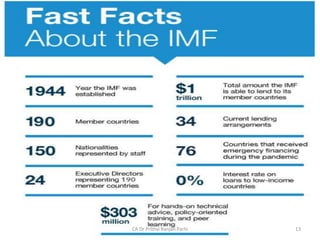
• Membership: 190 countries
• Headquarters: Washington, D.C.
• Executive Board: 24 Directors each representing a single
country or groups of countries
• Staff: Approximately 2,700 from 150 countries
• Total quotas: SDR 477 billion (US$687 billion)
• Borrowed resources envelope: SDR 492 billion (US$708
billion)
• Committed amounts under lending arrangements: SDR 200
billion (US$288 billion), of which SDR 94 billion (US$136
billion) has not been drawn.
• The largest borrowers: Argentina, Egypt, Ukraine, Pakistan
• The largest precautionary loans: Mexico, Chile, Colombia
• Capacity development spending: US$303 million in FY2020,
nearly a third of the IMF's total budget
14
CA Dr Prithvi Ranjan Parhi
Primary aims:
1. Promote international monetary cooperation;
2. Facilitate the expansion and balanced growth of
international trade;
3. Promote exchange stability;
4. Assist in the establishment of a multilateral system of
payments; and
5. Make resources available (with adequate safeguards) to
members experiencing balance-of-payments difficulties.
15
CA Dr Prithvi Ranjan Parhi
SDRs
• Special drawing rights are supplementary foreign
exchange reserve assets defined and maintained
by the International Monetary Fund.
• SDRs are units of account for the IMF, and not a
currency per se.
• They represent a claim to currency held by IMF
member countries for which they may be
exchanged.
CA Dr Prithvi Ranjan Parhi 16
SDRs:
• The IMF issues an international reserve asset known as Special Drawing
Rights, or SDRs, that can supplement the official reserves of member
countries participating in the SDR Department (currently all members of
the IMF).
• A general allocation of SDRs must be consistent with the objective of
meeting the long-term global need for reserve assets and requires
Board of Governors approval by an 85 percent majority of the total
voting power.
• Once agreed, the allocation is distributed to member countries in
proportion to their quota shares at the Fund.
• Total global allocations are currently about SDR 204.2 billion (some
$293 billion).
• IMF members can voluntarily exchange SDRs for currencies among
themselves.
CA Dr Prithvi Ranjan Parhi 17
Resources:
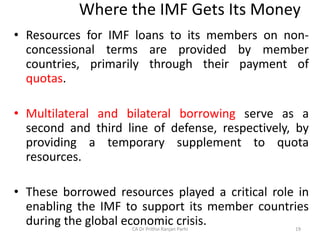
• Member quotas are the primary source of IMF financial resources.
• A member’s quota broadly reflects its size and position in the world economy.
• The IMF regularly conducts general reviews of quotas.
• The 14th Review, which was concluded in 2010 and became effective in 2016,
doubled quota resources to SDR 477 billion (about US$687 billion).
• The 15th Review was concluded in 2020 with no increase in quota.
• In addition to quota resources, credit arrangements between the IMF and a
group of members and institutions provide supplementary resources.
• These arrangements, called New Arrangements to Borrow (NAB) are the main
backstop to quotas.
• On January 16, 2020, the Executive Board agreed on amendments to the NAB,
including a doubling of its size to SDR 365 billion ($526 billion), for a new
period from 2021 to 2025. This reform entered into force on January 1, 2021.
• As a third line of defense, member countries have also committed resources to

the IMF through bilateral borrowing agreements (BBAs).
• On March 30, 2020, the Executive Board approved a borrowing framework for
a new round of BBAs.
• Of these, agreements for about SDR 128 ($183) have become effective as of
February 5, 2021.
CA Dr Prithvi Ranjan Parhi 18
Where the IMF Gets Its Money
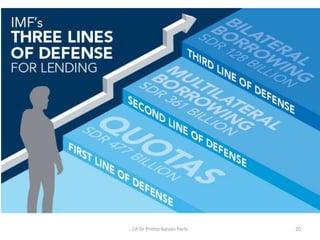
• Resources for IMF loans to its members on non-
concessional terms are provided by member
countries, primarily through their payment of
quotas.
• Multilateral and bilateral borrowing serve as a
second and third line of defense, respectively, by
providing a temporary supplement to quota
resources.
• These borrowed resources played a critical role in
enabling the IMF to support its member countries
during the global economic crisis.
CA Dr Prithvi Ranjan Parhi 19
CA Dr Prithvi Ranjan Parhi 20
Multilateral Borrowing
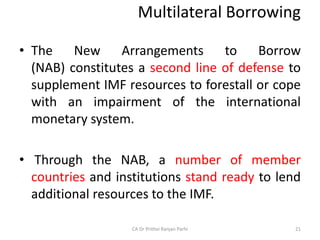
• The New Arrangements to Borrow
(NAB) constitutes a second line of defense to
supplement IMF resources to forestall or cope
with an impairment of the international
monetary system.
• Through the NAB, a number of member
countries and institutions stand ready to lend
additional resources to the IMF.
CA Dr Prithvi Ranjan Parhi 21
Bilateral Borrowing Agreements
• Bilateral Borrowing Agreements serve as a third line
of defense after quotas and the NAB.
• Since the onset of the global financing crisis, the
IMF has entered into several rounds of bilateral
borrowing agreements (BBAs) to ensure that it can
meet the financing needs of its members.
• BBAs serve as a third line of defense after quotas
and the NAB.
CA Dr Prithvi Ranjan Parhi 22
Governance and organization:
• The IMF is accountable to its member country governments. At the top of
its organizational structure is the Board of Governors, consisting of one
governor and one alternate governor from each member country, usually
the top officials from the central bank or finance ministry.
• The Board of Governors meets once a year at the IMF–World Bank Annual
Meetings.
• Twenty-four of the governors serve on the International Monetary and
Financial Committee, or IMFC, which advises the IMF's Executive Board on
the supervision and management of the international monetary and
financial system.
• The day-to-day work of the IMF is overseen by its 24-member Executive
Board, which represents the entire membership and supported by IMF
staff.
• The Managing Director is the head of the IMF staff and Chair of the
Executive Board and is assisted by four Deputy Managing Directors.
CA Dr Prithvi Ranjan Parhi 23
Functions of IMF
• The IMF’s fundamental mission is to ensure the
stability of the international monetary system.
• It does so in three ways:
1. keeping track of the global economy and the
economies of member countries;(Surveillance)
2. lending to countries with balance of payments
difficulties; (Lending)
3. giving practical help to members.(Technical
Assistance)
24
CA Dr Prithvi Ranjan Parhi
Who can Borrow from IMF
• A member country may request IMF financial
assistance if it has an actual or potential balance of
payments need—that is, if it lacks or potentially lacks
sufficient financing on affordable terms to meet its net
international payments (e.g., imports, external debt
redemptions) while maintaining adequate reserve
buffers going forward.
• IMF resources provide a cushion that eases the
adjustment policies and reforms that a country must
make to correct its balance of payments problem and
help restore conditions for strong economic growth.
25
CA Dr Prithvi Ranjan Parhi
Non Concessional Lending
The IMF’s instruments for non-concessional loans
are:
1. Stand-By Arrangements (SBA);
2. Flexible Credit Line (FCL);
3. Precautionary and Liquidity Line (PLL);
4. Extended Fund Facility (EFF)( for medium-term
needs)
5. Rapid Financing Instrument (RFI) (for
emergency assistance to members facing urgent
balance of payments needs)
26
CA Dr Prithvi Ranjan Parhi
Stand-By-Arrangements(SBA)
• Historically, the bulk of non-concessional IMF assistance
has been provided through SBAs.
• The SBA is designed to help countries address short-term
balance of payments problems.
• Program targets are designed to address these problems
and disbursements are made conditional on achieving
these targets (‘ conditionality’).
• The length of a SBA is typically 12–24 months, and
repayment is due within 3¼-5 years of disbursement.
• SBAs may be provided on a precautionary basis—where
countries choose not to draw upon approved amounts but
retain the option to do so if conditions deteriorate.
• The SBA provides for flexibility with respect to phasing,
with front-loaded access where appropriate.
27
CA Dr Prithvi Ranjan Parhi
Flexible Credit Line(FCL)
• The FCL is for countries with very strong fundamentals, policies, and
track records of policy implementation.
• FCL arrangements are approved, at the member country’s request,
for countries meeting pre-set qualification criteria.
• The length of the FCL is either one year or two years with an interim
review of continued qualification after one year.
• Access is determined on a case-by-case basis, is not subject to
access limits, and is available in a single up-front disbursement
rather than phased.
• Disbursements under the FCL are not conditional on
implementation of specific policy understandings as is the case
under the SBA because FCL-qualifying countries have a
demonstrated track record of implementing appropriate
macroeconomic policies.
• There is flexibility to either draw on the credit line at the time it is
approved or treat it as precautionary.
• The repayment term of the FCL is the same as that under the SBA.
28
CA Dr Prithvi Ranjan Parhi
Precautionary and Liquidity Line(PLL)
• The PLL is for countries with sound fundamentals and policies, and a track
record of implementing such policies.
• PLL-qualifying countries may face moderate vulnerabilities and may not meet
the FCL qualification standards, but they do not require the substantial policy
adjustments normally associated with SBAs.
• The PLL combines qualification (similar to the FCL but with a lower bar) with
focused conditions that aim at addressing the identified remaining
vulnerabilities.
• Duration of PLL arrangements range from either six months or one- to two
years. One-to-two year .PLL arrangements are subject to semi-annual reviews.
• Access under six-month PLL arrangements is limited to 125 percent of quota in
normal times, but this limit can be raised to 250 percent of quota in
exceptional circumstances where the balance of payments need is due to
exogenous shocks, including heightened regional or global stress.
• One- to two-year PLL arrangements are subject to an annual access limit of
250 percent of quota, and all PLL arrangements are subject to a cumulative cap
of 500 percent of quota.
• There is flexibility to either draw on the credit line or treat it as precautionary.
• The repayment term of the PLL is the same as for the SBA
29
CA Dr Prithvi Ranjan Parhi
Extended Fund Facility(EFF)
• This facility helps countries address medium- and longer-term balance of
payments problems reflecting extensive distortions that require fundamental
economic reforms.
• Its use has increased substantially in the recent crisis period, reflecting the
structural nature of some members’ balance of payments problems.
• Arrangements under the EFF are typically longer than SBAs—normally not
exceeding three years at approval.
• However, a maximum duration of up to four years is also allowed, predicated
on the existence of a balance of payments need beyond the three-year period,
the prolonged nature of the adjustment required to restore macroeconomic
stability, and the presence of adequate assurances about the member’s ability
and willingness to implement deep and sustained structural reforms.
• Repayment is due within 4½–10 years from the date of disbursement.
30
CA Dr Prithvi Ranjan Parhi
Rapid Financing Instrument(RFI)
• The RFI was introduced to replace and broaden
the scope of the earlier emergency assistance
policies.
• The RFI provides rapid financial assistance with
limited conditionality to all members facing an
urgent balance of payments need.
• Access under the RFI is subject to an annual limit
of 37.5 percent of quota and a cumulative limit of
75 percent of quota.
31
CA Dr Prithvi Ranjan Parhi
Concessional Lending
• The Fund’s concessional facilities for Low Income Countries (LICs) under
the PRGT were reformed in 2010 with refinements in 2013 as part of
broader efforts to make the Fund’s financial support more flexible and
better tailored to the diverse needs of LICs.
• The norms and limits for concessional facilities were expanded in 2015 to
maintain their levels relative to increasing production, trade, and capital
flows.
• Financing terms have been made more concessional, and the interest rate
is reviewed every two years (currently zero percent until end-2016).
• All facilities support country-owned programs aimed at achieving a
sustainable macroeconomic position consistent with strong and durable
poverty reduction and growth.
• Better-positioned PRGT-eligible countries may receive “blended” Fund
financial support that mixes non concessional and concessional resources.
32
CA Dr Prithvi Ranjan Parhi
Concessional Lending
• The Extended Credit Facility (ECF) is the Fund’s main tool for medium-
term support to LICs facing protracted balance of payments problems.
Financing under the ECF currently carries a zero interest rate, a grace
period of 5½ years, and a final maturity of 10 years.
• The Standby Credit Facility (SCF) provides financial assistance to LICs
with short-term or potential balance of payments needs. The SCF can
be used in a wide range of circumstances, including on a precautionary
basis. Financing under the SCF currently carries a zero interest rate,
with a grace period of 4 years, and a final maturity of 8 years.
• The Rapid Credit Facility (RCF) provides rapid financial assistance with
limited conditionality to LICs facing an urgent balance of payments
need. The RCF streamlines the Fund’s emergency assistance for LICs,
and can be used flexibly in a wide range of circumstances. Financing
under the RCF currently carries a zero interest rate, has a grace period
of 5½ years, and a final maturity of 10 years.
33
CA Dr Prithvi Ranjan Parhi
-------SDR(Special Drawing Right)
• The SDR is neither a currency, nor a claim on the IMF.
• Rather, it is a potential claim on the freely usable
currencies of IMF members.
• Holders of SDRs can obtain these currencies in
exchange for their SDRs in two ways: first, through the
arrangement of voluntary exchanges between
members; and second, by the IMF designating
members with strong external positions to purchase
SDRs from members with weak external positions.
• In addition to its role as a supplementary reserve
asset, the SDR serves as the unit of account of the IMF
and some other international organizations.
34
CA Dr Prithvi Ranjan Parhi
THANK YOU
35
CA Dr Prithvi Ranjan Parhi

International Monetary Fund

  • 1.
    International Monetary Fund (IMF) Classroom Deliberations CA Dr.Prithvi Ranjan Parhi CA Dr Prithvi Ranjan Parhi 1
  • 2.
    703- INTERNATIONAL TRADEAND BUSINESS MODULE- I International Trade: Concept, Importance, Benefits of International Trade, international Marking vs. Domestic Marking (differences). Theory of International Trade: theory of comparative Cost, factor proportion Theory. MODULE-II Multinational corporations (MNCs): Definition, Role of MNCs in International marking. International Trade barriers: Meaning, tariff and non-Tariff Barriers, Impact of Non-tariff barriers. MODULE-III Organizational and Agreements: WTO (Functions, Principle, agreements), IMF (Purposes, Facilities Provided by IMF), World Bank (Purpose, Principle, Policies). MODULE-IV Foreign Trade of India: Organizational Setup (Autonomous Bodies, Attached and subordinate offices), Major Export and Imports, Concept of Export House, EXIM Policy (2002-2007) of India (Features and Objectives of the Policy). MODULE-V Foreign Exchange market: Concept, Functions, Methods of international Payment, concept of Balance of Payment, Concept of Fixed and Flexible Exchange Rate and Convertibility of Rupee. CA Dr Prithvi Ranjan Parhi 2
  • 3.
    3 CA Dr PrithviRanjan Parhi
  • 4.
    Establishment • The IMFwas established in 1944 in the aftermath of the Great Depression of the 1930s. • 44 founding member countries sought to build a framework for international economic cooperation. • Today, its membership embraces 190 countries, with staff drawn from 150 nations. • The IMF is governed by and accountable to those 190 countries that make up its near-global membership. CA Dr Prithvi Ranjan Parhi 4
  • 5.
    Founding and mission: •The IMF was conceived in July 1944 at the United Nations Bretton Woods Conference in New Hampshire, United States. • The 44 countries in attendance sought to build a framework for international economic cooperation and avoid repeating the competitive currency devaluations that contributed to the Great Depression of the 1930s. • The IMF's primary mission is to ensure the stability of the international monetary system—the system of exchange rates and international payments that enables countries and their citizens to transact with each other. CA Dr Prithvi Ranjan Parhi 5
  • 6.
    IMF • The InternationalMonetary Fund, or IMF, promotes international financial stability and monetary cooperation. • It also facilitates international trade, promotes employment and sustainable economic growth, and helps to reduce global poverty. 6 CA Dr Prithvi Ranjan Parhi
  • 7.
    Organizational Structure • Atthe top of its is the Board of Governors. • The day-to-day work of the IMF is overseen by its 24-member Executive Board, which represents the entire membership and supported by IMF staff. • The Managing Director is the head of the IMF staff and Chair of the Executive Board. • S/he is assisted by four Deputy Managing Directors. CA Dr Prithvi Ranjan Parhi 7
  • 8.
    Finance • The IMF'sresources mainly come from the money that countries pay as their capital subscription (quotas) when they become members. • Each member of the IMF is assigned a quota, based broadly on its relative position in the world economy. • Countries can then borrow from this pool when the fall into financial difficulty. CA Dr Prithvi Ranjan Parhi 8
  • 9.
    Lending • The IMFprovides loans—including emergency loans—to member countries experiencing actual or potential balance of payments problems. • The aim is to help them to – rebuild their international reserves, – stabilize their currencies, – continue paying for imports, and – restore conditions for strong economic growth, while correcting underlying problems. CA Dr Prithvi Ranjan Parhi 9
  • 10.
    Surveillance: • In orderto maintain stability and prevent crises in the international monetary system, the IMF monitors member country policies as well as national, regional, and global economic and financial developments through a formal system known as surveillance. • The IMF provides advice to member countries and promotes policies designed to foster economic stability, reduce vulnerability to economic and financial crises, and raise living standards. • It also provides periodic assessments of global prospects in its World Economic Outlook, of financial markets in its Global Financial Stability Report, of public finance developments in its Fiscal Monitor, and of external positions of the largest economies in its External Sector Report, in addition to a series of regional economic outlooks. CA Dr Prithvi Ranjan Parhi 10
  • 11.
    Surveillance • The IMFmonitors the international monetary system and global economic developments to identify risks and recommend policies for growth and financial stability. • The Fund also undertakes a regular health check of the economic and financial policies of its 190 member countries. • In addition, the IMF identifies possible risks to the economic stability of its member countries and advises their governments on possible policy adjustments. CA Dr Prithvi Ranjan Parhi 11
  • 12.
    Capacity Development • TheIMF provides technical assistance and training to governments, including central banks, finance ministries, revenue administrations, and financial sector supervisory agencies. • These capacity development efforts are centered on the IMF’s core areas of expertise ranging from taxation through central bank operations to the reporting of macroeconomic data. • Such training also helps countries tackle cross- cutting issues, such as income inequality, gender equality, corruption, and climate change. CA Dr Prithvi Ranjan Parhi 12
  • 13.
    13 CA Dr PrithviRanjan Parhi
  • 14.
    Facts • Membership: 190countries • Headquarters: Washington, D.C. • Executive Board: 24 Directors each representing a single country or groups of countries • Staff: Approximately 2,700 from 150 countries • Total quotas: SDR 477 billion (US$687 billion) • Borrowed resources envelope: SDR 492 billion (US$708 billion) • Committed amounts under lending arrangements: SDR 200 billion (US$288 billion), of which SDR 94 billion (US$136 billion) has not been drawn. • The largest borrowers: Argentina, Egypt, Ukraine, Pakistan • The largest precautionary loans: Mexico, Chile, Colombia • Capacity development spending: US$303 million in FY2020, nearly a third of the IMF's total budget 14 CA Dr Prithvi Ranjan Parhi
  • 15.
    Primary aims: 1. Promoteinternational monetary cooperation; 2. Facilitate the expansion and balanced growth of international trade; 3. Promote exchange stability; 4. Assist in the establishment of a multilateral system of payments; and 5. Make resources available (with adequate safeguards) to members experiencing balance-of-payments difficulties. 15 CA Dr Prithvi Ranjan Parhi
  • 16.
    SDRs • Special drawingrights are supplementary foreign exchange reserve assets defined and maintained by the International Monetary Fund. • SDRs are units of account for the IMF, and not a currency per se. • They represent a claim to currency held by IMF member countries for which they may be exchanged. CA Dr Prithvi Ranjan Parhi 16
  • 17.
    SDRs: • The IMFissues an international reserve asset known as Special Drawing Rights, or SDRs, that can supplement the official reserves of member countries participating in the SDR Department (currently all members of the IMF). • A general allocation of SDRs must be consistent with the objective of meeting the long-term global need for reserve assets and requires Board of Governors approval by an 85 percent majority of the total voting power. • Once agreed, the allocation is distributed to member countries in proportion to their quota shares at the Fund. • Total global allocations are currently about SDR 204.2 billion (some $293 billion). • IMF members can voluntarily exchange SDRs for currencies among themselves. CA Dr Prithvi Ranjan Parhi 17
  • 18.
    Resources: • Member quotasare the primary source of IMF financial resources. • A member’s quota broadly reflects its size and position in the world economy. • The IMF regularly conducts general reviews of quotas. • The 14th Review, which was concluded in 2010 and became effective in 2016, doubled quota resources to SDR 477 billion (about US$687 billion). • The 15th Review was concluded in 2020 with no increase in quota. • In addition to quota resources, credit arrangements between the IMF and a group of members and institutions provide supplementary resources. • These arrangements, called New Arrangements to Borrow (NAB) are the main backstop to quotas. • On January 16, 2020, the Executive Board agreed on amendments to the NAB, including a doubling of its size to SDR 365 billion ($526 billion), for a new period from 2021 to 2025. This reform entered into force on January 1, 2021. • As a third line of defense, member countries have also committed resources to the IMF through bilateral borrowing agreements (BBAs). • On March 30, 2020, the Executive Board approved a borrowing framework for a new round of BBAs. • Of these, agreements for about SDR 128 ($183) have become effective as of February 5, 2021. CA Dr Prithvi Ranjan Parhi 18
  • 19.
    Where the IMFGets Its Money • Resources for IMF loans to its members on non- concessional terms are provided by member countries, primarily through their payment of quotas. • Multilateral and bilateral borrowing serve as a second and third line of defense, respectively, by providing a temporary supplement to quota resources. • These borrowed resources played a critical role in enabling the IMF to support its member countries during the global economic crisis. CA Dr Prithvi Ranjan Parhi 19
  • 20.
    CA Dr PrithviRanjan Parhi 20
  • 21.
    Multilateral Borrowing • TheNew Arrangements to Borrow (NAB) constitutes a second line of defense to supplement IMF resources to forestall or cope with an impairment of the international monetary system. • Through the NAB, a number of member countries and institutions stand ready to lend additional resources to the IMF. CA Dr Prithvi Ranjan Parhi 21
  • 22.
    Bilateral Borrowing Agreements •Bilateral Borrowing Agreements serve as a third line of defense after quotas and the NAB. • Since the onset of the global financing crisis, the IMF has entered into several rounds of bilateral borrowing agreements (BBAs) to ensure that it can meet the financing needs of its members. • BBAs serve as a third line of defense after quotas and the NAB. CA Dr Prithvi Ranjan Parhi 22
  • 23.
    Governance and organization: •The IMF is accountable to its member country governments. At the top of its organizational structure is the Board of Governors, consisting of one governor and one alternate governor from each member country, usually the top officials from the central bank or finance ministry. • The Board of Governors meets once a year at the IMF–World Bank Annual Meetings. • Twenty-four of the governors serve on the International Monetary and Financial Committee, or IMFC, which advises the IMF's Executive Board on the supervision and management of the international monetary and financial system. • The day-to-day work of the IMF is overseen by its 24-member Executive Board, which represents the entire membership and supported by IMF staff. • The Managing Director is the head of the IMF staff and Chair of the Executive Board and is assisted by four Deputy Managing Directors. CA Dr Prithvi Ranjan Parhi 23
  • 24.
    Functions of IMF •The IMF’s fundamental mission is to ensure the stability of the international monetary system. • It does so in three ways: 1. keeping track of the global economy and the economies of member countries;(Surveillance) 2. lending to countries with balance of payments difficulties; (Lending) 3. giving practical help to members.(Technical Assistance) 24 CA Dr Prithvi Ranjan Parhi
  • 25.
    Who can Borrowfrom IMF • A member country may request IMF financial assistance if it has an actual or potential balance of payments need—that is, if it lacks or potentially lacks sufficient financing on affordable terms to meet its net international payments (e.g., imports, external debt redemptions) while maintaining adequate reserve buffers going forward. • IMF resources provide a cushion that eases the adjustment policies and reforms that a country must make to correct its balance of payments problem and help restore conditions for strong economic growth. 25 CA Dr Prithvi Ranjan Parhi
  • 26.
    Non Concessional Lending TheIMF’s instruments for non-concessional loans are: 1. Stand-By Arrangements (SBA); 2. Flexible Credit Line (FCL); 3. Precautionary and Liquidity Line (PLL); 4. Extended Fund Facility (EFF)( for medium-term needs) 5. Rapid Financing Instrument (RFI) (for emergency assistance to members facing urgent balance of payments needs) 26 CA Dr Prithvi Ranjan Parhi
  • 27.
    Stand-By-Arrangements(SBA) • Historically, thebulk of non-concessional IMF assistance has been provided through SBAs. • The SBA is designed to help countries address short-term balance of payments problems. • Program targets are designed to address these problems and disbursements are made conditional on achieving these targets (‘ conditionality’). • The length of a SBA is typically 12–24 months, and repayment is due within 3¼-5 years of disbursement. • SBAs may be provided on a precautionary basis—where countries choose not to draw upon approved amounts but retain the option to do so if conditions deteriorate. • The SBA provides for flexibility with respect to phasing, with front-loaded access where appropriate. 27 CA Dr Prithvi Ranjan Parhi
  • 28.
    Flexible Credit Line(FCL) •The FCL is for countries with very strong fundamentals, policies, and track records of policy implementation. • FCL arrangements are approved, at the member country’s request, for countries meeting pre-set qualification criteria. • The length of the FCL is either one year or two years with an interim review of continued qualification after one year. • Access is determined on a case-by-case basis, is not subject to access limits, and is available in a single up-front disbursement rather than phased. • Disbursements under the FCL are not conditional on implementation of specific policy understandings as is the case under the SBA because FCL-qualifying countries have a demonstrated track record of implementing appropriate macroeconomic policies. • There is flexibility to either draw on the credit line at the time it is approved or treat it as precautionary. • The repayment term of the FCL is the same as that under the SBA. 28 CA Dr Prithvi Ranjan Parhi
  • 29.
    Precautionary and LiquidityLine(PLL) • The PLL is for countries with sound fundamentals and policies, and a track record of implementing such policies. • PLL-qualifying countries may face moderate vulnerabilities and may not meet the FCL qualification standards, but they do not require the substantial policy adjustments normally associated with SBAs. • The PLL combines qualification (similar to the FCL but with a lower bar) with focused conditions that aim at addressing the identified remaining vulnerabilities. • Duration of PLL arrangements range from either six months or one- to two years. One-to-two year .PLL arrangements are subject to semi-annual reviews. • Access under six-month PLL arrangements is limited to 125 percent of quota in normal times, but this limit can be raised to 250 percent of quota in exceptional circumstances where the balance of payments need is due to exogenous shocks, including heightened regional or global stress. • One- to two-year PLL arrangements are subject to an annual access limit of 250 percent of quota, and all PLL arrangements are subject to a cumulative cap of 500 percent of quota. • There is flexibility to either draw on the credit line or treat it as precautionary. • The repayment term of the PLL is the same as for the SBA 29 CA Dr Prithvi Ranjan Parhi
  • 30.
    Extended Fund Facility(EFF) •This facility helps countries address medium- and longer-term balance of payments problems reflecting extensive distortions that require fundamental economic reforms. • Its use has increased substantially in the recent crisis period, reflecting the structural nature of some members’ balance of payments problems. • Arrangements under the EFF are typically longer than SBAs—normally not exceeding three years at approval. • However, a maximum duration of up to four years is also allowed, predicated on the existence of a balance of payments need beyond the three-year period, the prolonged nature of the adjustment required to restore macroeconomic stability, and the presence of adequate assurances about the member’s ability and willingness to implement deep and sustained structural reforms. • Repayment is due within 4½–10 years from the date of disbursement. 30 CA Dr Prithvi Ranjan Parhi
  • 31.
    Rapid Financing Instrument(RFI) •The RFI was introduced to replace and broaden the scope of the earlier emergency assistance policies. • The RFI provides rapid financial assistance with limited conditionality to all members facing an urgent balance of payments need. • Access under the RFI is subject to an annual limit of 37.5 percent of quota and a cumulative limit of 75 percent of quota. 31 CA Dr Prithvi Ranjan Parhi
  • 32.
    Concessional Lending • TheFund’s concessional facilities for Low Income Countries (LICs) under the PRGT were reformed in 2010 with refinements in 2013 as part of broader efforts to make the Fund’s financial support more flexible and better tailored to the diverse needs of LICs. • The norms and limits for concessional facilities were expanded in 2015 to maintain their levels relative to increasing production, trade, and capital flows. • Financing terms have been made more concessional, and the interest rate is reviewed every two years (currently zero percent until end-2016). • All facilities support country-owned programs aimed at achieving a sustainable macroeconomic position consistent with strong and durable poverty reduction and growth. • Better-positioned PRGT-eligible countries may receive “blended” Fund financial support that mixes non concessional and concessional resources. 32 CA Dr Prithvi Ranjan Parhi
  • 33.
    Concessional Lending • TheExtended Credit Facility (ECF) is the Fund’s main tool for medium- term support to LICs facing protracted balance of payments problems. Financing under the ECF currently carries a zero interest rate, a grace period of 5½ years, and a final maturity of 10 years. • The Standby Credit Facility (SCF) provides financial assistance to LICs with short-term or potential balance of payments needs. The SCF can be used in a wide range of circumstances, including on a precautionary basis. Financing under the SCF currently carries a zero interest rate, with a grace period of 4 years, and a final maturity of 8 years. • The Rapid Credit Facility (RCF) provides rapid financial assistance with limited conditionality to LICs facing an urgent balance of payments need. The RCF streamlines the Fund’s emergency assistance for LICs, and can be used flexibly in a wide range of circumstances. Financing under the RCF currently carries a zero interest rate, has a grace period of 5½ years, and a final maturity of 10 years. 33 CA Dr Prithvi Ranjan Parhi
  • 34.
    -------SDR(Special Drawing Right) •The SDR is neither a currency, nor a claim on the IMF. • Rather, it is a potential claim on the freely usable currencies of IMF members. • Holders of SDRs can obtain these currencies in exchange for their SDRs in two ways: first, through the arrangement of voluntary exchanges between members; and second, by the IMF designating members with strong external positions to purchase SDRs from members with weak external positions. • In addition to its role as a supplementary reserve asset, the SDR serves as the unit of account of the IMF and some other international organizations. 34 CA Dr Prithvi Ranjan Parhi
  • 35.
    THANK YOU 35 CA DrPrithvi Ranjan Parhi