International Monetary Fund
IMF
• International Monetary Fund
• “It is an organization of 189 countries ,working to
foster global monetary cooperation , secure
financial stability ,facilitate international trade
,promote high employment and sustainable
economic growth and reduce poverty” .
• The IMF is the most detailed attempt to organize
the conduct of international monetary affairs.
• Head :Kristalina Ivanova Georgieva-Kinova
Objectives of IMF
• To Promote International Monetary
Cooperation
• To establish a system of Multilateral Payments
• To maintain Stability in Exchange Rate
• To abolish Exchange Restrictions
• To Provide Aid to Members during Emergency
• To Reduce Disequilibrium in Balance of
Payments
Objectives of IMF
• To help in Profitable Investment in Capital
• To promote Balanced Economic Development
• To prevent Spreading of Financial Crisis
Functions of IMF
• Lending for meeting Temporary Unfavorable
Balance of Payments Position.
• Purchase & Sale of Foreign Currency
• Bank of Central Banks: As central bank holds
reserves of commercial banks, IMF hold
reserves of central banks of members.
• Technical Assistance
Functions of IMF
• Imparts Training
• Facilities during Emergency: IMF oppose any
sort of controls either on foreign exchange or
on foreign trade, yet member countries have
been given the right to resort to these controls
during emergency.
• Increases International Liquidity: It means
ability to pay for its imports. For liquidity new
currency in the form of SDR is created.
Functions of IMF
• Determining Exchange rate of every Member
Country: Now exchange rate is determined by
market forces of demand and supply, so this
function has been dropped.
• Poverty Reduction; A special fund has been set
up. In this fund developed and emerging
developing nations contribute.
Functions of IMF
• Research Functions: IMF has set up a
separate bureau for conducting research
regarding balance of payments, money &
banking, finance & fiscal policy, etc.
Functions of IMF
• Change in Exchange rate:
If any country wants to change the par value of
its currency up to 10%, no prior permission is
needed from IMF, only intimation.
If any country wants to change its exchange
rate from 11 to 20%, prior permission of IMF
is required
If more than 20%, such decision is taken with
the consent of 2/3 members.
Functions of IMF
• Special Lending Facilities of IMF
Compensatory & Contingency Financing
Facility (CCFF): Special financial assistance for
compensating them for shortfall in exports due to
some contingencies like flood, earthquakes, etc.
Buffer Stock Financing Facility (BSFF):
Special assistance is provided to member nations
for maintaining buffer stocks of primary products
like food grains.
Functions of IMF
Structural Adjustment Facility (SAF):
Concessional loans are provided to least
developed member nations for meeting deficit
in balance of payments. Rate of interest is
between 0.5% to 1% p.a.
Enhanced Structural Adjustment Facility
(ESAF): Enhanced loans are provided to least
developed members with heavy debt burdens
for making economic reforms. A member
country can take loans up to 425% of its quota.
Membership
 There are two types of members:
1) ORIGINAL MEMBERS: All those countries whose
representatives took part in BRETTONWOODS
CONFERENCE and who agreed to be the members of the
fund prior to 31st December,1945.
2) ORDINARY MEMBERS: All those who became its
members subsequently.
*BANK has the authority to suspend any member and similarly
every member is free to resign.
Resource of the Fund
• QUOTAS AND THEIR FIXATION: The fund
has general account based on quotas allocated
to its members. When a country joins the fund,
it is assigned a quota that governs the size of
its subscription, its voting power and its
drawing rights .
Operations of IMF
Operations
of IMF
Technical
Assistance
IMF
Surveillance
IMF
Lending
Operations of IMF
• IMF Surveillance: Gathering data and
assessing economic policies of countries.
• IMF Lending: Lending to countries to support
reforms
• Technical Assistance: Strengthening human
skills and institutional capacity of countries
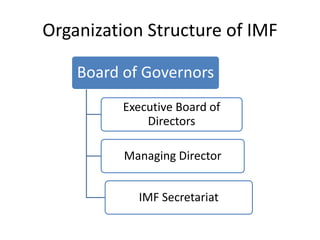
Organization Structure of IMF
Board of Governors
Executive Board of
Directors
Managing Director
IMF Secretariat
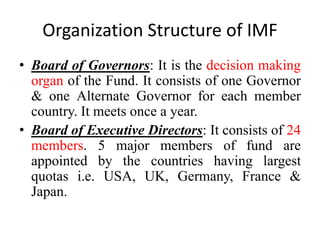
Organization Structure of IMF
• Board of Governors: It is the decision making
organ of the Fund. It consists of one Governor
& one Alternate Governor for each member
country. It meets once a year.
• Board of Executive Directors: It consists of 24
members. 5 major members of fund are
appointed by the countries having largest
quotas i.e. USA, UK, Germany, France &
Japan.
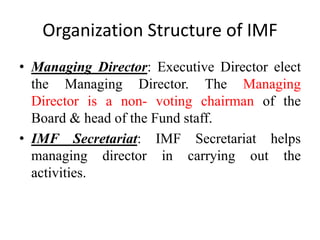
Organization Structure of IMF
• Managing Director: Executive Director elect
the Managing Director. The Managing
Director is a non- voting chairman of the
Board & head of the Fund staff.
• IMF Secretariat: IMF Secretariat helps
managing director in carrying out the
activities.
Special Drawing Rights (SDR)
• For increasing international liquidity, IMF
created a scheme called Special Drawing
Rights (SDRs). It is also known as paper gold.
• SDRs are like coupons which can be exchanged
for currencies required by holder of SDRs for
making international payment.
Special Drawing Rights (SDR)
• Each member country was allocated a quota
of SDR. This quota is fixed on the basis of
contribution of member country to the capital
of IMF.
• SDR quotas of member countries are revised
after every 5 years.
• These quotas can be increased with consent
of at least 85% members.
Benefits of SDRs
• Dependence on gold for making international
payments has reduced.
• International liquidity has increased.
• It has benefitted the member countries having
unfavorable balance of payments.
• SDRs are costless to produce as it is paper
currency, whereas gold involved huge cost. There
is no fear of SDR being stolen.
• Payment through SDR is easier and more flexible.
Criticism of SDRs
• More quota for rich countries.
• There is no difference in interest rates charged
from developed and developing countries.
• Quotas of SDRs were not fixed according to
the development need for finance of member
countries.
• Earlier interest payable on use of SDRs was
1.5% p.a. but now it is charged at market rate
of interest prevailing in 5 major countries.
Achievements of IMF
• International Monetary Cooperation
• Reconstruction of European Countries: Rich
countries like America gave liberal assistance
for reconstruction otherwise they could not
have been rehabilitated.
• Multilateral system of Foreign Payments: IMF
provides for conversion of currency of
different countries & it urges members to
remove all sorts of exchange controls.
Achievements of IMF
• Increase in International Liquidity
• Increase in International Trade
• Special Aid to Developing Countries
• Providing Statistical Data & Information:
Separate statistical bureau has been set up for
conducting research regarding balance of
payments, money & banking, etc. It also
publishes report of such research work.
Achievements of IMF
• Helpful in Times of Difficulties
• Easiness & Flexibility in Making
International Payments
• Special Lending to Crisis Hit Nations
Failures of IMF
• Lack of stability in exchange rate
• Lack of stability in price of Gold
• Inability to remove restrictions on Foreign
Trade
• Rich Nations Club
• No help for Development Projects
• No solution of Problem of International
Liquidity
Failures of IMF
• Interference in Domestic Economies
• Inability to Tackle the Monetary Crisis of
1971: A global monetary crisis triggered off
when America not only devalued dollar but
also stopped its convertibility into gold. The
IMF failed to resolve the crisis
• Less Aid for Developing Countries
• High Rate of interest(6.5%)
Advantages of IMF to India
• Facility of Foreign Exchange: Enabled India to
get foreign currencies from IMF as per its
requirements.
• Freedom from British Pound-Sterling: Prior to
IMF, Indian rupee was convertible into other
currencies through the medium of U.K. pound-
sterling.
• Membership of World Bank: By virtue of its
membership of Fund, India has also become
member of World Bank.
Advantages of IMF to India
• Importance of India in International Sector:
India was among those six nations who were
permanent members of Board of Directors. By
virtue of its status, India used to play
significant role in policy-making of the fund.
• Economic Consultation: Fund has given
valuable advice to govt. of India in financial
management of Five year plans.
Advantages of IMF to India
• Help during Emergency
• Financial Help for Five Year plans
• Special Drawing Rights: India’s quota of SDR
has been raised from time to time.
• India-IMF Joint Training Institute(PUNE)
Some Indian facts regarding IMF
• 8th India
• 13,114.4 – QUOTA IN MILLION SDR
• 2.76 – QUOTA PERCENTSGE OF TOTAL VOTES
• Nirmala Sitharaman
• Shaktikanta Das
• 132,609 – NO.OF VOTES
• 2.64 – PERCENTAGE OUT OF TOTAL VOTES
• 1 SDR= 1.398$

IMF.pptx

  • 1.
  • 2.
    IMF • International MonetaryFund • “It is an organization of 189 countries ,working to foster global monetary cooperation , secure financial stability ,facilitate international trade ,promote high employment and sustainable economic growth and reduce poverty” . • The IMF is the most detailed attempt to organize the conduct of international monetary affairs. • Head :Kristalina Ivanova Georgieva-Kinova
  • 3.
    Objectives of IMF •To Promote International Monetary Cooperation • To establish a system of Multilateral Payments • To maintain Stability in Exchange Rate • To abolish Exchange Restrictions • To Provide Aid to Members during Emergency • To Reduce Disequilibrium in Balance of Payments
  • 4.
    Objectives of IMF •To help in Profitable Investment in Capital • To promote Balanced Economic Development • To prevent Spreading of Financial Crisis
  • 5.
    Functions of IMF •Lending for meeting Temporary Unfavorable Balance of Payments Position. • Purchase & Sale of Foreign Currency • Bank of Central Banks: As central bank holds reserves of commercial banks, IMF hold reserves of central banks of members. • Technical Assistance
  • 6.
    Functions of IMF •Imparts Training • Facilities during Emergency: IMF oppose any sort of controls either on foreign exchange or on foreign trade, yet member countries have been given the right to resort to these controls during emergency. • Increases International Liquidity: It means ability to pay for its imports. For liquidity new currency in the form of SDR is created.
  • 7.
    Functions of IMF •Determining Exchange rate of every Member Country: Now exchange rate is determined by market forces of demand and supply, so this function has been dropped. • Poverty Reduction; A special fund has been set up. In this fund developed and emerging developing nations contribute.
  • 8.
    Functions of IMF •Research Functions: IMF has set up a separate bureau for conducting research regarding balance of payments, money & banking, finance & fiscal policy, etc.
  • 9.
    Functions of IMF •Change in Exchange rate: If any country wants to change the par value of its currency up to 10%, no prior permission is needed from IMF, only intimation. If any country wants to change its exchange rate from 11 to 20%, prior permission of IMF is required If more than 20%, such decision is taken with the consent of 2/3 members.
  • 10.
    Functions of IMF •Special Lending Facilities of IMF Compensatory & Contingency Financing Facility (CCFF): Special financial assistance for compensating them for shortfall in exports due to some contingencies like flood, earthquakes, etc. Buffer Stock Financing Facility (BSFF): Special assistance is provided to member nations for maintaining buffer stocks of primary products like food grains.
  • 11.
    Functions of IMF StructuralAdjustment Facility (SAF): Concessional loans are provided to least developed member nations for meeting deficit in balance of payments. Rate of interest is between 0.5% to 1% p.a. Enhanced Structural Adjustment Facility (ESAF): Enhanced loans are provided to least developed members with heavy debt burdens for making economic reforms. A member country can take loans up to 425% of its quota.
  • 12.
    Membership  There aretwo types of members: 1) ORIGINAL MEMBERS: All those countries whose representatives took part in BRETTONWOODS CONFERENCE and who agreed to be the members of the fund prior to 31st December,1945. 2) ORDINARY MEMBERS: All those who became its members subsequently. *BANK has the authority to suspend any member and similarly every member is free to resign.
  • 13.
    Resource of theFund • QUOTAS AND THEIR FIXATION: The fund has general account based on quotas allocated to its members. When a country joins the fund, it is assigned a quota that governs the size of its subscription, its voting power and its drawing rights .
  • 14.
    Operations of IMF Operations ofIMF Technical Assistance IMF Surveillance IMF Lending
  • 15.
    Operations of IMF •IMF Surveillance: Gathering data and assessing economic policies of countries. • IMF Lending: Lending to countries to support reforms • Technical Assistance: Strengthening human skills and institutional capacity of countries
  • 16.
    Organization Structure ofIMF Board of Governors Executive Board of Directors Managing Director IMF Secretariat
  • 17.
    Organization Structure ofIMF • Board of Governors: It is the decision making organ of the Fund. It consists of one Governor & one Alternate Governor for each member country. It meets once a year. • Board of Executive Directors: It consists of 24 members. 5 major members of fund are appointed by the countries having largest quotas i.e. USA, UK, Germany, France & Japan.
  • 18.
    Organization Structure ofIMF • Managing Director: Executive Director elect the Managing Director. The Managing Director is a non- voting chairman of the Board & head of the Fund staff. • IMF Secretariat: IMF Secretariat helps managing director in carrying out the activities.
  • 19.
    Special Drawing Rights(SDR) • For increasing international liquidity, IMF created a scheme called Special Drawing Rights (SDRs). It is also known as paper gold. • SDRs are like coupons which can be exchanged for currencies required by holder of SDRs for making international payment.
  • 20.
    Special Drawing Rights(SDR) • Each member country was allocated a quota of SDR. This quota is fixed on the basis of contribution of member country to the capital of IMF. • SDR quotas of member countries are revised after every 5 years. • These quotas can be increased with consent of at least 85% members.
  • 21.
    Benefits of SDRs •Dependence on gold for making international payments has reduced. • International liquidity has increased. • It has benefitted the member countries having unfavorable balance of payments. • SDRs are costless to produce as it is paper currency, whereas gold involved huge cost. There is no fear of SDR being stolen. • Payment through SDR is easier and more flexible.
  • 22.
    Criticism of SDRs •More quota for rich countries. • There is no difference in interest rates charged from developed and developing countries. • Quotas of SDRs were not fixed according to the development need for finance of member countries. • Earlier interest payable on use of SDRs was 1.5% p.a. but now it is charged at market rate of interest prevailing in 5 major countries.
  • 23.
    Achievements of IMF •International Monetary Cooperation • Reconstruction of European Countries: Rich countries like America gave liberal assistance for reconstruction otherwise they could not have been rehabilitated. • Multilateral system of Foreign Payments: IMF provides for conversion of currency of different countries & it urges members to remove all sorts of exchange controls.
  • 24.
    Achievements of IMF •Increase in International Liquidity • Increase in International Trade • Special Aid to Developing Countries • Providing Statistical Data & Information: Separate statistical bureau has been set up for conducting research regarding balance of payments, money & banking, etc. It also publishes report of such research work.
  • 25.
    Achievements of IMF •Helpful in Times of Difficulties • Easiness & Flexibility in Making International Payments • Special Lending to Crisis Hit Nations
  • 26.
    Failures of IMF •Lack of stability in exchange rate • Lack of stability in price of Gold • Inability to remove restrictions on Foreign Trade • Rich Nations Club • No help for Development Projects • No solution of Problem of International Liquidity
  • 27.
    Failures of IMF •Interference in Domestic Economies • Inability to Tackle the Monetary Crisis of 1971: A global monetary crisis triggered off when America not only devalued dollar but also stopped its convertibility into gold. The IMF failed to resolve the crisis • Less Aid for Developing Countries • High Rate of interest(6.5%)
  • 28.
    Advantages of IMFto India • Facility of Foreign Exchange: Enabled India to get foreign currencies from IMF as per its requirements. • Freedom from British Pound-Sterling: Prior to IMF, Indian rupee was convertible into other currencies through the medium of U.K. pound- sterling. • Membership of World Bank: By virtue of its membership of Fund, India has also become member of World Bank.
  • 29.
    Advantages of IMFto India • Importance of India in International Sector: India was among those six nations who were permanent members of Board of Directors. By virtue of its status, India used to play significant role in policy-making of the fund. • Economic Consultation: Fund has given valuable advice to govt. of India in financial management of Five year plans.
  • 30.
    Advantages of IMFto India • Help during Emergency • Financial Help for Five Year plans • Special Drawing Rights: India’s quota of SDR has been raised from time to time. • India-IMF Joint Training Institute(PUNE)
  • 31.
    Some Indian factsregarding IMF • 8th India • 13,114.4 – QUOTA IN MILLION SDR • 2.76 – QUOTA PERCENTSGE OF TOTAL VOTES • Nirmala Sitharaman • Shaktikanta Das • 132,609 – NO.OF VOTES • 2.64 – PERCENTAGE OUT OF TOTAL VOTES • 1 SDR= 1.398$