 The IMF is an intergovernmental institution established
by an international treaty in 1945 to create a framework
for international economic cooperation focusing on
balance of payment problems and the stability of
currencies.
 IMF headquarters is in Washington D.C , U.S.A
In the beginning ( 1945-2003 ) consisted of 29
member countries but In 2007, the number
of member countries of IMF increased to
189 ( Nauru).
Establishment of IMF
IMF was founded on 27th december,1945. During
the closing years of World War Second, different
countries realized that there must be a common
International Forum for achieving economy
cooperation, promoting International Trade and
providing help to needy nations during emergency.
So IMF was formed for this purpose.
World War Second has its adverse effect on
global economy. To remedy the situation, an
international monetary conference was
convened in 1944, at Bretton Woods in
America.
It was attended by the represenatives of 44
countries. India also participated therein.
It was decided in this Conference to set up
IMF for the economic development of all
countries.
1) To Promote International Monetary Cooperation
2) To Establish a System of Multilateral Payments
3) To Maintain Stability in the Rate of Exchange
4) To Provide Aid to Members during emergency
5) To reduce Disequilibrium in Balance of Payments
6) To promote balanced economic development
FUNCTIONS OF IMF
1) The funds provide a mechanism for improving
short-term BOP Position
2) Surveillance - Gathering data and assessing
economic policies of countries
3)Technical Assistance Strengthening human skills
and institutional capacity of countries
4)Financial Assistance Lending to countries to
support reforms
5) Facilities during emergency
6) It serves as a short-term credit institutions
7) Determining Exchange Rate for every
Country
MEMBER
COUNTRIES
BOARD OF
GOVERNORS
DEPUTY
MANAGING
DIRECTOR
DEPUTY
MANAGING
DIRECTOR
EXECUTIVE
BOARD
FIRST DPTY
MANAGING
DIRECTOR
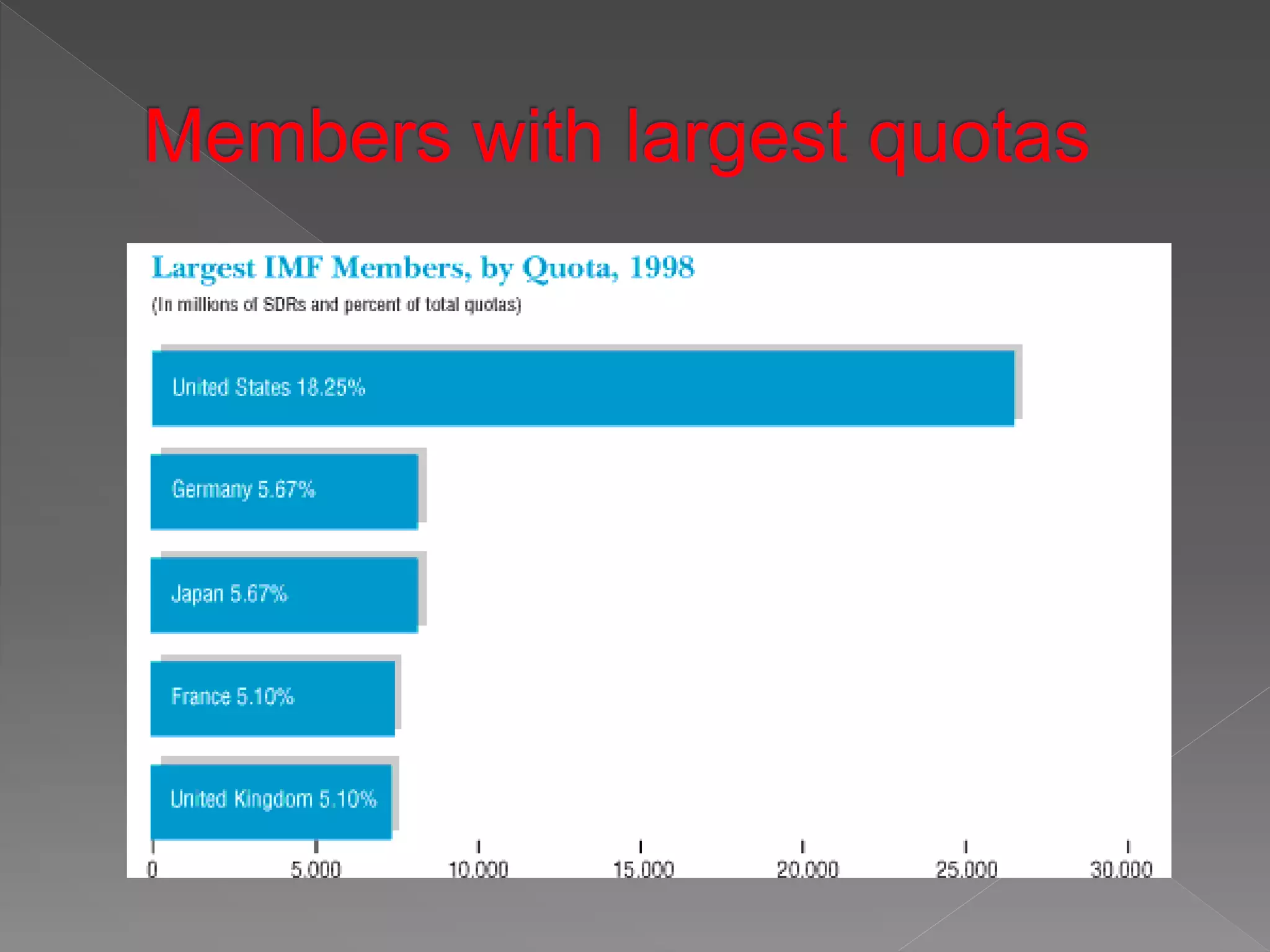
 Most comes from the quota subscriptions
› the money each member contributes when
joining the IMF. The Capital resources of the
fund are subscribed by the various member
countries by way of their respective quotas.
Quotas are based on size of an economy. Each
Member country is required to subscribe its
quota partly in gold and partly in its own
national currency.
 General Arrangements to Borrow (1962)
› 10 member countries ( Japan, France, UK,
USA, Italy, Belgium, Netherlands and Canada,
Sweden, Germany)
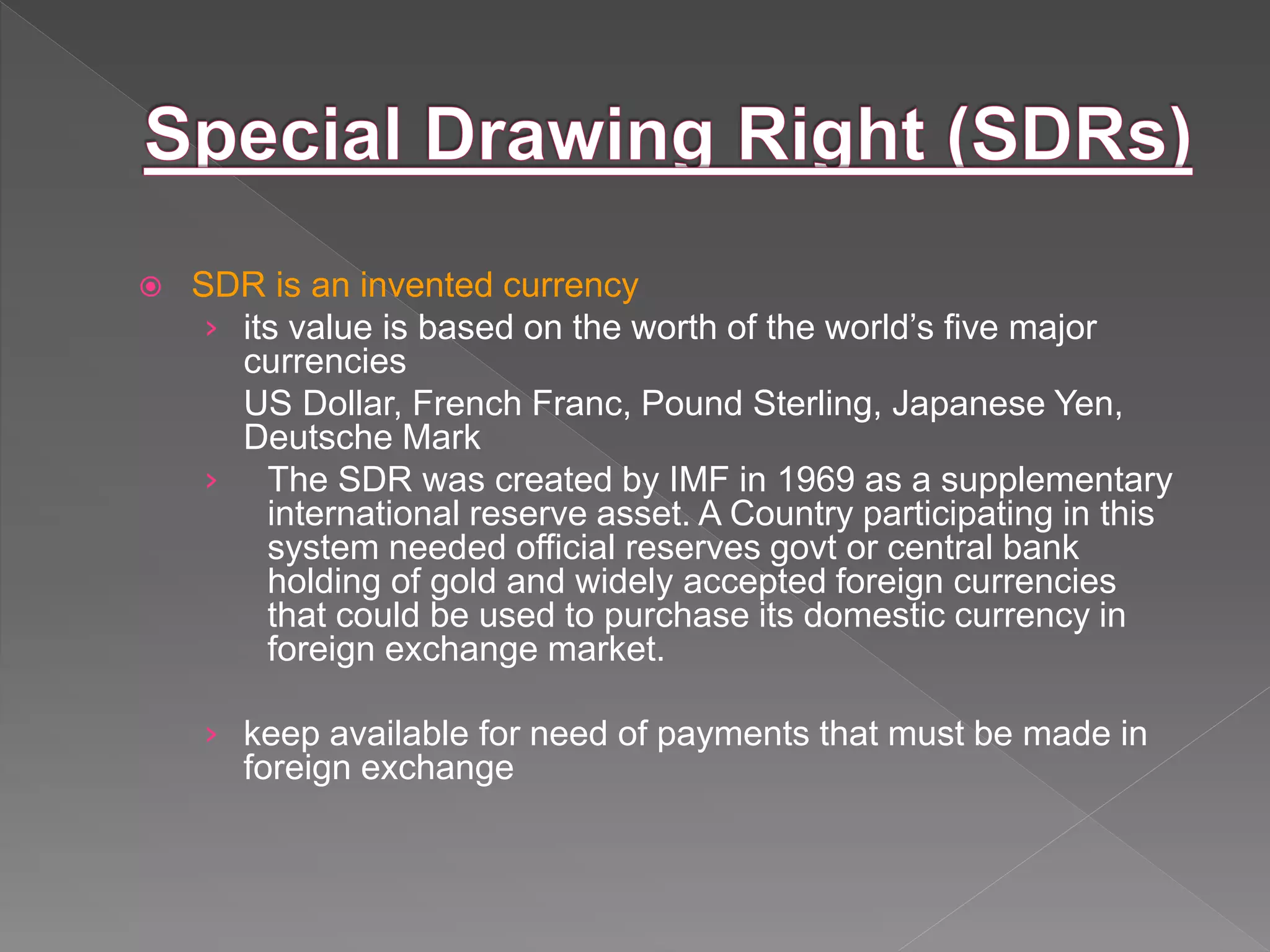
 SDR is an invented currency
› its value is based on the worth of the world’s five major
currencies
US Dollar, French Franc, Pound Sterling, Japanese Yen,
Deutsche Mark
› The SDR was created by IMF in 1969 as a supplementary
international reserve asset. A Country participating in this
system needed official reserves govt or central bank
holding of gold and widely accepted foreign currencies
that could be used to purchase its domestic currency in
foreign exchange market.
› keep available for need of payments that must be made in
foreign exchange
SUCCESS OF IMF
1) International Monetary Cooperation
2) Reconstruction of European Countries
3) Multilateral System of Foreign Payments
4) Increase in International Liquidity
5) Increase in International Trade
6) Special Aid to Developing Countries
7) Helpful in Times of Difficulties
8) Easiness & Flexibility in Making International
Payments
1) Lack of Stability in Exchange Rate
2) Lack of Stability in the Price of Gold
3) Inability to Remove Restrictions on Foreign Trade
4) Rich Nations Club
5) No help for development projects
6) No Solution of International Liquidity
7) Interference in Domestic Economies
8) Less Aid for Developing Countries
9) High Rate of Interest
IMF AND INDIA
India is a founder member of IMF. Earlier
India was made a permanent Executive
Director of the Board of Directors.
At present India is no longer a permanent
director. India is now an elected member of
IMF.
India’s rank is 13th among 185 member
nations.
Thank you..

imf.ppt

  • 2.
     The IMFis an intergovernmental institution established by an international treaty in 1945 to create a framework for international economic cooperation focusing on balance of payment problems and the stability of currencies.  IMF headquarters is in Washington D.C , U.S.A
  • 3.
    In the beginning( 1945-2003 ) consisted of 29 member countries but In 2007, the number of member countries of IMF increased to 189 ( Nauru).
  • 4.
    Establishment of IMF IMFwas founded on 27th december,1945. During the closing years of World War Second, different countries realized that there must be a common International Forum for achieving economy cooperation, promoting International Trade and providing help to needy nations during emergency. So IMF was formed for this purpose.
  • 5.
    World War Secondhas its adverse effect on global economy. To remedy the situation, an international monetary conference was convened in 1944, at Bretton Woods in America. It was attended by the represenatives of 44 countries. India also participated therein. It was decided in this Conference to set up IMF for the economic development of all countries.
  • 6.
    1) To PromoteInternational Monetary Cooperation 2) To Establish a System of Multilateral Payments 3) To Maintain Stability in the Rate of Exchange
  • 7.
    4) To ProvideAid to Members during emergency 5) To reduce Disequilibrium in Balance of Payments 6) To promote balanced economic development
  • 8.
    FUNCTIONS OF IMF 1)The funds provide a mechanism for improving short-term BOP Position 2) Surveillance - Gathering data and assessing economic policies of countries 3)Technical Assistance Strengthening human skills and institutional capacity of countries 4)Financial Assistance Lending to countries to support reforms
  • 9.
    5) Facilities duringemergency 6) It serves as a short-term credit institutions 7) Determining Exchange Rate for every Country
  • 10.
  • 12.
     Most comesfrom the quota subscriptions › the money each member contributes when joining the IMF. The Capital resources of the fund are subscribed by the various member countries by way of their respective quotas. Quotas are based on size of an economy. Each Member country is required to subscribe its quota partly in gold and partly in its own national currency.  General Arrangements to Borrow (1962) › 10 member countries ( Japan, France, UK, USA, Italy, Belgium, Netherlands and Canada, Sweden, Germany)
  • 13.
     SDR isan invented currency › its value is based on the worth of the world’s five major currencies US Dollar, French Franc, Pound Sterling, Japanese Yen, Deutsche Mark › The SDR was created by IMF in 1969 as a supplementary international reserve asset. A Country participating in this system needed official reserves govt or central bank holding of gold and widely accepted foreign currencies that could be used to purchase its domestic currency in foreign exchange market. › keep available for need of payments that must be made in foreign exchange
  • 15.
    SUCCESS OF IMF 1)International Monetary Cooperation 2) Reconstruction of European Countries 3) Multilateral System of Foreign Payments 4) Increase in International Liquidity 5) Increase in International Trade
  • 16.
    6) Special Aidto Developing Countries 7) Helpful in Times of Difficulties 8) Easiness & Flexibility in Making International Payments
  • 17.
    1) Lack ofStability in Exchange Rate 2) Lack of Stability in the Price of Gold 3) Inability to Remove Restrictions on Foreign Trade 4) Rich Nations Club 5) No help for development projects
  • 18.
    6) No Solutionof International Liquidity 7) Interference in Domestic Economies 8) Less Aid for Developing Countries 9) High Rate of Interest
  • 19.
    IMF AND INDIA Indiais a founder member of IMF. Earlier India was made a permanent Executive Director of the Board of Directors. At present India is no longer a permanent director. India is now an elected member of IMF. India’s rank is 13th among 185 member nations.
  • 20.