U N I T I – I I . I N T E R N AT I O N A L C U I S I N E S
Food Production Management
Worlds Top 10 Cuisines
Chinese
French
Italian
Indian
Japanese
Moroccan
Spanish
Thai
Turkish
Indonesian
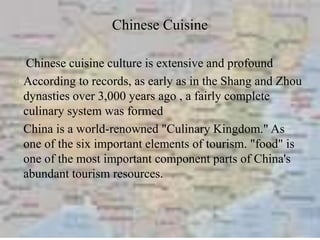
Chinese Cuisine
♯ Chinese cuisine culture is extensive and profound
♯ According to records, as early as in the Shang and Zhou
dynasties over 3,000 years ago , a fairly complete
culinary system was formed
♯ China is a world-renowned "Culinary Kingdom." As
one of the six important elements of tourism. "food" is
one of the most important component parts of China's
abundant tourism resources.
Chinese
 Anhui
Cantonese
Fujian
Hunan
Jiangsu
Shandong
Szechuan
Zhejiang
French Cuisine
♯ French cuisine has evolved extensively over
centuries
♯ Rich Cuisine usually accompanied by a number
of wines
♯ There are many dishes that are considered part of
the nation's national cuisine today
French Cuisine
♯ Foundation
♯ Cheese
♯ Wine
♯ Meat
♯ Duck
♯ Oysters
♯ French classical Menu
Italian Cuisine
♯ Cuisine known today has evolved from centuries
of social and Political change
♯ Ingredients and dishes very region
♯ Many Significant regional dishes that have
become both national and regional
Italian Cuisine
♯ Aperitivo
♯ Antipasto
♯ Primo
♯ Secondo
♯ Contorno
♯ Formmagio e Frutta
♯ Dolce
♯ Caffe
♯ Digestivo
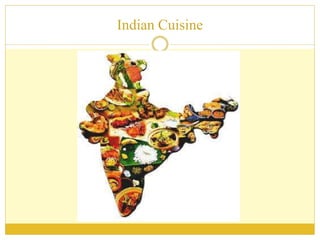
Indian Cuisine
Indian Cuisine
♯ Indian cuisine has been influenced by a 5000
year history of various groups and cultures
interacting with the subcontinent, leading to the
diversity of flavors and regional cuisines found
in modern-day India.
Indian Cuisine
 Pre-Vadic; Indus Valley Civilization:
 Bronze Age civilization (3300–1300 BCE; mature
period 2600–1900 BCE) that was located in the
northwestern region of the Indian Subcontinent
 Early Food Producing Era from 7000- 5500 BCE
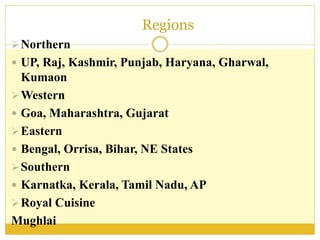
Regions
Northern
 UP, Raj, Kashmir, Punjab, Haryana, Gharwal,
Kumaon
Western
 Goa, Maharashtra, Gujarat
Eastern
 Bengal, Orrisa, Bihar, NE States
Southern
 Karnatka, Kerala, Tamil Nadu, AP
Royal Cuisine
Mughlai
Japanese Cuisine
Emphasis on seasonality of food,
Emphasis on quality of ingredients and
presentation
Based on combining staple foods
A standard meal consists of several different
okazu accompanying a bowl of rice
Different cooking techniques are applied to
each of the three okazu
View of a meal is reflected according to cooking
techniques
Regional Cuisine
Japanese cuisine offers a vast array of regional
specialties known as kyōdo ryōri,
Kanto Region;
 Foods taste very strong ie ”DASHI” SOBA serving with
‘udon’ noodles is heavy on dark soy sauce
Kansai region ;
 foods are lightly seasoned, with clear udon noodles made with
light soy sauce
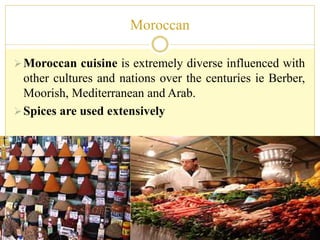
Moroccan
Moroccan cuisine is extremely diverse influenced with
other cultures and nations over the centuries ie Berber,
Moorish, Mediterranean and Arab.
Spices are used extensively
Moroccan
The midday meal is the main meal;
Hot and cold salads; zaalouk,Moroccan spreads
Tagine ; Tunisian tajine
Bread ; Khobz
Lamb and Chicken ; Pastilla, Merguez
Meat and Vegetable ; Couscous
Desserts; kaab el ghzal , Pastili
Cup of sweet mint tea
The consumption of pork and alcohol forbidden
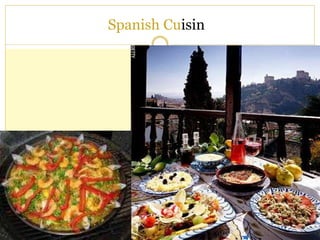
Spanish Cuisine
Spanish Cuisine
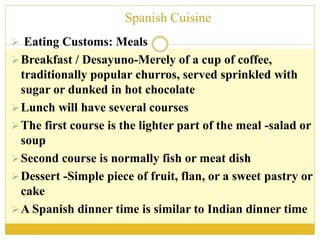
 Eating Customs: Meals
Breakfast / Desayuno-Merely of a cup of coffee,
traditionally popular churros, served sprinkled with
sugar or dunked in hot chocolate
Lunch will have several courses
The first course is the lighter part of the meal -salad or
soup
Second course is normally fish or meat dish
Dessert -Simple piece of fruit, flan, or a sweet pastry or
cake
A Spanish dinner time is similar to Indian dinner time
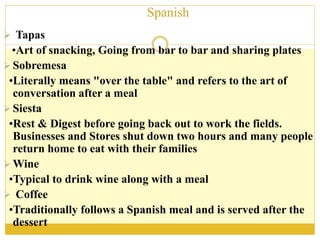
Spanish
 Tapas
•Art of snacking, Going from bar to bar and sharing plates
 Sobremesa
•Literally means "over the table" and refers to the art of
conversation after a meal
 Siesta
•Rest & Digest before going back out to work the fields.
Businesses and Stores shut down two hours and many people
return home to eat with their families
 Wine
•Typical to drink wine along with a meal
 Coffee
•Traditionally follows a Spanish meal and is served after the
dessert
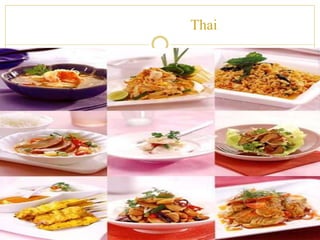
Thai
Appreciation of Thai cuisine
Lightness, heat and passionate smell
Herbs used have a dissimilar scent from western
ones
Herbs are much more aromatic and yield different
flavours in each Thai dish
Thais eat their foods with rice
The experience of having a Thai dinner is a
communal eating
Many dishes are served for all to share
Thai meal composition -
Titbits: Hors d’oeuvres
Salads : A harmony of tastes and herbal flavours
General Fare : A sweet and sour dish
Dips
Soups : Embody more flavourand textures
Curries : Simple and complex
Single dishes : Rice and noodles dishes
Dessert : Uniformly sweet
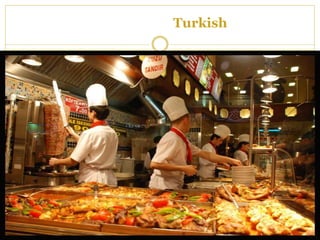
Turkish
Turkish
 Frequently used ingredients are eggplant, lentils,
onions, green pepper, bean, tomato, garlic.
 Grape, apricot, cherry, pine nuts, almond, hazel
nuts, watermelon are the fruits that are mostly used.
Preferred herbs and spices are parsley, thyme,
cumin, pepper, paprika and mint
Turkish
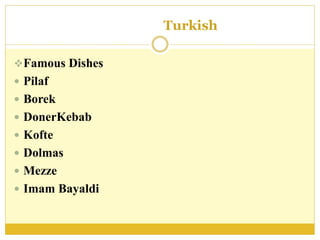
Famous Dishes
 Pilaf
 Borek
 DonerKebab
 Kofte
 Dolmas
 Mezze
 Imam Bayaldi
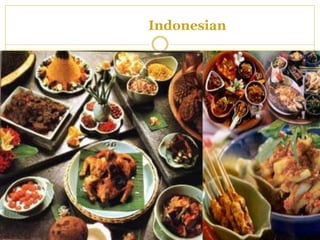
Indonesian
Indonesian
Cuisine is heavily based on rice with
vegetables, meat, fish, eggs and poultry
acting as supplements
Each region or province has its own cuisine,
which varies in the method of cooking and
the ingredients used
The Javanese cuisine generally consists of
vegetables, soybeans, beef and chicken
The Sumatrans generally eat more beef
Indonesian
 To the east, seafood is the most prominent
on the daily diet, either grilled or made into
curries
In Bali, IrianJayaand the highlands of North
Sumatra and North Sulawesi, pork dishes are
specialties
As the majority of the Indonesian population
is Muslim, pork is not usually served
Indonesian
Famous Dishes
 NasiGoreng
 Satay
 GadoGado
 Sambal
 Rendang
 Soto Ayam
 Supuk

International cuisines

  • 1.
    U N IT I – I I . I N T E R N AT I O N A L C U I S I N E S Food Production Management
  • 2.
    Worlds Top 10Cuisines Chinese French Italian Indian Japanese Moroccan Spanish Thai Turkish Indonesian
  • 3.
    Chinese Cuisine ♯ Chinesecuisine culture is extensive and profound ♯ According to records, as early as in the Shang and Zhou dynasties over 3,000 years ago , a fairly complete culinary system was formed ♯ China is a world-renowned "Culinary Kingdom." As one of the six important elements of tourism. "food" is one of the most important component parts of China's abundant tourism resources.
  • 4.
  • 5.
    French Cuisine ♯ Frenchcuisine has evolved extensively over centuries ♯ Rich Cuisine usually accompanied by a number of wines ♯ There are many dishes that are considered part of the nation's national cuisine today
  • 6.
    French Cuisine ♯ Foundation ♯Cheese ♯ Wine ♯ Meat ♯ Duck ♯ Oysters ♯ French classical Menu
  • 7.
    Italian Cuisine ♯ Cuisineknown today has evolved from centuries of social and Political change ♯ Ingredients and dishes very region ♯ Many Significant regional dishes that have become both national and regional
  • 8.
    Italian Cuisine ♯ Aperitivo ♯Antipasto ♯ Primo ♯ Secondo ♯ Contorno ♯ Formmagio e Frutta ♯ Dolce ♯ Caffe ♯ Digestivo
  • 9.
  • 10.
    Indian Cuisine ♯ Indiancuisine has been influenced by a 5000 year history of various groups and cultures interacting with the subcontinent, leading to the diversity of flavors and regional cuisines found in modern-day India.
  • 11.
    Indian Cuisine  Pre-Vadic;Indus Valley Civilization:  Bronze Age civilization (3300–1300 BCE; mature period 2600–1900 BCE) that was located in the northwestern region of the Indian Subcontinent  Early Food Producing Era from 7000- 5500 BCE
  • 12.
    Regions Northern  UP, Raj,Kashmir, Punjab, Haryana, Gharwal, Kumaon Western  Goa, Maharashtra, Gujarat Eastern  Bengal, Orrisa, Bihar, NE States Southern  Karnatka, Kerala, Tamil Nadu, AP Royal Cuisine Mughlai
  • 13.
    Japanese Cuisine Emphasis onseasonality of food, Emphasis on quality of ingredients and presentation Based on combining staple foods A standard meal consists of several different okazu accompanying a bowl of rice Different cooking techniques are applied to each of the three okazu View of a meal is reflected according to cooking techniques
  • 14.
    Regional Cuisine Japanese cuisineoffers a vast array of regional specialties known as kyōdo ryōri, Kanto Region;  Foods taste very strong ie ”DASHI” SOBA serving with ‘udon’ noodles is heavy on dark soy sauce Kansai region ;  foods are lightly seasoned, with clear udon noodles made with light soy sauce
  • 15.
    Moroccan Moroccan cuisine isextremely diverse influenced with other cultures and nations over the centuries ie Berber, Moorish, Mediterranean and Arab. Spices are used extensively
  • 16.
    Moroccan The midday mealis the main meal; Hot and cold salads; zaalouk,Moroccan spreads Tagine ; Tunisian tajine Bread ; Khobz Lamb and Chicken ; Pastilla, Merguez Meat and Vegetable ; Couscous Desserts; kaab el ghzal , Pastili Cup of sweet mint tea The consumption of pork and alcohol forbidden
  • 17.
  • 18.
    Spanish Cuisine  EatingCustoms: Meals Breakfast / Desayuno-Merely of a cup of coffee, traditionally popular churros, served sprinkled with sugar or dunked in hot chocolate Lunch will have several courses The first course is the lighter part of the meal -salad or soup Second course is normally fish or meat dish Dessert -Simple piece of fruit, flan, or a sweet pastry or cake A Spanish dinner time is similar to Indian dinner time
  • 19.
    Spanish  Tapas •Art ofsnacking, Going from bar to bar and sharing plates  Sobremesa •Literally means "over the table" and refers to the art of conversation after a meal  Siesta •Rest & Digest before going back out to work the fields. Businesses and Stores shut down two hours and many people return home to eat with their families  Wine •Typical to drink wine along with a meal  Coffee •Traditionally follows a Spanish meal and is served after the dessert
  • 20.
  • 21.
    Appreciation of Thaicuisine Lightness, heat and passionate smell Herbs used have a dissimilar scent from western ones Herbs are much more aromatic and yield different flavours in each Thai dish Thais eat their foods with rice The experience of having a Thai dinner is a communal eating Many dishes are served for all to share
  • 22.
    Thai meal composition- Titbits: Hors d’oeuvres Salads : A harmony of tastes and herbal flavours General Fare : A sweet and sour dish Dips Soups : Embody more flavourand textures Curries : Simple and complex Single dishes : Rice and noodles dishes Dessert : Uniformly sweet
  • 23.
  • 24.
    Turkish  Frequently usedingredients are eggplant, lentils, onions, green pepper, bean, tomato, garlic.  Grape, apricot, cherry, pine nuts, almond, hazel nuts, watermelon are the fruits that are mostly used. Preferred herbs and spices are parsley, thyme, cumin, pepper, paprika and mint
  • 25.
    Turkish Famous Dishes  Pilaf Borek  DonerKebab  Kofte  Dolmas  Mezze  Imam Bayaldi
  • 26.
  • 27.
    Indonesian Cuisine is heavilybased on rice with vegetables, meat, fish, eggs and poultry acting as supplements Each region or province has its own cuisine, which varies in the method of cooking and the ingredients used The Javanese cuisine generally consists of vegetables, soybeans, beef and chicken The Sumatrans generally eat more beef
  • 28.
    Indonesian  To theeast, seafood is the most prominent on the daily diet, either grilled or made into curries In Bali, IrianJayaand the highlands of North Sumatra and North Sulawesi, pork dishes are specialties As the majority of the Indonesian population is Muslim, pork is not usually served
  • 29.
    Indonesian Famous Dishes  NasiGoreng Satay  GadoGado  Sambal  Rendang  Soto Ayam  Supuk