NAMA NO. MATRIK
YASIN 1161675
RASYID 1161590
NABILA HUDA BINTI EMRAN 1161488
SITI NOR AMIRAH BINTI MOHD AMIRUL MOMIN 1161675
KAK PIPAH 1161509
PRINSIP PENGURUSAN PERNIAGAAN
TITLE :
COMPENSATION SYSTEM
NAMA PENSYARAH :
MUHAMMAD RAHIM BIN DEEN
COMPENSATION
SYSTEM
Describe the main components of
compensation system that firms offer to
employees
Definition
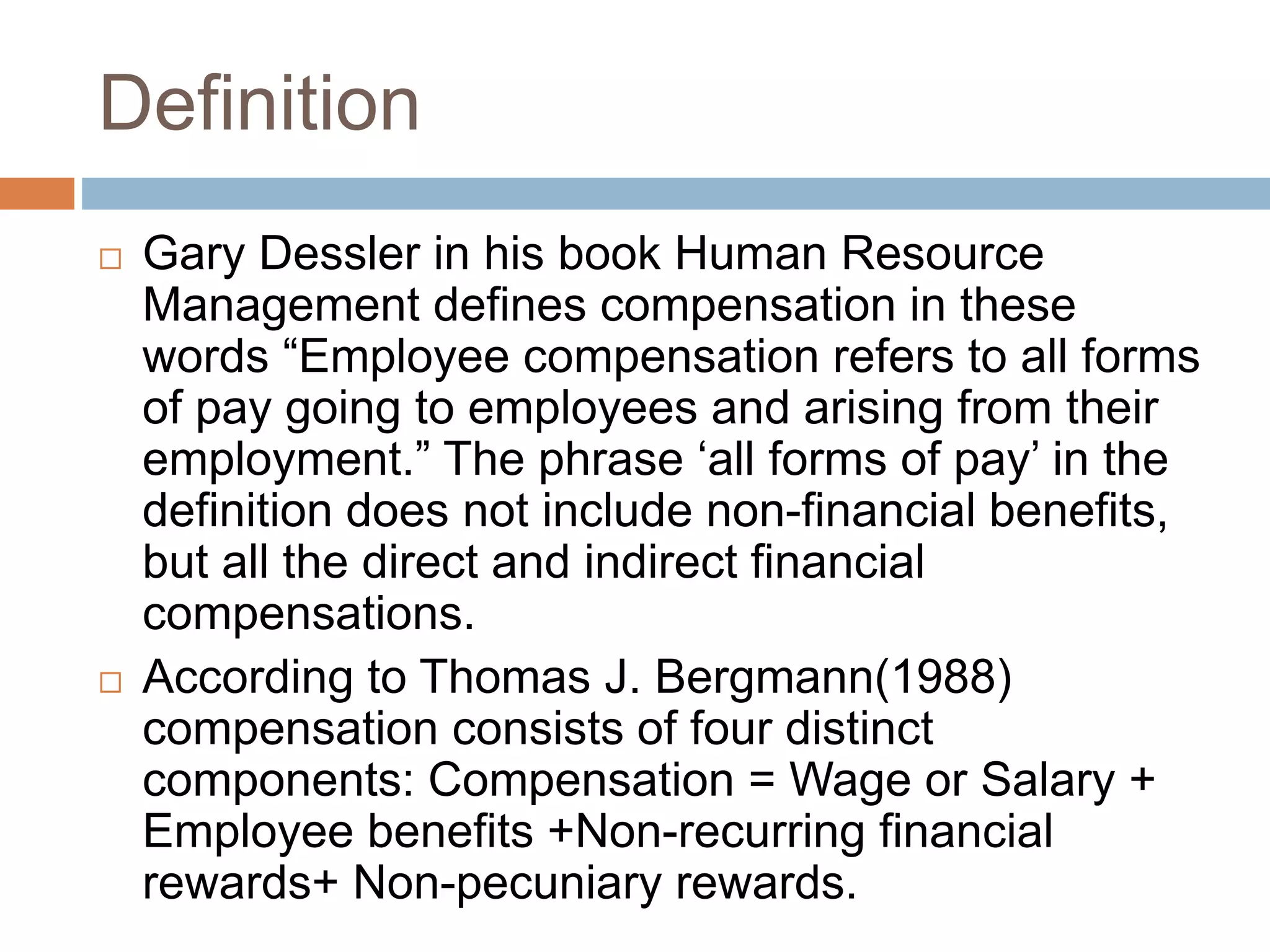
 Gary Dessler in his book Human Resource
Management defines compensation in these
words “Employee compensation refers to all forms
of pay going to employees and arising from their
employment.” The phrase ‘all forms of pay’ in the
definition does not include non-financial benefits,
but all the direct and indirect financial
compensations.
 According to Thomas J. Bergmann(1988)
compensation consists of four distinct
components: Compensation = Wage or Salary +
Employee benefits +Non-recurring financial
rewards+ Non-pecuniary rewards.
The Concept of Compensation
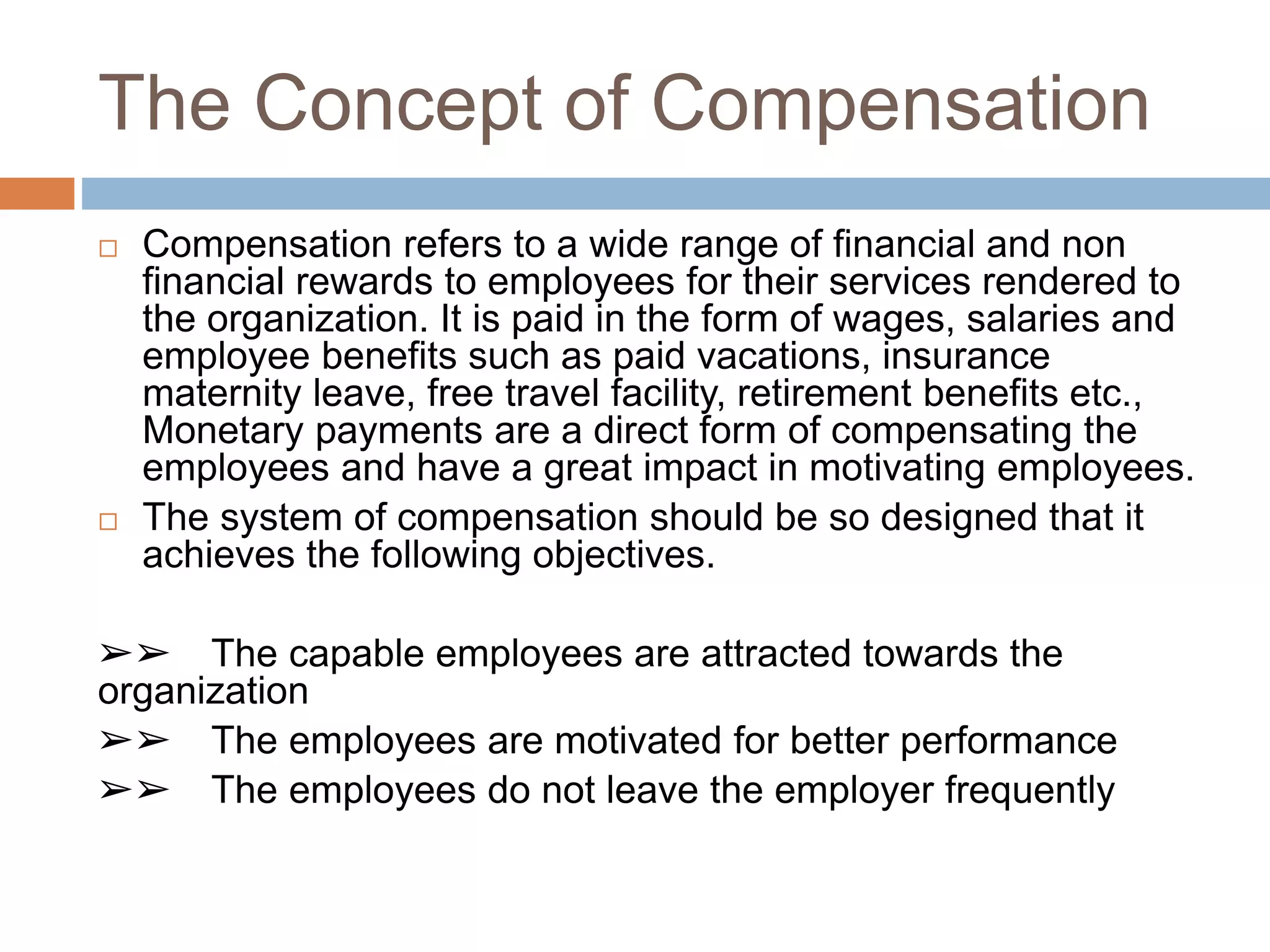
 Compensation refers to a wide range of financial and non
financial rewards to employees for their services rendered to
the organization. It is paid in the form of wages, salaries and
employee benefits such as paid vacations, insurance
maternity leave, free travel facility, retirement benefits etc.,
Monetary payments are a direct form of compensating the
employees and have a great impact in motivating employees.
 The system of compensation should be so designed that it
achieves the following objectives.
➢➢ The capable employees are attracted towards the
organization
➢➢ The employees are motivated for better performance
➢➢ The employees do not leave the employer frequently
Components of Compensation
Basic Wages/Salaries
o Basic wages / salaries refer to the cash
component of the wage structure based on which
other elements of compensation may be
structured. It is normally a fixed amount which is
subject to changes based on annual increments
or subject to periodical pay hikes.
o Wages represent hourly rates of pay, and salary
refers to the monthly rate of pay, irrespective of
the number of hours put in by the employee.
Wages and salaries are subject to the annual
increments. They differ from employee to
employee, and depend upon the nature of job,
seniority, and merit.
Dearness Allowance
 The payment of dearness allowance facilitates
employees and workers to face the price increase
or inflation of prices of goods and services
consumed by him. The onslaught of price
increase has a major bearing on the living
conditions of the labour.
 The increasing prices reduce the compensation to
nothing and the money’s worth is coming down
based on the level of inflation. The payment of
dearness allowance, which may be a fixed
percentage on the basic wage, enables the
employees to face the increasing prices.
Incentives
 Incentives are paid in addition to wages and
salaries and are also called ‘payments by results’.
Incentives depend upon productivity, sales, profit,
or cost reduction efforts.
 There are:
(a) Individual incentive schemes, and
(b) Group incentive programmes.
 Individual incentives are applicable to specific
employee performance. Where a given task
demands group efforts for completion, incentives
are paid to the group as a whole. The amount is
later divided among group members on an
equitable basis.
Bonus
 The bonus can be paid in different ways. It can
be fixed percentage on the basic wage paid
annually or in proportion to the profitability. The
Government also prescribes a minimum
statutory bonus for all employees and workers.
There is also a bonus plan which
compensates the managers and employees
based on the sales revenue or profit margin
achieved. Bonus plans can also be based on
piece wages but depends upon the
productivity of labour.
Non-Monetary Benefits
 These benefits give psychological satisfaction to
employees even when financial benefit is not
available.
 Such benefits are:
(a) Recognition of merit through certificate,
etc. (b) Offering challenging job responsibilities,
(c) Promoting growth prospects,
(d) Comfortable working conditions,
(e) Competent supervision, and
(f) Job sharing and flexi-time.
Commissions
 Commission to managers and employees may
be based on the sales revenue or profits of the
company. It is always a fixed percentage on
the target achieved. For taxation purposes,
commission is again a taxable component of
compensation.
 The payment of commission as a component
of commission is practiced heavily on target
based sales. Depending upon the targets
achieved, companies may pay a commission
on a monthly or periodical basis
Mixed Plans
 Companies may also pay employees and
others a combination of pay as well as
commissions. This plan is called combination
or mixed plan. Apart from the salaries paid, the
employees may be eligible for a fixed
percentage of commission upon achievement
of fixed target of sales or profits or
Performance objectives. Nowadays, most of
the corporate sector is following this practice.
This is also termed as variable component of
compensation.
Piece Rate Wages
 Piece rate wages are prevalent in the
manufacturing wages. The laborers are paid
wages for each of the Quantity produced by
them. The gross earnings of the labour would
be equivalent to number of goods produced by
them. Piece rate wages improves productivity
and is an absolute measurement of
productivity to wage structure. The fairness of
compensation is totally based on the
productivity and not by other qualitative
factors.
Fringe Benefits
 Fringe benefits may be defined as wide range of benefits and
services that employees receive as an integral part of their
total compensation package. They are based on critical job
factors and performance. Fringe benefits constitute indirect
compensation as they are usually extended as a condition of
employment and not directly related to performance of
concerned employee. Fringe benefits are supplements to
regular wages received by the workers at a cost of
employers. They include benefits such as paid vacation,
pension, health and insurance plans, etc. Such benefits are
computable in terms of money and the amount of benefit is
generally not predetermined. The purpose of fringe benefits is
to retain efficient and capable people in the organization over
a long period. They foster loyalty and acts as a security base
for the employees.
Profit Sharing
 Profit-sharing is regarded as a stepping stone to industrial
democracy. Profit-sharing is an agreement by which
employees receive a share, fixed in advance of the profits.
Profitsharing usually involves the determination of an
organization’s profit at the end of the fiscal year and the
distribution of a percentage of the profits to the workers
qualified to share in the earnings. The percentage to be
shared by the workers is often predetermined at the
beginning of the work period and is often communicated to
the workers so that they have some knowledge of their
potential gains. To enable the workers to participate in
profitsharing, they are required to work for certain number of
years and develop some seniority. The theory behind profit-
sharing is that management feels its workers will fulfill their
responsibilities more diligently if they realize that their efforts
may result in higher profits, which will be returned to the
workers through profit-sharing.
Types of Compensation / Base and
Supplementary Compensation
 Total compensation returns are more transactional. They
include pay received directly as cash (like base, merit,
incentives, cost of living adjustments) and indirectly as
benefits (like pensions, medical insurance, programs to help
balance work and life demands, brightly coloured uniforms).
Programme to pay to people can be designed in a wide
variety of ways, and a single employer typically uses more
than one.
 Direct /Base Compensation
 Direct compensation refers to monetary benefits offered and
provided to employees in return of the services they provide
to the organization. The monetary benefits include basic 8
salary, house rent allowance, conveyance, leave travel
allowance, medical reimbursements, special allowances,
bonus, Pf/Gratuity, etc. They are given at a regular interval at
a definite time
 Basic Salary
 Salary is the amount received by the employee in lieu of the work
done by him/her for a certain period say a day, a week, a month,
etc. It is the money an employee receives from his/her employer by
rendering his/her services
 House Rent Allowance
 Organizations either provide accommodations to its employees who
are from different state or country or they provide house rent
allowances to its employees. This is done to provide them social
security and motivate them to work.
 Conveyance
 Organizations provide for cab facilities tto their employees. Few
organizations also provide vehicles and petrol allowances to their
employees to motivate them
 Leave Travel Allowance
 These allowances are provided to retain the best talent in the
organization. The employees are given allowances to visit any place
they wish with their families. The allowances are scaled as per the
position of employee in the organization.
 Medical Reimbursement
 Organizations also look after the health conditions of their employees. The
employees are provided with medi-claims for them and their family
members. These medi-claims include health-insurances and treatment bills
reimbursements.
 Bonus
 Bonus is paid to the employees during festive seasons to motivate them
and provide them the social security. The bonus amount usually amounts to
one month’s salary of the employee. 9
 Special Allowance
 Special allowance such as overtime, mobile allowances, meals,
commissions, travel expenses, reduced interest loans; insurance, club
memberships, etc are provided to employees to provide them social
security and motivate them which improve the organizational productivity
Indirect /Supplementary
CompensationIndirect compensation refers to non-monetary benefits offered and provided to employees in
lieu of the services provided by them to the organization. They include Leave Policy, Overtime
Policy, Car policy, Hospitalization, Insurance, Leave travel Assistance Limits, Retirement
Benefits, Holiday Homes.
 Leave Policy
 It is the right of employee to get adequate number of leave while working with the
organization. The organizations provide for paid leaves such as, casual leaves, medical leaves
(sick leave), and maternity leaves, statutory pay, etc.
 Overtime Policy
 Employees should be provided with the adequate allowances and facilities during their
overtime, if they happened to do so, such as transport facilities, overtime pay, etc.
 Hospitalization
 The employees should be provided allowances to get their regular check-ups, say at an
interval of one year. Even their dependents should be eligible for the medi-claims that
provide them emotional and social security. Indirect Compensation
 Insurance
 Organizations also provide for accidental insurance and life insurance for employees. This
gives them the emotional security and they feel themselves valued in the organization.
 Leave Travel
 The employees are provided with leaves and travel allowances to go for holiday with their
families. Some organizations arrange for a tour for the employees of the organization. This is
usually done to make the employees stress free.
 Retirement Benefits
 Organizations provide for pension plans and other benefits for their employees which
benefits them after they retire from the organization at the prescribed age.
 Holiday Homes
 Organizations provide for holiday homes and guest house for their employees at different
locations. These holiday homes are usually located in hill station and other most wanted
holiday spots. The organizations make sure that the employees do not face any kind of
difficulties during their stay in the guest house.
 Flexible Timings
 Organizations provide for flexible timings to the employees who cannot come to work during
normal shifts due to their personal problems and valid reasons.

Compensation system

  • 1.
    NAMA NO. MATRIK YASIN1161675 RASYID 1161590 NABILA HUDA BINTI EMRAN 1161488 SITI NOR AMIRAH BINTI MOHD AMIRUL MOMIN 1161675 KAK PIPAH 1161509 PRINSIP PENGURUSAN PERNIAGAAN TITLE : COMPENSATION SYSTEM NAMA PENSYARAH : MUHAMMAD RAHIM BIN DEEN
  • 2.
    COMPENSATION SYSTEM Describe the maincomponents of compensation system that firms offer to employees
  • 3.
    Definition  Gary Desslerin his book Human Resource Management defines compensation in these words “Employee compensation refers to all forms of pay going to employees and arising from their employment.” The phrase ‘all forms of pay’ in the definition does not include non-financial benefits, but all the direct and indirect financial compensations.  According to Thomas J. Bergmann(1988) compensation consists of four distinct components: Compensation = Wage or Salary + Employee benefits +Non-recurring financial rewards+ Non-pecuniary rewards.
  • 4.
    The Concept ofCompensation  Compensation refers to a wide range of financial and non financial rewards to employees for their services rendered to the organization. It is paid in the form of wages, salaries and employee benefits such as paid vacations, insurance maternity leave, free travel facility, retirement benefits etc., Monetary payments are a direct form of compensating the employees and have a great impact in motivating employees.  The system of compensation should be so designed that it achieves the following objectives. ➢➢ The capable employees are attracted towards the organization ➢➢ The employees are motivated for better performance ➢➢ The employees do not leave the employer frequently
  • 5.
    Components of Compensation BasicWages/Salaries o Basic wages / salaries refer to the cash component of the wage structure based on which other elements of compensation may be structured. It is normally a fixed amount which is subject to changes based on annual increments or subject to periodical pay hikes. o Wages represent hourly rates of pay, and salary refers to the monthly rate of pay, irrespective of the number of hours put in by the employee. Wages and salaries are subject to the annual increments. They differ from employee to employee, and depend upon the nature of job, seniority, and merit.
  • 6.
    Dearness Allowance  Thepayment of dearness allowance facilitates employees and workers to face the price increase or inflation of prices of goods and services consumed by him. The onslaught of price increase has a major bearing on the living conditions of the labour.  The increasing prices reduce the compensation to nothing and the money’s worth is coming down based on the level of inflation. The payment of dearness allowance, which may be a fixed percentage on the basic wage, enables the employees to face the increasing prices.
  • 7.
    Incentives  Incentives arepaid in addition to wages and salaries and are also called ‘payments by results’. Incentives depend upon productivity, sales, profit, or cost reduction efforts.  There are: (a) Individual incentive schemes, and (b) Group incentive programmes.  Individual incentives are applicable to specific employee performance. Where a given task demands group efforts for completion, incentives are paid to the group as a whole. The amount is later divided among group members on an equitable basis.
  • 8.
    Bonus  The bonuscan be paid in different ways. It can be fixed percentage on the basic wage paid annually or in proportion to the profitability. The Government also prescribes a minimum statutory bonus for all employees and workers. There is also a bonus plan which compensates the managers and employees based on the sales revenue or profit margin achieved. Bonus plans can also be based on piece wages but depends upon the productivity of labour.
  • 9.
    Non-Monetary Benefits  Thesebenefits give psychological satisfaction to employees even when financial benefit is not available.  Such benefits are: (a) Recognition of merit through certificate, etc. (b) Offering challenging job responsibilities, (c) Promoting growth prospects, (d) Comfortable working conditions, (e) Competent supervision, and (f) Job sharing and flexi-time.
  • 10.
    Commissions  Commission tomanagers and employees may be based on the sales revenue or profits of the company. It is always a fixed percentage on the target achieved. For taxation purposes, commission is again a taxable component of compensation.  The payment of commission as a component of commission is practiced heavily on target based sales. Depending upon the targets achieved, companies may pay a commission on a monthly or periodical basis
  • 11.
    Mixed Plans  Companiesmay also pay employees and others a combination of pay as well as commissions. This plan is called combination or mixed plan. Apart from the salaries paid, the employees may be eligible for a fixed percentage of commission upon achievement of fixed target of sales or profits or Performance objectives. Nowadays, most of the corporate sector is following this practice. This is also termed as variable component of compensation.
  • 12.
    Piece Rate Wages Piece rate wages are prevalent in the manufacturing wages. The laborers are paid wages for each of the Quantity produced by them. The gross earnings of the labour would be equivalent to number of goods produced by them. Piece rate wages improves productivity and is an absolute measurement of productivity to wage structure. The fairness of compensation is totally based on the productivity and not by other qualitative factors.
  • 13.
    Fringe Benefits  Fringebenefits may be defined as wide range of benefits and services that employees receive as an integral part of their total compensation package. They are based on critical job factors and performance. Fringe benefits constitute indirect compensation as they are usually extended as a condition of employment and not directly related to performance of concerned employee. Fringe benefits are supplements to regular wages received by the workers at a cost of employers. They include benefits such as paid vacation, pension, health and insurance plans, etc. Such benefits are computable in terms of money and the amount of benefit is generally not predetermined. The purpose of fringe benefits is to retain efficient and capable people in the organization over a long period. They foster loyalty and acts as a security base for the employees.
  • 14.
    Profit Sharing  Profit-sharingis regarded as a stepping stone to industrial democracy. Profit-sharing is an agreement by which employees receive a share, fixed in advance of the profits. Profitsharing usually involves the determination of an organization’s profit at the end of the fiscal year and the distribution of a percentage of the profits to the workers qualified to share in the earnings. The percentage to be shared by the workers is often predetermined at the beginning of the work period and is often communicated to the workers so that they have some knowledge of their potential gains. To enable the workers to participate in profitsharing, they are required to work for certain number of years and develop some seniority. The theory behind profit- sharing is that management feels its workers will fulfill their responsibilities more diligently if they realize that their efforts may result in higher profits, which will be returned to the workers through profit-sharing.
  • 15.
    Types of Compensation/ Base and Supplementary Compensation  Total compensation returns are more transactional. They include pay received directly as cash (like base, merit, incentives, cost of living adjustments) and indirectly as benefits (like pensions, medical insurance, programs to help balance work and life demands, brightly coloured uniforms). Programme to pay to people can be designed in a wide variety of ways, and a single employer typically uses more than one.  Direct /Base Compensation  Direct compensation refers to monetary benefits offered and provided to employees in return of the services they provide to the organization. The monetary benefits include basic 8 salary, house rent allowance, conveyance, leave travel allowance, medical reimbursements, special allowances, bonus, Pf/Gratuity, etc. They are given at a regular interval at a definite time
  • 16.
     Basic Salary Salary is the amount received by the employee in lieu of the work done by him/her for a certain period say a day, a week, a month, etc. It is the money an employee receives from his/her employer by rendering his/her services  House Rent Allowance  Organizations either provide accommodations to its employees who are from different state or country or they provide house rent allowances to its employees. This is done to provide them social security and motivate them to work.  Conveyance  Organizations provide for cab facilities tto their employees. Few organizations also provide vehicles and petrol allowances to their employees to motivate them  Leave Travel Allowance  These allowances are provided to retain the best talent in the organization. The employees are given allowances to visit any place they wish with their families. The allowances are scaled as per the position of employee in the organization.
  • 17.
     Medical Reimbursement Organizations also look after the health conditions of their employees. The employees are provided with medi-claims for them and their family members. These medi-claims include health-insurances and treatment bills reimbursements.  Bonus  Bonus is paid to the employees during festive seasons to motivate them and provide them the social security. The bonus amount usually amounts to one month’s salary of the employee. 9  Special Allowance  Special allowance such as overtime, mobile allowances, meals, commissions, travel expenses, reduced interest loans; insurance, club memberships, etc are provided to employees to provide them social security and motivate them which improve the organizational productivity
  • 18.
    Indirect /Supplementary CompensationIndirect compensationrefers to non-monetary benefits offered and provided to employees in lieu of the services provided by them to the organization. They include Leave Policy, Overtime Policy, Car policy, Hospitalization, Insurance, Leave travel Assistance Limits, Retirement Benefits, Holiday Homes.  Leave Policy  It is the right of employee to get adequate number of leave while working with the organization. The organizations provide for paid leaves such as, casual leaves, medical leaves (sick leave), and maternity leaves, statutory pay, etc.  Overtime Policy  Employees should be provided with the adequate allowances and facilities during their overtime, if they happened to do so, such as transport facilities, overtime pay, etc.  Hospitalization  The employees should be provided allowances to get their regular check-ups, say at an interval of one year. Even their dependents should be eligible for the medi-claims that provide them emotional and social security. Indirect Compensation  Insurance  Organizations also provide for accidental insurance and life insurance for employees. This gives them the emotional security and they feel themselves valued in the organization.
  • 19.
     Leave Travel The employees are provided with leaves and travel allowances to go for holiday with their families. Some organizations arrange for a tour for the employees of the organization. This is usually done to make the employees stress free.  Retirement Benefits  Organizations provide for pension plans and other benefits for their employees which benefits them after they retire from the organization at the prescribed age.  Holiday Homes  Organizations provide for holiday homes and guest house for their employees at different locations. These holiday homes are usually located in hill station and other most wanted holiday spots. The organizations make sure that the employees do not face any kind of difficulties during their stay in the guest house.  Flexible Timings  Organizations provide for flexible timings to the employees who cannot come to work during normal shifts due to their personal problems and valid reasons.