Compensation
Compensation: An Overview
• Compensation: Total rewards provided to
employees in return for services
• Direct financial compensation: Wages,
salaries, bonuses, and commissions
• Indirect financial compensation (benefits):
All other financial rewards
• Nonfinancial compensation: Satisfaction
from job itself or from psychological and/or
physical environment in which employee works
Components of Total Compensation Program
External Environment
Internal Environment
Compensation
Direct
Wages
Salaries
Commissions
Bonuses
Indirect (Benefits)
Legally Required Benefits
Social Security
Unemployment Compensation
Workers’ Compensation
Discretionary Benefits
Payment for Time Not Worked
Health Care
Life Insurance
Retirement Plans
Disability Protection
Employee Stock Option Plans
Employee Services
Premium Pay
Voluntary Benefits
The Job
Meaningful and
Satisfying Job
Recognition for
Accomplishment
Feeling of
Achievement
Possibility of
Increased
Responsibility
Opportunity for
Growth and
Advancement
Enjoy Doing the Job
Job Environment
Sound Policies
Capable Managers
Competent Employees
Congenial Coworkers
Appropriate Status
Symbols
Working Conditions
Workplace Flexibility
Flextime
Compressed Workweek
Job Sharing
Telecommuting
Part-time Work
Financial Nonfinancial
Employee Compensation
Meaning :
Employee compensation refers to the benefits in the
form of cash or vacation that an employee receives in
exchange for the service they provide to their employer.
Employee compensation is generally one of the
largest costs or expenses for any organization. There are
many different types of compensation paid to employees.
The following are the examples of the compensation paid to
employees:
• Cash compensation consisting of wages or salaries
• Retirement plans
• Employer-paid health insurance
• Life insurance
• Paid leave for vacation and sick period
• Disability insurance
Definition of Compensation
“ Compensation means the reward that is
received by an employee for the work performed
in an organization “.
It is an important function of human
resource management. Employees may receive
financial and non-financial compensations for the
work performed by them.
Financial compensation includes salary, bonus,
and all the benefits and incentives, whereas non-
financial compensation includes awards,
rewards, citation, praise, recognition, which can
motivate the employees towards highest
productivity.
Definition of Compensation
• According to Gary Dessler defines
compensation in the following words ,
"Employee compensation refers to all
forms of pay going to employees and
arising from their employment. But the
phase 'all forms of pay' in the definition not
includes non-financial benefits, but all the
direct and indirect financial compensations.
• Compensation refers to exchange, but in
monetary terms. Compensation is the
employer's response for an employee's
work. It simply is the monetary value that
the employer gives it to his employees in
return of their services.
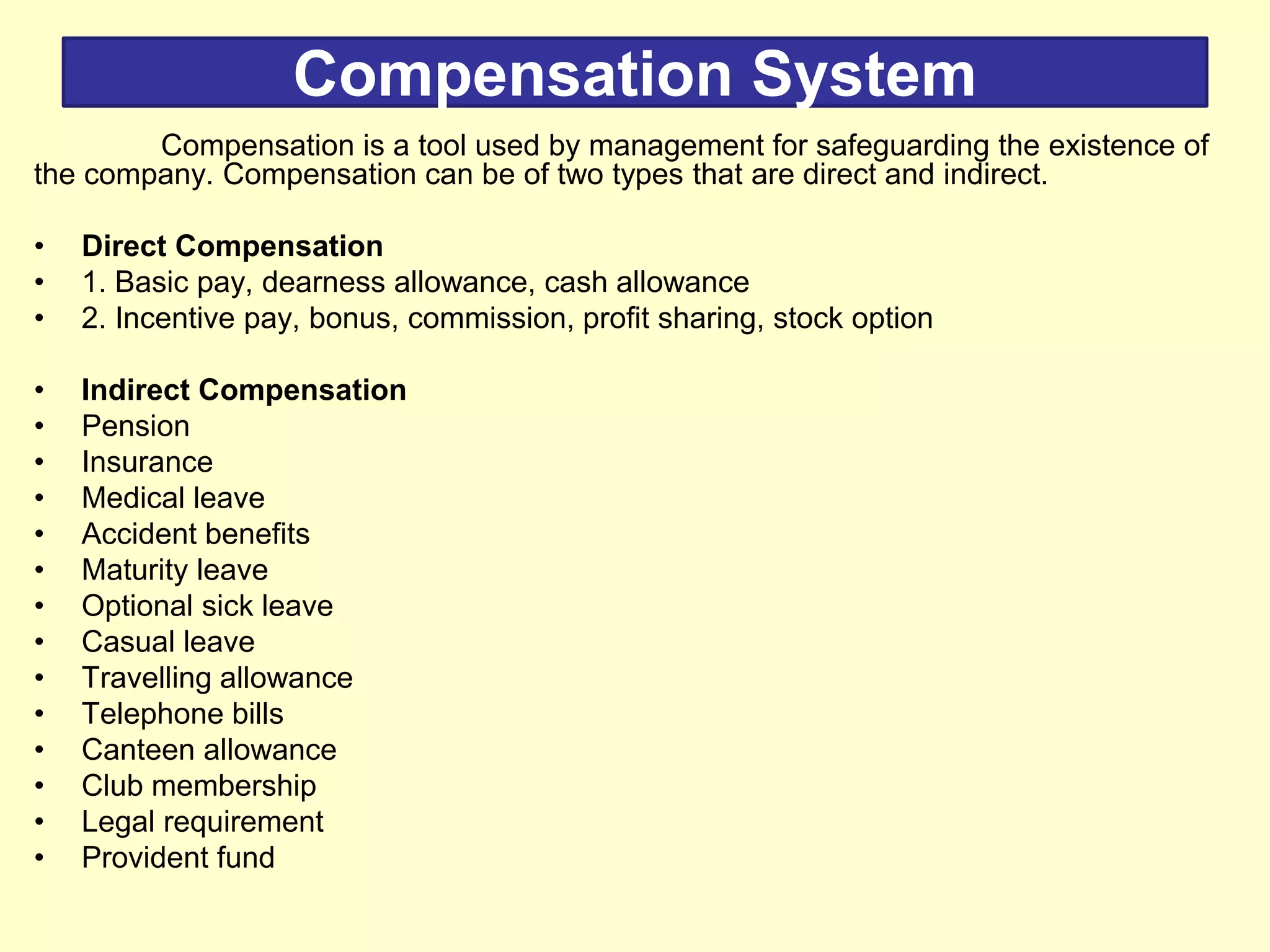
Compensation System
Compensation is a tool used by management for safeguarding the existence of
the company. Compensation can be of two types that are direct and indirect.
• Direct Compensation
• 1. Basic pay, dearness allowance, cash allowance
• 2. Incentive pay, bonus, commission, profit sharing, stock option
• Indirect Compensation
• Pension
• Insurance
• Medical leave
• Accident benefits
• Maturity leave
• Optional sick leave
• Casual leave
• Travelling allowance
• Telephone bills
• Canteen allowance
• Club membership
• Legal requirement
• Provident fund
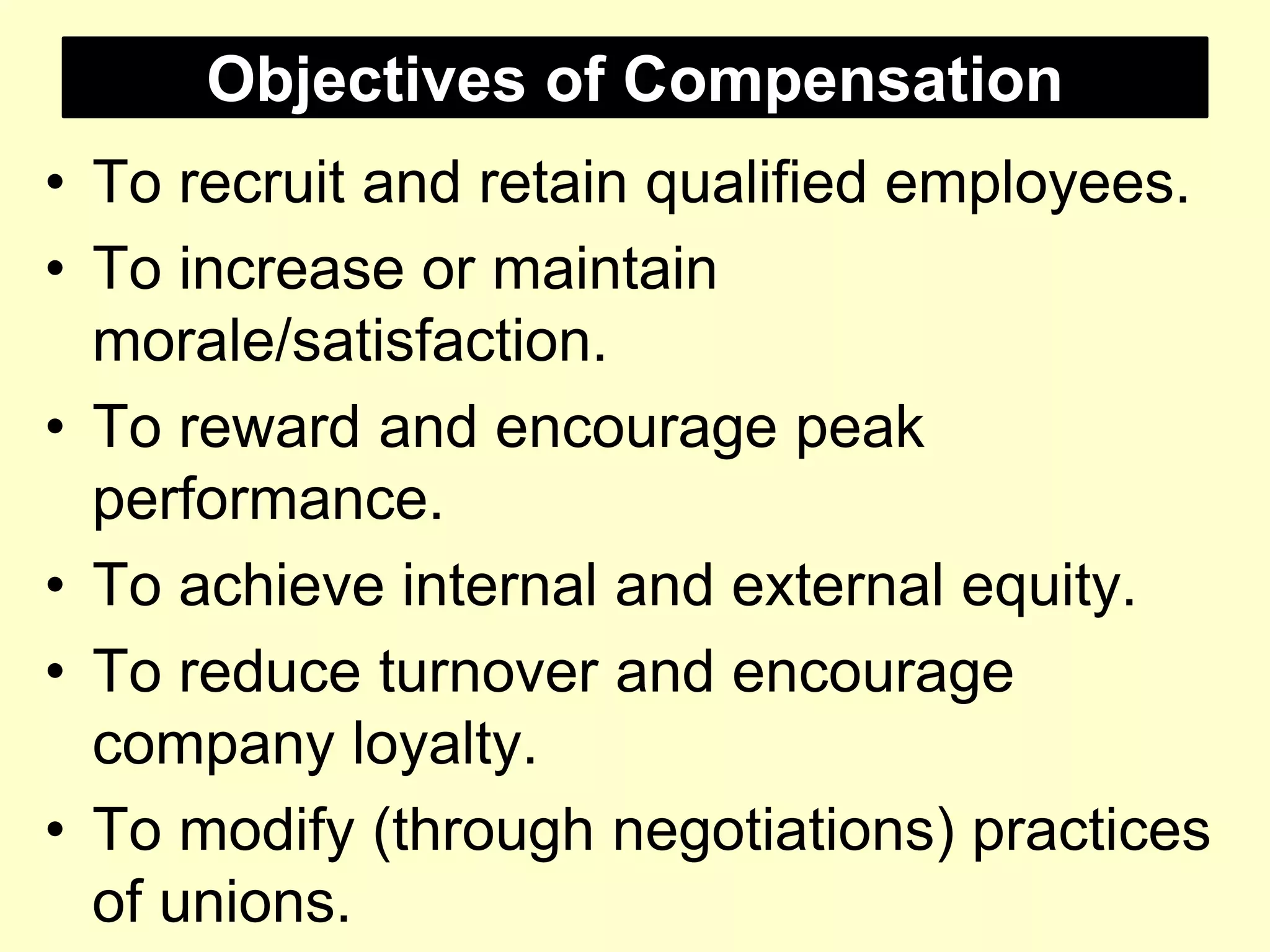
Objectives of Compensation
• To recruit and retain qualified employees.
• To increase or maintain
morale/satisfaction.
• To reward and encourage peak
performance.
• To achieve internal and external equity.
• To reduce turnover and encourage
company loyalty.
• To modify (through negotiations) practices
of unions.
ADVANTAGES / BENEFITS OF COMPENSATION
Increases self-confidence: Compensation will also increase
the self-confidence of workforce; they feel secure if they get
adequate compensation from their employer or from
organisation to some extent. It will be the cause of good
relationship between employer and employee.
Less Absenteeism: In case if employees enjoy the office
environment and if they are happy with their salary structure and
get what they need, then there won’t be any absenteeism. If
there is no absenteeism , then there will a good progress and it
is possible to achieve more productivity.
Low Turnover: If good compensation structure exists in
organisation, if it is reasonable then surely it won’t create any
effect on employee turnover. If really the employees are satisfied
with their pay, if they believe there is no exploitation then they
won’t think to go out from that company. Therefore, satisfied
compensation structure always retains the employees to stay
under one institution for a longer period.
ADVANTAGES / BENEFITS OF COMPENSATION
• Motivation: Employees have different kinds of
needs. Some of them wants higher pay, some one
expects value achievement more than money; they
would associate themselves with firms which offer
greater chances of promotion, learning and
development. A compensation plan that fulfils
employee’s needs is certain aspects to motivate
them to act in the desired way.
• Job satisfaction: Employees would be happy with
their jobs and would love to work for organisation if
they get fair rewards in exchange of their services.
• Peace of Mind: if an organisation offering several
types of insurances to employees then the
employees or workers will get some kind of relieves
from certain fears and it leads them to get peace of
mind.
Meaning of Fringe Benefits
• It means, “An extra benefit supplementing
an employee's money wage or salary, for
example a company car, private health
care, etc.”
• According to Merriam Webster, fringe
benefit is nothing but “it is an employment
benefit (as a pension or a paid holiday)
granted by an employer that has a
monetary value but does not affect basic
wage rates”.
• In simple words, fringe benefit means,
“Something extra (such as vacation time)
that is given by an employer to workers in
addition to their regular pay”.
Objectives of Fringe Benefits
• To promote employee’s welfare by providing welfare
measures
• To create a sense of belongingness among employees
and to retain them. Therefore, fringe benefits are called
golden hand-cuffs.
• To meet necessities of various legislations relating to
fringe benefits.
• To protect the health of the employees
• To provide safety against accidents
• To create and improve sound industrial relations
• To improve employee morale
• To motivate the employees by identifying and satisfying
their unsatisfied needs.
• To provide qualitative work environment and work life.
• To provide security against social risks like old age
benefits and maternity benefits.
Type of fringe benefits
• Health Protection
Benefits under this heading, includes accident
insurance, disability insurance, health insurance,
hospitalization, life insurance, medical care, sick
benefits, sick leave, etc.
• Employment Security
Under this type of benefit , fringe benefit includes
unemployment, insurance, technological adjustment
pay, leave travel pay, overtime pay, level for
negotiation, leave for maternity, leave for grievances,
holidays, cost of living bonus, call-back pay, lay-off,
retiring rooms, jobs to the sons/daughters of the
employees and etc.,
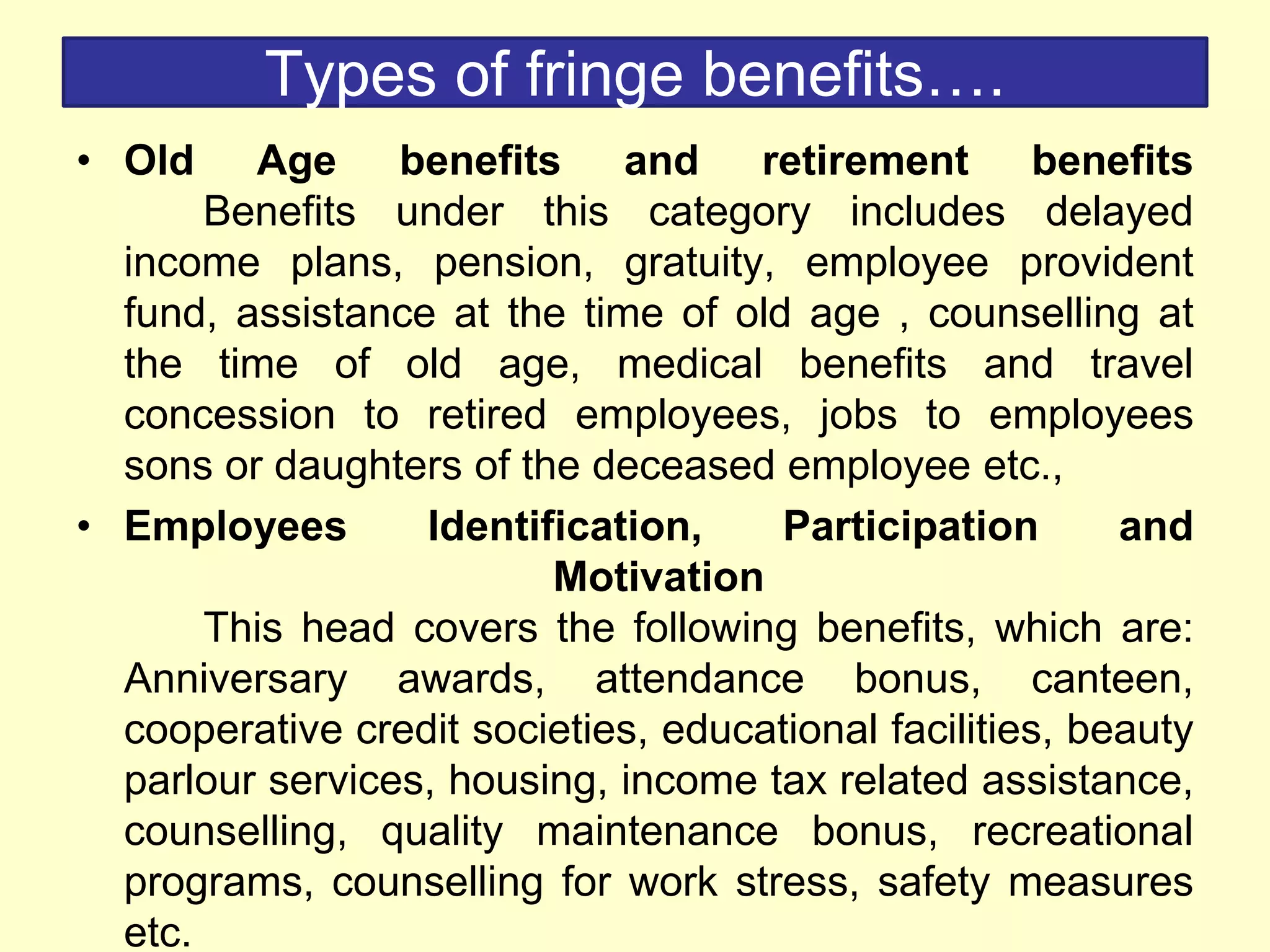
Types of fringe benefits….
• Old Age benefits and retirement benefits
Benefits under this category includes delayed
income plans, pension, gratuity, employee provident
fund, assistance at the time of old age , counselling at
the time of old age, medical benefits and travel
concession to retired employees, jobs to employees
sons or daughters of the deceased employee etc.,
• Employees Identification, Participation and
Motivation
This head covers the following benefits, which are:
Anniversary awards, attendance bonus, canteen,
cooperative credit societies, educational facilities, beauty
parlour services, housing, income tax related assistance,
counselling, quality maintenance bonus, recreational
programs, counselling for work stress, safety measures
etc.
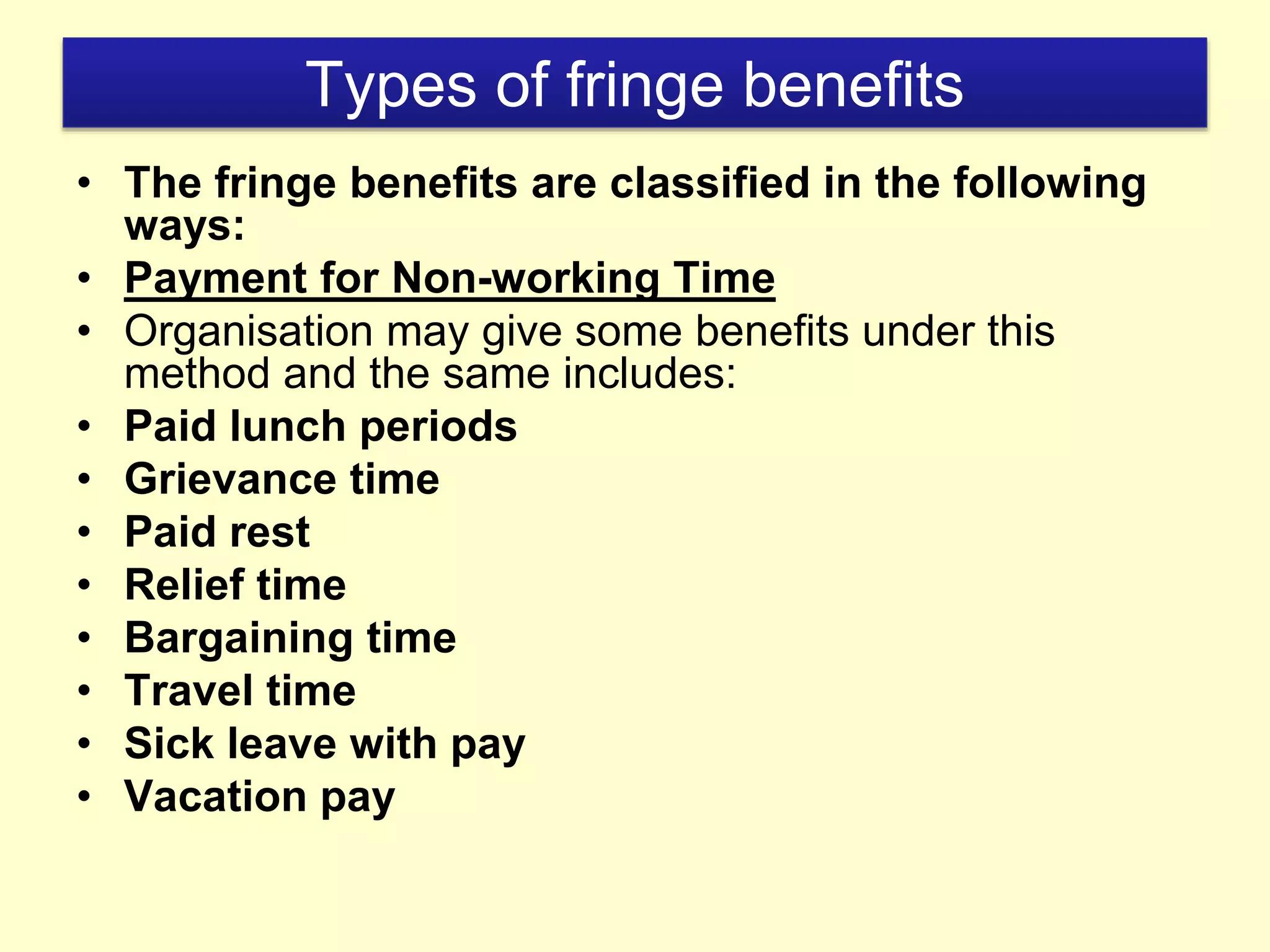
Types of fringe benefits
• The fringe benefits are classified in the following
ways:
• Payment for Non-working Time
• Organisation may give some benefits under this
method and the same includes:
• Paid lunch periods
• Grievance time
• Paid rest
• Relief time
• Bargaining time
• Travel time
• Sick leave with pay
• Vacation pay
Types of fringe benefits
• Extra Pay for time Worked
• This category of fringe benefit covers the following:
• Profit sharing
• Unemployment compensation
• Christmas bonus
• Food cost subsidy
• Housing subsidy
• Recreation
• Premium pay
• Incentive bonus
• Shift premium
• Old age insurance
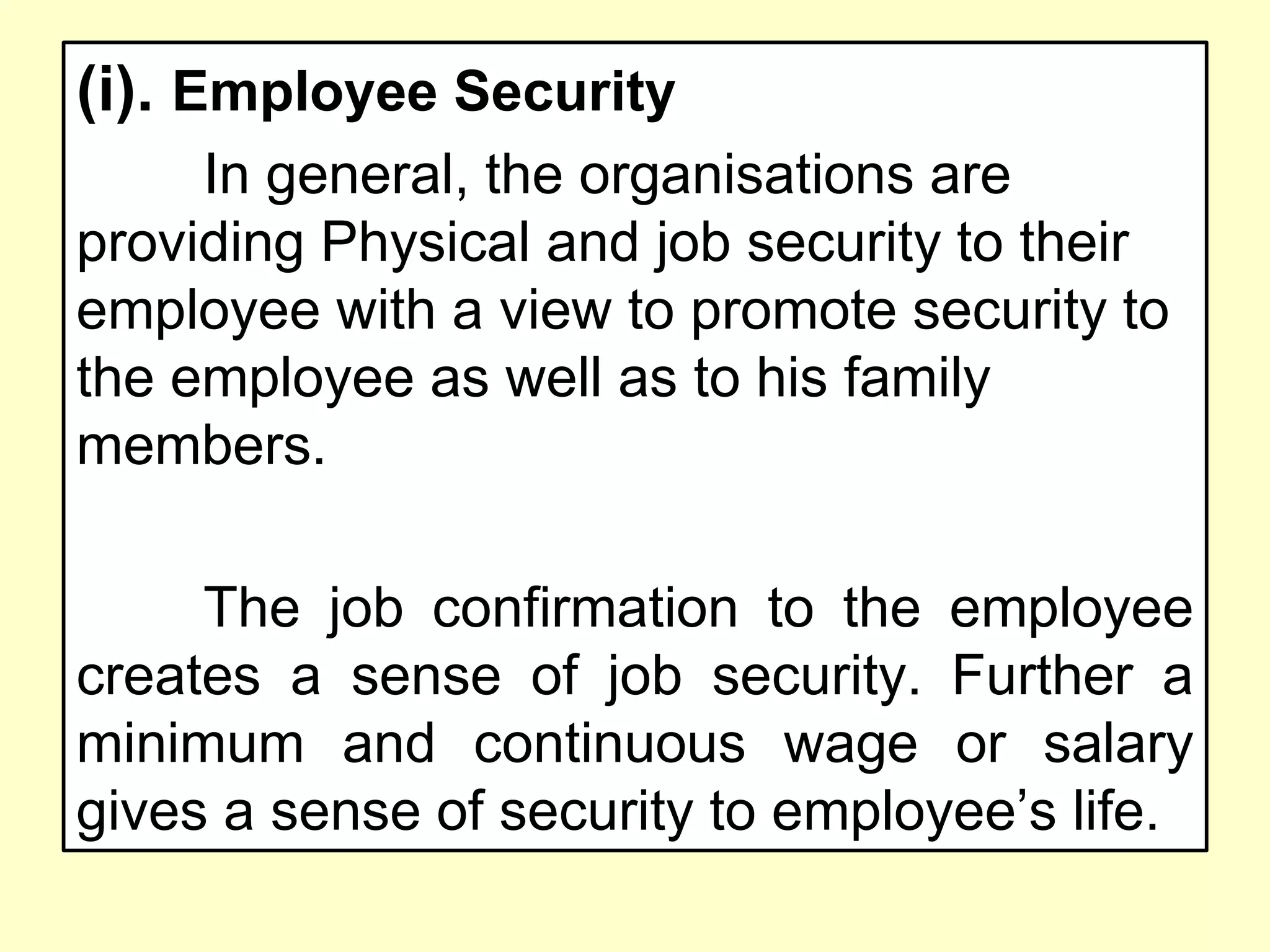
(i). Employee Security
In general, the organisations are
providing Physical and job security to their
employee with a view to promote security to
the employee as well as to his family
members.
The job confirmation to the employee
creates a sense of job security. Further a
minimum and continuous wage or salary
gives a sense of security to employee’s life.
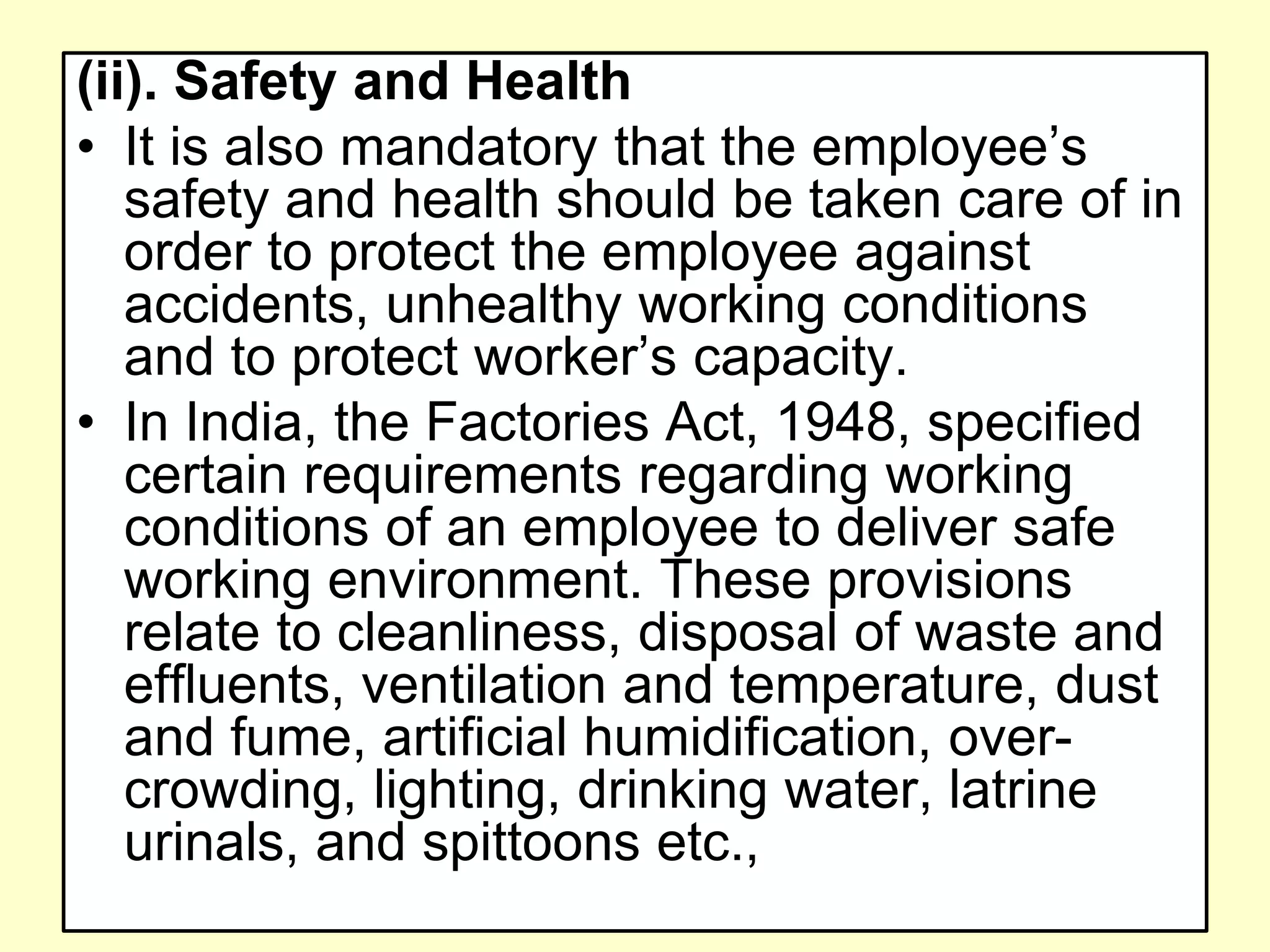
(ii). Safety and Health
• It is also mandatory that the employee’s
safety and health should be taken care of in
order to protect the employee against
accidents, unhealthy working conditions
and to protect worker’s capacity.
• In India, the Factories Act, 1948, specified
certain requirements regarding working
conditions of an employee to deliver safe
working environment. These provisions
relate to cleanliness, disposal of waste and
effluents, ventilation and temperature, dust
and fume, artificial humidification, over-
crowding, lighting, drinking water, latrine
urinals, and spittoons etc.,
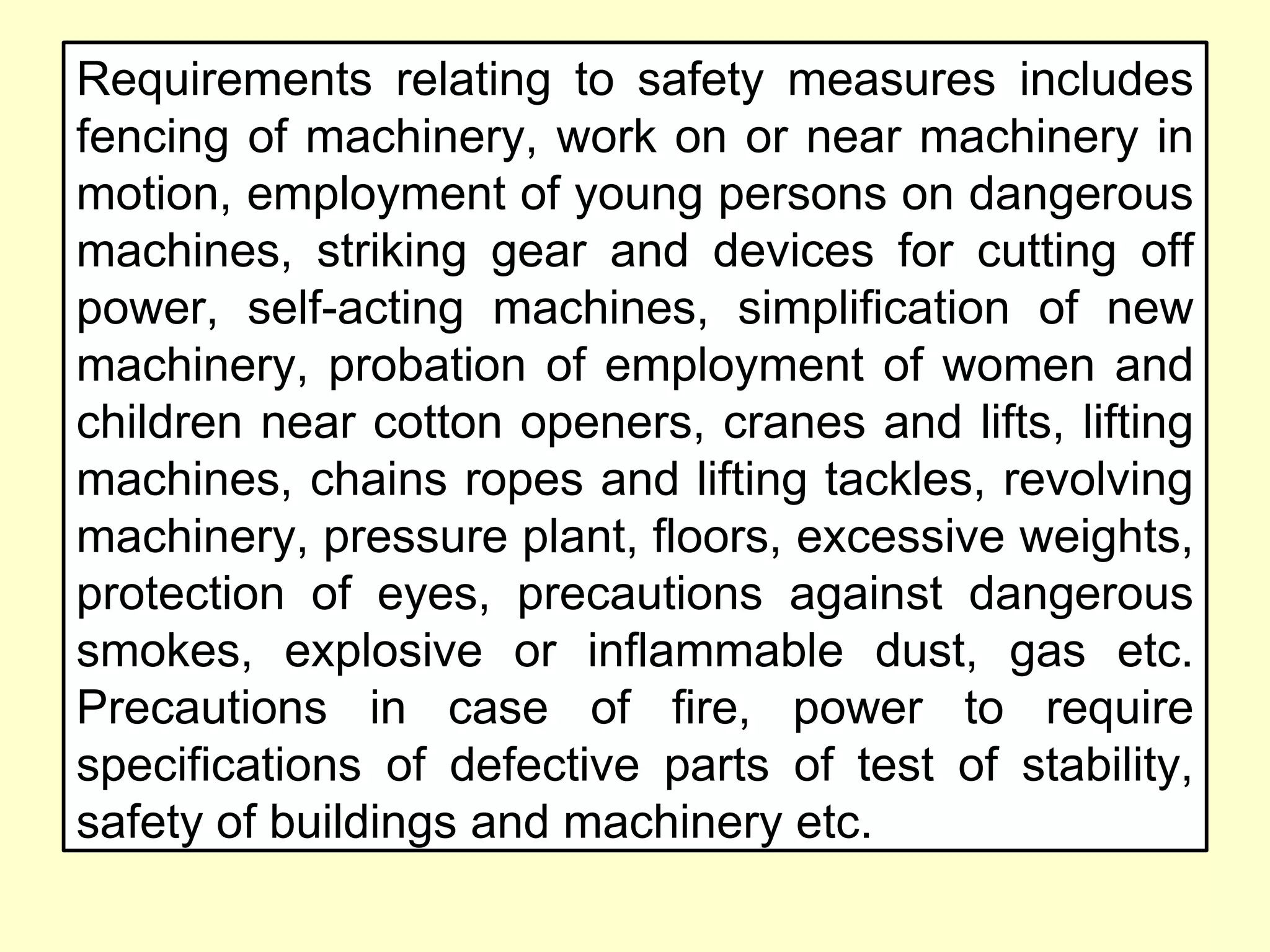
Requirements relating to safety measures includes
fencing of machinery, work on or near machinery in
motion, employment of young persons on dangerous
machines, striking gear and devices for cutting off
power, self-acting machines, simplification of new
machinery, probation of employment of women and
children near cotton openers, cranes and lifts, lifting
machines, chains ropes and lifting tackles, revolving
machinery, pressure plant, floors, excessive weights,
protection of eyes, precautions against dangerous
smokes, explosive or inflammable dust, gas etc.
Precautions in case of fire, power to require
specifications of defective parts of test of stability,
safety of buildings and machinery etc.
(iii). Lay-off Compensation
Under this benefit, at the time of lay-off, employees are
entitled to get lay-off compensation at the rate to half of the
total of the basic wage and dearness allowance for the period
of their lay-off except for weekly holidays. Lay-off
compensation can normally be paid up to 45 days in a year.
(iv). Retrenchment Compensation
According to Industrial Disputes Act, 1947, the act
insists to provide payment of compensation in case of lay-off
and retrenchment. If non-seasonal industrial establishments
employing 50 or more than 50 workers then it has to give one
month’s notice or one month’s wages to all the workers who
are retrenched after one year’s continuous service. The
compensation should be paid at the rate of 15 days wage for
every completed year of service with a maximum of 45 days
wage in a year. Workers are eligible for getting compensation
as stated above even in case of closing down of
establishments.
Indirect Financial Compensation (Benefits)
in a Total Compensation Program
External Environment
Internal Environment
Compensation
Indirect (Benefits)
Legally Required Benefits
Social Security
Unemployment Compensation
Workers’ Compensation
Discretionary Benefits
Payment for Time Not Worked
Health Care
Life Insurance
Retirement Plans
Disability Protection
Employee Stock Option Plans
Employee Services
Premium Pay
Voluntary Benefits
Financial Nonfinancial
The Job Job Environment
Direct
Mandated Benefits
(Legally Required)
• Social Security
• Unemployment
compensation
• Workers’
compensation

Compensation ch 8.ppt

  • 1.
  • 2.
    Compensation: An Overview •Compensation: Total rewards provided to employees in return for services • Direct financial compensation: Wages, salaries, bonuses, and commissions • Indirect financial compensation (benefits): All other financial rewards • Nonfinancial compensation: Satisfaction from job itself or from psychological and/or physical environment in which employee works
  • 3.
    Components of TotalCompensation Program External Environment Internal Environment Compensation Direct Wages Salaries Commissions Bonuses Indirect (Benefits) Legally Required Benefits Social Security Unemployment Compensation Workers’ Compensation Discretionary Benefits Payment for Time Not Worked Health Care Life Insurance Retirement Plans Disability Protection Employee Stock Option Plans Employee Services Premium Pay Voluntary Benefits The Job Meaningful and Satisfying Job Recognition for Accomplishment Feeling of Achievement Possibility of Increased Responsibility Opportunity for Growth and Advancement Enjoy Doing the Job Job Environment Sound Policies Capable Managers Competent Employees Congenial Coworkers Appropriate Status Symbols Working Conditions Workplace Flexibility Flextime Compressed Workweek Job Sharing Telecommuting Part-time Work Financial Nonfinancial
  • 4.
    Employee Compensation Meaning : Employeecompensation refers to the benefits in the form of cash or vacation that an employee receives in exchange for the service they provide to their employer. Employee compensation is generally one of the largest costs or expenses for any organization. There are many different types of compensation paid to employees. The following are the examples of the compensation paid to employees: • Cash compensation consisting of wages or salaries • Retirement plans • Employer-paid health insurance • Life insurance • Paid leave for vacation and sick period • Disability insurance
  • 5.
    Definition of Compensation “Compensation means the reward that is received by an employee for the work performed in an organization “. It is an important function of human resource management. Employees may receive financial and non-financial compensations for the work performed by them. Financial compensation includes salary, bonus, and all the benefits and incentives, whereas non- financial compensation includes awards, rewards, citation, praise, recognition, which can motivate the employees towards highest productivity.
  • 6.
    Definition of Compensation •According to Gary Dessler defines compensation in the following words , "Employee compensation refers to all forms of pay going to employees and arising from their employment. But the phase 'all forms of pay' in the definition not includes non-financial benefits, but all the direct and indirect financial compensations. • Compensation refers to exchange, but in monetary terms. Compensation is the employer's response for an employee's work. It simply is the monetary value that the employer gives it to his employees in return of their services.
  • 7.
    Compensation System Compensation isa tool used by management for safeguarding the existence of the company. Compensation can be of two types that are direct and indirect. • Direct Compensation • 1. Basic pay, dearness allowance, cash allowance • 2. Incentive pay, bonus, commission, profit sharing, stock option • Indirect Compensation • Pension • Insurance • Medical leave • Accident benefits • Maturity leave • Optional sick leave • Casual leave • Travelling allowance • Telephone bills • Canteen allowance • Club membership • Legal requirement • Provident fund
  • 8.
    Objectives of Compensation •To recruit and retain qualified employees. • To increase or maintain morale/satisfaction. • To reward and encourage peak performance. • To achieve internal and external equity. • To reduce turnover and encourage company loyalty. • To modify (through negotiations) practices of unions.
  • 9.
    ADVANTAGES / BENEFITSOF COMPENSATION Increases self-confidence: Compensation will also increase the self-confidence of workforce; they feel secure if they get adequate compensation from their employer or from organisation to some extent. It will be the cause of good relationship between employer and employee. Less Absenteeism: In case if employees enjoy the office environment and if they are happy with their salary structure and get what they need, then there won’t be any absenteeism. If there is no absenteeism , then there will a good progress and it is possible to achieve more productivity. Low Turnover: If good compensation structure exists in organisation, if it is reasonable then surely it won’t create any effect on employee turnover. If really the employees are satisfied with their pay, if they believe there is no exploitation then they won’t think to go out from that company. Therefore, satisfied compensation structure always retains the employees to stay under one institution for a longer period.
  • 10.
    ADVANTAGES / BENEFITSOF COMPENSATION • Motivation: Employees have different kinds of needs. Some of them wants higher pay, some one expects value achievement more than money; they would associate themselves with firms which offer greater chances of promotion, learning and development. A compensation plan that fulfils employee’s needs is certain aspects to motivate them to act in the desired way. • Job satisfaction: Employees would be happy with their jobs and would love to work for organisation if they get fair rewards in exchange of their services. • Peace of Mind: if an organisation offering several types of insurances to employees then the employees or workers will get some kind of relieves from certain fears and it leads them to get peace of mind.
  • 11.
    Meaning of FringeBenefits • It means, “An extra benefit supplementing an employee's money wage or salary, for example a company car, private health care, etc.” • According to Merriam Webster, fringe benefit is nothing but “it is an employment benefit (as a pension or a paid holiday) granted by an employer that has a monetary value but does not affect basic wage rates”. • In simple words, fringe benefit means, “Something extra (such as vacation time) that is given by an employer to workers in addition to their regular pay”.
  • 12.
    Objectives of FringeBenefits • To promote employee’s welfare by providing welfare measures • To create a sense of belongingness among employees and to retain them. Therefore, fringe benefits are called golden hand-cuffs. • To meet necessities of various legislations relating to fringe benefits. • To protect the health of the employees • To provide safety against accidents • To create and improve sound industrial relations • To improve employee morale • To motivate the employees by identifying and satisfying their unsatisfied needs. • To provide qualitative work environment and work life. • To provide security against social risks like old age benefits and maternity benefits.
  • 13.
    Type of fringebenefits • Health Protection Benefits under this heading, includes accident insurance, disability insurance, health insurance, hospitalization, life insurance, medical care, sick benefits, sick leave, etc. • Employment Security Under this type of benefit , fringe benefit includes unemployment, insurance, technological adjustment pay, leave travel pay, overtime pay, level for negotiation, leave for maternity, leave for grievances, holidays, cost of living bonus, call-back pay, lay-off, retiring rooms, jobs to the sons/daughters of the employees and etc.,
  • 14.
    Types of fringebenefits…. • Old Age benefits and retirement benefits Benefits under this category includes delayed income plans, pension, gratuity, employee provident fund, assistance at the time of old age , counselling at the time of old age, medical benefits and travel concession to retired employees, jobs to employees sons or daughters of the deceased employee etc., • Employees Identification, Participation and Motivation This head covers the following benefits, which are: Anniversary awards, attendance bonus, canteen, cooperative credit societies, educational facilities, beauty parlour services, housing, income tax related assistance, counselling, quality maintenance bonus, recreational programs, counselling for work stress, safety measures etc.
  • 15.
    Types of fringebenefits • The fringe benefits are classified in the following ways: • Payment for Non-working Time • Organisation may give some benefits under this method and the same includes: • Paid lunch periods • Grievance time • Paid rest • Relief time • Bargaining time • Travel time • Sick leave with pay • Vacation pay
  • 16.
    Types of fringebenefits • Extra Pay for time Worked • This category of fringe benefit covers the following: • Profit sharing • Unemployment compensation • Christmas bonus • Food cost subsidy • Housing subsidy • Recreation • Premium pay • Incentive bonus • Shift premium • Old age insurance
  • 17.
    (i). Employee Security Ingeneral, the organisations are providing Physical and job security to their employee with a view to promote security to the employee as well as to his family members. The job confirmation to the employee creates a sense of job security. Further a minimum and continuous wage or salary gives a sense of security to employee’s life.
  • 18.
    (ii). Safety andHealth • It is also mandatory that the employee’s safety and health should be taken care of in order to protect the employee against accidents, unhealthy working conditions and to protect worker’s capacity. • In India, the Factories Act, 1948, specified certain requirements regarding working conditions of an employee to deliver safe working environment. These provisions relate to cleanliness, disposal of waste and effluents, ventilation and temperature, dust and fume, artificial humidification, over- crowding, lighting, drinking water, latrine urinals, and spittoons etc.,
  • 19.
    Requirements relating tosafety measures includes fencing of machinery, work on or near machinery in motion, employment of young persons on dangerous machines, striking gear and devices for cutting off power, self-acting machines, simplification of new machinery, probation of employment of women and children near cotton openers, cranes and lifts, lifting machines, chains ropes and lifting tackles, revolving machinery, pressure plant, floors, excessive weights, protection of eyes, precautions against dangerous smokes, explosive or inflammable dust, gas etc. Precautions in case of fire, power to require specifications of defective parts of test of stability, safety of buildings and machinery etc.
  • 20.
    (iii). Lay-off Compensation Underthis benefit, at the time of lay-off, employees are entitled to get lay-off compensation at the rate to half of the total of the basic wage and dearness allowance for the period of their lay-off except for weekly holidays. Lay-off compensation can normally be paid up to 45 days in a year. (iv). Retrenchment Compensation According to Industrial Disputes Act, 1947, the act insists to provide payment of compensation in case of lay-off and retrenchment. If non-seasonal industrial establishments employing 50 or more than 50 workers then it has to give one month’s notice or one month’s wages to all the workers who are retrenched after one year’s continuous service. The compensation should be paid at the rate of 15 days wage for every completed year of service with a maximum of 45 days wage in a year. Workers are eligible for getting compensation as stated above even in case of closing down of establishments.
  • 21.
    Indirect Financial Compensation(Benefits) in a Total Compensation Program External Environment Internal Environment Compensation Indirect (Benefits) Legally Required Benefits Social Security Unemployment Compensation Workers’ Compensation Discretionary Benefits Payment for Time Not Worked Health Care Life Insurance Retirement Plans Disability Protection Employee Stock Option Plans Employee Services Premium Pay Voluntary Benefits Financial Nonfinancial The Job Job Environment Direct
  • 22.
    Mandated Benefits (Legally Required) •Social Security • Unemployment compensation • Workers’ compensation