Presentation By: Yogesh

1
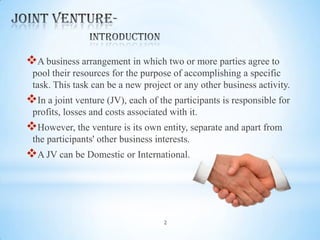
A business arrangement in which two or more parties agree to
pool their resources for the purpose of accomplishing a specific
task. This task can be a new project or any other business activity.

In a joint venture (JV), each of the participants is responsible for
profits, losses and costs associated with it.

However, the venture is its own entity, separate and apart from
the participants' other business interests.

A JV can be Domestic or International.

2
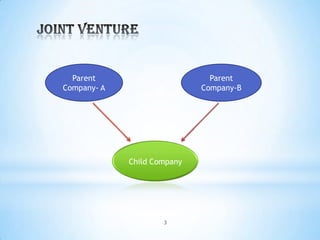
Parent
Company- A

Parent
Company-B

Child Company

3
 Financial Resources can be shared
Fund can be generate together for bigger investment

 Reduction of Business Risk
A JV allows Investor Diversification
A JV reduces Local Friction

 Economies Of Scale
A JV can be used to reduce Fixed cost per Product

 Control Over Functional Activities
A JV allows for direct Management of Business Activities

4
 Sharing Technology and Management skills
The Competitive strengths of two parties can be combined
Higher profitability

 Market Penetration
A local JV partner knows the market

Rapid sales growth

 Host Country Incentives
Economics incentives add value to JV

5
 Investment risk. although initial investment in JV need not necessarily
be high.

 JV Profits are shared
Conflict could be there in cash distribution

 Shared Technologies can be used beyond the JV
 The management Process may be fraught with difficulties and
conflicts (which happen more often in JV)

 Local Management of an JV can be an unknown
 The possibility that JV may have over estimated as a form of
international business activity.

6
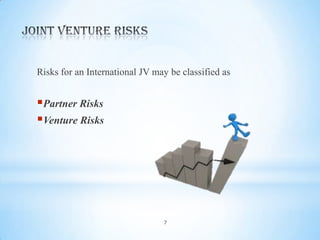
Risks for an International JV may be classified as

Partner Risks
Venture Risks

7
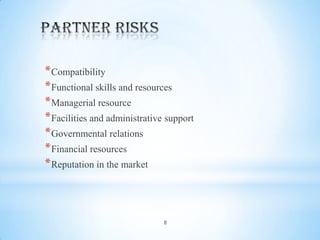
* Compatibility
* Functional skills and resources
* Managerial resource
* Facilities and administrative support
* Governmental relations
* Financial resources
* Reputation in the market

8
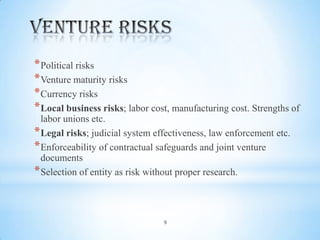
* Political risks
* Venture maturity risks
* Currency risks
* Local business risks; labor cost, manufacturing cost. Strengths of
labor unions etc.
* Legal risks; judicial system effectiveness, law enforcement etc.
* Enforceability of contractual safeguards and joint venture
documents
* Selection of entity as risk without proper research.

9
* IJV is a efficient and cost effective ways to enter foreign markets.
* It allow companies to share risks and exploit synergies with partner
companies.

* A IJVs can provide access to unique business opportunities and new
geographic markets that may not otherwise be available, especially to
smaller and medium sized businesses.

* Companies should be aware of the limitations and risks inherent in the
IJV, and they should take advantage of some of the painful lessons
learned over the years.

* A careful planning, a thoughtful structure and a willingness to remain
flexible during the life of the venture are critical to increasing the
chances of success.

10
11

International Joint Venture

  • 1.
  • 2.
    A business arrangementin which two or more parties agree to pool their resources for the purpose of accomplishing a specific task. This task can be a new project or any other business activity. In a joint venture (JV), each of the participants is responsible for profits, losses and costs associated with it. However, the venture is its own entity, separate and apart from the participants' other business interests. A JV can be Domestic or International. 2
  • 3.
  • 4.
     Financial Resourcescan be shared Fund can be generate together for bigger investment  Reduction of Business Risk A JV allows Investor Diversification A JV reduces Local Friction  Economies Of Scale A JV can be used to reduce Fixed cost per Product  Control Over Functional Activities A JV allows for direct Management of Business Activities 4
  • 5.
     Sharing Technologyand Management skills The Competitive strengths of two parties can be combined Higher profitability  Market Penetration A local JV partner knows the market Rapid sales growth  Host Country Incentives Economics incentives add value to JV 5
  • 6.
     Investment risk.although initial investment in JV need not necessarily be high.  JV Profits are shared Conflict could be there in cash distribution  Shared Technologies can be used beyond the JV  The management Process may be fraught with difficulties and conflicts (which happen more often in JV)  Local Management of an JV can be an unknown  The possibility that JV may have over estimated as a form of international business activity. 6
  • 7.
    Risks for anInternational JV may be classified as Partner Risks Venture Risks 7
  • 8.
    * Compatibility * Functionalskills and resources * Managerial resource * Facilities and administrative support * Governmental relations * Financial resources * Reputation in the market 8
  • 9.
    * Political risks *Venture maturity risks * Currency risks * Local business risks; labor cost, manufacturing cost. Strengths of labor unions etc. * Legal risks; judicial system effectiveness, law enforcement etc. * Enforceability of contractual safeguards and joint venture documents * Selection of entity as risk without proper research. 9
  • 10.
    * IJV isa efficient and cost effective ways to enter foreign markets. * It allow companies to share risks and exploit synergies with partner companies. * A IJVs can provide access to unique business opportunities and new geographic markets that may not otherwise be available, especially to smaller and medium sized businesses. * Companies should be aware of the limitations and risks inherent in the IJV, and they should take advantage of some of the painful lessons learned over the years. * A careful planning, a thoughtful structure and a willingness to remain flexible during the life of the venture are critical to increasing the chances of success. 10
  • 11.