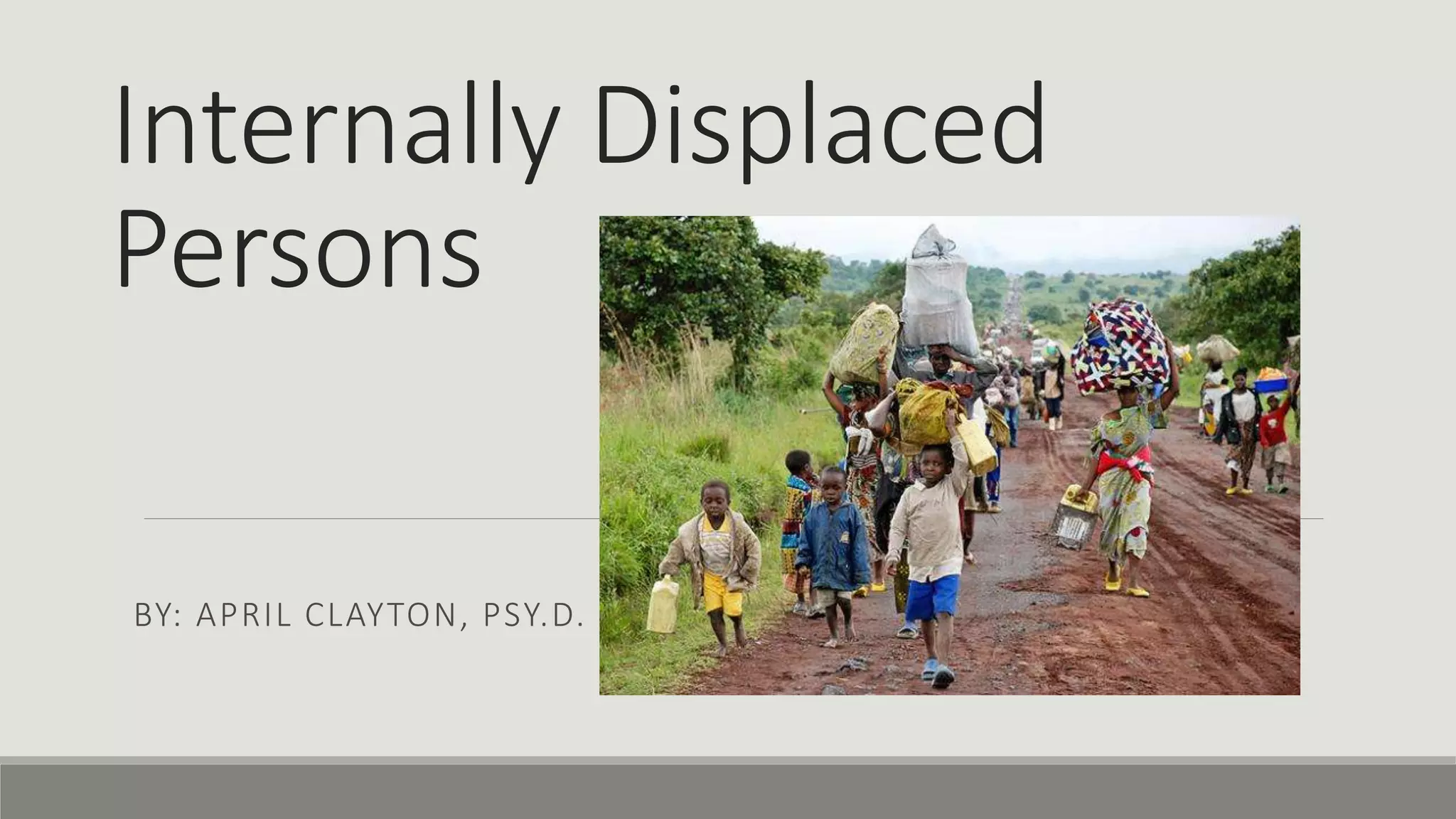
Internally Displaced
Persons
BY: APRIL CLAYTON, PSY.D.
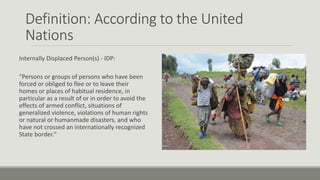
Definition: According to the United
Nations
Internally Displaced Person(s) - IDP:
“Persons or groups of persons who have been
forced or obliged to flee or to leave their
homes or places of habitual residence, in
particular as a result of or in order to avoid the
effects of armed conflict, situations of
generalized violence, violations of human rights
or natural or humanmade disasters, and who
have not crossed an internationally recognized
State border."
IDP’s and the United Nations
(UNHCR)
IDPs stay within their own country and remain under the
protection of its government, even if that government is the
reason for their displacement. They often move to areas where
it is difficult for the UN to deliver humanitarian assistance and
as a result, these people are among the most vulnerable in the
world.
In 2016, UNHCR cared for 13.9 million IDPs in over 30 countries
worldwide, including 5.5 million who were newly displaced
that year.
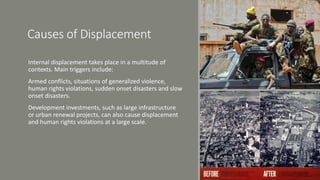
Causes of Displacement
Internal displacement takes place in a multitude of
contexts. Main triggers include:
Armed conflicts, situations of generalized violence,
human rights violations, sudden onset disasters and slow
onset disasters.
Development investments, such as large infrastructure
or urban renewal projects, can also cause displacement
and human rights violations at a large scale.
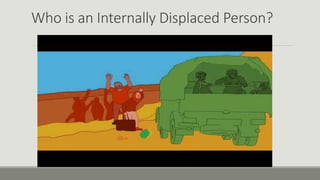
Who is an Internally Displaced Person?
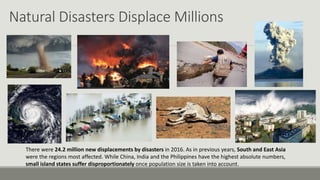
Natural Disasters Displace Millions
There were 24.2 million new displacements by disasters in 2016. As in previous years, South and East Asia
were the regions most affected. While China, India and the Philippines have the highest absolute numbers,
small island states suffer disproportionately once population size is taken into account.
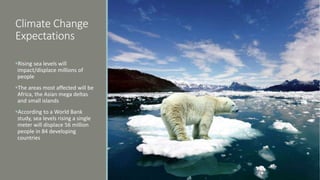
Climate Change
Expectations
Rising sea levels will
impact/displace millions of
people
The areas most affected will be
Africa, the Asian mega deltas
and small islands
According to a World Bank
study, sea levels rising a single
meter will displace 56 million
people in 84 developing
countries
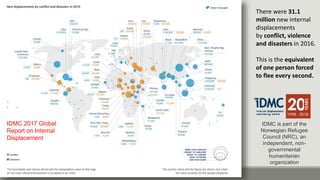
There were 31.1
million new internal
displacements
by conflict, violence
and disasters in 2016.
This is the equivalent
of one person forced
to flee every second.
IDMC 2017 Global
Report on Internal
Displacement
IDMC is part of the
Norwegian Refugee
Council (NRC), an
independent, non-
governmental
humanitarian
organization
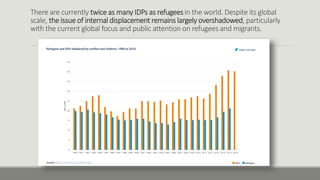
There are currently twice as many IDPs as refugeesin the world. Despite its global
scale, the issue of internal displacement remains largely overshadowed, particularly
with the current global focus and public attention on refugees and migrants.
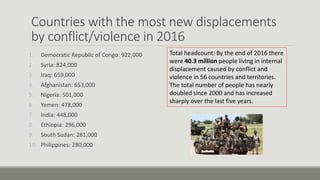
Countries with the most new displacements
by conflict/violence in 2016
1. Democratic Republic of Congo: 922,000
2. Syria: 824,000
3. Iraq: 659,000
4. Afghanistan: 653,000
5. Nigeria: 501,000
6. Yemen: 478,000
7. India: 448,000
8. Ethiopia: 296,000
9. South Sudan: 281,000
10. Philippines: 280,000
Total headcount: By the end of 2016 there
were 40.3 million people living in internal
displacement caused by conflict and
violence in 56 countries and territories.
The total number of people has nearly
doubled since 2000 and has increased
sharply over the last five years.
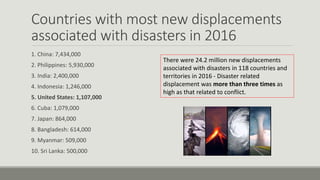
Countries with most new displacements
associated with disasters in 2016
1. China: 7,434,000
2. Philippines: 5,930,000
3. India: 2,400,000
4. Indonesia: 1,246,000
5. United States: 1,107,000
6. Cuba: 1,079,000
7. Japan: 864,000
8. Bangladesh: 614,000
9. Myanmar: 509,000
10. Sri Lanka: 500,000
There were 24.2 million new displacements
associated with disasters in 118 countries and
territories in 2016 - Disaster related
displacement was more than three times as
high as that related to conflict.
International Humanitarian Law (IHL)
Geneva Convention Protections (1998)
•International humanitarian law (IHL) seeks to limit the effects of
armed conflict and to protect persons who are not or are no longer
participating in the hostilities.
•IHL violations – such as attacks against civilians and ill-treatment of
them, destruction of property, sexual violence and restricted access
to health care and other essential services – are some of the main
causes triggering displacement.
•While displaced, these communities struggle to meet essential
needs amid exacerbated hardship and they may face particular
threats, such as tension between them and host communities,
settlement in unsafe or unfit locations, and forced return to unsafe
areas.
•IHL contains important provisions to prevent the displacement of
people and the suffering that follows and for the protection of
persons forced to flee.
International Committee of
the Red Cross
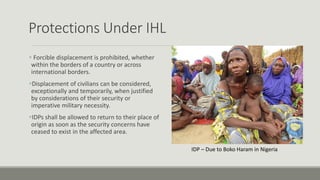
Protections Under IHL
 Forcible displacement is prohibited, whether
within the borders of a country or across
international borders.
Displacement of civilians can be considered,
exceptionally and temporarily, when justified
by considerations of their security or
imperative military necessity.
IDPs shall be allowed to return to their place of
origin as soon as the security concerns have
ceased to exist in the affected area.
IDP – Due to Boko Haram in Nigeria
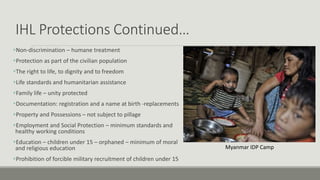
IHL Protections Continued…
Non-discrimination – humane treatment
Protection as part of the civilian population
The right to life, to dignity and to freedom
Life standards and humanitarian assistance
Family life – unity protected
Documentation: registration and a name at birth -replacements
Property and Possessions – not subject to pillage
Employment and Social Protection – minimum standards and
healthy working conditions
Education – children under 15 – orphaned – minimum of moral
and religious education
Prohibition of forcible military recruitment of children under 15
Myanmar IDP Camp
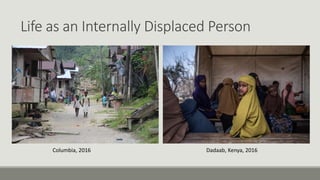
Life as an Internally Displaced Person
Columbia, 2016 Dadaab, Kenya, 2016
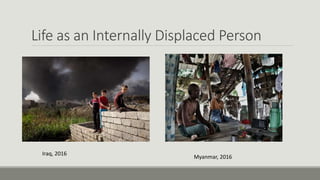
Life as an Internally Displaced Person
Iraq, 2016
Myanmar, 2016
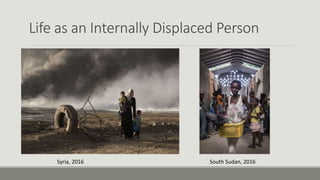
Life as an Internally Displaced Person
Syria, 2016 South Sudan, 2016
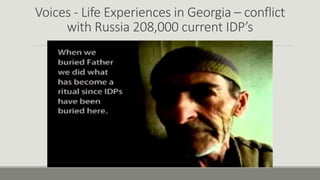
Voices - Life Experiences in Georgia – conflict
with Russia 208,000 current IDP’s
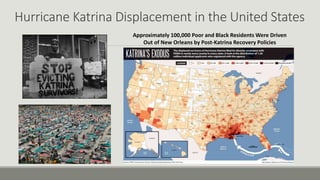
Hurricane Katrina Displacement in the United States
Approximately 100,000 Poor and Black Residents Were Driven
Out of New Orleans by Post-Katrina Recovery Policies
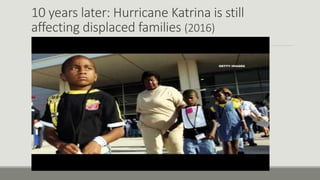
10 years later: Hurricane Katrina is still
affecting displaced families (2016)
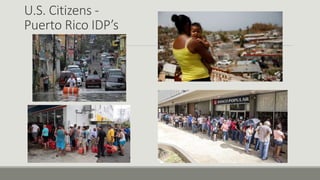
U.S. Citizens -
Puerto Rico IDP’s
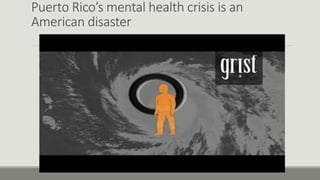
Puerto Rico’s mental health crisis is an
American disaster
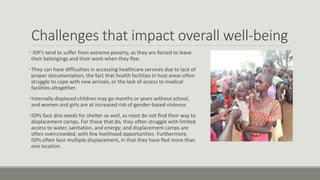
Challenges that impact overall well-being
 IDP’s tend to suffer from extreme poverty, as they are forced to leave
their belongings and their work when they flee.
They can have difficulties in accessing healthcare services due to lack of
proper documentation, the fact that health facilities in host areas often
struggle to cope with new arrivals, or the lack of access to medical
facilities altogether.
Internally displaced children may go months or years without school,
and women and girls are at increased risk of gender-based violence.
IDPs face dire needs for shelter as well, as most do not find their way to
displacement camps. For those that do, they often struggle with limited
access to water, sanitation, and energy; and displacement camps are
often overcrowded, with few livelihood opportunities. Furthermore,
IDPs often face multiple displacement, in that they have fled more than
one location.
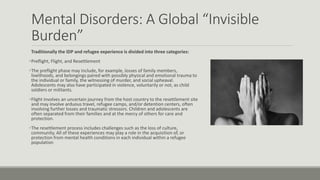
Mental Disorders: A Global “Invisible
Burden”
Traditionally the IDP and refugee experience is divided into three categories:
Preflight, Flight, and Resettlement
The preflight phase may include, for example, losses of family members,
livelihoods, and belongings paired with possibly physical and emotional trauma to
the individual or family, the witnessing of murder, and social upheaval.
Adolescents may also have participated in violence, voluntarily or not, as child
soldiers or militants.
Flight involves an uncertain journey from the host country to the resettlement site
and may involve arduous travel, refugee camps, and/or detention centers, often
involving further losses and traumatic stressors. Children and adolescents are
often separated from their families and at the mercy of others for care and
protection.
The resettlement process includes challenges such as the loss of culture,
community. All of these experiences may play a role in the acquisition of, or
protection from mental health conditions in each individual within a refugee
population
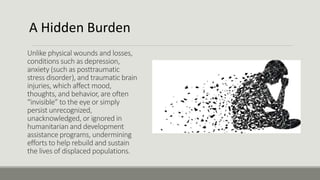
Unlike physical wounds and losses,
conditions such as depression,
anxiety (such as posttraumatic
stress disorder), and traumatic brain
injuries, which affect mood,
thoughts, and behavior, are often
“invisible” to the eye or simply
persist unrecognized,
unacknowledged, or ignored in
humanitarian and development
assistance programs, undermining
efforts to help rebuild and sustain
the lives of displaced populations.
A Hidden Burden
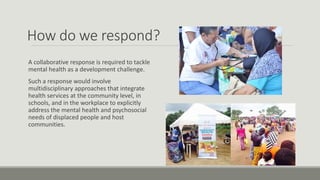
How do we respond?
A collaborative response is required to tackle
mental health as a development challenge.
Such a response would involve
multidisciplinary approaches that integrate
health services at the community level, in
schools, and in the workplace to explicitly
address the mental health and psychosocial
needs of displaced people and host
communities.
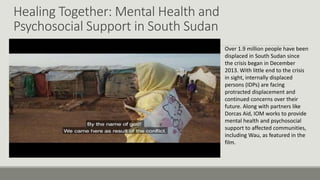
Healing Together: Mental Health and
Psychosocial Support in South Sudan
Over 1.9 million people have been
displaced in South Sudan since
the crisis began in December
2013. With little end to the crisis
in sight, internally displaced
persons (IDPs) are facing
protracted displacement and
continued concerns over their
future. Along with partners like
Dorcas Aid, IOM works to provide
mental health and psychosocial
support to affected communities,
including Wau, as featured in the
film.
Personal Story from Doctor’s Without
Borders - Darfur
Key Messages
1. Significant new internal displacement associated with conflict and disasters takes
place every year, mainly in low and lower-middle income countries. Those affected join
the many millions of people already living in displacement, reflecting the intractable
nature of the phenomenon, and the inability of governments to cope.
2. Some countries regularly drop off the international agenda only to re-emerge a few
years later with significant numbers of new displacements.
3. Despite the fact that internally displaced people (IDPs) outnumber refugees by
around two to one, internal displacement has been side lined in recent global policy
processes and is overshadowed by the current focus on refugees and migrants.
4. There is a need for more development spending to be allocated to reducing existing
vulnerabilities and future risk and for mitigating the longer-term impacts of internal
displacement. Current humanitarian budgets are not designed to respond to the
complex needs of people caught up in protracted, cyclical and repeated displacement.
Continued…
5. Displacement will continue to have major impacts unless the drivers of conflict, poverty,
environmental change and state fragility are addressed. Many more political and financial
resources should be invested in conflict prevention, disaster risk management, state-building
and diplomacy to address the multiple interwoven causes of displacement crises.
6. There have been several demands for rigorous and transparent data on internal displacement,
which is needed to establish a global baseline and measure progress toward targets.
Displacement is rarely monitored from its outset to its end, which means that global figures
currently do not reflect the true scale, nature and patterns of the phenomenon.
7. States are not investing sufficiently in the collection and publication of credible data on
internal displacement. This severely limits their capacity to address IDPs’ needs, and our ability
to paint a comprehensive picture.
References
Displaced people. (2012, August 24). Retrieved from
http://www.who.int/environmental_health_emergencies/displaced_people/en/
Global Report on Internal Displacement. (2017). Retrieved from http://www.internal-
displacement.org/global-report/grid2017/
IDP Images (2018). Retrieved April, 2018, from https://images.google.com/
Internally displaced persons and international humanitarian law. (2018, April 04). Retrieved from
https://www.icrc.org/en/document/internally-displaced-persons-and-international-
humanitarian-law
Medical aid where it is needed most. Independent. Neutral. Impartial. (2018). Retrieved from
https://www.doctorswithoutborders.org/
United Nations. (2018). Internally Displaced People. Retrieved from
http://www.unhcr.org/internally-displaced-people.html

Internally Displaced Persons - IDP's

  • 1.
  • 2.
    Definition: According tothe United Nations Internally Displaced Person(s) - IDP: “Persons or groups of persons who have been forced or obliged to flee or to leave their homes or places of habitual residence, in particular as a result of or in order to avoid the effects of armed conflict, situations of generalized violence, violations of human rights or natural or humanmade disasters, and who have not crossed an internationally recognized State border."
  • 3.
    IDP’s and theUnited Nations (UNHCR) IDPs stay within their own country and remain under the protection of its government, even if that government is the reason for their displacement. They often move to areas where it is difficult for the UN to deliver humanitarian assistance and as a result, these people are among the most vulnerable in the world. In 2016, UNHCR cared for 13.9 million IDPs in over 30 countries worldwide, including 5.5 million who were newly displaced that year.
  • 4.
    Causes of Displacement Internaldisplacement takes place in a multitude of contexts. Main triggers include: Armed conflicts, situations of generalized violence, human rights violations, sudden onset disasters and slow onset disasters. Development investments, such as large infrastructure or urban renewal projects, can also cause displacement and human rights violations at a large scale.
  • 5.
    Who is anInternally Displaced Person?
  • 6.
    Natural Disasters DisplaceMillions There were 24.2 million new displacements by disasters in 2016. As in previous years, South and East Asia were the regions most affected. While China, India and the Philippines have the highest absolute numbers, small island states suffer disproportionately once population size is taken into account.
  • 7.
    Climate Change Expectations Rising sealevels will impact/displace millions of people The areas most affected will be Africa, the Asian mega deltas and small islands According to a World Bank study, sea levels rising a single meter will displace 56 million people in 84 developing countries
  • 8.
    There were 31.1 millionnew internal displacements by conflict, violence and disasters in 2016. This is the equivalent of one person forced to flee every second. IDMC 2017 Global Report on Internal Displacement IDMC is part of the Norwegian Refugee Council (NRC), an independent, non- governmental humanitarian organization
  • 9.
    There are currentlytwice as many IDPs as refugeesin the world. Despite its global scale, the issue of internal displacement remains largely overshadowed, particularly with the current global focus and public attention on refugees and migrants.
  • 10.
    Countries with themost new displacements by conflict/violence in 2016 1. Democratic Republic of Congo: 922,000 2. Syria: 824,000 3. Iraq: 659,000 4. Afghanistan: 653,000 5. Nigeria: 501,000 6. Yemen: 478,000 7. India: 448,000 8. Ethiopia: 296,000 9. South Sudan: 281,000 10. Philippines: 280,000 Total headcount: By the end of 2016 there were 40.3 million people living in internal displacement caused by conflict and violence in 56 countries and territories. The total number of people has nearly doubled since 2000 and has increased sharply over the last five years.
  • 11.
    Countries with mostnew displacements associated with disasters in 2016 1. China: 7,434,000 2. Philippines: 5,930,000 3. India: 2,400,000 4. Indonesia: 1,246,000 5. United States: 1,107,000 6. Cuba: 1,079,000 7. Japan: 864,000 8. Bangladesh: 614,000 9. Myanmar: 509,000 10. Sri Lanka: 500,000 There were 24.2 million new displacements associated with disasters in 118 countries and territories in 2016 - Disaster related displacement was more than three times as high as that related to conflict.
  • 12.
    International Humanitarian Law(IHL) Geneva Convention Protections (1998) •International humanitarian law (IHL) seeks to limit the effects of armed conflict and to protect persons who are not or are no longer participating in the hostilities. •IHL violations – such as attacks against civilians and ill-treatment of them, destruction of property, sexual violence and restricted access to health care and other essential services – are some of the main causes triggering displacement. •While displaced, these communities struggle to meet essential needs amid exacerbated hardship and they may face particular threats, such as tension between them and host communities, settlement in unsafe or unfit locations, and forced return to unsafe areas. •IHL contains important provisions to prevent the displacement of people and the suffering that follows and for the protection of persons forced to flee. International Committee of the Red Cross
  • 13.
    Protections Under IHL Forcible displacement is prohibited, whether within the borders of a country or across international borders. Displacement of civilians can be considered, exceptionally and temporarily, when justified by considerations of their security or imperative military necessity. IDPs shall be allowed to return to their place of origin as soon as the security concerns have ceased to exist in the affected area. IDP – Due to Boko Haram in Nigeria
  • 14.
    IHL Protections Continued… Non-discrimination– humane treatment Protection as part of the civilian population The right to life, to dignity and to freedom Life standards and humanitarian assistance Family life – unity protected Documentation: registration and a name at birth -replacements Property and Possessions – not subject to pillage Employment and Social Protection – minimum standards and healthy working conditions Education – children under 15 – orphaned – minimum of moral and religious education Prohibition of forcible military recruitment of children under 15 Myanmar IDP Camp
  • 15.
    Life as anInternally Displaced Person Columbia, 2016 Dadaab, Kenya, 2016
  • 16.
    Life as anInternally Displaced Person Iraq, 2016 Myanmar, 2016
  • 17.
    Life as anInternally Displaced Person Syria, 2016 South Sudan, 2016
  • 18.
    Voices - LifeExperiences in Georgia – conflict with Russia 208,000 current IDP’s
  • 19.
    Hurricane Katrina Displacementin the United States Approximately 100,000 Poor and Black Residents Were Driven Out of New Orleans by Post-Katrina Recovery Policies
  • 20.
    10 years later:Hurricane Katrina is still affecting displaced families (2016)
  • 21.
  • 22.
    Puerto Rico’s mentalhealth crisis is an American disaster
  • 23.
    Challenges that impactoverall well-being  IDP’s tend to suffer from extreme poverty, as they are forced to leave their belongings and their work when they flee. They can have difficulties in accessing healthcare services due to lack of proper documentation, the fact that health facilities in host areas often struggle to cope with new arrivals, or the lack of access to medical facilities altogether. Internally displaced children may go months or years without school, and women and girls are at increased risk of gender-based violence. IDPs face dire needs for shelter as well, as most do not find their way to displacement camps. For those that do, they often struggle with limited access to water, sanitation, and energy; and displacement camps are often overcrowded, with few livelihood opportunities. Furthermore, IDPs often face multiple displacement, in that they have fled more than one location.
  • 24.
    Mental Disorders: AGlobal “Invisible Burden” Traditionally the IDP and refugee experience is divided into three categories: Preflight, Flight, and Resettlement The preflight phase may include, for example, losses of family members, livelihoods, and belongings paired with possibly physical and emotional trauma to the individual or family, the witnessing of murder, and social upheaval. Adolescents may also have participated in violence, voluntarily or not, as child soldiers or militants. Flight involves an uncertain journey from the host country to the resettlement site and may involve arduous travel, refugee camps, and/or detention centers, often involving further losses and traumatic stressors. Children and adolescents are often separated from their families and at the mercy of others for care and protection. The resettlement process includes challenges such as the loss of culture, community. All of these experiences may play a role in the acquisition of, or protection from mental health conditions in each individual within a refugee population
  • 25.
    Unlike physical woundsand losses, conditions such as depression, anxiety (such as posttraumatic stress disorder), and traumatic brain injuries, which affect mood, thoughts, and behavior, are often “invisible” to the eye or simply persist unrecognized, unacknowledged, or ignored in humanitarian and development assistance programs, undermining efforts to help rebuild and sustain the lives of displaced populations. A Hidden Burden
  • 26.
    How do werespond? A collaborative response is required to tackle mental health as a development challenge. Such a response would involve multidisciplinary approaches that integrate health services at the community level, in schools, and in the workplace to explicitly address the mental health and psychosocial needs of displaced people and host communities.
  • 27.
    Healing Together: MentalHealth and Psychosocial Support in South Sudan Over 1.9 million people have been displaced in South Sudan since the crisis began in December 2013. With little end to the crisis in sight, internally displaced persons (IDPs) are facing protracted displacement and continued concerns over their future. Along with partners like Dorcas Aid, IOM works to provide mental health and psychosocial support to affected communities, including Wau, as featured in the film.
  • 28.
    Personal Story fromDoctor’s Without Borders - Darfur
  • 29.
    Key Messages 1. Significantnew internal displacement associated with conflict and disasters takes place every year, mainly in low and lower-middle income countries. Those affected join the many millions of people already living in displacement, reflecting the intractable nature of the phenomenon, and the inability of governments to cope. 2. Some countries regularly drop off the international agenda only to re-emerge a few years later with significant numbers of new displacements. 3. Despite the fact that internally displaced people (IDPs) outnumber refugees by around two to one, internal displacement has been side lined in recent global policy processes and is overshadowed by the current focus on refugees and migrants. 4. There is a need for more development spending to be allocated to reducing existing vulnerabilities and future risk and for mitigating the longer-term impacts of internal displacement. Current humanitarian budgets are not designed to respond to the complex needs of people caught up in protracted, cyclical and repeated displacement.
  • 30.
    Continued… 5. Displacement willcontinue to have major impacts unless the drivers of conflict, poverty, environmental change and state fragility are addressed. Many more political and financial resources should be invested in conflict prevention, disaster risk management, state-building and diplomacy to address the multiple interwoven causes of displacement crises. 6. There have been several demands for rigorous and transparent data on internal displacement, which is needed to establish a global baseline and measure progress toward targets. Displacement is rarely monitored from its outset to its end, which means that global figures currently do not reflect the true scale, nature and patterns of the phenomenon. 7. States are not investing sufficiently in the collection and publication of credible data on internal displacement. This severely limits their capacity to address IDPs’ needs, and our ability to paint a comprehensive picture.
  • 31.
    References Displaced people. (2012,August 24). Retrieved from http://www.who.int/environmental_health_emergencies/displaced_people/en/ Global Report on Internal Displacement. (2017). Retrieved from http://www.internal- displacement.org/global-report/grid2017/ IDP Images (2018). Retrieved April, 2018, from https://images.google.com/ Internally displaced persons and international humanitarian law. (2018, April 04). Retrieved from https://www.icrc.org/en/document/internally-displaced-persons-and-international- humanitarian-law Medical aid where it is needed most. Independent. Neutral. Impartial. (2018). Retrieved from https://www.doctorswithoutborders.org/ United Nations. (2018). Internally Displaced People. Retrieved from http://www.unhcr.org/internally-displaced-people.html