Presented by : Sirjana Tiwari
School of Health and Allied Science , Pokhara
University
History of Public Health
What is Public Health?
“To promote health and quality of life by
preventing and controlling disease,
injury, and disability.”
—CDC Mission Statement
Definition of Public Health 1
“the science and art of
preventing disease,
prolonging life and
promoting health and
efficiency through organized
community effort”
CEA Winslow (1920)
Winslow’s definition….
the science and the art of:
(1) preventing disease,
(2) prolonging life, and
(3) promoting physical health and efficiency through
organized community efforts for:
(a) the sanitation of the environment,
(b) the control of community infections,
(c) the education of the individual in principles of
personal hygiene,
(d) the organization of medical and nursing service
for the early diagnosis and preventive treatment of
disease, and
Winslow’s definition….
(e) the development of the social machinery which
will ensure to every individual in the community
a standard of living adequate for the maintenance
of health
so organizing these benefits as to enable every
citizen to realize his birthright of health and
longevity
Definition of Public Health 2
 “Public health is defined as the practices, procedures,
institutions, and disciplines required to achieve the
desired state of population health.” (Friedman, D. J.,
Parrish, R., & Ross, D. A. 2013)
Historical glimpse
 Ancient Greece (500-323 BC)
 Roman Empire (23 BC – 476 AD)
 Middle Ages (476-1450 AD)
 Birth of Modern Medicine (1650-1800 AD)
 Great Sanitary Awakening (1800s-1900s)
 Modern Public Health (1900 AD & onward)
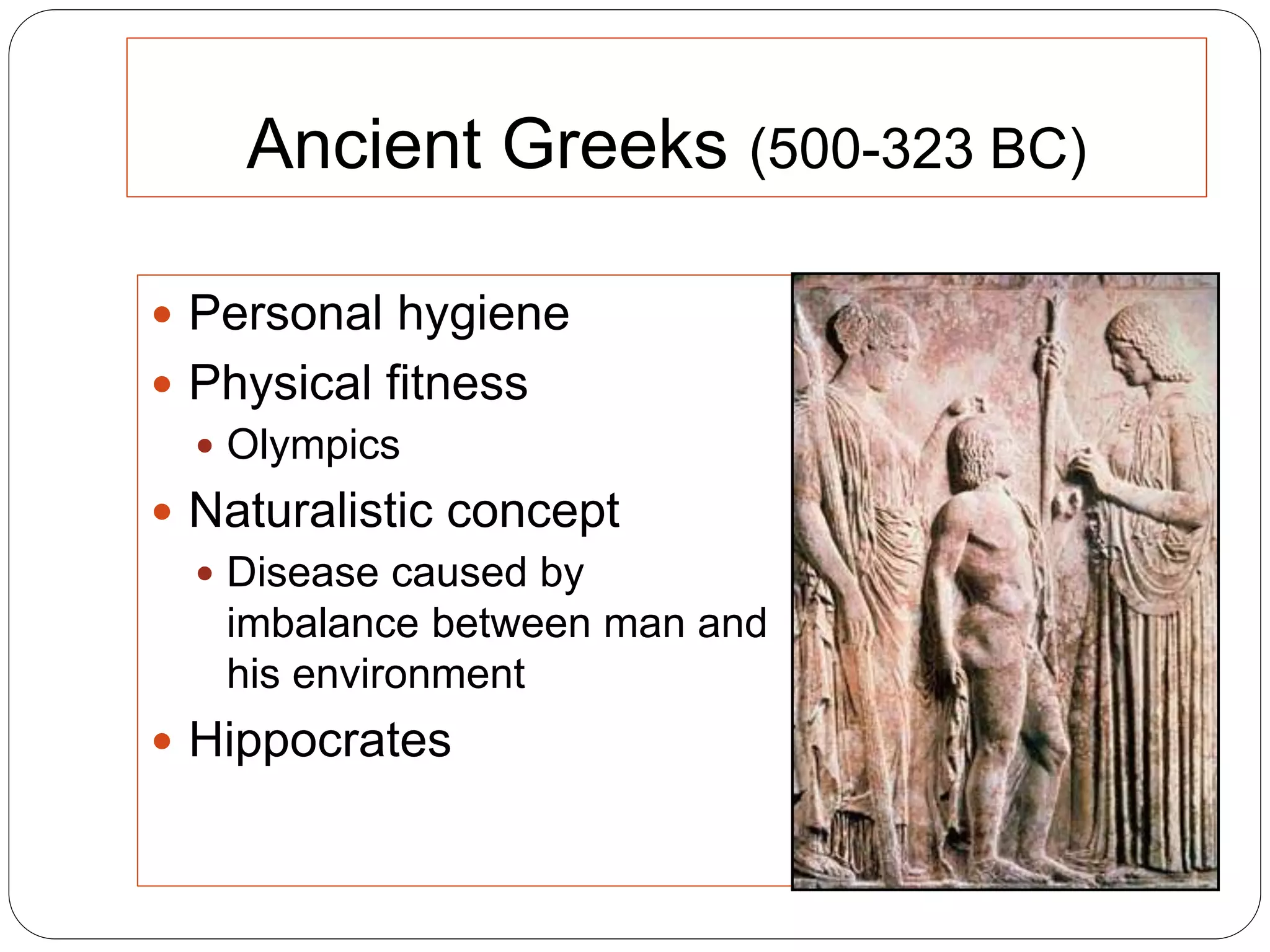
Ancient Greeks (500-323 BC)
 Personal hygiene
 Physical fitness
 Olympics
 Naturalistic concept
 Disease caused by
imbalance between man and
his environment
 Hippocrates
Hippocrates (460 - 375 BC)
 Father of Western medicine
 Recognized body consist of
4 humours: blood, black bile,
yellow bile and phlegm
 To create balance in body : exercise,
Nutrition, excretion and rest required
 Causal relationships
 Disease and climate, water, lifestyle,
and nutrition
 Coined the term epidemic and endemic
Roman Empire (23 BC – 476 AD)
 Adopted Greek health
values by hiring greek
Physician as personnel healer
 Great engineers
 Built Sewage systems
 Aqueducts: bringing fresh
water in city
 Establish bereaurocratic system
Administration
 Public baths
 Private Water supply
 Physician were employed by municipalities to
provide health sercvice
 Markets
Roman Aqueducts
Le Pont du Gard
Middle Ages (476-1450 AD)
 Urbanization in Europe
 overcrowding
 Decline of hygiene and
sanitation
 Major epidemic of bubonic
Plague and black death
 Church endorsed public
health
 Faith and prayer were the
accepted treatment for illness.
 Beginnings of PH tools
 Quarantine of ships for 40
days
At the end of middle age
The Plague (The Black Death)
 Worst from 1348-1352
 Killed at least 25 million
people in Europe (1/3 of the
population).
 Killed more than 60 million
worldwide.
 Death of
25% to 50%
of population
Renaissance (1400-1600 AD)
Global Exploration
 Disease (Small pox,
measles and typhoid),
spread by traders and
explorers
 Killed 90% of
indigenous people in
New World/Americas
Birth of Modern Medicine(1650-
1800 AD)
Industrialization
Urbanization (1800s)
Birth of Modern Medicine(1650-
1800 AD)
After Industrialization
 Malnutrition , overcrowding, poor
working condition contribute to
severe disease outbreak: typhus,
typhoid, cholera
Great Sanitary Awakening
(1800s-1900s)
 Growth in scientific
knowledge
 Humanitarian ideals
 Connection between
poverty
and disease
 Water supply and sewage
removal
 Monitor community health
status
Dr. John Snow (1813-1858)
Epidemiology (1854)
Broad Street Pump
Map of Diphtheria Deaths
New York City
May 1, 1874 to December 31, 1875
Made under the direction of
W. De F. Day, M.D., Sanitary Superintendent, NYC Health Dept.
www.ihm.nlm.nih.gov
Birth of Modern Medicine
 Louis Pasteur
 1862 germs caused many diseases
 1888 first public health lab
 Robert Koch
 1883 identified the vibrio that causes
cholera, 20 years after Snow’s
discovery
 Discovered the tuberculosis bacterium
1843-1910
1822-1895
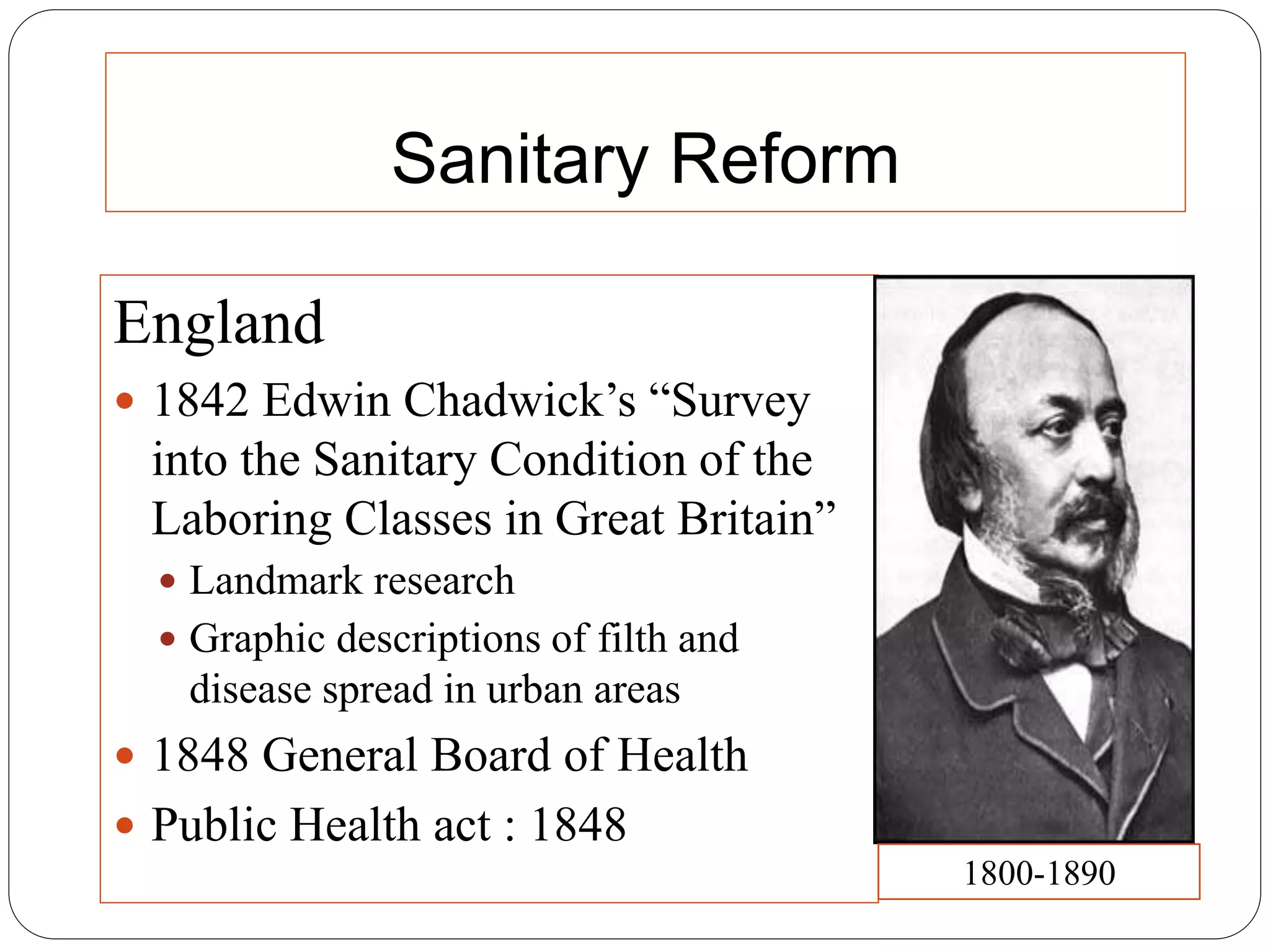
Sanitary Reform
England
 1842 Edwin Chadwick’s “Survey
into the Sanitary Condition of the
Laboring Classes in Great Britain”
 Landmark research
 Graphic descriptions of filth and
disease spread in urban areas
 1848 General Board of Health
 Public Health act : 1848
1800-1890
Sanitary Reform
United States
 Colonial period
 Endemic disease are: malaria,
smallpox, cholera, typhoid, diphtheria
 50thousand people contacted with
yellow fever.
 1850 Lemuel Shattuck’s “Report of
the Sanitary Commission of
Massachusetts”
 1869 State Board of Health
 Qurantine act, quarntain law was
formed 1793-1859
Sanitation Revolution
 Clean water; water treatment
 Food inspection
 Soaps, disinfectants, and pharmaceuticals
 Personal hygiene (bathing)
 Public works departments; garbage collection,
landfills, and street cleaning
 Public health departments and regulation
Modern Public Health (1900 AD & onward)
 At the beginning of the 20th century
 Life expectancy was less than 50 years
 Leading causes of death were communicable
diseases (influenza, pneumonia, tuberculosis
and GI infections)
 Vitamin deficiency diseases were common
including rickets, pellagra and scurvy
 Deaths associated with pregnancy and
childbirth were also high
C.E.A Winslow characterized sanitation as the
first step to uplift public health.
 Health resources development period (1900-1960) is
further divided into
 The reform phase (1900-1920)
 The 1920s
 The great depression and World War II
 The post war years
Modern Public Health (1900 AD & onward)
 Period of social engineering (1960-1973)
 Period of health promotion (1973 to present)
Modern Public Health (1900 AD & onward)
 The Reform Phase of Public Health
 Involved both social and moral as well as health
issues
 Public health nursing started with a school nursing
program in New York in 1902
 In 1906 the passage of the Pure Foods and Drugs
Act
 In 1910 New York passed Worker’s Compensation
Act
Modern Public Health (1900 AD & onward)
 First School of Public Health was established in 1918
at Johns Hopkins University
 1918 was the birth of school health education
 Birth of first national level volunteer health agencies
 American Cancer Society 1913
 Rockefeller Foundation established 1913
Modern Public Health (1900 AD & onward)
 The 1920s
 Period of slow development in Public Health
 Prohibition produced decline in alcoholics and
alcohol related deaths
 Number of county health departments rose to 467
 Life expectancy in 1930 risen to 59.7 years
Modern Public Health (1900 AD & onward)
 The Great Depression and World War II
 by 1933 private resources could no longer meet the
needs of the people who needed assistance
 Beginning in 1933, President Roosevelt’s New Deal
created agencies and programs for public works
 Building of hospitals and laboratories, control of
malaria and the construction of municipal water and
sewer systems
Modern Public Health (1900 AD & onward)
 The Great Depression and World War II
 1935 The Social Security Act marked the beginning
of the involvement of the government in social
issues including health
 World War II decreased the availability of funds and
resources for public health, but led to the
development of many important medical discoveries
that were made available once the war ended
Modern Public Health (1900 AD & onward)
 The post war years
 Antibiotic penicillin was made available
 Insecticide DDT to kill insects that transmitted
communicable diseases was made available
 Communicable Disease Center was set up in Atlanta
during the war, now known as the Center for Disease
Control and Prevention (CDC)
Modern Public Health (1900 AD & onward)
 The post war years
 Two major events in the 1950s
 Development of a vaccine to prevent polio
 President Eisenhower’s heart attack focused
attention on the nations number one killer, heart
disease
Modern Public Health (1900 AD & onward)
 Period of Social Engineering
 1965 passage of the Medicare and Medicaid bills
 Medicare provides for health care to the elderly
and some disable people
 Medicaid provides health care for the poor
 Period of Health Promotion (1974-present)
 Recognition that the greatest potential for saving
lives is by education and life-style changes by
individuals
Modern Public Health (1900 AD & onward)
 Situation by the end of the Twentieth Century
 Life expectancy increased by 30 years
 Major infectious diseases brought under control
 Infant and maternal mortality rates decreased by 90
and 99% respectively
 Safer workplaces
 Safer and healthier foods
Modern Public Health (1900 AD & onward)
 In 1970s, CDC conducted a study that examined
premature death
 Study revealed that approx 48% of all premature
deaths were because of lifestyle or health behavior-
choices people make
 This led the way for U.S. government’s publication
Healthy People: The surgeon General’s Report on
Health Promotion and Disease Prevention
Modern Public Health (1900 AD & onward)
 Prior to 1850 Battling Epidemics
 1850–1949 Building State and Local Infrastructure
 1950–1999 Filling Gaps in Medical Care Delivery
 After 1999 Preparing for and Responding to
Community Health Threats
Modern Public Health (1900 AD & onward)
 Problems to be faced
 Health care delivery
 Environmental problems
 Lifestyle diseases
 Alcohol and other drug abuse
 New communicable diseases or old diseases that
have become resistant to drug therapy
Healthy People 2010
 These are the governments goals for improved
health in the population
 Also includes projected mechanisms to be used to
help to reach these goals
Healthy people 2010
 Comprehensive, nationwide health promotion and
disease prevention agenda.
 Designed to serve as a roadmap for improving the
health of all people in the United States during the
first decade of the 21st century.
 Committed to a single, overarching purpose:
promoting health and preventing illness, disability,
and premature death.
Healthy people 2010
 Can be used by many different people, States,
communities, professional organizations, and
others to help them develop programs to improve
health.
Healthy People
Entering its Third Decade
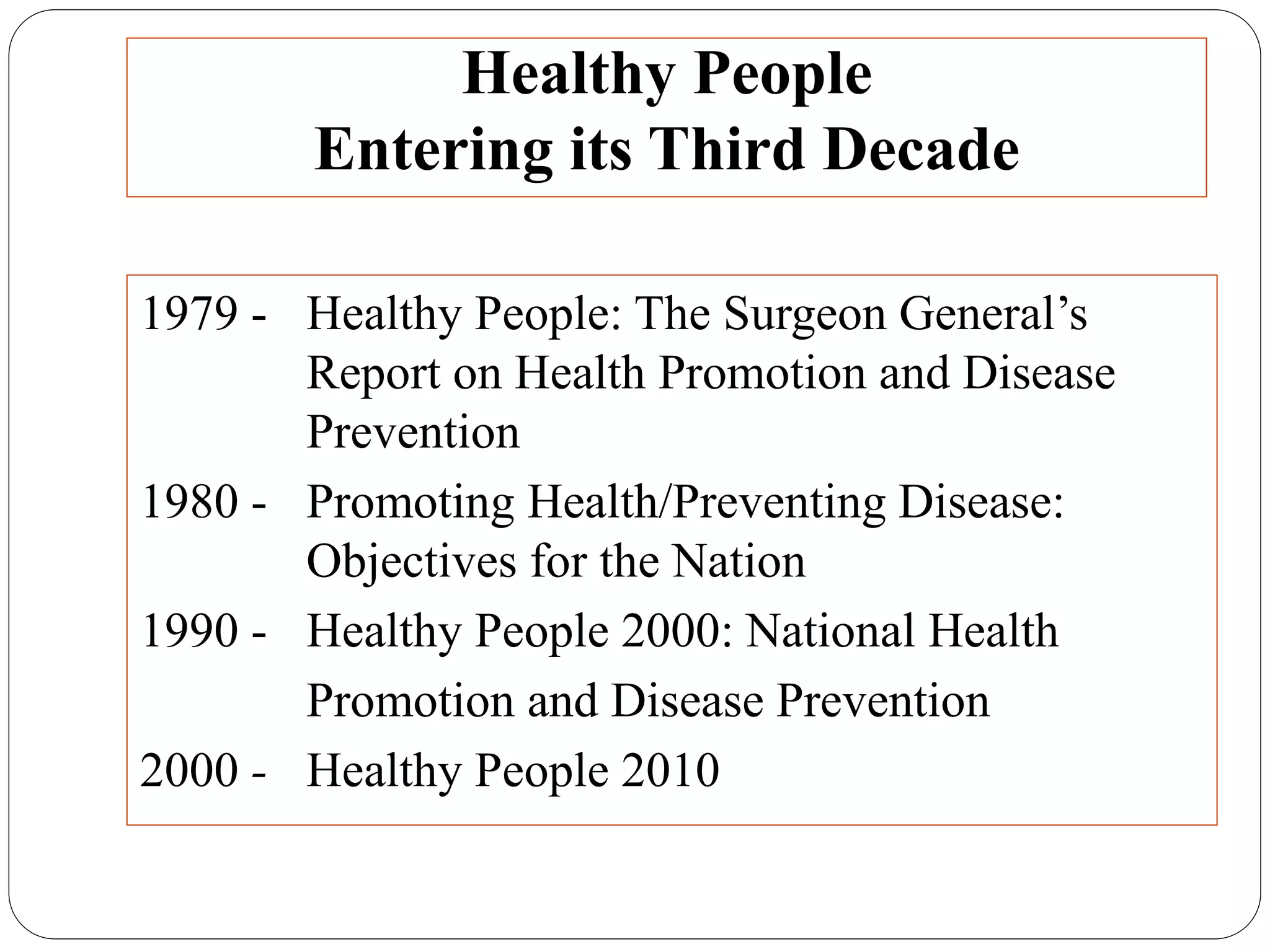
1979 - Healthy People: The Surgeon General’s
Report on Health Promotion and Disease
Prevention
1980 - Promoting Health/Preventing Disease:
Objectives for the Nation
1990 - Healthy People 2000: National Health
Promotion and Disease Prevention
2000 - Healthy People 2010
Healthy People 2010
 Two overarching goals
 28 focus areas
 467 specific objectives
 10 Leading Health Indicators
THANK YOU

History of public health

  • 1.
    Presented by :Sirjana Tiwari School of Health and Allied Science , Pokhara University History of Public Health
  • 2.
    What is PublicHealth? “To promote health and quality of life by preventing and controlling disease, injury, and disability.” —CDC Mission Statement
  • 3.
    Definition of PublicHealth 1 “the science and art of preventing disease, prolonging life and promoting health and efficiency through organized community effort” CEA Winslow (1920)
  • 4.
    Winslow’s definition…. the scienceand the art of: (1) preventing disease, (2) prolonging life, and (3) promoting physical health and efficiency through organized community efforts for: (a) the sanitation of the environment, (b) the control of community infections, (c) the education of the individual in principles of personal hygiene, (d) the organization of medical and nursing service for the early diagnosis and preventive treatment of disease, and
  • 5.
    Winslow’s definition…. (e) thedevelopment of the social machinery which will ensure to every individual in the community a standard of living adequate for the maintenance of health so organizing these benefits as to enable every citizen to realize his birthright of health and longevity
  • 6.
    Definition of PublicHealth 2  “Public health is defined as the practices, procedures, institutions, and disciplines required to achieve the desired state of population health.” (Friedman, D. J., Parrish, R., & Ross, D. A. 2013)
  • 7.
    Historical glimpse  AncientGreece (500-323 BC)  Roman Empire (23 BC – 476 AD)  Middle Ages (476-1450 AD)  Birth of Modern Medicine (1650-1800 AD)  Great Sanitary Awakening (1800s-1900s)  Modern Public Health (1900 AD & onward)
  • 8.
    Ancient Greeks (500-323BC)  Personal hygiene  Physical fitness  Olympics  Naturalistic concept  Disease caused by imbalance between man and his environment  Hippocrates
  • 9.
    Hippocrates (460 -375 BC)  Father of Western medicine  Recognized body consist of 4 humours: blood, black bile, yellow bile and phlegm  To create balance in body : exercise, Nutrition, excretion and rest required  Causal relationships  Disease and climate, water, lifestyle, and nutrition  Coined the term epidemic and endemic
  • 10.
    Roman Empire (23BC – 476 AD)  Adopted Greek health values by hiring greek Physician as personnel healer  Great engineers  Built Sewage systems  Aqueducts: bringing fresh water in city  Establish bereaurocratic system Administration  Public baths  Private Water supply  Physician were employed by municipalities to provide health sercvice  Markets
  • 11.
  • 12.
    Middle Ages (476-1450AD)  Urbanization in Europe  overcrowding  Decline of hygiene and sanitation  Major epidemic of bubonic Plague and black death  Church endorsed public health  Faith and prayer were the accepted treatment for illness.  Beginnings of PH tools  Quarantine of ships for 40 days
  • 13.
    At the endof middle age The Plague (The Black Death)  Worst from 1348-1352  Killed at least 25 million people in Europe (1/3 of the population).  Killed more than 60 million worldwide.  Death of 25% to 50% of population
  • 14.
    Renaissance (1400-1600 AD) GlobalExploration  Disease (Small pox, measles and typhoid), spread by traders and explorers  Killed 90% of indigenous people in New World/Americas
  • 15.
    Birth of ModernMedicine(1650- 1800 AD)
  • 16.
  • 17.
    Birth of ModernMedicine(1650- 1800 AD) After Industrialization  Malnutrition , overcrowding, poor working condition contribute to severe disease outbreak: typhus, typhoid, cholera
  • 18.
    Great Sanitary Awakening (1800s-1900s) Growth in scientific knowledge  Humanitarian ideals  Connection between poverty and disease  Water supply and sewage removal  Monitor community health status
  • 19.
    Dr. John Snow(1813-1858)
  • 20.
  • 21.
  • 22.
    Map of DiphtheriaDeaths New York City May 1, 1874 to December 31, 1875 Made under the direction of W. De F. Day, M.D., Sanitary Superintendent, NYC Health Dept. www.ihm.nlm.nih.gov
  • 23.
    Birth of ModernMedicine  Louis Pasteur  1862 germs caused many diseases  1888 first public health lab  Robert Koch  1883 identified the vibrio that causes cholera, 20 years after Snow’s discovery  Discovered the tuberculosis bacterium 1843-1910 1822-1895
  • 24.
    Sanitary Reform England  1842Edwin Chadwick’s “Survey into the Sanitary Condition of the Laboring Classes in Great Britain”  Landmark research  Graphic descriptions of filth and disease spread in urban areas  1848 General Board of Health  Public Health act : 1848 1800-1890
  • 25.
    Sanitary Reform United States Colonial period  Endemic disease are: malaria, smallpox, cholera, typhoid, diphtheria  50thousand people contacted with yellow fever.  1850 Lemuel Shattuck’s “Report of the Sanitary Commission of Massachusetts”  1869 State Board of Health  Qurantine act, quarntain law was formed 1793-1859
  • 26.
    Sanitation Revolution  Cleanwater; water treatment  Food inspection  Soaps, disinfectants, and pharmaceuticals  Personal hygiene (bathing)  Public works departments; garbage collection, landfills, and street cleaning  Public health departments and regulation
  • 27.
    Modern Public Health(1900 AD & onward)  At the beginning of the 20th century  Life expectancy was less than 50 years  Leading causes of death were communicable diseases (influenza, pneumonia, tuberculosis and GI infections)  Vitamin deficiency diseases were common including rickets, pellagra and scurvy  Deaths associated with pregnancy and childbirth were also high C.E.A Winslow characterized sanitation as the first step to uplift public health.
  • 28.
     Health resourcesdevelopment period (1900-1960) is further divided into  The reform phase (1900-1920)  The 1920s  The great depression and World War II  The post war years Modern Public Health (1900 AD & onward)
  • 29.
     Period ofsocial engineering (1960-1973)  Period of health promotion (1973 to present) Modern Public Health (1900 AD & onward)
  • 30.
     The ReformPhase of Public Health  Involved both social and moral as well as health issues  Public health nursing started with a school nursing program in New York in 1902  In 1906 the passage of the Pure Foods and Drugs Act  In 1910 New York passed Worker’s Compensation Act Modern Public Health (1900 AD & onward)
  • 31.
     First Schoolof Public Health was established in 1918 at Johns Hopkins University  1918 was the birth of school health education  Birth of first national level volunteer health agencies  American Cancer Society 1913  Rockefeller Foundation established 1913 Modern Public Health (1900 AD & onward)
  • 32.
    Modern Public Health(1900 AD & onward)  The 1920s  Period of slow development in Public Health  Prohibition produced decline in alcoholics and alcohol related deaths  Number of county health departments rose to 467  Life expectancy in 1930 risen to 59.7 years
  • 33.
    Modern Public Health(1900 AD & onward)  The Great Depression and World War II  by 1933 private resources could no longer meet the needs of the people who needed assistance  Beginning in 1933, President Roosevelt’s New Deal created agencies and programs for public works  Building of hospitals and laboratories, control of malaria and the construction of municipal water and sewer systems
  • 34.
    Modern Public Health(1900 AD & onward)  The Great Depression and World War II  1935 The Social Security Act marked the beginning of the involvement of the government in social issues including health  World War II decreased the availability of funds and resources for public health, but led to the development of many important medical discoveries that were made available once the war ended
  • 35.
    Modern Public Health(1900 AD & onward)  The post war years  Antibiotic penicillin was made available  Insecticide DDT to kill insects that transmitted communicable diseases was made available  Communicable Disease Center was set up in Atlanta during the war, now known as the Center for Disease Control and Prevention (CDC)
  • 36.
    Modern Public Health(1900 AD & onward)  The post war years  Two major events in the 1950s  Development of a vaccine to prevent polio  President Eisenhower’s heart attack focused attention on the nations number one killer, heart disease
  • 37.
    Modern Public Health(1900 AD & onward)  Period of Social Engineering  1965 passage of the Medicare and Medicaid bills  Medicare provides for health care to the elderly and some disable people  Medicaid provides health care for the poor  Period of Health Promotion (1974-present)  Recognition that the greatest potential for saving lives is by education and life-style changes by individuals
  • 38.
    Modern Public Health(1900 AD & onward)  Situation by the end of the Twentieth Century  Life expectancy increased by 30 years  Major infectious diseases brought under control  Infant and maternal mortality rates decreased by 90 and 99% respectively  Safer workplaces  Safer and healthier foods
  • 39.
    Modern Public Health(1900 AD & onward)  In 1970s, CDC conducted a study that examined premature death  Study revealed that approx 48% of all premature deaths were because of lifestyle or health behavior- choices people make  This led the way for U.S. government’s publication Healthy People: The surgeon General’s Report on Health Promotion and Disease Prevention
  • 40.
    Modern Public Health(1900 AD & onward)  Prior to 1850 Battling Epidemics  1850–1949 Building State and Local Infrastructure  1950–1999 Filling Gaps in Medical Care Delivery  After 1999 Preparing for and Responding to Community Health Threats
  • 41.
    Modern Public Health(1900 AD & onward)  Problems to be faced  Health care delivery  Environmental problems  Lifestyle diseases  Alcohol and other drug abuse  New communicable diseases or old diseases that have become resistant to drug therapy
  • 42.
    Healthy People 2010 These are the governments goals for improved health in the population  Also includes projected mechanisms to be used to help to reach these goals
  • 43.
    Healthy people 2010 Comprehensive, nationwide health promotion and disease prevention agenda.  Designed to serve as a roadmap for improving the health of all people in the United States during the first decade of the 21st century.  Committed to a single, overarching purpose: promoting health and preventing illness, disability, and premature death.
  • 44.
    Healthy people 2010 Can be used by many different people, States, communities, professional organizations, and others to help them develop programs to improve health.
  • 45.
    Healthy People Entering itsThird Decade 1979 - Healthy People: The Surgeon General’s Report on Health Promotion and Disease Prevention 1980 - Promoting Health/Preventing Disease: Objectives for the Nation 1990 - Healthy People 2000: National Health Promotion and Disease Prevention 2000 - Healthy People 2010
  • 46.
    Healthy People 2010 Two overarching goals  28 focus areas  467 specific objectives  10 Leading Health Indicators
  • 47.