FIRST GENEVA
CONVENTION
CONVENTION FOR THE AMELIORATION OF THE
CONDITION OF THE WOUNDED IN ARMIES IN THE
FIELD. GENEVA, 22 AUGUST 1864
By: Tharindu S Bandara. BSc(NMS) Hons ,Dip in Mgt (IMSL)
SEQUENCE
2
Aim
Introduction
History
SEQUENCE
3
Conventions
First Geneva convention
Includes
SEQUENCE
4
Applications
Infographics
Bibliography
AIM
To Discuss About Geneva Convention And Its Application To Modern Society
5
INTRODUCTION
 The Geneva Convention was a series of international
diplomatic meetings that produced a number of
agreements
 The Humanitarian Law of Armed Conflicts
 A group of international laws for the humane
treatment of wounded or captured military
personnel
 Medical personnel and non-military civilians during
war or armed conflicts
 The agreements originated in 1864 and were
significantly updated in 1949 after World War II
6
HISTORY
• In 1859, Genevan businessman Henry Dunant
traveled to Emperor Napoleon III’s headquarters in
northern Italy
• To seek land rights for a business venture
• He got much more than he bargained
• He found himself a witness to the aftermath of the
Battle of Solferino
• A gory battle in the Second War of Italian
Independence
7
HISTORY
• The horrific suffering Dunant saw impacted him so
greatly
• He wrote a first-hand account in 1862 called A
Memory of Solferino
• But he didn’t just write about what he’d observed,
he also proposed a solution
• All nations come together to create trained,
volunteer relief groups to treat battlefield wounded
and offer humanitarian assistance to those affected
by war
8
HISTORY
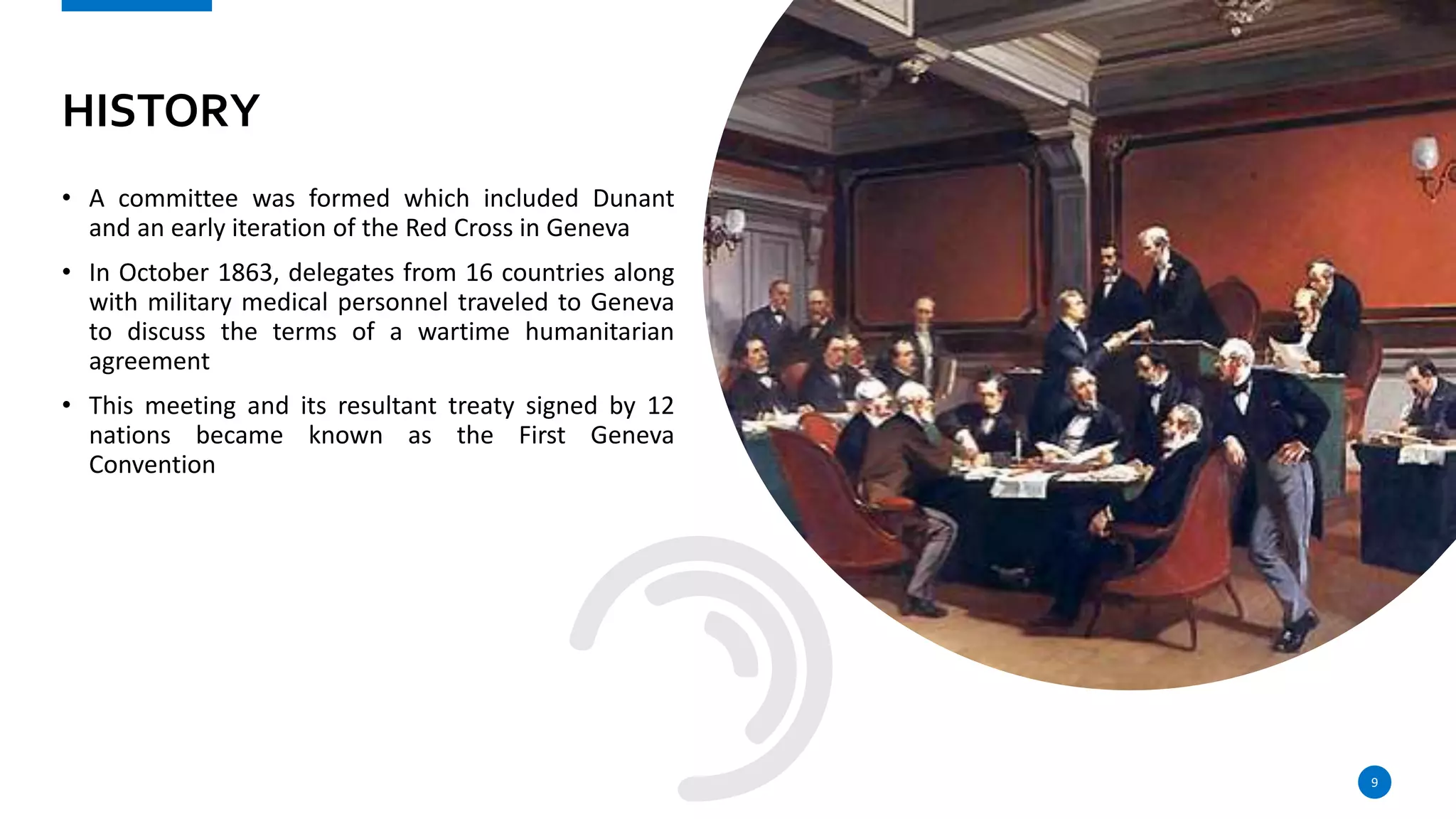
• A committee was formed which included Dunant
and an early iteration of the Red Cross in Geneva
• In October 1863, delegates from 16 countries along
with military medical personnel traveled to Geneva
to discuss the terms of a wartime humanitarian
agreement
• This meeting and its resultant treaty signed by 12
nations became known as the First Geneva
Convention
9
HISTORY
• Despite playing an important role in the progression
of what became the International Committee of the
Red Cross
• Continuing his work as champion for the battle-
wounded and prisoners of war and winning the first
Nobel Peace Prize, Dunant lived and died in near
poverty
10
CONVENTIONS
11
1st Geneva Conventions
• first adopted in 1864, revised in 1906, 1929 and
finally 1949
2nd Geneva Conventions
• first adopted in 1949, successor of the Hague
Convention (X) 1907
3rd Geneva Convention
• first adopted in 1929, last revision in 1949
4th Geneva Convention
• first adopted in 1949, based on parts of the Hague
Convention (II) of 1899 and Hague Convention (IV)
1907
CONVENTIONS
12
1st Geneva Convention
• For the Amelioration of the Condition of the
Wounded and Sick in Armed Forces in the Field
• First adopted in 1864, revised in 1906, 1929 and
finally 1949
CONVENTIONS
13
2nd Geneva Convention
• For the Amelioration of the Condition of
Wounded, Sick and Shipwrecked Members of
Armed Forces at Sea
• First adopted in 1949, successor of the Hague
Convention (X) 1907
CONVENTIONS
14
3rd Geneva Convention
• Relative to the Treatment of Prisoners of War
• First adopted in 1929, last revision in 1949
CONVENTIONS
15
4th Geneva Convention
• Relative to the Protection of Civilian Persons in
Time of War
• First adopted in 1949, based on parts of the
Hague Convention (II) of 1899 and Hague
Convention (IV) 1907
FIRST GENEVA CONVENTION
16
9 Chapters
1 Final Provisions
64 Articles
2 Annexes
INCLUDES
17
Chapter 1
• General Provisions
• Article 1-Article 11
Chapter 2
• Wounded and sick
• Article 12-Article 18
INCLUDES
18
Chapter 3
• Medical units and Establishments
• Article 19-Article 23
Chapter 4
• Personnel
• Article 24-Article 32
INCLUDES
19
Chapter 5
• Buildings and Materials
• Article 33-Article 34
Chapter 6
• Medical Transport
• Article 35-Article 37
INCLUDES
20
Chapter 7
• Distinctive Emblem
• Article 38-Article 44
Chapter 8
• Execution of Convection
• Article 45-Article 48
INCLUDES
21
Chapter 9
• Repression of abuses and infractions
• Article 49-Article 54
Final Provisions
• Article 55-Article 64
INCLUDES
22
Annex I
• Draft Agreement Relating To Hospital Zones
And Localities
Annex II
• Identity Card for members of medical and
religious personnel attached to the armed
forced
APPLICATIONS
23
• Afghan war
• Iran war
• Sri Lankan humanitarian Operations
• Ukraine war
24
CONCLUSION
1st Geneva
Convention
“The Amelioration of the Condition
of the Wounded and Sick in Armed
Forces in the Field“
CONCLUSION
9 CHAPTERS
64 ARTICLES
1 FINAL
PROVISION
Additional
protocol II
1977
Additional
protocol I
1977
Additional
protocol III
2005
2 ANNEXES
“First adopted in 1864, revised in
1906, 1929 and finally 1949”
BIBLIOGRAPHY
26
• History Documentary; www.history.com
• Britannica Encyclopedia;
www.britannica.com
• Summary of the Geneva conventions of
12 august 1949 and their additional
protocols by ICRC
THANKYOU!

geneva convention 1.pptx

  • 1.
    FIRST GENEVA CONVENTION CONVENTION FORTHE AMELIORATION OF THE CONDITION OF THE WOUNDED IN ARMIES IN THE FIELD. GENEVA, 22 AUGUST 1864 By: Tharindu S Bandara. BSc(NMS) Hons ,Dip in Mgt (IMSL)
  • 2.
  • 3.
  • 4.
  • 5.
    AIM To Discuss AboutGeneva Convention And Its Application To Modern Society 5
  • 6.
    INTRODUCTION  The GenevaConvention was a series of international diplomatic meetings that produced a number of agreements  The Humanitarian Law of Armed Conflicts  A group of international laws for the humane treatment of wounded or captured military personnel  Medical personnel and non-military civilians during war or armed conflicts  The agreements originated in 1864 and were significantly updated in 1949 after World War II 6
  • 7.
    HISTORY • In 1859,Genevan businessman Henry Dunant traveled to Emperor Napoleon III’s headquarters in northern Italy • To seek land rights for a business venture • He got much more than he bargained • He found himself a witness to the aftermath of the Battle of Solferino • A gory battle in the Second War of Italian Independence 7
  • 8.
    HISTORY • The horrificsuffering Dunant saw impacted him so greatly • He wrote a first-hand account in 1862 called A Memory of Solferino • But he didn’t just write about what he’d observed, he also proposed a solution • All nations come together to create trained, volunteer relief groups to treat battlefield wounded and offer humanitarian assistance to those affected by war 8
  • 9.
    HISTORY • A committeewas formed which included Dunant and an early iteration of the Red Cross in Geneva • In October 1863, delegates from 16 countries along with military medical personnel traveled to Geneva to discuss the terms of a wartime humanitarian agreement • This meeting and its resultant treaty signed by 12 nations became known as the First Geneva Convention 9
  • 10.
    HISTORY • Despite playingan important role in the progression of what became the International Committee of the Red Cross • Continuing his work as champion for the battle- wounded and prisoners of war and winning the first Nobel Peace Prize, Dunant lived and died in near poverty 10
  • 11.
    CONVENTIONS 11 1st Geneva Conventions •first adopted in 1864, revised in 1906, 1929 and finally 1949 2nd Geneva Conventions • first adopted in 1949, successor of the Hague Convention (X) 1907 3rd Geneva Convention • first adopted in 1929, last revision in 1949 4th Geneva Convention • first adopted in 1949, based on parts of the Hague Convention (II) of 1899 and Hague Convention (IV) 1907
  • 12.
    CONVENTIONS 12 1st Geneva Convention •For the Amelioration of the Condition of the Wounded and Sick in Armed Forces in the Field • First adopted in 1864, revised in 1906, 1929 and finally 1949
  • 13.
    CONVENTIONS 13 2nd Geneva Convention •For the Amelioration of the Condition of Wounded, Sick and Shipwrecked Members of Armed Forces at Sea • First adopted in 1949, successor of the Hague Convention (X) 1907
  • 14.
    CONVENTIONS 14 3rd Geneva Convention •Relative to the Treatment of Prisoners of War • First adopted in 1929, last revision in 1949
  • 15.
    CONVENTIONS 15 4th Geneva Convention •Relative to the Protection of Civilian Persons in Time of War • First adopted in 1949, based on parts of the Hague Convention (II) of 1899 and Hague Convention (IV) 1907
  • 16.
    FIRST GENEVA CONVENTION 16 9Chapters 1 Final Provisions 64 Articles 2 Annexes
  • 17.
    INCLUDES 17 Chapter 1 • GeneralProvisions • Article 1-Article 11 Chapter 2 • Wounded and sick • Article 12-Article 18
  • 18.
    INCLUDES 18 Chapter 3 • Medicalunits and Establishments • Article 19-Article 23 Chapter 4 • Personnel • Article 24-Article 32
  • 19.
    INCLUDES 19 Chapter 5 • Buildingsand Materials • Article 33-Article 34 Chapter 6 • Medical Transport • Article 35-Article 37
  • 20.
    INCLUDES 20 Chapter 7 • DistinctiveEmblem • Article 38-Article 44 Chapter 8 • Execution of Convection • Article 45-Article 48
  • 21.
    INCLUDES 21 Chapter 9 • Repressionof abuses and infractions • Article 49-Article 54 Final Provisions • Article 55-Article 64
  • 22.
    INCLUDES 22 Annex I • DraftAgreement Relating To Hospital Zones And Localities Annex II • Identity Card for members of medical and religious personnel attached to the armed forced
  • 23.
    APPLICATIONS 23 • Afghan war •Iran war • Sri Lankan humanitarian Operations • Ukraine war
  • 24.
  • 25.
    1st Geneva Convention “The Ameliorationof the Condition of the Wounded and Sick in Armed Forces in the Field“ CONCLUSION 9 CHAPTERS 64 ARTICLES 1 FINAL PROVISION Additional protocol II 1977 Additional protocol I 1977 Additional protocol III 2005 2 ANNEXES “First adopted in 1864, revised in 1906, 1929 and finally 1949”
  • 26.
    BIBLIOGRAPHY 26 • History Documentary;www.history.com • Britannica Encyclopedia; www.britannica.com • Summary of the Geneva conventions of 12 august 1949 and their additional protocols by ICRC
  • 27.