Combustion In
Diesel Engine
I- Description of Combustion Process in Diesel Engine
II- The Stages of the Diesel Engine Combustion Process.
III-Knocking In Diesel Engine.
IV- Rating of Diesel Engine fuels.
V- Relation Between Cetane Number and Octane Number.
VI- Critical Composition Ratio ( C C R ).
Presentation Outline
Description Of Combustion
Process
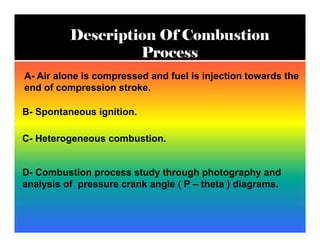
A- Air alone is compressed and fuel is injection towards the
end of compression stroke.
B- Spontaneous ignition.
C- Heterogeneous combustion.
D- Combustion process study through photography and
analysis of pressure crank angle ( P – theta ) diagrams.
Description Of Combustion
Process
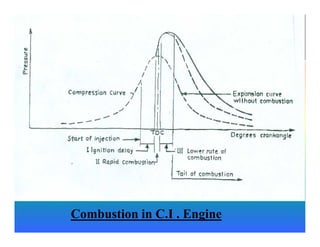
Combustion in C.I . Engine
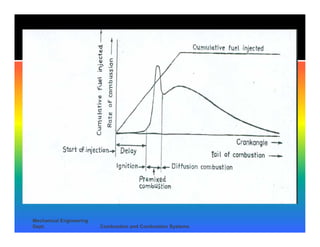
Mechanical Engineering
Dept. Combustion and Combustion Systems
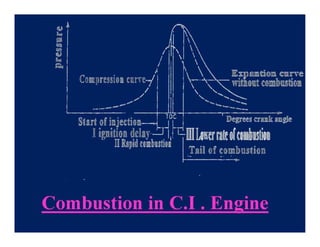
Combustion in C.I . Engine
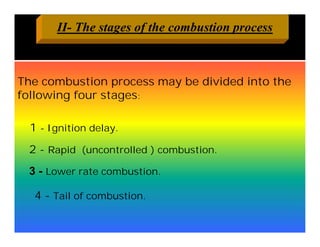
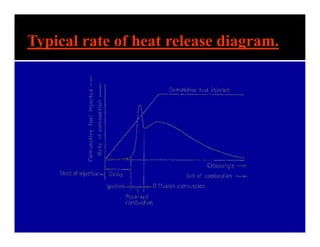
The combustion process may be divided into the
following four stages:
1 - Ignition delay.
2 - Rapid (uncontrolled ) combustion.
-3 Lower rate combustion.
4 - Tail of combustion.
II- The stages of the combustion process
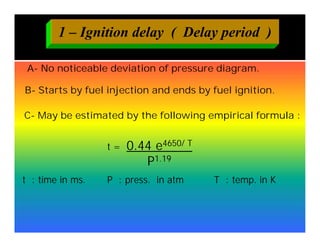
A- No noticeable deviation of pressure diagram.
B- Starts by fuel injection and ends by fuel ignition.
C- May be estimated by the following empirical formula :
t = 0.44 e4650/ T
P1.19
t : time in ms. P : press. in atm T : temp. in K
1 – Ignition delay ( Delay period )
1- Starts by ignition.
2- Prepared fuel during delay period is rapidly
combusted.
3- Depends on the duration of the delay period.
4- Combustion is pre- mixed in this stage, and it
gives little radiation and produces little carbon.
B- Rapid uncontrolled combustion
Lower rate combustion-C
1- The rate of combustion falls to a value that can be
maintained by preparation of fresh fuel.
2- Combustion depends on the need for fuel to find
oxygen.
3- Combustion is party regulated by the injection
process as well as by the mixing and diffusion
process.
4- Ends by the end of fuel injection.
Very low rate of combustion-D
1- combustion continues at a diminishing rate.
2- As the previous stage , it is characterized by diffusion
combustion with production and combustion of carbon
particles and a high rate of heat transfer by radiation.
3- Extends along expansion stroke.
Typical rate of heat release diagram.
Knocking In Diesel Engine-III
A It has opposite causes to that occurs in petrol engine.
B It is primarily due to too long delay period.
C It is worse at high speed, low C.R., low ambient temp.,
with fuel that have resistance to ignition
( compact structure )….
D Anti-knock characteristics ( ignition quality ) is
measured by Cetane Number.
Rating of Diesel Engine Fuels.-IV
A Ignition quality of fuel may be measured by the diesel
index.
Diesel index = (Aniline point ) x (A.P.I. gravity )
Aniline point is the lowest temp. at which equal volumes
of diesel fuel and freshly distilled water-free aniline are
completely miscible.
B A high diesel index fuel indicates a fuel of high ignition
quality.
C Centane number is the most important indicator of diesel
fuel ignition quality, and its anti-knock characteristics.
)ContinuedRating of Diesel Engine fuels (-IV
D Cetane number is considered
100 for cetane (Hexadecane C16 H34 ),
and zero for (alpha-methyl-naphthalene C11H10 )
E Hexadecane is very fast ignition fuel, and alpha-methyl-
naphthalene is a very slow ignition fuel.
F The Cetane number is measured by testing the unknown
fuel in a variable compression ratio co-operative fuel
research engine (C.F.R. engine)
IV- Rating of Diesel Engine Fuels (continued)
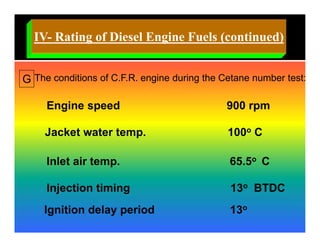
G The conditions of C.F.R. engine during the Cetane number test:
Engine speed 900 rpm
Jacket water temp. 100o C
Inlet air temp. 65.5o C
Injection timing 13o BTDC
Ignition delay period 13o
)continuedRating of Diesel Engine Fuels (-VI
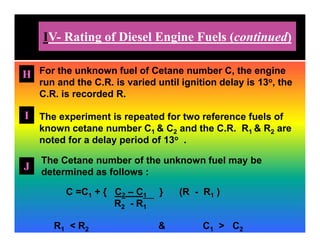
H For the unknown fuel of Cetane number C, the engine
run and the C.R. is varied until ignition delay is 13o, the
C.R. is recorded R.
I The experiment is repeated for two reference fuels of
known cetane number C1 & C2 and the C.R. R1 & R2 are
noted for a delay period of 13o .
J
The Cetane number of the unknown fuel may be
determined as follows :
C =C1 + { C2 – C1 } (R - R1 )
R2 - R1
R1 < R2 & C1 > C2
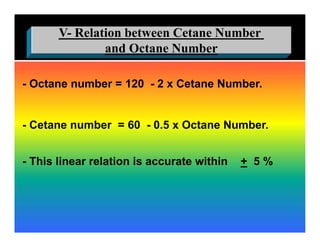
Relation between Cetane Number-V
and Octane Number
- Octane number = 120 - 2 x Cetane Number.
- Cetane number = 60 - 0.5 x Octane Number.
- This linear relation is accurate within + 5 %
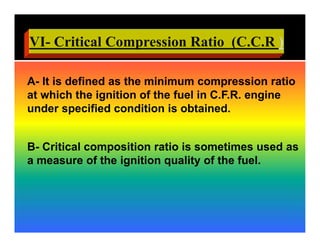
)Critical Compression Ratio (C.C.R-VI
A- It is defined as the minimum compression ratio
at which the ignition of the fuel in C.F.R. engine
under specified condition is obtained.
B- Critical composition ratio is sometimes used as
a measure of the ignition quality of the fuel.
Thank you
Prof. Dr . Mahmoud A. El Kady

4 combustion in-diesel_engine

  • 1.
  • 2.
    I- Description ofCombustion Process in Diesel Engine II- The Stages of the Diesel Engine Combustion Process. III-Knocking In Diesel Engine. IV- Rating of Diesel Engine fuels. V- Relation Between Cetane Number and Octane Number. VI- Critical Composition Ratio ( C C R ). Presentation Outline
  • 3.
    Description Of Combustion Process A-Air alone is compressed and fuel is injection towards the end of compression stroke. B- Spontaneous ignition. C- Heterogeneous combustion. D- Combustion process study through photography and analysis of pressure crank angle ( P – theta ) diagrams.
  • 4.
  • 5.
  • 6.
  • 7.
  • 8.
    The combustion processmay be divided into the following four stages: 1 - Ignition delay. 2 - Rapid (uncontrolled ) combustion. -3 Lower rate combustion. 4 - Tail of combustion. II- The stages of the combustion process
  • 9.
    A- No noticeabledeviation of pressure diagram. B- Starts by fuel injection and ends by fuel ignition. C- May be estimated by the following empirical formula : t = 0.44 e4650/ T P1.19 t : time in ms. P : press. in atm T : temp. in K 1 – Ignition delay ( Delay period )
  • 10.
    1- Starts byignition. 2- Prepared fuel during delay period is rapidly combusted. 3- Depends on the duration of the delay period. 4- Combustion is pre- mixed in this stage, and it gives little radiation and produces little carbon. B- Rapid uncontrolled combustion
  • 11.
    Lower rate combustion-C 1-The rate of combustion falls to a value that can be maintained by preparation of fresh fuel. 2- Combustion depends on the need for fuel to find oxygen. 3- Combustion is party regulated by the injection process as well as by the mixing and diffusion process. 4- Ends by the end of fuel injection.
  • 12.
    Very low rateof combustion-D 1- combustion continues at a diminishing rate. 2- As the previous stage , it is characterized by diffusion combustion with production and combustion of carbon particles and a high rate of heat transfer by radiation. 3- Extends along expansion stroke.
  • 13.
    Typical rate ofheat release diagram.
  • 14.
    Knocking In DieselEngine-III A It has opposite causes to that occurs in petrol engine. B It is primarily due to too long delay period. C It is worse at high speed, low C.R., low ambient temp., with fuel that have resistance to ignition ( compact structure )…. D Anti-knock characteristics ( ignition quality ) is measured by Cetane Number.
  • 15.
    Rating of DieselEngine Fuels.-IV A Ignition quality of fuel may be measured by the diesel index. Diesel index = (Aniline point ) x (A.P.I. gravity ) Aniline point is the lowest temp. at which equal volumes of diesel fuel and freshly distilled water-free aniline are completely miscible. B A high diesel index fuel indicates a fuel of high ignition quality. C Centane number is the most important indicator of diesel fuel ignition quality, and its anti-knock characteristics.
  • 16.
    )ContinuedRating of DieselEngine fuels (-IV D Cetane number is considered 100 for cetane (Hexadecane C16 H34 ), and zero for (alpha-methyl-naphthalene C11H10 ) E Hexadecane is very fast ignition fuel, and alpha-methyl- naphthalene is a very slow ignition fuel. F The Cetane number is measured by testing the unknown fuel in a variable compression ratio co-operative fuel research engine (C.F.R. engine)
  • 17.
    IV- Rating ofDiesel Engine Fuels (continued) G The conditions of C.F.R. engine during the Cetane number test: Engine speed 900 rpm Jacket water temp. 100o C Inlet air temp. 65.5o C Injection timing 13o BTDC Ignition delay period 13o
  • 18.
    )continuedRating of DieselEngine Fuels (-VI H For the unknown fuel of Cetane number C, the engine run and the C.R. is varied until ignition delay is 13o, the C.R. is recorded R. I The experiment is repeated for two reference fuels of known cetane number C1 & C2 and the C.R. R1 & R2 are noted for a delay period of 13o . J The Cetane number of the unknown fuel may be determined as follows : C =C1 + { C2 – C1 } (R - R1 ) R2 - R1 R1 < R2 & C1 > C2
  • 19.
    Relation between CetaneNumber-V and Octane Number - Octane number = 120 - 2 x Cetane Number. - Cetane number = 60 - 0.5 x Octane Number. - This linear relation is accurate within + 5 %
  • 20.
    )Critical Compression Ratio(C.C.R-VI A- It is defined as the minimum compression ratio at which the ignition of the fuel in C.F.R. engine under specified condition is obtained. B- Critical composition ratio is sometimes used as a measure of the ignition quality of the fuel.
  • 21.
    Thank you Prof. Dr. Mahmoud A. El Kady