Experimental Method
- is basically a collection of research
designs, guidelines for using them, principles and
procedures for determining statistical
significance, and criteria for determining the quality
of a study
For some researchers , the experimental
method is the premier method, all others being
‘ground clearing’ operations, that is, preliminary
data collection and interpretation exercises to
prepare for a formal experiment.
Experiments are generally conducted in order to test the
strength of relationships between variables. We also saw that
when the researcher is testing the influence of one variable on
another , the variable doing the influencing is called the
independent variable, while the other being influenced is
called the dependent variable.
Example:
“In a study of the effect of two different methods for
teaching grammar, the teaching method would me the
independent variable, and the students’ performance on a test of
grammar knowledge would be the dependent variable”.
QUALITY CONTROL
ISSUES:
THREATS TO INTERNAL VALIDITY
Quality Control – in the experimental method, is
largely a matter of understanding the many things that
can go wrong and taking steps to prevent or minimize
those threats.
Threats to internal validity can be divided to three
categories:
Experience Bias factors
Participant Bias
Instrumentation Bias
Threats to Internal Validity
Based on Experience
Three Experience Bias
Factors
- refers to events –things that happen during
an experiment which may influence the results.
- can also have an unintended influence on the
outcomes of the treatment.
Example :
“If classes in the study are disrupted due to natural
disasters or political unrest, the research will be affected”
Experience Bias factors are those “based on what
occurs within a research study as it progresses”.
- refers to the fact that taking a pre-test may
influence the subjects’ performance on post-test.
That is in addition to learning from the
treatment, learners may do better on the post-test
because the pre-test alerted them to what was being
investigated in the study.
- A treatment may appear to increase learning
effectiveness as compared to that of a control or
comparison group, not because it really boosts
effectiveness but because either the experimenter or
the subjects believe that it does and behave according
to this expectation ( Tuckman, 1999)
Threats to Internal Validity
Based on Participants
Participant Bias is a result of the “characteristics of
the people on whom the study is conducted”
Five participant bias factors:
-as a threat to Internal validity is the idea that somehow the
groups to be compared turn out to be different before the
treatment
Safeguard:
Random selection and random assignment are
used to combat this problem.
-refers to the normal development people undergo
whether or not they are receiving a treatment of some kind.
Safeguard:
This problem is addressed through the use of control
group, which is at the same development level as the
treatment group and goes through the same experiences for
the period of time.
-is the name of a tendency for people’s test scores to
change whether or not the knowledge, skill or ability to being
measured truly changes.
Safeguard:
Using subjects who represent an entire range of
ability levels in your design is one way to avoid this problem.
- Is the problem of losing subjects from the study. It can
be especially worrisome if the groups end up being quite
different sizes because people dropped out.
-happens when more than one threat is present in
a study.
Safeguard:
To deal with this threat, researchers often try to
recruit more people for a study than they may actually
need.
Safeguard:
Careful planning is needed to avoid these sorts of
problems.
Threats to Internal Validity
Based on Instrumentation
Instrumentation Bias has to do with “the way the
data are collected”
The threat of instrumentation is also sometimes called
instability of measures, because it occurs if the measurement
or recording processes change during the experiment.
Safeguard:
Observer training, rater training, and the careful
piloting of all questionnaires and data collection devices.
QUALITY CONTROL
ISSUES:
THREATS TO EXTERNAL VALITY
There are four issues concern about external
validity:
- It is related to the testing threat ( or practice effect to
internal validity. In this situation, the presence of a pre-
test may give the effects of the treatment boost. Then, when
the outcomes of the experiment are transferred to the real
world where no pre-test is involved, that extra boost will be
lacking.
-This threat is very interesting problem. This idea
refers to the fact that sometimes just knowing that one is in
an experiment is enough to cause a difference that may be
captured by the dependent variable , whether or not one is
in the treatment group.
-occurs when the sample in an experiment is not
really representative of the population from which it was
drawn.
-This term means that before we select people
from the population to be in the sample, we determine
what the relevant characteristics of the population are and
make sure that the levels in the sample represents the
population appropriately.
-This threat is hard to manage in the classroom
research , especially in second language settings where
students have access to the target language outside of
class.
RESEARCH DESIGNS IN
THE EXPERIMENTAL
METHOD
In order to deal with these threats, the
experimental method includes many
different research designs to counteract the
possible confounding variables that could
influence the internal and external validity
of a study. The various designs have
different strength and weaknesses. Anyone
who chooses to do an experiment must
balance the focus of the research question
against the time resources available for
conducting the study in order to choose the
best design.
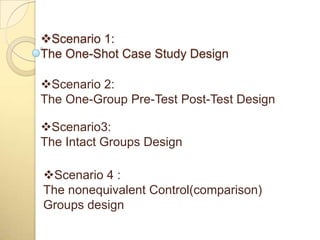
Scenario 1:
The One-Shot Case Study Design
Scenario 2:
The One-Group Pre-Test Post-Test Design
Scenario3:
The Intact Groups Design
Scenario 4 :
The nonequivalent Control(comparison)
Groups design
Scenario 5:
The Time Series Design
Scenario 6:
The Equivalent Time Samples Design
Scenario 7:
Post- Test Only Control Group
Design
Scenario 8:
Pre-test Post Test Control
Design

Experimentalmethod

  • 2.
    Experimental Method - isbasically a collection of research designs, guidelines for using them, principles and procedures for determining statistical significance, and criteria for determining the quality of a study For some researchers , the experimental method is the premier method, all others being ‘ground clearing’ operations, that is, preliminary data collection and interpretation exercises to prepare for a formal experiment.
  • 3.
    Experiments are generallyconducted in order to test the strength of relationships between variables. We also saw that when the researcher is testing the influence of one variable on another , the variable doing the influencing is called the independent variable, while the other being influenced is called the dependent variable. Example: “In a study of the effect of two different methods for teaching grammar, the teaching method would me the independent variable, and the students’ performance on a test of grammar knowledge would be the dependent variable”.
  • 4.
    QUALITY CONTROL ISSUES: THREATS TOINTERNAL VALIDITY Quality Control – in the experimental method, is largely a matter of understanding the many things that can go wrong and taking steps to prevent or minimize those threats. Threats to internal validity can be divided to three categories: Experience Bias factors Participant Bias Instrumentation Bias
  • 5.
    Threats to InternalValidity Based on Experience Three Experience Bias Factors - refers to events –things that happen during an experiment which may influence the results. - can also have an unintended influence on the outcomes of the treatment. Example : “If classes in the study are disrupted due to natural disasters or political unrest, the research will be affected” Experience Bias factors are those “based on what occurs within a research study as it progresses”.
  • 6.
    - refers tothe fact that taking a pre-test may influence the subjects’ performance on post-test. That is in addition to learning from the treatment, learners may do better on the post-test because the pre-test alerted them to what was being investigated in the study. - A treatment may appear to increase learning effectiveness as compared to that of a control or comparison group, not because it really boosts effectiveness but because either the experimenter or the subjects believe that it does and behave according to this expectation ( Tuckman, 1999)
  • 7.
    Threats to InternalValidity Based on Participants Participant Bias is a result of the “characteristics of the people on whom the study is conducted” Five participant bias factors: -as a threat to Internal validity is the idea that somehow the groups to be compared turn out to be different before the treatment Safeguard: Random selection and random assignment are used to combat this problem.
  • 8.
    -refers to thenormal development people undergo whether or not they are receiving a treatment of some kind. Safeguard: This problem is addressed through the use of control group, which is at the same development level as the treatment group and goes through the same experiences for the period of time. -is the name of a tendency for people’s test scores to change whether or not the knowledge, skill or ability to being measured truly changes. Safeguard: Using subjects who represent an entire range of ability levels in your design is one way to avoid this problem.
  • 9.
    - Is theproblem of losing subjects from the study. It can be especially worrisome if the groups end up being quite different sizes because people dropped out. -happens when more than one threat is present in a study. Safeguard: To deal with this threat, researchers often try to recruit more people for a study than they may actually need. Safeguard: Careful planning is needed to avoid these sorts of problems.
  • 10.
    Threats to InternalValidity Based on Instrumentation Instrumentation Bias has to do with “the way the data are collected” The threat of instrumentation is also sometimes called instability of measures, because it occurs if the measurement or recording processes change during the experiment. Safeguard: Observer training, rater training, and the careful piloting of all questionnaires and data collection devices.
  • 11.
  • 12.
    There are fourissues concern about external validity: - It is related to the testing threat ( or practice effect to internal validity. In this situation, the presence of a pre- test may give the effects of the treatment boost. Then, when the outcomes of the experiment are transferred to the real world where no pre-test is involved, that extra boost will be lacking. -This threat is very interesting problem. This idea refers to the fact that sometimes just knowing that one is in an experiment is enough to cause a difference that may be captured by the dependent variable , whether or not one is in the treatment group.
  • 13.
    -occurs when thesample in an experiment is not really representative of the population from which it was drawn. -This term means that before we select people from the population to be in the sample, we determine what the relevant characteristics of the population are and make sure that the levels in the sample represents the population appropriately. -This threat is hard to manage in the classroom research , especially in second language settings where students have access to the target language outside of class.
  • 14.
    RESEARCH DESIGNS IN THEEXPERIMENTAL METHOD
  • 15.
    In order todeal with these threats, the experimental method includes many different research designs to counteract the possible confounding variables that could influence the internal and external validity of a study. The various designs have different strength and weaknesses. Anyone who chooses to do an experiment must balance the focus of the research question against the time resources available for conducting the study in order to choose the best design.
  • 16.
    Scenario 1: The One-ShotCase Study Design Scenario 2: The One-Group Pre-Test Post-Test Design Scenario3: The Intact Groups Design Scenario 4 : The nonequivalent Control(comparison) Groups design
  • 17.
    Scenario 5: The TimeSeries Design Scenario 6: The Equivalent Time Samples Design Scenario 7: Post- Test Only Control Group Design Scenario 8: Pre-test Post Test Control Design