Exploiting	Rapid	
Change	in	Technology	
Enhanced	Learning
…	for	Post	Graduate	Education
Quantitative Methodology Part Two
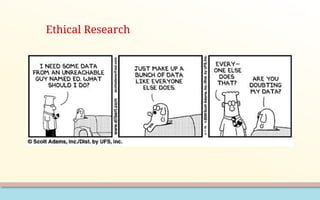
Ethical Research
Our Focus for Today
1. Discussion of the exercises presented in part one
2. Pre-experimental quantitative research methods
3. Threats to validity
Exercises from Part One
Establish what research design is appropriate for
this study…
•Problem: A researcher has three different groups of employees
(engineers, administrators, sales personal) which are not
performing at the expected level. Data shows three different levels
of current performance: high, average, and low.
•Purpose: To determine the effects of different types of feedback
on employees’ performance
•Research Question: What is the effect of different types of
feedback over the performance of employees?
• Values of the independent variable: positive, negative, no
feedback
Establish what research design is appropriate for
this study…
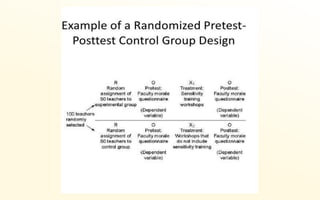
•Problem: Faculty morale is low at a university according to
the results of a questionnaire applied.
•Purpose: To establish the effect of sensitivity training on
faculty morale
•Research Question: What is the effect of sensitivity training
workshops on faculty morale?
• Values of the independent variable: treatment, no
treatment
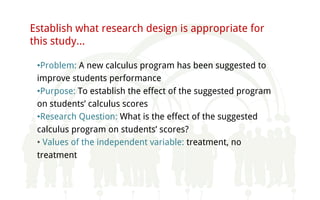
Establish what research design is appropriate for
this study…
•Problem: A new calculus program has been suggested to
improve students performance
•Purpose: To establish the effect of the suggested program
on students’ calculus scores
•Research Question: What is the effect of the suggested
calculus program on students’ scores?
• Values of the independent variable: treatment, no
treatment
Now do the same with your own study…
•Problem:
• Research Question:
• Research Design:
•Research Method:
Sharing Your Experience
1. What was the most clear point?
2. What was the least clear point?
3. What would you like to say about the experience?
4. Any specific exercise you want to talk about?
Pre-Experimental Designs
• Ex Post Facto Research
• Survey Design
Ex Post Facto Research
• Description: Variables are studied after the fact has occurred without
interference from the researcher. Possible relationships and effects are
searched. It is applied in contexts in which it is not possible or acceptable
to manipulate the characteristics of human participants or in situations in
which it is not practical or ethically acceptable to apply the full protocol of
a true experimental design. They are widely used in social sciences.
• Types:
– Causal-Comparative Design
– Correlational Design
Causal-Comparative Design
• Description: Researchers try to establish the possible cause-effect
relationship that already exists between variables in a
nonexperimental setting. There are comparison groups rather than
experimental and control groups.
• Basic approaches:
– Retrospective
– Prospective
Correlational Design
• Description: It determines	whether	or	not	two	variables	are	correlated,	
which	means	that	an	increase	or	decrease	in	one	variable	corresponds	to	
an	increase	or	decrease	in	the	other	variable.	It	is	very	important	to	note	
that	correlation	does	not	imply	causation,	just	an	association.
• Types :
– Relational Design
– Prediction design
Survey Design
• Description: It intends to describe a situation using the answers
to questions
• Types of Designs:
– Longitudinal Design
• Trend Study
• Cohort Study
• Panel Study
– Cross-Sectional Design
• Types of Surveys:
– Questionnaire
– Interview
Difference-in-Difference Estimation
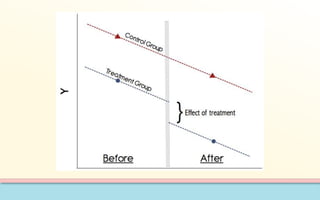
The simplest set up is one where outcomes are observed for two groups
for two time periods. One of the groups is exposed to a treatment in the
second period, but not in the first period. The second group is not
exposed to the treatment during either period. Then, the researcher
estimates the “difference of differences”
An estimator, not a design. Used to study policy questions by estimating
treatment effects with nonexperimental data
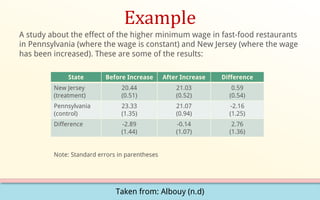
Example
A study about the effect of the higher minimum wage in fast-food restaurants
in Pennsylvania (where the wage is constant) and New Jersey (where the wage
has been increased). These are some of the results:
State Before Increase After Increase Difference
New Jersey
(treatment)
20.44
(0.51)
21.03
(0.52)
0.59
(0.54)
Pennsylvania
(control)
23.33
(1.35)
21.07
(0.94)
-2.16
(1.25)
Difference -2.89
(1.44)
-0.14
(1.07)
2.76
(1.36)
Note: Standard errors in parentheses
Taken from: Albouy (n.d)
Taken from: Wiersma, W. & Jurs, S.G. (2009)
Threats to Internal Validity
History
Description: Unanticipated events occurring while the
experiment is in progress that affect the dependent
variable
Maturation
Description: Processes operating within the subjects as
a function of time
Testing
Description: The effect that taking one test has on the
results of a subsequent test
Instrumentation
Description: An effect due to inconsistent use of the
measuring instruments, observers, or scorers that may
affect the results
Statistical Regression
Description: An effect caused by a tendency for subjects
selected on the basis of extreme scores to regress
toward an average performance on a subsequent test. It
is also known as “regression to the mean”
Selection
Description: An effect due to the groups of subjects
not being randomly assigned to groups; a selection bias
is operating such that the groups are not equivalent
Mortality
Description: An effect due to subjects dropping out of
the experiment. The subjects that stay may be more
motivated or capable and that affects the results
Selection- Maturation Interaction
Description: An effect of maturation not being
consistent across the groups because of some selection
factor may lead to confusing results and an erroneous
interpretation of the effect of the treatment.
Taken from: Wiersma, W. & Jurs, S.G. (2009)
Threats to External Validity
Interaction Effect of Testing
Description: Pretesting interacts with the experimental
treatment and causes some effect such that the results
cannot be not generalized to an unpretested population
Interaction Effects of Selection
Biases and the Experimental
Treatment
Description: An effect of some selection factor of intact
groups interacting with the experimental treatment that
would not be the case if the groups were formed
randomly
Reactive Effects of Experimental
Arrangements
Description: An effect that is due to the artificial or novel
experimental setting. It may also threaten internal
validity
Multiple-Treatment Interference
Description: When the same subjects receive two or more
treatments, there may be a carryover effect between
treatments and therefore the results cannot be
generalized to single treatments
Taken from: Wiersma, W. & Jurs, S.G. (2009)
Threats to Construct Validity
Inadequate Preoperational
Explication of Constructs
Description: Insufficient definition of the variables
Mono-Operation Bias
Description: Only one form of the experimental variable is
implemented
Mono-Method Bias
Description: Only one form of the dependent variable is
implemented
Hypothesis-Guessing within
Experimental Conditions
Description: Participants behave differently when they
know they are part of an experiment
Participants’ behavior can also threaten internal validity
Confounding Constructs and Levels
of Constructs
Description: Drawing conclusions about variables when
some levels of the variable are absent
Taken from: Wiersma, W. & Jurs, S.G. (2009)
Threats to Statistical Conclusion
Validity
Low-Statistical Validity
Description: Using a sample size that is too small to detect
differences between groups
Violated Assumptions of Statistical
Tests
Description: Failing to meet the underlying assumptions
Fishing and the Error Rate Problem
Description: Capitalizing on chance findings
Reliability of Measures
Description: Using technically inadequate measures
Now you know
1. The pre-experimental designs
2. What difference-in-difference
estimation is
3. Different types of threats to validity
Reference
Albouy, D. (n.d). Program evaluation and the difference in
difference estimator. Retrieved from
http://eml.berkeley.edu/~webfac/saez/e131_s04/diff.pdf
Wiersma, W. & Jurs, S.G. (2009). Research methods in education:
An introduction (9th ed.). Boston, MA: Allyn and Bacon
What’s Up at MN & DN this summer?
1. VERY IMPORTANT – backwards map your summer work
2. 30 day writing challenge, 30 day work-life balance challenge, and 365s -
keep you in touch with your work
3. Group work – RLC writing OR
Lingerers
Avoid this one
1. VERY IMPORTANT – backwards map your summer work
2. 30 day writing challenge, 30 day work-life balance challenge, and 365s -
keep you in touch with your work
3. Group work – RLC writing OR Lingerers
Quantitative methodology part two.compressed 2

Quantitative methodology part two.compressed 2

  • 1.
  • 2.
  • 3.
    Our Focus forToday 1. Discussion of the exercises presented in part one 2. Pre-experimental quantitative research methods 3. Threats to validity
  • 4.
  • 5.
    Establish what researchdesign is appropriate for this study… •Problem: A researcher has three different groups of employees (engineers, administrators, sales personal) which are not performing at the expected level. Data shows three different levels of current performance: high, average, and low. •Purpose: To determine the effects of different types of feedback on employees’ performance •Research Question: What is the effect of different types of feedback over the performance of employees? • Values of the independent variable: positive, negative, no feedback
  • 6.
    Establish what researchdesign is appropriate for this study… •Problem: Faculty morale is low at a university according to the results of a questionnaire applied. •Purpose: To establish the effect of sensitivity training on faculty morale •Research Question: What is the effect of sensitivity training workshops on faculty morale? • Values of the independent variable: treatment, no treatment
  • 8.
    Establish what researchdesign is appropriate for this study… •Problem: A new calculus program has been suggested to improve students performance •Purpose: To establish the effect of the suggested program on students’ calculus scores •Research Question: What is the effect of the suggested calculus program on students’ scores? • Values of the independent variable: treatment, no treatment
  • 9.
    Now do thesame with your own study… •Problem: • Research Question: • Research Design: •Research Method:
  • 10.
    Sharing Your Experience 1.What was the most clear point? 2. What was the least clear point? 3. What would you like to say about the experience? 4. Any specific exercise you want to talk about?
  • 11.
    Pre-Experimental Designs • ExPost Facto Research • Survey Design
  • 12.
    Ex Post FactoResearch • Description: Variables are studied after the fact has occurred without interference from the researcher. Possible relationships and effects are searched. It is applied in contexts in which it is not possible or acceptable to manipulate the characteristics of human participants or in situations in which it is not practical or ethically acceptable to apply the full protocol of a true experimental design. They are widely used in social sciences. • Types: – Causal-Comparative Design – Correlational Design
  • 13.
    Causal-Comparative Design • Description:Researchers try to establish the possible cause-effect relationship that already exists between variables in a nonexperimental setting. There are comparison groups rather than experimental and control groups. • Basic approaches: – Retrospective – Prospective
  • 14.
    Correlational Design • Description:It determines whether or not two variables are correlated, which means that an increase or decrease in one variable corresponds to an increase or decrease in the other variable. It is very important to note that correlation does not imply causation, just an association. • Types : – Relational Design – Prediction design
  • 15.
    Survey Design • Description:It intends to describe a situation using the answers to questions • Types of Designs: – Longitudinal Design • Trend Study • Cohort Study • Panel Study – Cross-Sectional Design • Types of Surveys: – Questionnaire – Interview
  • 16.
    Difference-in-Difference Estimation The simplestset up is one where outcomes are observed for two groups for two time periods. One of the groups is exposed to a treatment in the second period, but not in the first period. The second group is not exposed to the treatment during either period. Then, the researcher estimates the “difference of differences” An estimator, not a design. Used to study policy questions by estimating treatment effects with nonexperimental data
  • 18.
    Example A study aboutthe effect of the higher minimum wage in fast-food restaurants in Pennsylvania (where the wage is constant) and New Jersey (where the wage has been increased). These are some of the results: State Before Increase After Increase Difference New Jersey (treatment) 20.44 (0.51) 21.03 (0.52) 0.59 (0.54) Pennsylvania (control) 23.33 (1.35) 21.07 (0.94) -2.16 (1.25) Difference -2.89 (1.44) -0.14 (1.07) 2.76 (1.36) Note: Standard errors in parentheses Taken from: Albouy (n.d)
  • 19.
    Taken from: Wiersma,W. & Jurs, S.G. (2009) Threats to Internal Validity
  • 20.
    History Description: Unanticipated eventsoccurring while the experiment is in progress that affect the dependent variable
  • 21.
    Maturation Description: Processes operatingwithin the subjects as a function of time
  • 22.
    Testing Description: The effectthat taking one test has on the results of a subsequent test
  • 23.
    Instrumentation Description: An effectdue to inconsistent use of the measuring instruments, observers, or scorers that may affect the results
  • 24.
    Statistical Regression Description: Aneffect caused by a tendency for subjects selected on the basis of extreme scores to regress toward an average performance on a subsequent test. It is also known as “regression to the mean”
  • 25.
    Selection Description: An effectdue to the groups of subjects not being randomly assigned to groups; a selection bias is operating such that the groups are not equivalent
  • 26.
    Mortality Description: An effectdue to subjects dropping out of the experiment. The subjects that stay may be more motivated or capable and that affects the results
  • 27.
    Selection- Maturation Interaction Description:An effect of maturation not being consistent across the groups because of some selection factor may lead to confusing results and an erroneous interpretation of the effect of the treatment.
  • 28.
    Taken from: Wiersma,W. & Jurs, S.G. (2009) Threats to External Validity
  • 29.
    Interaction Effect ofTesting Description: Pretesting interacts with the experimental treatment and causes some effect such that the results cannot be not generalized to an unpretested population
  • 30.
    Interaction Effects ofSelection Biases and the Experimental Treatment Description: An effect of some selection factor of intact groups interacting with the experimental treatment that would not be the case if the groups were formed randomly
  • 31.
    Reactive Effects ofExperimental Arrangements Description: An effect that is due to the artificial or novel experimental setting. It may also threaten internal validity
  • 32.
    Multiple-Treatment Interference Description: Whenthe same subjects receive two or more treatments, there may be a carryover effect between treatments and therefore the results cannot be generalized to single treatments
  • 33.
    Taken from: Wiersma,W. & Jurs, S.G. (2009) Threats to Construct Validity
  • 34.
    Inadequate Preoperational Explication ofConstructs Description: Insufficient definition of the variables
  • 35.
    Mono-Operation Bias Description: Onlyone form of the experimental variable is implemented
  • 36.
    Mono-Method Bias Description: Onlyone form of the dependent variable is implemented
  • 37.
    Hypothesis-Guessing within Experimental Conditions Description:Participants behave differently when they know they are part of an experiment Participants’ behavior can also threaten internal validity
  • 38.
    Confounding Constructs andLevels of Constructs Description: Drawing conclusions about variables when some levels of the variable are absent
  • 39.
    Taken from: Wiersma,W. & Jurs, S.G. (2009) Threats to Statistical Conclusion Validity
  • 40.
    Low-Statistical Validity Description: Usinga sample size that is too small to detect differences between groups
  • 41.
    Violated Assumptions ofStatistical Tests Description: Failing to meet the underlying assumptions
  • 42.
    Fishing and theError Rate Problem Description: Capitalizing on chance findings
  • 43.
    Reliability of Measures Description:Using technically inadequate measures
  • 44.
    Now you know 1.The pre-experimental designs 2. What difference-in-difference estimation is 3. Different types of threats to validity
  • 45.
    Reference Albouy, D. (n.d).Program evaluation and the difference in difference estimator. Retrieved from http://eml.berkeley.edu/~webfac/saez/e131_s04/diff.pdf Wiersma, W. & Jurs, S.G. (2009). Research methods in education: An introduction (9th ed.). Boston, MA: Allyn and Bacon
  • 46.
    What’s Up atMN & DN this summer? 1. VERY IMPORTANT – backwards map your summer work 2. 30 day writing challenge, 30 day work-life balance challenge, and 365s - keep you in touch with your work 3. Group work – RLC writing OR Lingerers
  • 47.
    Avoid this one 1.VERY IMPORTANT – backwards map your summer work 2. 30 day writing challenge, 30 day work-life balance challenge, and 365s - keep you in touch with your work 3. Group work – RLC writing OR Lingerers