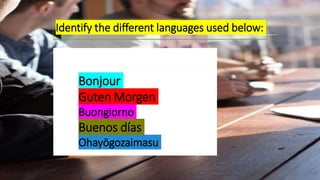
Bonjour
Guten Morgen
Buongiorno
Buenos días
Ohayōgozaimasu
Identify the different languages used below:
Chapter III
Intercultural Communication
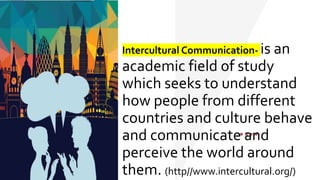
Intercultural Communication- is an
academic field of study
which seeks to understand
how people from different
countries and culture behave
and communicate and
perceive the world around
them. (http//www.intercultural.org/)
Elements of Intercultural Communication
Perceptions: beliefs, values, attitudes, world
views, and social organizations
Verbal Processes: the ways in which cultures
employ symbols to portray things and
experiences
Nonverbal Processes: shared thoughts and feelings
of bodily behaviour, time and space(Kinesics,
Proxemics, Paralanguage, Haptics, Chronemics,
Oculesics)
Contextual Elements: business, education and health
care, tourism and personal relationships
Why do we study Intercultural Communication?
 Increases Self-awareness of our own culture and helps to avoid Ethnocentrism
 Demographic Changes The constant demographic shifts that countries and
communities experience result to more immigrants, refugees and undocumented
individuals.
 Workplace and Economic Globalization To compete effectively in a global
market we must understand how business and cultural practices are conducted in
other countries.
 Creative Problem Solving According to research, we learn from people who are
different than us from those who are similar to us (Stanberg/Ting-Toomey & Chung, 2005).
 Global and Intrapersonal Peace Respect is fundamental to peace, global and
intrapersonal. If we are at peace with ourselves, we will hold more compassion
and caring for others around us (Ting-Toomey & Chung, 2005).
Importance of Intercultural Communication in Education
Education relies on effective interaction between teachers and
learners. Teachers should therefore be sensitive to the potentially
problematic outcomes of intercultural communication in the
culturally diverse class.
Communication can a useful source of IC and mutual enrichment
between culturally diverse students if managed proactively by the
teacher. Otherwise, communication could be a source of frustration,
misapprehensions, intercultural conflict and ultimately school
failure.
8
Paralanguage
Gestures, Glances, Tone of Voice
Kinesics
Language of gestures, expressions and
postures
Communication and Language
Throughout the world, human beings
are thousands of language to
communicate with one another. Some
of these are spoken in many countries
and enjoy international status, while
others are used in country or region or
even in a single village.
Linguists refer to all of these auxiliary
communication devices as
paralanguage.
It helps prevent ineffective
communication.
9
What is a Language?
A language is a system of verbal and, in many
cases, written symbols with rules about how those
symbols can be strung together to convey more
complex meanings.
Language is the key factor in the human race’s
success
in creating and preserving culture, for without
language the ability to convey ideas and traditions
impossible.
1. Phonology – the system of sounds that a particular language uses, includes not only
the language’s basic unit of sounds, or phonemes, but rules about how we put
phonemes together to form words and rules about the proper intonations patterns for
phrases and sentences.
2. Semantics – is the study of word meanings and word combinations. Comprehension
of written as well as spoken language requires not only a knowledge of specific words
and their definitions but an understanding of how we use words and how we combine
them in phrases, clauses, and sentences.
3. Grammar- describes the structure of a language consists of two major parts:
a) Morphology- language’s study of smallest units of meaning, called morphemes-suffixes,
prefixes, and root words.
b) Syntax- is the grammatical structure of sentences. The format in which words and
phrases are arranged to create sentences is called syntax.
Four Areas of the Study of Language
4. Pragmatics- is defined as an approach to things that focuses on the practical or logical
response. Addressing problems logically and practically is an example of pragmatism.
Four Areas of the Study of Language
Perhaps the most significant of the inventions made possible by
culture is language. The learning of culture takes place through
language. From our enormous capacity to learn and use
language is derived our collective memory (myths, fables,
sayings, and ballads). As well as writing, art, and all other media
that shape human consciousness and store and transmit
knowledge.
Language is an integral part of culture and human culture cannot
exist without it. All human societies have languages.
Language and Culture
12
THANKYOU!!!
13
Lorem ipsum dolor sit amet, consectetuer adipiscing elit.
Maecenas porttitor congue massa. Fusce posuere, magna
sed pulvinar ultricies, purus lectus malesuada libero, sit amet
commodo magna eros quis urna.
LOREM IPSUM DOLOR SIT AMET,
CONSECTETUER ADIPISCING ELIT.
14
THANKYOU
Name
Phone
Email
Website
16
Customize thisTemplate
Template Editing Instructions
and Feedback

Intercultural Communication

  • 1.
  • 2.
  • 3.
    Intercultural Communication- isan academic field of study which seeks to understand how people from different countries and culture behave and communicate and perceive the world around them. (http//www.intercultural.org/)
  • 4.
    Elements of InterculturalCommunication Perceptions: beliefs, values, attitudes, world views, and social organizations Verbal Processes: the ways in which cultures employ symbols to portray things and experiences
  • 5.
    Nonverbal Processes: sharedthoughts and feelings of bodily behaviour, time and space(Kinesics, Proxemics, Paralanguage, Haptics, Chronemics, Oculesics) Contextual Elements: business, education and health care, tourism and personal relationships
  • 6.
    Why do westudy Intercultural Communication?  Increases Self-awareness of our own culture and helps to avoid Ethnocentrism  Demographic Changes The constant demographic shifts that countries and communities experience result to more immigrants, refugees and undocumented individuals.  Workplace and Economic Globalization To compete effectively in a global market we must understand how business and cultural practices are conducted in other countries.  Creative Problem Solving According to research, we learn from people who are different than us from those who are similar to us (Stanberg/Ting-Toomey & Chung, 2005).  Global and Intrapersonal Peace Respect is fundamental to peace, global and intrapersonal. If we are at peace with ourselves, we will hold more compassion and caring for others around us (Ting-Toomey & Chung, 2005).
  • 7.
    Importance of InterculturalCommunication in Education Education relies on effective interaction between teachers and learners. Teachers should therefore be sensitive to the potentially problematic outcomes of intercultural communication in the culturally diverse class. Communication can a useful source of IC and mutual enrichment between culturally diverse students if managed proactively by the teacher. Otherwise, communication could be a source of frustration, misapprehensions, intercultural conflict and ultimately school failure.
  • 8.
    8 Paralanguage Gestures, Glances, Toneof Voice Kinesics Language of gestures, expressions and postures Communication and Language Throughout the world, human beings are thousands of language to communicate with one another. Some of these are spoken in many countries and enjoy international status, while others are used in country or region or even in a single village. Linguists refer to all of these auxiliary communication devices as paralanguage. It helps prevent ineffective communication.
  • 9.
    9 What is aLanguage? A language is a system of verbal and, in many cases, written symbols with rules about how those symbols can be strung together to convey more complex meanings. Language is the key factor in the human race’s success in creating and preserving culture, for without language the ability to convey ideas and traditions impossible.
  • 10.
    1. Phonology –the system of sounds that a particular language uses, includes not only the language’s basic unit of sounds, or phonemes, but rules about how we put phonemes together to form words and rules about the proper intonations patterns for phrases and sentences. 2. Semantics – is the study of word meanings and word combinations. Comprehension of written as well as spoken language requires not only a knowledge of specific words and their definitions but an understanding of how we use words and how we combine them in phrases, clauses, and sentences. 3. Grammar- describes the structure of a language consists of two major parts: a) Morphology- language’s study of smallest units of meaning, called morphemes-suffixes, prefixes, and root words. b) Syntax- is the grammatical structure of sentences. The format in which words and phrases are arranged to create sentences is called syntax. Four Areas of the Study of Language
  • 11.
    4. Pragmatics- isdefined as an approach to things that focuses on the practical or logical response. Addressing problems logically and practically is an example of pragmatism. Four Areas of the Study of Language
  • 12.
    Perhaps the mostsignificant of the inventions made possible by culture is language. The learning of culture takes place through language. From our enormous capacity to learn and use language is derived our collective memory (myths, fables, sayings, and ballads). As well as writing, art, and all other media that shape human consciousness and store and transmit knowledge. Language is an integral part of culture and human culture cannot exist without it. All human societies have languages. Language and Culture 12
  • 13.
  • 14.
    Lorem ipsum dolorsit amet, consectetuer adipiscing elit. Maecenas porttitor congue massa. Fusce posuere, magna sed pulvinar ultricies, purus lectus malesuada libero, sit amet commodo magna eros quis urna. LOREM IPSUM DOLOR SIT AMET, CONSECTETUER ADIPISCING ELIT. 14
  • 15.
  • 16.