Interbank Loans, Collateral
and Modern Monetary
Policy
SYstemic Risk TOmography:
Signals, Measurements, Transmission Channels, and
Policy Interventions
Michiel van de Leur (a)
Marcin Wolski (b)
(a)VU Amsterdam (b)European Investment Bank
Université Paris I Sorbonne
February 2016
Introduction
Interbank markets played a central role in propagating the distress
during the financial crisis.
Secured transactions are settled with collateral. The risk
depends on quality of collateral, and distress originates from
common-factor shocks.
The risk of unsecured trades depends on the counterparty, and
malaise spreads through contagion.
In general, the unsecured market is much smaller market in size,
and with higher rates.
Both interbank markets are heavily interdependent as in equilibrium
there should be no arbitrage opportunities between them.
Interbank Loans, Collateral and Modern Monetary Policy 2 / 23
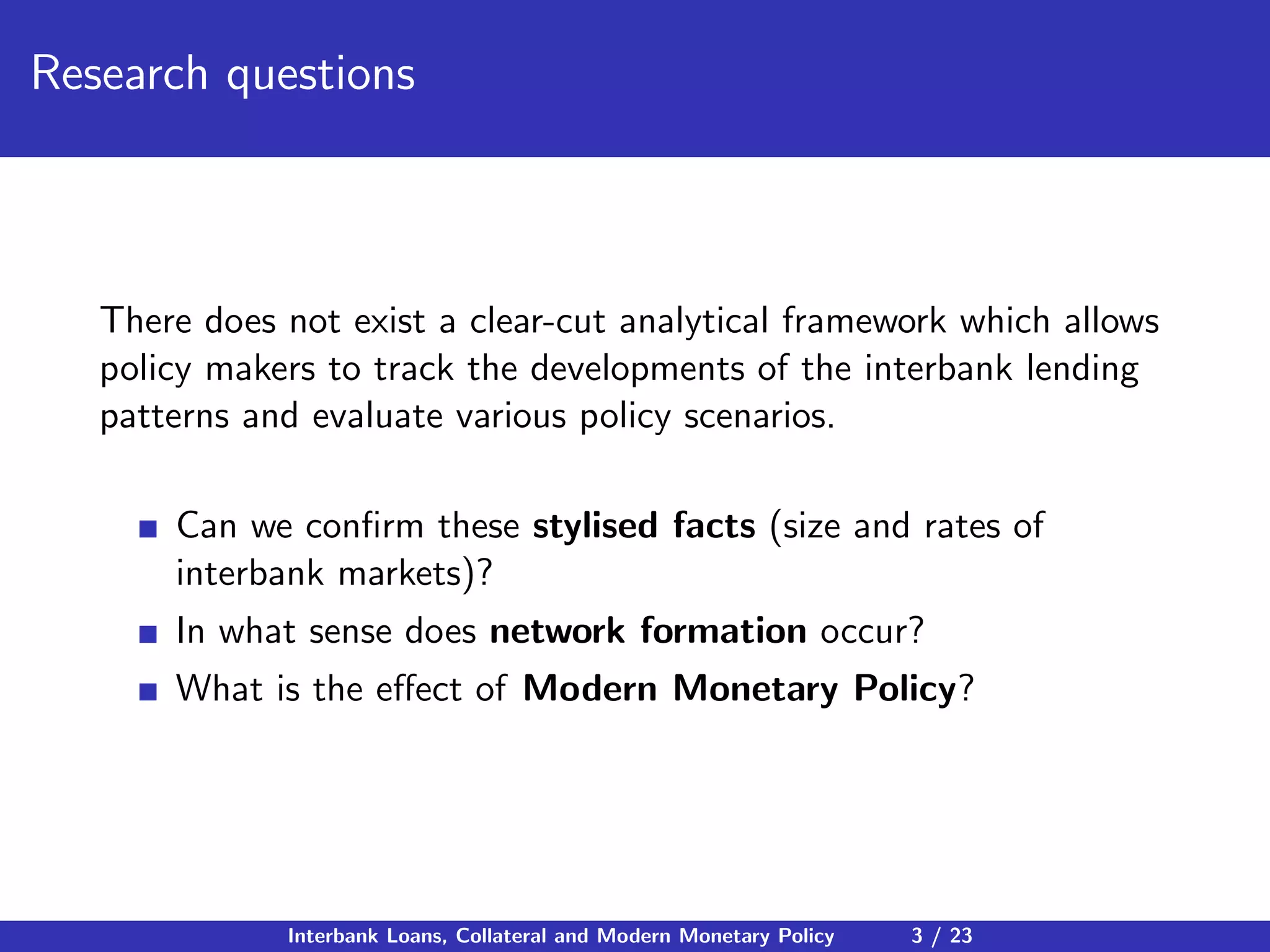
Research questions
There does not exist a clear-cut analytical framework which allows
policy makers to track the developments of the interbank lending
patterns and evaluate various policy scenarios.
Can we confirm these stylised facts (size and rates of
interbank markets)?
In what sense does network formation occur?
What is the effect of Modern Monetary Policy?
Interbank Loans, Collateral and Modern Monetary Policy 3 / 23
Model
1 update forecasting strategies,
2 update deposits,
3 realize profits from maturing investment loans and bonds,
4 realize profits from maturing interbank loans and declare
bankruptcies,
5 form risk and return expectations,
6 calculate the optimal portfolio allocation,
7 trade in the interbank market,
8 store the variables and go to the next period.
Interbank Loans, Collateral and Modern Monetary Policy 4 / 23
Balance sheet
Assets Liabilities
LI,t Dept
LIB,t Eqt
Bt DIB,t
Ret Dt
Table: Stylized balance sheet of an individual bank in period t. On the
asset side LI,t are the investment loans, LIB,t are the interbank loans, Bt
are the bond holdings and Ret are the reserves. On the liability side Dept
are the deposits, Eqt is the equity capital, DIB,t is the interbank debt and
Dt are other debt obligations.
Interbank Loans, Collateral and Modern Monetary Policy 5 / 23
Markets
An unlimited amount of bonds are available, which price yields a
minimal volatility.
Investments last for 4 periods. For every bank in each period one
business project is available. The projects expected return is
known, and yields a higher riskiness if the expected return is high.
Deposits equal a random multiple of equity.
Liquidity backstop, borrowing from a central bank at a
discouragingly high interest rate.
Interbank Loans, Collateral and Modern Monetary Policy 6 / 23
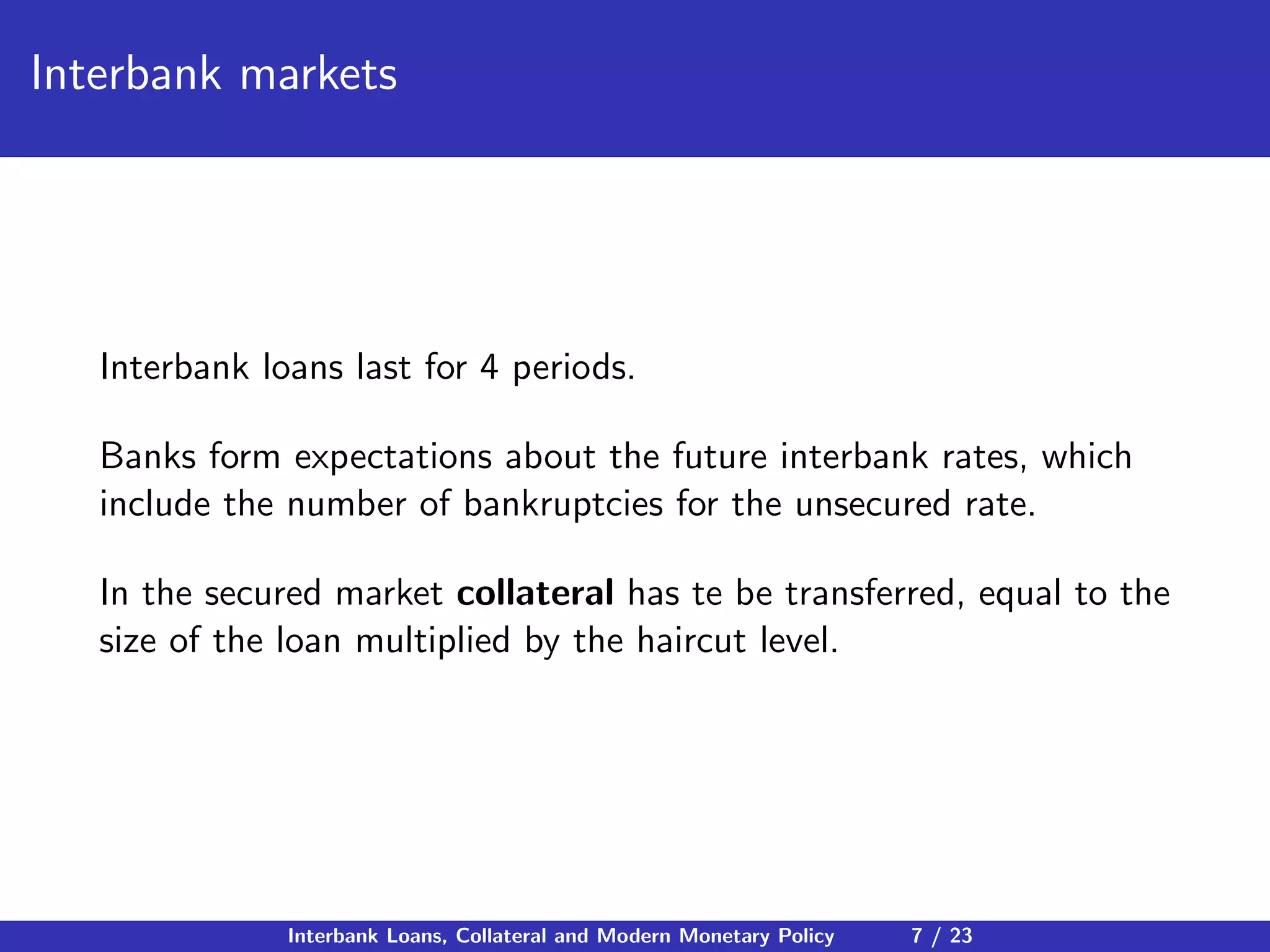
Interbank markets
Interbank loans last for 4 periods.
Banks form expectations about the future interbank rates, which
include the number of bankruptcies for the unsecured rate.
In the secured market collateral has te be transferred, equal to the
size of the loan multiplied by the haircut level.
Interbank Loans, Collateral and Modern Monetary Policy 7 / 23
Trading mechanism
For simplicity we assume that traders are submitting their rate
forecast as offer. This situation is equal to a situation in which the
ranking of offers remains (it just slightly increases the number of
trades).
Orders are matched, the highest bid with the lowest ask and so on,
until no further trades are possible.
Interbank Loans, Collateral and Modern Monetary Policy 8 / 23
Allocation strategy
Banks allocate to market segments using the optimal portfolio
selection strategy from Markowitz (1952).
This maximizes the Constant Relative Risk Aversion
next-period utility, where the risk is represented by the
variance-covariance matrix between all the markets. Moreover risk
aversion increases with maturity.
Expectations on bonds and interbank rates are formed, investment
return distribution is known and a minimum cash reserve is held.
We additionally restrict the weights corresponding to the target
leverage ratio set by a policy maker.
Interbank Loans, Collateral and Modern Monetary Policy 9 / 23
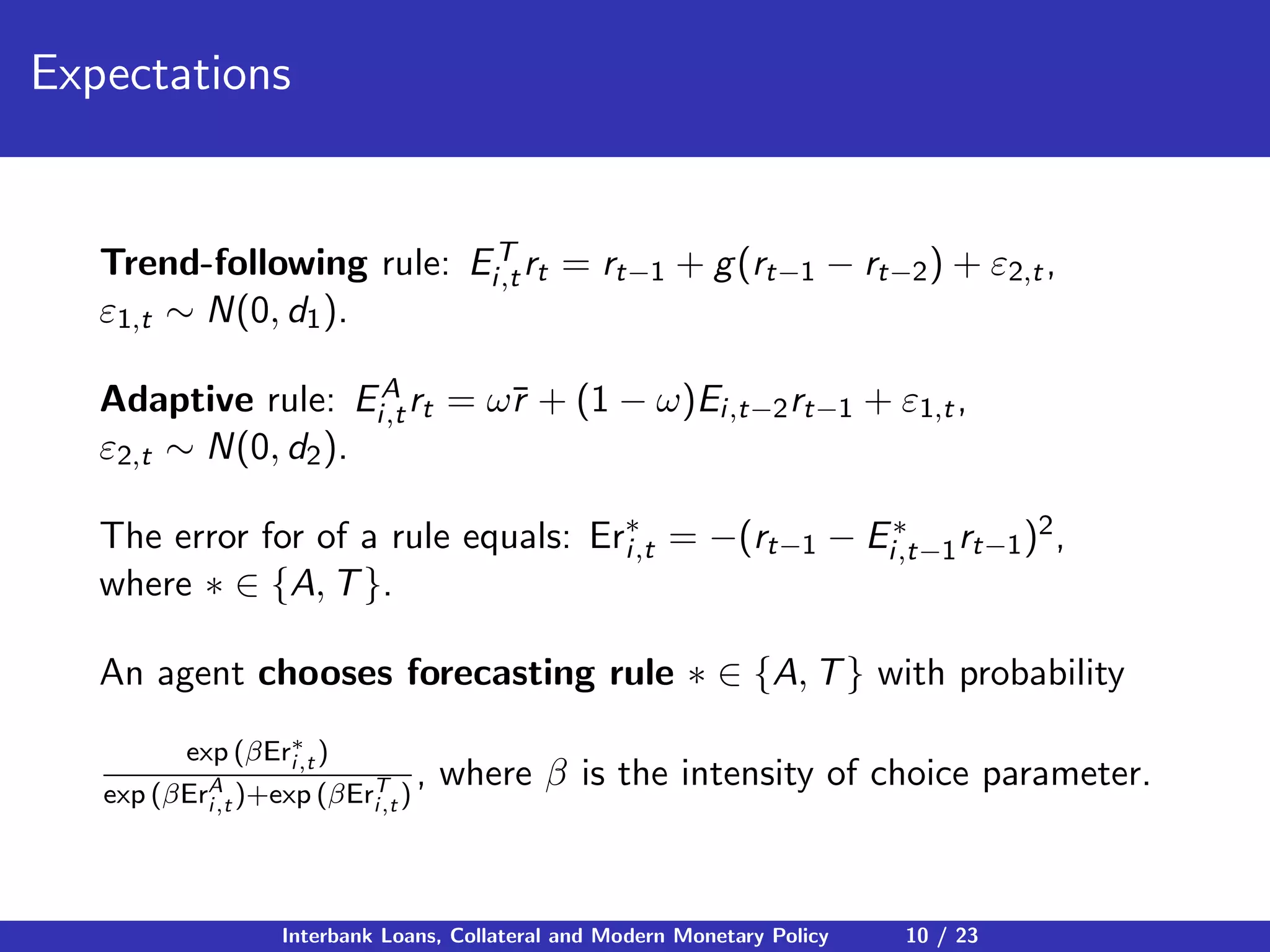
Expectations
Trend-following rule: ET
i,trt = rt−1 + g(rt−1 − rt−2) + ε2,t,
ε1,t ∼ N(0, d1).
Adaptive rule: EA
i,trt = ω¯r + (1 − ω)Ei,t−2rt−1 + ε1,t,
ε2,t ∼ N(0, d2).
The error for of a rule equals: Er∗
i,t = −(rt−1 − E∗
i,t−1rt−1)2,
where ∗ ∈ {A, T}.
An agent chooses forecasting rule ∗ ∈ {A, T} with probability
exp (βEr∗
i,t )
exp (βErA
i,t )+exp (βErT
i,t )
, where β is the intensity of choice parameter.
Interbank Loans, Collateral and Modern Monetary Policy 10 / 23
Interbank network formation
A priori banks do not prioritize counterparties, but are only
concerned with the eventual transaction price, i.e. rate.
We still observe non-arbitrary network formation for two
reasons:
1 a difference in size of banks and therefore a difference in
demand on the interbank market
2 in subsequent periods banks tend to use the same
expectational rule
Letting lending banks prioritize counterparties that are less risky
in terms of their leverage, does not largely influence our results.
Interbank Loans, Collateral and Modern Monetary Policy 11 / 23
Model
1 update forecasting strategies,
2 update deposits,
3 realize profits from maturing investment loans and bonds,
4 realize profits from maturing interbank loans and declare
bankruptcies,
5 form risk and return expectations,
6 calculate the optimal portfolio allocation,
7 trade in the interbank market,
8 store the variables and go to the next period.
Interbank Loans, Collateral and Modern Monetary Policy 12 / 23
Balance sheet distribution
Smoothened densities of the model and 2549 German banks:
0 1 2 3 4 5 6
0.00.51.01.5
Standardized size
Density
Model
German banks in 2007
German banks in 2013
−1 0 1 2 3 4
0.00.51.01.52.0
Log−leverage
Density
Model
German banks in 2007
German banks in 2013
0.0 0.2 0.4 0.6 0.8 1.0
02468
Bonds
Density
Model
German banks in 2007
German banks in 2013
0.0 0.2 0.4 0.6 0.8 1.0
0.00.51.01.52.02.53.0
Production loans
Density
Model
German banks in 2007
German banks in 2013
0.0 0.2 0.4 0.6 0.8 1.0
02468
Interbank debt
Density
Model
German banks in 2007
German banks in 2013
0.0 0.2 0.4 0.6 0.8 1.0
02468
Central bank debt
Density
Model
German banks in 2007
German banks in 2013
Interbank Loans, Collateral and Modern Monetary Policy 13 / 23
Balance sheet distribution
The model reproduces the highly skewed distribution of banks’
balance sheets observed in reality.
The model-implied distributions are relatively flatter, because of
the lower number of banks and a bank-recovery procedure.
Production loans are larger in the model, because less asset classes
are present and empirical figures only show net loans.
The remainder of balance sheet components are represented well in
the model, althought the funding from the central bank slightly
overshoots.
Interbank Loans, Collateral and Modern Monetary Policy 14 / 23
Baseline model
100 200 300 400 500
0.000.010.020.030.04
Time
Interestrates
Unsecured
Secured
Risk free
100 200 300 400 500
0100030005000
Time
Interbankloans
Unsecured
Secured
100 200 300 400 500
0100200300400
Time
Averagesize
Total
Bonds
Inv. loans
Interbank loans
Reserves
100 200 300 400 500
0100200300400
Time
Averagesize
Total
Equity
Interbank debt
Other debt
Deposits
Interbank Loans, Collateral and Modern Monetary Policy 15 / 23
Baseline network structure
100 200 300 400 500
0.050.100.150.20
Time
Averagehubcentrality
Unsecured
Secured
100 200 300 400 500
2.22.42.62.83.03.2
Time
Averagetotaldegree
Unsecured
Secured
100 200 300 400 500
0.040.080.120.16
Time
Averageclustering
Unsecured
Secured
100 200 300 400 500
222426283032
Time
Averagenumberofislands
Unsecured
Secured
Interbank Loans, Collateral and Modern Monetary Policy 16 / 23
Baseline model
Unsecured rate is significantly higher, leading to a smaller market.
The secured rate yields a higher volatility, making it less risky to
trade in that market.
The network statistics suggest:
the unsecured network consists of many star-like communities
with the hubs being connected between each other
the secured network is more interlinked but has a small
fraction of central hubs (dealer banks)
Interbank Loans, Collateral and Modern Monetary Policy 17 / 23
Scenarios
Exogenous shocks
decrease of collateral quality
negative production shock
Policy actions
forward guidance
decrease of the bond rate to the negative territory
decrease of the bond rate
improved collateral quality
increase in the target leverage ratio
decrease in the target leverage ratio
capped availability of collateral securities
Interbank Loans, Collateral and Modern Monetary Policy 18 / 23
Scenarios
Exogenous shocks
A decrease in quality of collateral increases the secured rate and
the unsecured market, yielding more bankruptcies. This is
consistent with the so-called “pop-corn” effect.
Lower production loan returns decrease the overall size of the
banking sector and shifts banks’ preferences towards safer assets.
Policy actions
Forward guidance reduces bankruptcies and restores market
confidence, with a lower unsecured rate and debt to central banks.
A bond rate decrease urges banks to invest in higher-yield
instruments and finance from central banks.
Improved collateral quality shows no significant effect, indicating
that effects of collateral are asymmetric.
Interbank Loans, Collateral and Modern Monetary Policy 19 / 23
Scenarios
Shifts in the leverage constraint influence the entire dynamics: a
higher allowance increases average profits but also bankruptcies.
Moreover, banks pose more demand for unsecured funds so that
the unsecured rates increase. Decreasing the leverage targets
results in the opposite dynamics.
A capped availability of collateral, due to asset-purchase
programs, leads bank to engage less in interbank transactions and
keep higher capital buffers and deposit bases. As a result, the
number of bankruptcies decreases.
Interbank Loans, Collateral and Modern Monetary Policy 20 / 23
Summary
We have developed an agent-based model of the interbank
markets which allows to study the effectiveness of Modern
Monetary Policy.
We confirm stylized facts of the balancesheet distribution, and
the relationships between the interest rates and volumes of the
interbank markets.
Clustering occurs in both interbank markets, where dealer banks
emerge in the secured, and star-like connections in the unsecured
market.
Moreover the model has allowed us to determine the effect of
exogenous shocks and different policies, which sketches
interesting guidelines for central banks and regulators.
Interbank Loans, Collateral and Modern Monetary Policy 21 / 23
Future research
Timing and strategic behavior in the interbank market.
Varying maturities of loans and investments.
A quantity constraint of the liquidity backstop.
Improve distribution of leverage.
Endogenize investment projects.
Interbank Loans, Collateral and Modern Monetary Policy 22 / 23
This project has received funding from the European Union’s
Seventh Framework Programme for research, technological
development and demonstration under grant agreement no° 320270
www.syrtoproject.eu
This document reflects only the author’s views.
The European Union is not liable for any use that may be made of the information contained therein.

Interbank loans, collateral, and monetary policy

  • 1.
    Interbank Loans, Collateral andModern Monetary Policy SYstemic Risk TOmography: Signals, Measurements, Transmission Channels, and Policy Interventions Michiel van de Leur (a) Marcin Wolski (b) (a)VU Amsterdam (b)European Investment Bank Université Paris I Sorbonne February 2016
  • 2.
    Introduction Interbank markets playeda central role in propagating the distress during the financial crisis. Secured transactions are settled with collateral. The risk depends on quality of collateral, and distress originates from common-factor shocks. The risk of unsecured trades depends on the counterparty, and malaise spreads through contagion. In general, the unsecured market is much smaller market in size, and with higher rates. Both interbank markets are heavily interdependent as in equilibrium there should be no arbitrage opportunities between them. Interbank Loans, Collateral and Modern Monetary Policy 2 / 23
  • 3.
    Research questions There doesnot exist a clear-cut analytical framework which allows policy makers to track the developments of the interbank lending patterns and evaluate various policy scenarios. Can we confirm these stylised facts (size and rates of interbank markets)? In what sense does network formation occur? What is the effect of Modern Monetary Policy? Interbank Loans, Collateral and Modern Monetary Policy 3 / 23
  • 4.
    Model 1 update forecastingstrategies, 2 update deposits, 3 realize profits from maturing investment loans and bonds, 4 realize profits from maturing interbank loans and declare bankruptcies, 5 form risk and return expectations, 6 calculate the optimal portfolio allocation, 7 trade in the interbank market, 8 store the variables and go to the next period. Interbank Loans, Collateral and Modern Monetary Policy 4 / 23
  • 5.
    Balance sheet Assets Liabilities LI,tDept LIB,t Eqt Bt DIB,t Ret Dt Table: Stylized balance sheet of an individual bank in period t. On the asset side LI,t are the investment loans, LIB,t are the interbank loans, Bt are the bond holdings and Ret are the reserves. On the liability side Dept are the deposits, Eqt is the equity capital, DIB,t is the interbank debt and Dt are other debt obligations. Interbank Loans, Collateral and Modern Monetary Policy 5 / 23
  • 6.
    Markets An unlimited amountof bonds are available, which price yields a minimal volatility. Investments last for 4 periods. For every bank in each period one business project is available. The projects expected return is known, and yields a higher riskiness if the expected return is high. Deposits equal a random multiple of equity. Liquidity backstop, borrowing from a central bank at a discouragingly high interest rate. Interbank Loans, Collateral and Modern Monetary Policy 6 / 23
  • 7.
    Interbank markets Interbank loanslast for 4 periods. Banks form expectations about the future interbank rates, which include the number of bankruptcies for the unsecured rate. In the secured market collateral has te be transferred, equal to the size of the loan multiplied by the haircut level. Interbank Loans, Collateral and Modern Monetary Policy 7 / 23
  • 8.
    Trading mechanism For simplicitywe assume that traders are submitting their rate forecast as offer. This situation is equal to a situation in which the ranking of offers remains (it just slightly increases the number of trades). Orders are matched, the highest bid with the lowest ask and so on, until no further trades are possible. Interbank Loans, Collateral and Modern Monetary Policy 8 / 23
  • 9.
    Allocation strategy Banks allocateto market segments using the optimal portfolio selection strategy from Markowitz (1952). This maximizes the Constant Relative Risk Aversion next-period utility, where the risk is represented by the variance-covariance matrix between all the markets. Moreover risk aversion increases with maturity. Expectations on bonds and interbank rates are formed, investment return distribution is known and a minimum cash reserve is held. We additionally restrict the weights corresponding to the target leverage ratio set by a policy maker. Interbank Loans, Collateral and Modern Monetary Policy 9 / 23
  • 10.
    Expectations Trend-following rule: ET i,trt= rt−1 + g(rt−1 − rt−2) + ε2,t, ε1,t ∼ N(0, d1). Adaptive rule: EA i,trt = ω¯r + (1 − ω)Ei,t−2rt−1 + ε1,t, ε2,t ∼ N(0, d2). The error for of a rule equals: Er∗ i,t = −(rt−1 − E∗ i,t−1rt−1)2, where ∗ ∈ {A, T}. An agent chooses forecasting rule ∗ ∈ {A, T} with probability exp (βEr∗ i,t ) exp (βErA i,t )+exp (βErT i,t ) , where β is the intensity of choice parameter. Interbank Loans, Collateral and Modern Monetary Policy 10 / 23
  • 11.
    Interbank network formation Apriori banks do not prioritize counterparties, but are only concerned with the eventual transaction price, i.e. rate. We still observe non-arbitrary network formation for two reasons: 1 a difference in size of banks and therefore a difference in demand on the interbank market 2 in subsequent periods banks tend to use the same expectational rule Letting lending banks prioritize counterparties that are less risky in terms of their leverage, does not largely influence our results. Interbank Loans, Collateral and Modern Monetary Policy 11 / 23
  • 12.
    Model 1 update forecastingstrategies, 2 update deposits, 3 realize profits from maturing investment loans and bonds, 4 realize profits from maturing interbank loans and declare bankruptcies, 5 form risk and return expectations, 6 calculate the optimal portfolio allocation, 7 trade in the interbank market, 8 store the variables and go to the next period. Interbank Loans, Collateral and Modern Monetary Policy 12 / 23
  • 13.
    Balance sheet distribution Smootheneddensities of the model and 2549 German banks: 0 1 2 3 4 5 6 0.00.51.01.5 Standardized size Density Model German banks in 2007 German banks in 2013 −1 0 1 2 3 4 0.00.51.01.52.0 Log−leverage Density Model German banks in 2007 German banks in 2013 0.0 0.2 0.4 0.6 0.8 1.0 02468 Bonds Density Model German banks in 2007 German banks in 2013 0.0 0.2 0.4 0.6 0.8 1.0 0.00.51.01.52.02.53.0 Production loans Density Model German banks in 2007 German banks in 2013 0.0 0.2 0.4 0.6 0.8 1.0 02468 Interbank debt Density Model German banks in 2007 German banks in 2013 0.0 0.2 0.4 0.6 0.8 1.0 02468 Central bank debt Density Model German banks in 2007 German banks in 2013 Interbank Loans, Collateral and Modern Monetary Policy 13 / 23
  • 14.
    Balance sheet distribution Themodel reproduces the highly skewed distribution of banks’ balance sheets observed in reality. The model-implied distributions are relatively flatter, because of the lower number of banks and a bank-recovery procedure. Production loans are larger in the model, because less asset classes are present and empirical figures only show net loans. The remainder of balance sheet components are represented well in the model, althought the funding from the central bank slightly overshoots. Interbank Loans, Collateral and Modern Monetary Policy 14 / 23
  • 15.
    Baseline model 100 200300 400 500 0.000.010.020.030.04 Time Interestrates Unsecured Secured Risk free 100 200 300 400 500 0100030005000 Time Interbankloans Unsecured Secured 100 200 300 400 500 0100200300400 Time Averagesize Total Bonds Inv. loans Interbank loans Reserves 100 200 300 400 500 0100200300400 Time Averagesize Total Equity Interbank debt Other debt Deposits Interbank Loans, Collateral and Modern Monetary Policy 15 / 23
  • 16.
    Baseline network structure 100200 300 400 500 0.050.100.150.20 Time Averagehubcentrality Unsecured Secured 100 200 300 400 500 2.22.42.62.83.03.2 Time Averagetotaldegree Unsecured Secured 100 200 300 400 500 0.040.080.120.16 Time Averageclustering Unsecured Secured 100 200 300 400 500 222426283032 Time Averagenumberofislands Unsecured Secured Interbank Loans, Collateral and Modern Monetary Policy 16 / 23
  • 17.
    Baseline model Unsecured rateis significantly higher, leading to a smaller market. The secured rate yields a higher volatility, making it less risky to trade in that market. The network statistics suggest: the unsecured network consists of many star-like communities with the hubs being connected between each other the secured network is more interlinked but has a small fraction of central hubs (dealer banks) Interbank Loans, Collateral and Modern Monetary Policy 17 / 23
  • 18.
    Scenarios Exogenous shocks decrease ofcollateral quality negative production shock Policy actions forward guidance decrease of the bond rate to the negative territory decrease of the bond rate improved collateral quality increase in the target leverage ratio decrease in the target leverage ratio capped availability of collateral securities Interbank Loans, Collateral and Modern Monetary Policy 18 / 23
  • 19.
    Scenarios Exogenous shocks A decreasein quality of collateral increases the secured rate and the unsecured market, yielding more bankruptcies. This is consistent with the so-called “pop-corn” effect. Lower production loan returns decrease the overall size of the banking sector and shifts banks’ preferences towards safer assets. Policy actions Forward guidance reduces bankruptcies and restores market confidence, with a lower unsecured rate and debt to central banks. A bond rate decrease urges banks to invest in higher-yield instruments and finance from central banks. Improved collateral quality shows no significant effect, indicating that effects of collateral are asymmetric. Interbank Loans, Collateral and Modern Monetary Policy 19 / 23
  • 20.
    Scenarios Shifts in theleverage constraint influence the entire dynamics: a higher allowance increases average profits but also bankruptcies. Moreover, banks pose more demand for unsecured funds so that the unsecured rates increase. Decreasing the leverage targets results in the opposite dynamics. A capped availability of collateral, due to asset-purchase programs, leads bank to engage less in interbank transactions and keep higher capital buffers and deposit bases. As a result, the number of bankruptcies decreases. Interbank Loans, Collateral and Modern Monetary Policy 20 / 23
  • 21.
    Summary We have developedan agent-based model of the interbank markets which allows to study the effectiveness of Modern Monetary Policy. We confirm stylized facts of the balancesheet distribution, and the relationships between the interest rates and volumes of the interbank markets. Clustering occurs in both interbank markets, where dealer banks emerge in the secured, and star-like connections in the unsecured market. Moreover the model has allowed us to determine the effect of exogenous shocks and different policies, which sketches interesting guidelines for central banks and regulators. Interbank Loans, Collateral and Modern Monetary Policy 21 / 23
  • 22.
    Future research Timing andstrategic behavior in the interbank market. Varying maturities of loans and investments. A quantity constraint of the liquidity backstop. Improve distribution of leverage. Endogenize investment projects. Interbank Loans, Collateral and Modern Monetary Policy 22 / 23
  • 23.
    This project hasreceived funding from the European Union’s Seventh Framework Programme for research, technological development and demonstration under grant agreement no° 320270 www.syrtoproject.eu This document reflects only the author’s views. The European Union is not liable for any use that may be made of the information contained therein.