SYRTO/LABEX ReFi
Closing Conference
Paris, February 2016
Joint work with:
István Barra (a)
Francisco Blasques (a)
Siem Jan Koopman (a,b)
Rutger Jan Lange (a)
Michiel van de Leur (a)
Rutger Lit (a)
Federico Nucera (c)
Julia Schaumburg (a)
Bernd Schwaab (d,*)
Arjen Siegmann (a)
Xin Zhang (e,*)
a)Vrije Universiteit Amsterdam and Tinbergen Institute
b)CREATES
c) Luiss, Rome
d) ECB, these are not the opinions of the ECB
e) Riksbank, these are not the opinions of the Riksbank
André Lucas	
  
Systemic Risk Indicators
SYstemic	
  Risk	
  TOmography:	
  
Signals,	
  Measurements,	
  Transmission	
  
Channels,	
  and	
  Policy	
  Interven@ons	
  
(Gerlach,	
  2009:	
  policy	
  note	
  to	
  European	
  Parliament)	
  
Financial	
  surveillance	
  before	
  the	
  current	
  crisis	
  erupted	
  suggested	
  that	
  
problems	
  were	
  forming	
  but	
  the	
  indica@ons	
  were	
  too	
  imprecise	
  to	
  permit	
  a	
  
policy	
  response.	
  	
  
Work	
  is	
  currently	
  being	
  undertaken	
  to	
  improve	
  the	
  measurement,	
  monitoring	
  
and	
  management	
  of	
  systemic	
  risk.	
  	
  
That	
  requires	
  it	
  to	
  be	
  defined,	
  which	
  is	
  unproblema5c,	
  and	
  opera5onalized,	
  
which	
  is	
  not.	
  	
  
While	
  promising	
  methods	
  to	
  measure	
  risk	
  exist,	
  the	
  data	
  demands	
  are	
  so	
  
pronounced	
  that	
  sta5s5cal	
  risk	
  monitoring	
  will	
  remain	
  an	
  imprecise	
  science	
  
for	
  years	
  to	
  come.	
  
Where	
  are	
  we	
  now	
  ?	
  
Types	
  of	
  systemic	
  risk	
  
•  Level	
  of	
  systemic	
  risk	
  
– is	
  systemic	
  risk	
  currently	
  high	
  or	
  low:	
  ``objec@ve’’	
  policy	
  
trigger	
  
•  Dynamics	
  of	
  systemic	
  risk	
  
– is	
  systemic	
  risk	
  building	
  up	
  or	
  not,	
  growing	
  misalignments,	
  
bubbles,	
  growing	
  linkages	
  
•  Distribu@on	
  of	
  systemic	
  risk	
  
– finding	
  biggest	
  systemic	
  risk	
  contributors,	
  targeNed	
  
monitoring	
  
Types	
  of	
  measurements	
  
•  Market	
  prices	
  
– forward	
  looking	
  (stock	
  markets,	
  yields,	
  CDS),	
  …	
  
– but	
  also	
  possibly	
  misaligned	
  risk	
  cycles	
  (Minksy)	
  
– signals	
  typically	
  coincidental	
  
ESRB	
  Risk	
  Dashboard	
  (2016)	
  
Lucas,	
  Schwaab,	
  Zhang	
  (2014,	
  SYRTO/JBES):	
  	
  Condi@onal	
  euro	
  area	
  sovereign	
  default	
  risk	
  
Lucas,	
  Schwaab,	
  Zhang	
  (2016,	
  SYRTO/JAppEctr):	
  Measuring	
  Credit	
  Risk	
  in	
  a	
  Large	
  Banking	


   System:	
  Econometric	
  Modeling	
  and	
  Empirics	
  
Lange,	
  Siegmann	
  (2016,	
  SYRTO):	
  Es@ma@ng	
  Sovereign	
  Join	
  Default	
  Probabili@es	
  
from	
  Bond	
  Yields	
  
Types	
  of	
  measurements	
  
•  Fundamentals	
  versus	
  experience,	
  or	
  versus	
  prices	
  
– create	
  a	
  benchmark	
  (fundamental)	
  and	
  see	
  whether	
  data	
  
are	
  aligned	
  with	
  the	
  fundamentals	
  
– typically	
  more	
  leading	
  
Creal,	
  Schwaab,	
  Koopman,	
  Lucas	
  (2014,	
  SYRTO/REStat):	
  Observa@on	
  Driven	
  Mixed-­‐	
  
	
   Measurement	
  Dynamic	
  Factor	
  Models	
  with	
  an	
  Applica@on	
  to	
  Credit	
  Risk	
  
Koopman,	
  Lucas,	
  Schwaab	
  (2014,	
  SYRTO/IJF):	
  Nowcas@ng	
  and	
  forecas@ng	
  global	
  financial	


   sector	
  stress	
  and	
  credit	
  market	
  disloca@on	
  
Creal,	
  Schwaab,	
  Koopman,	
  Lucas	
  (2014,	
  SYRTO/REStat):	
  Observa@on	
  Driven	
  Mixed-­‐	
  
	
   Measurement	
  Dynamic	
  Factor	
  Models	
  with	
  an	
  Applica@on	
  to	
  Credit	
  Risk	
  
Koopman,	
  Lucas,	
  Schwaab	
  (2014,	
  SYRTO/IJF):	
  Nowcas@ng	
  and	
  forecas@ng	
  global	
  financial	


   sector	
  stress	
  and	
  credit	
  market	
  disloca@on	
  
Schwaab,	
  Koopman,	
  Lucas	
  (2016,	
  SYRTO/JAppEctr):	
  Global	
  Credit	
  Risk:	
  World,	


   Country	
  and	
  Industry	
  Factors	
  
ESRB	
  Risk	
  Dashboard	
  (2016)	
  
Schwaab,	
  Koopman,	
  Lucas	
  (2016,	
  SYRTO/JAppEctr):	
  Global	
  Credit	
  Risk:	
  World,	


   Country	
  and	
  Industry	
  Factors	
  
Creal,	
  Schwaab,	
  Koopman,	
  Lucas	
  (2014,	
  SYRTO/REStat):	
  Observa@on	
  Driven	
  Mixed-­‐	
  
	
   Measurement	
  Dynamic	
  Factor	
  Models	
  with	
  an	
  Applica@on	
  to	
  Credit	
  Risk	
  
Koopman,	
  Lucas,	
  Schwaab	
  (2014,	
  SYRTO/IJF):	
  Nowcas@ng	
  and	
  forecas@ng	
  global	
  financial	


   sector	
  stress	
  and	
  credit	
  market	
  disloca@on	
  
Barra,	
  Lucas	
  (2016,	
  SYRTO):	
  Unobserved	
  components	
  in	
  corporate	
  defaults	
  and	
  bond	
  prices	
  
Nucera,	
  Schwaab,	
  Koopman,	
  Lucas	
  (2016,	
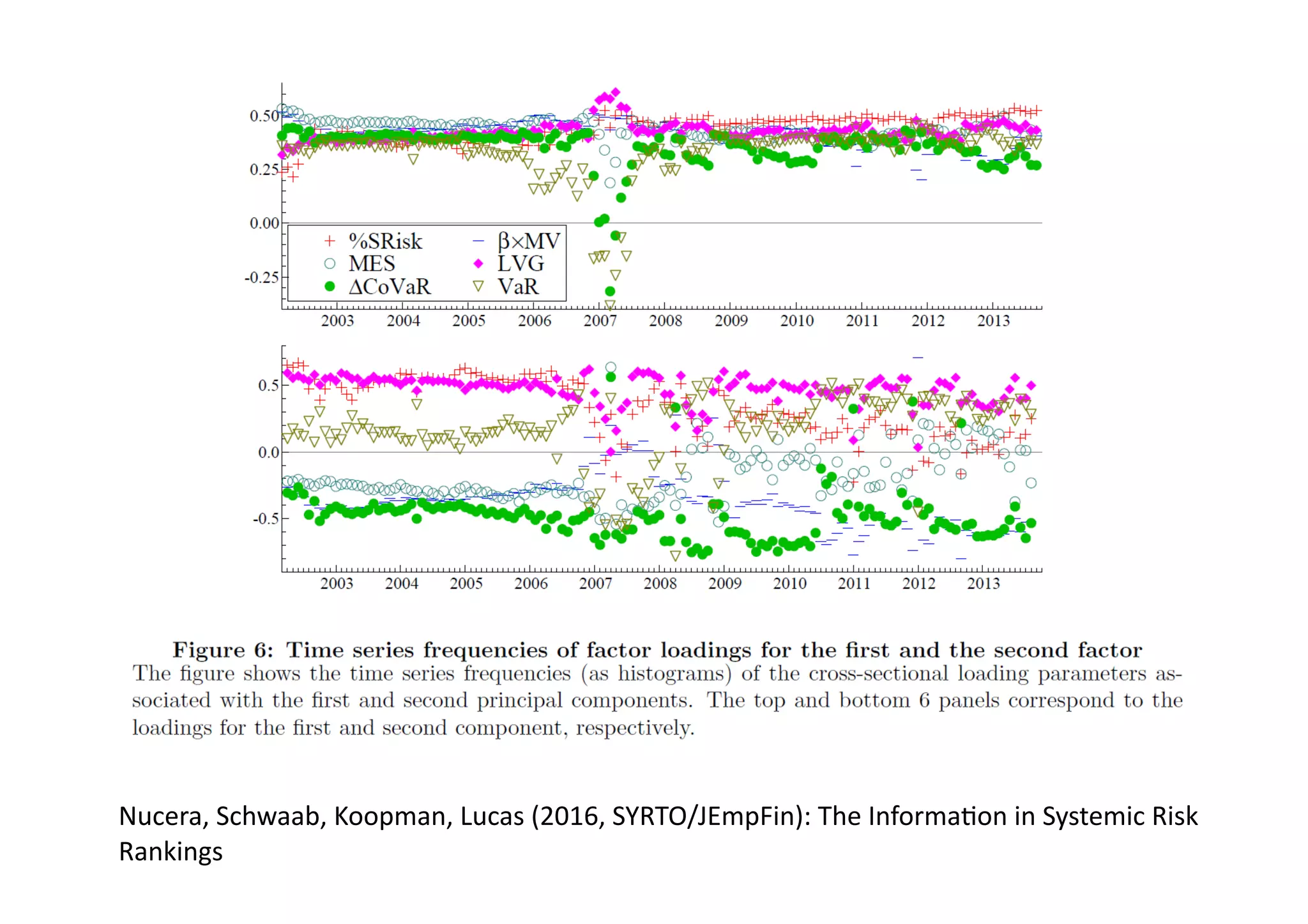
  SYRTO/JEmpFin):	
  The	
  Informa@on	
  in	
  Systemic	
  Risk	
  
Rankings	
  
Koopman,	
  Lit,	
  Lucas	
  (2016,	
  SYRTO):	
  A	
  decomposi@on	
  of	
  economic	
  and	
  financial	
  @me	
  series	


   into	
  business	
  and	
  financial	
  cycles	
  
Types	
  of	
  measurements	
  
•  Network	
  structures	
  
– create	
  summary	
  measures	
  of	
  the	
  network	
  structure	
  
– leading	
  or	
  coincidental?	
  
– value-­‐added	
  to	
  macro	
  summaries?	
  
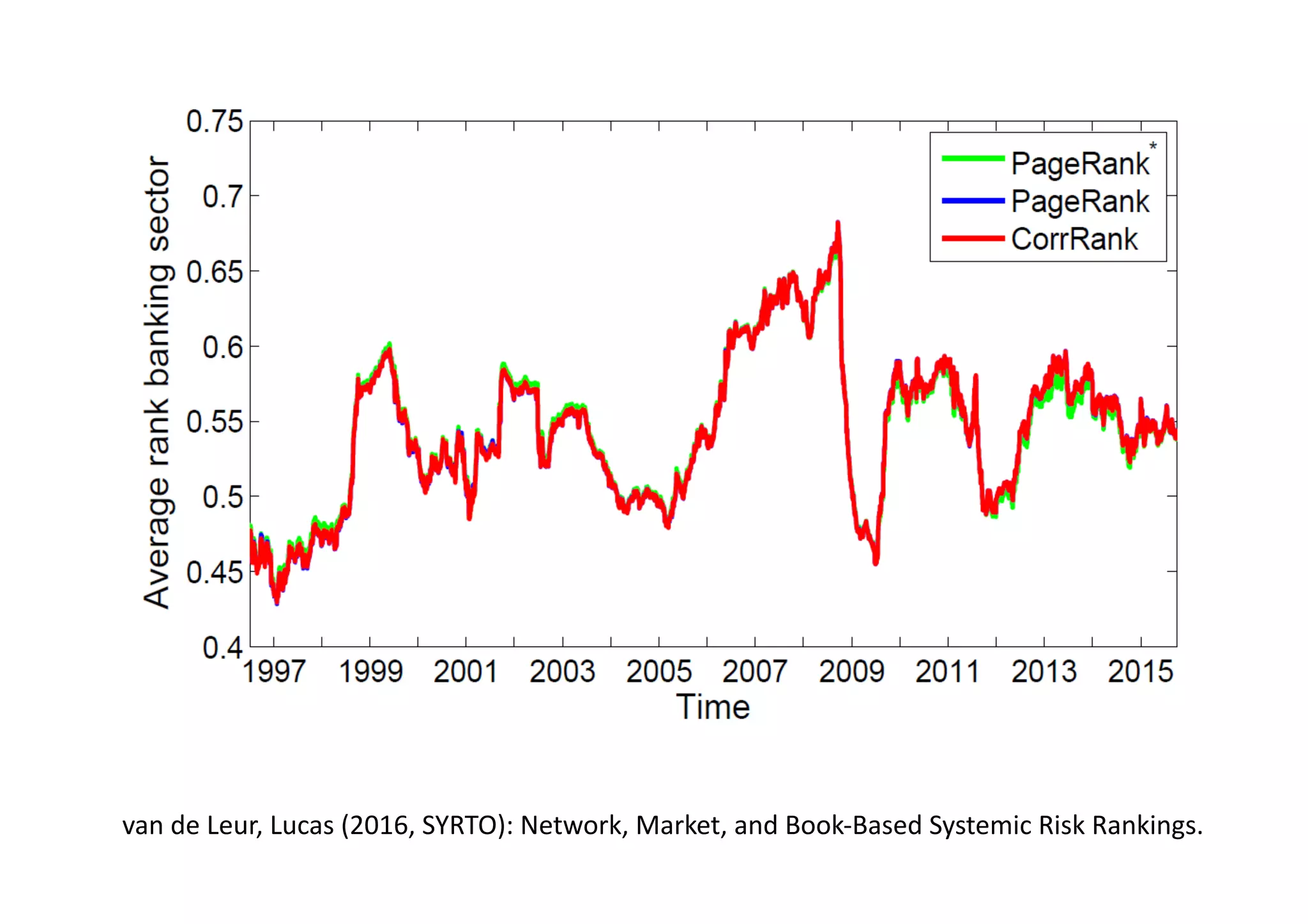
van	
  de	
  Leur,	
  Lucas	
  (2016,	
  SYRTO):	
  Network,	
  Market,	
  and	
  Book-­‐Based	
  Systemic	
  Risk	
  Rankings.	
  
van	
  de	
  Leur,	
  Lucas	
  (2016,	
  SYRTO):	
  Network,	
  Market,	
  and	
  Book-­‐Based	
  Systemic	
  Risk	
  Rankings.	
  
van	
  de	
  Leur,	
  Lucas	
  (2016,	
  SYRTO):	
  Network,	
  Market,	
  and	
  Book-­‐Based	
  Systemic	
  Risk	
  Rankings.	
  
Types	
  of	
  measurements	
  
•  Text	
  parsing	
  
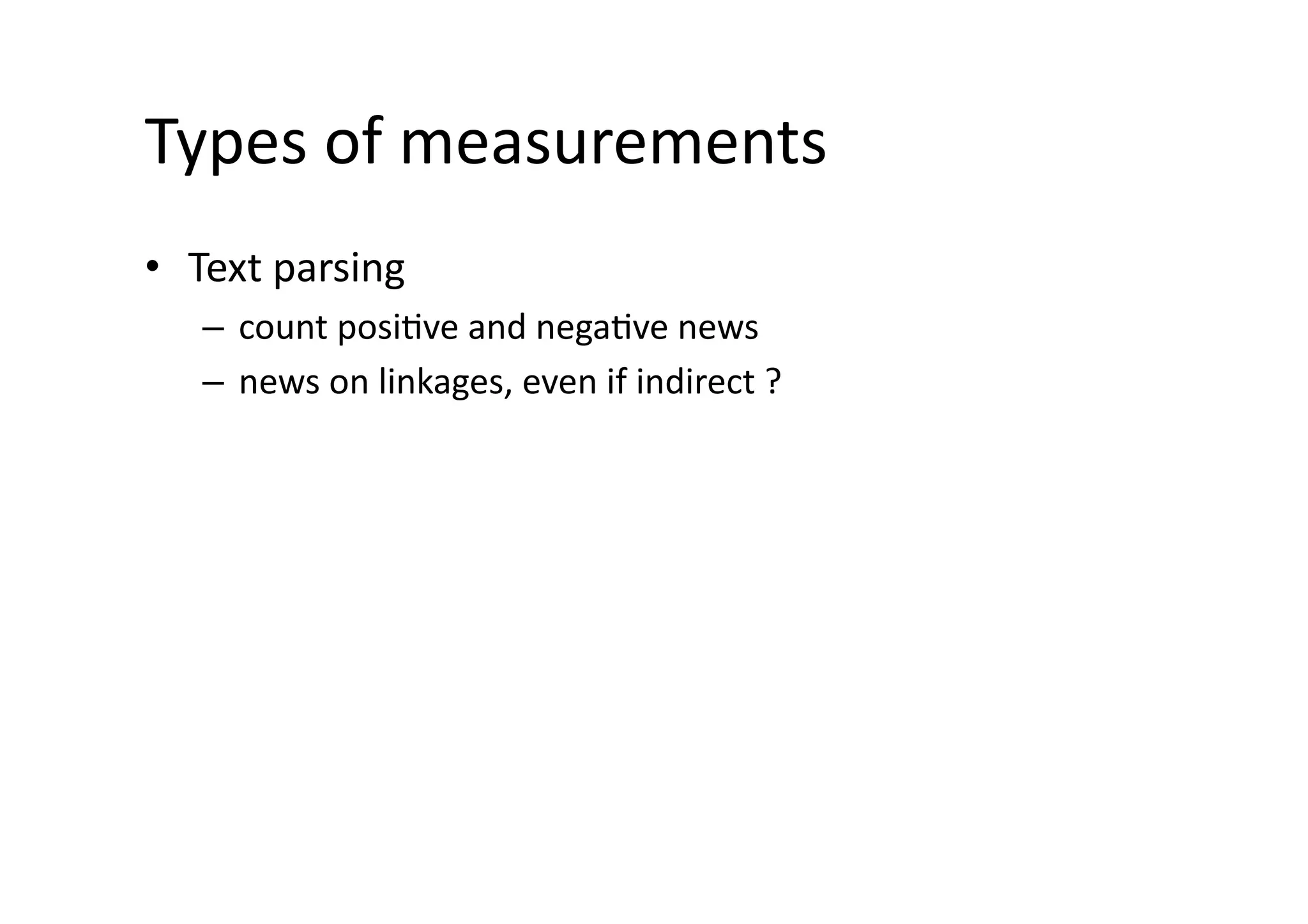
– count	
  posi@ve	
  and	
  nega@ve	
  news	
  
– news	
  on	
  linkages,	
  even	
  if	
  indirect	
  ?	
  
Garmaev,	
  Rus@ge,	
  Lammers,	
  Borovkova	
  (2016,	
  VU):	
  Systemic	
  Risk:	
  A	
  News	
  Sen@ment	
  based	
  
Approach	
  
SRisk	
  
SensR	
  
Summary	
  and	
  conclusions	
  
•  Price	
  based	
  informa@on	
  largely	
  coincidental	
  
•  Misalignments	
  more	
  promising	
  in	
  lead	
  @mes,	
  though	
  also	
  
more	
  data/methodology	
  intensive	
  
•  Network	
  data	
  appear	
  to	
  add	
  new	
  informa@on:	
  which?	
  
And	
  how	
  useful?	
  
•  Research	
  direc@ons	
  
–  beNer	
  understanding	
  of	
  the	
  genesis	
  of	
  risks	
  and	
  imbalances;	
  
find	
  appropriate	
  proxies	
  
–  exploi@ng	
  new	
  network	
  data	
  (benchmarking	
  will	
  be	
  hard)	
  
–  exploi@ng	
  text	
  or	
  other	
  big	
  data	
  sources	
  
–  measuring	
  and	
  exploi@ng	
  misalignments	
  
This project has received funding from the European Union’s
Seventh Framework Programme for research, technological
development and demonstration under grant agreement no° 320270
www.syrtoproject.eu
This document reflects only the author’s views.
The European Union is not liable for any use that may be made of the information contained therein.

Systemic risk indicators

  • 1.
    SYRTO/LABEX ReFi Closing Conference Paris,February 2016 Joint work with: István Barra (a) Francisco Blasques (a) Siem Jan Koopman (a,b) Rutger Jan Lange (a) Michiel van de Leur (a) Rutger Lit (a) Federico Nucera (c) Julia Schaumburg (a) Bernd Schwaab (d,*) Arjen Siegmann (a) Xin Zhang (e,*) a)Vrije Universiteit Amsterdam and Tinbergen Institute b)CREATES c) Luiss, Rome d) ECB, these are not the opinions of the ECB e) Riksbank, these are not the opinions of the Riksbank André Lucas   Systemic Risk Indicators SYstemic  Risk  TOmography:   Signals,  Measurements,  Transmission   Channels,  and  Policy  Interven@ons  
  • 2.
    (Gerlach,  2009:  policy  note  to  European  Parliament)   Financial  surveillance  before  the  current  crisis  erupted  suggested  that   problems  were  forming  but  the  indica@ons  were  too  imprecise  to  permit  a   policy  response.     Work  is  currently  being  undertaken  to  improve  the  measurement,  monitoring   and  management  of  systemic  risk.     That  requires  it  to  be  defined,  which  is  unproblema5c,  and  opera5onalized,   which  is  not.     While  promising  methods  to  measure  risk  exist,  the  data  demands  are  so   pronounced  that  sta5s5cal  risk  monitoring  will  remain  an  imprecise  science   for  years  to  come.   Where  are  we  now  ?  
  • 3.
    Types  of  systemic  risk   •  Level  of  systemic  risk   – is  systemic  risk  currently  high  or  low:  ``objec@ve’’  policy   trigger   •  Dynamics  of  systemic  risk   – is  systemic  risk  building  up  or  not,  growing  misalignments,   bubbles,  growing  linkages   •  Distribu@on  of  systemic  risk   – finding  biggest  systemic  risk  contributors,  targeNed   monitoring  
  • 4.
    Types  of  measurements   •  Market  prices   – forward  looking  (stock  markets,  yields,  CDS),  …   – but  also  possibly  misaligned  risk  cycles  (Minksy)   – signals  typically  coincidental  
  • 5.
    ESRB  Risk  Dashboard  (2016)   Lucas,  Schwaab,  Zhang  (2014,  SYRTO/JBES):    Condi@onal  euro  area  sovereign  default  risk   Lucas,  Schwaab,  Zhang  (2016,  SYRTO/JAppEctr):  Measuring  Credit  Risk  in  a  Large  Banking       System:  Econometric  Modeling  and  Empirics  
  • 6.
    Lange,  Siegmann  (2016,  SYRTO):  Es@ma@ng  Sovereign  Join  Default  Probabili@es   from  Bond  Yields  
  • 7.
    Types  of  measurements   •  Fundamentals  versus  experience,  or  versus  prices   – create  a  benchmark  (fundamental)  and  see  whether  data   are  aligned  with  the  fundamentals   – typically  more  leading  
  • 8.
    Creal,  Schwaab,  Koopman,  Lucas  (2014,  SYRTO/REStat):  Observa@on  Driven  Mixed-­‐     Measurement  Dynamic  Factor  Models  with  an  Applica@on  to  Credit  Risk   Koopman,  Lucas,  Schwaab  (2014,  SYRTO/IJF):  Nowcas@ng  and  forecas@ng  global  financial       sector  stress  and  credit  market  disloca@on  
  • 9.
    Creal,  Schwaab,  Koopman,  Lucas  (2014,  SYRTO/REStat):  Observa@on  Driven  Mixed-­‐     Measurement  Dynamic  Factor  Models  with  an  Applica@on  to  Credit  Risk   Koopman,  Lucas,  Schwaab  (2014,  SYRTO/IJF):  Nowcas@ng  and  forecas@ng  global  financial       sector  stress  and  credit  market  disloca@on  
  • 10.
    Schwaab,  Koopman,  Lucas  (2016,  SYRTO/JAppEctr):  Global  Credit  Risk:  World,       Country  and  Industry  Factors  
  • 11.
    ESRB  Risk  Dashboard  (2016)   Schwaab,  Koopman,  Lucas  (2016,  SYRTO/JAppEctr):  Global  Credit  Risk:  World,       Country  and  Industry  Factors   Creal,  Schwaab,  Koopman,  Lucas  (2014,  SYRTO/REStat):  Observa@on  Driven  Mixed-­‐     Measurement  Dynamic  Factor  Models  with  an  Applica@on  to  Credit  Risk   Koopman,  Lucas,  Schwaab  (2014,  SYRTO/IJF):  Nowcas@ng  and  forecas@ng  global  financial       sector  stress  and  credit  market  disloca@on  
  • 12.
    Barra,  Lucas  (2016,  SYRTO):  Unobserved  components  in  corporate  defaults  and  bond  prices  
  • 13.
    Nucera,  Schwaab,  Koopman,  Lucas  (2016,  SYRTO/JEmpFin):  The  Informa@on  in  Systemic  Risk   Rankings  
  • 14.
    Koopman,  Lit,  Lucas  (2016,  SYRTO):  A  decomposi@on  of  economic  and  financial  @me  series       into  business  and  financial  cycles  
  • 15.
    Types  of  measurements   •  Network  structures   – create  summary  measures  of  the  network  structure   – leading  or  coincidental?   – value-­‐added  to  macro  summaries?  
  • 16.
    van  de  Leur,  Lucas  (2016,  SYRTO):  Network,  Market,  and  Book-­‐Based  Systemic  Risk  Rankings.  
  • 17.
    van  de  Leur,  Lucas  (2016,  SYRTO):  Network,  Market,  and  Book-­‐Based  Systemic  Risk  Rankings.  
  • 18.
    van  de  Leur,  Lucas  (2016,  SYRTO):  Network,  Market,  and  Book-­‐Based  Systemic  Risk  Rankings.  
  • 19.
    Types  of  measurements   •  Text  parsing   – count  posi@ve  and  nega@ve  news   – news  on  linkages,  even  if  indirect  ?  
  • 20.
    Garmaev,  Rus@ge,  Lammers,  Borovkova  (2016,  VU):  Systemic  Risk:  A  News  Sen@ment  based   Approach   SRisk   SensR  
  • 21.
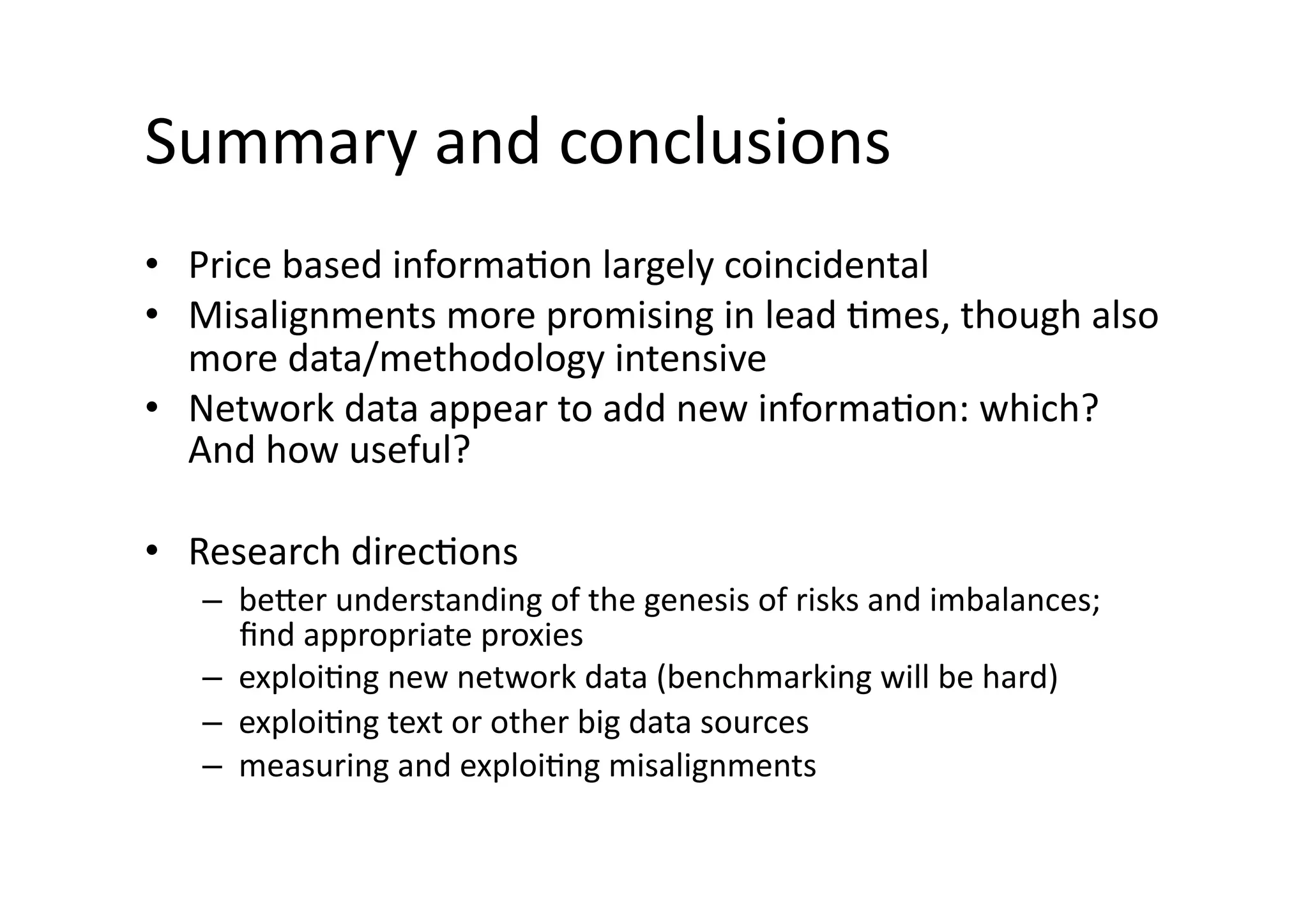
    Summary  and  conclusions   •  Price  based  informa@on  largely  coincidental   •  Misalignments  more  promising  in  lead  @mes,  though  also   more  data/methodology  intensive   •  Network  data  appear  to  add  new  informa@on:  which?   And  how  useful?   •  Research  direc@ons   –  beNer  understanding  of  the  genesis  of  risks  and  imbalances;   find  appropriate  proxies   –  exploi@ng  new  network  data  (benchmarking  will  be  hard)   –  exploi@ng  text  or  other  big  data  sources   –  measuring  and  exploi@ng  misalignments  
  • 22.
    This project hasreceived funding from the European Union’s Seventh Framework Programme for research, technological development and demonstration under grant agreement no° 320270 www.syrtoproject.eu This document reflects only the author’s views. The European Union is not liable for any use that may be made of the information contained therein.